

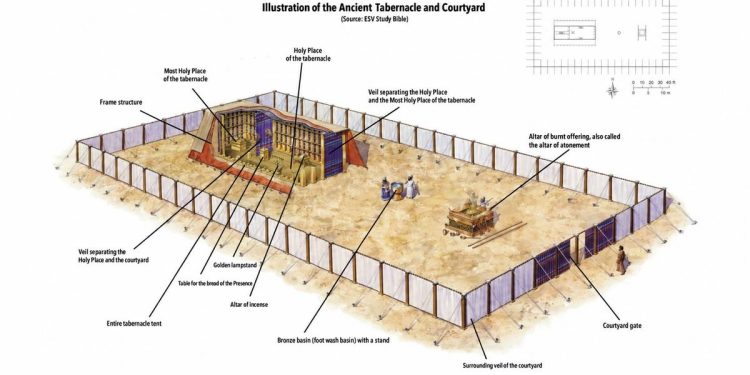
According to the Hebrew Bible, the tabernacle of Moses (Hebrew: מִשְׁכַּן, mishkan, meaning “dwelling place” or “residence”), also known as the Tent of Meeting or Tent of the Congregation, was the portable earthly dwelling place of the God of Israel, used by the Israelites from the exodus out of Egypt until the conquest of Canaan. That is, for roughly 40 years while they were in the wilderness, but also afterward, right up until the time of Solomon’s Temple.
Moses was instructed on Mount Sinai to build the tabernacle and to carry it along with the Israelites throughout their journey through the wilderness and the later conquest of the Promised Land. After 440 years, Solomon’s Temple in Jerusalem replaced it as God’s dwelling place. The main source describing the tabernacle of Moses is the biblical book of Exodus, specifically chapters 25-31 and 35-40. Israel’s Feast of Tabernacles still commemorates, to this day, that time of wandering before the Israelites entered the land of Canaan.
The whole picture, plan, and divine revelation connected with the tabernacle of Moses has at least three applications:
- First, for the Israelites of that time, as they were learning to live with God.
- Second, a prophetic message pointing to Jesus, who would become the redemption for Israel and for the whole world.
- Third, a picture of how the church and believers function in our own time.
The History of the Temples in Israel
Throughout its history, Israel had four official temples:
- The tabernacle of Moses (c. 1446-960 BC). This was a portable, mobile sanctuary that traveled with the Israelites, among other places, through the wilderness.
- Solomon’s Temple (960-586 BC). Built by King Solomon in Jerusalem on the Temple Mount. It was plundered and destroyed by the Babylonians.
- Zerubbabel’s Temple (516-20 BC). It was rebuilt, though not in as magnificent a form.
- Herod’s Temple (20 BC – 70 AD). This was the same temple, enlarged and rebuilt by King Herod the Great. In 70 AD it was destroyed by the Romans, in fulfillment of the prophecy spoken by Jesus.
God decided that the fifth temple would not be built of stone, but would be found within us. The number five speaks of God’s grace.
“Howbeit the most High dwelleth not in temples made with hands; as saith the prophet, Heaven is my throne, and earth is my footstool: what house will ye build me? saith the Lord: or what is the place of my rest? Hath not my hand made all these things?” – Acts 7:48-50
“Know ye not that ye are the temple of God, and that the Spirit of God dwelleth in you? If any man defile the temple of God, him shall God destroy; for the temple of God is holy, which temple ye are.” – 1 Cor 3:16-17
As believers, we are the fifth temple of God, and thanks to God’s grace and His redemption, He dwells in us through the Holy Spirit.
What Was the Purpose of Such a Place?
Among the purposes and reasons behind the tabernacle of Moses was that God would dwell continually among His people and lead them. Another reason was so that people could properly exalt and worship God, and learn to live in complete dependence on Him alone – through faith.
The Israelites had only just come out of Egypt, out from under the rule of an oppressor – Pharaoh – which was a symbol of our own coming out from under the rule of darkness and the power of the devil into light and the Kingdom of God. Yet it turned out to be easier to leave Egypt than to be set free from the way of thinking that had taken root there. The Israelites, as former slaves, still felt like slaves inside, and could not shake off their old ways of thinking and behaving.
It is easier to come out of Egypt than to be free of the mindset and mentality of living in Egypt
The Israelites had nothing in the wilderness that could distract them, yet even so, this process of learning was no easy task for them. The journey through the wilderness to the “Promised Land” should have taken them two weeks; instead, because of their unbelief, they spent 40 years there, and unfortunately almost the entire old generation died (except for a few) in the wilderness. Only the new generation entered and took possession of what God had promised them.
This tells us that we too, being born again into His Kingdom, go through a certain process of “dying” to our fleshly nature, and we also learn how to walk with God every day, to listen to Him, and to live by faith. Can we, then, be born again and yet not experience the full measure of what God has prepared for us? Unfortunately, yes! Everything in the Kingdom of God is available through faith. And it was precisely because of unbelief that Israel did not enter the Promised Land the first time around (Heb 3:19).
The most important purpose behind the building of the tabernacle, however, was a prophetic one. It was meant to show that in the future a Savior would come – Jesus – who would offer, once for all, a sacrifice for each one of us, in order to redeem us, reconcile us to God, and cleanse us so that we might serve Him and have access to Him. And it is from this angle that we will now examine seven elements of the tabernacle that still speak to us today and show how the church and believers function even now.
The tabernacle was a prophetic announcement that in the future God would truly dwell among His people
The final purpose, which we already mentioned above when discussing the history of the temples, is to show, going forward, how the church and believers in our own time ought to function.
Other purposes of the Tabernacle:
- TO LEARN to follow God and His presence (the cloud over the tabernacle)
- TO LEARN to be a community living in unity
- TO LEARN to depend on the Shepherd
- TO LEARN God’s ways, the principles of functioning under God’s law
- TO LEARN that the LORD God was their God
- TO UNDERSTAND that God should always be at the center of their camp
- TO LEARN how they could be saved and cleansed of sin

Preparing for Construction
Considering its size, the tabernacle was the most expensive structure ever built. If you were to calculate the amount of gold, silver, and bronze alone (leaving aside the value of the other materials and the labor), the value of those materials would come to around 10 million dollars.
- GOLD: 29 talents, 730 shekels = about 1 1/4 tons (a talent of gold weighed about 120 pounds)
- SILVER: 100 talents, 1,775 shekels = about 4 1/4 tons (a talent of silver was about 100 pounds, a shekel about half an ounce)
- BRONZE: 70 talents, 2,400 shekels = about 4 tons
Where did they get this wealth? (Exod 12:35-36) On their way out of Egypt, all of Israel received a great amount of gold and valuables from the Egyptians, who wanted to be rid of the Israelites after the plagues they had suffered. The Israelites had been slaves, so they had no significant resources of their own beyond what they received on their way out of Egypt. What they received from the Egyptians probably belonged to them anyway, in return for all those years of oppression (roughly 400 years of slavery).
All of Israel gave generously toward the building; it is written that they gave more than was needed, so much so that Moses had to bring the collection to a close.
People provide the materials and the labor, but God gives us the plan and the wisdom to carry it out.
Choosing the Craftsmen
“Behold, I have called by name Bezaleel the son of Uri, the son of Hur, of the tribe of Judah: And I have filled him with the spirit of God, in wisdom, and in understanding, and in knowledge, and in all manner of workmanship, To devise cunning works, to work in gold, and in silver, and in brass, And in the cutting of stones, to set them, and in carving of timber, to work in all manner of workmanship. And I, behold, I have given with him Aholiab, the son of Ahisamach, of the tribe of Dan: and in the hearts of all that are wise hearted I have put wisdom, that they may make all that I have commanded thee; The tabernacle of the congregation, and the ark of the testimony, and the mercy seat that is thereupon, and all the furniture of the tabernacle, And the table and his furniture, and the pure candlestick with all his furniture, and the altar of incense, And the altar of burnt offering with all his furniture, and the laver and his foot, And the cloths of service, and the holy garments for Aaron the priest, and the garments of his sons, to minister in the priest’s office, And the anointing oil, and sweet incense for the holy place: according to all that I have commanded thee shall they do.” – Exod 31:2-11
As we can see, God appointed Bezaleel to carry out, or to oversee, all the work. His name means “In the shadow of God,” and it captured this man’s character – someone ready to do whatever was God’s will. Bezaleel is a type of the Holy Spirit, who, in keeping with God’s will, oversees and manages everything according to that will. It was he who assigned the various responsibilities for the building work. Under his supervision worked everyone – both women and men!
In the same way, today the Holy Spirit gifts us and grants us abilities and authority. He places us in the right areas of the church’s work. Everyone is engaged in the shared work that is God’s plan for us, so that God’s will may be done on earth as it is in heaven!
It’s worth noting that everyone involved in this work had been given various kinds of wisdom, knowledge from God, and abilities.
Moses is a type of Jesus Christ, who builds His church on earth, passing on all activity and wisdom through the Holy Spirit, who then distributes the whole work among believers
Priests and the High Priest
The priests carried out their service throughout the entire tabernacle, both in the outer courtyard and in the Holy Place. Only the high priest had access to the Most Holy Place, and only once a year. Today, every believer functions in the role of a priest, ministering both before God and before people (1 Pet 2:5-9). We have what is called the universal priesthood of believers.
The Foundation
A foundation always plays a major role in building something lasting, and this case is no different! In Exod 30:15 we read that every Israelite over the age of 20 was to give half a “shekel” of silver as a ransom for his life. This speaks of the redemptive work of Jesus, who shed His blood for us (1 Pet 1:18-19). That is why we read, in Exodus chapter 38, that it was precisely this “ransom money” that was used to make the silver sockets for the boards. Every board had to rest on this silver, redemptive foundation. So the entire tabernacle literally rested on the redemptive work of Jesus (1 Cor 3:11)!
“For other foundation can no man lay than that is laid, which is Jesus Christ.” – 1 Cor 3:11
Only on the foundation of Jesus can we build a lasting, properly ordered life and community.
The Whole Structure of the Building
The boards used to build the sanctuary (Exod 26:15) were made of hard, non-perishable acacia wood – shittim wood – which was then overlaid with gold. Each board, standing upright next to the others, symbolized an individual believer who is part of the whole church. Each of these boards had once been something else – a hard, wilderness tree. It took a great deal of work to cut these boards, prepare them, overlay them, and join them to one another.
Each of us has been cut, separated from this world, cleansed of sin, and overlaid with gold – that is, with God’s righteousness. In addition, we have been joined together into a single whole. All these boards rested on silver sockets, which, as we’ve already mentioned, symbolize the work of redemption.
The tabernacle also had 15 crossbars, five each on the north, south, and west sides. These supported the boards described above, of which there were 20 on the north and south sides (40 in total) and 8 on the west side. The number 40 symbolizes testing and trial. These were 40 boards, tried and tested, that could serve as walls supporting the whole structure and forming part of the church. The number 8, meanwhile, symbolizes the resurrection of Christ and a new beginning.
As for the crossbars, it is thanks to God’s grace and power (the number 5) that we can stand joined together in unity (40 boards). The number 5 also speaks of the 5 gifts of ministry that should function in the church for its building up and strengthening (apostles, prophets, evangelists, teachers, and pastors).
“And he gave some, apostles; and some, prophets; and some, evangelists; and some, pastors and teachers; for…” – Eph 4:11-13
- the perfecting of the saints (equipping believers)
- for the work of the ministry, (so that they may carry out various ministries according to their giftings)
- for the edifying of the body of Christ, (so that everyone builds up the church)
- till we all come in the unity of the faith, and of the knowledge of the Son of God, (so that it remains in unity and proper understanding)
- unto a perfect man, unto the measure of the stature of the fulness of Christ. (and becomes like the perfect image – Jesus)
The whole structure was first raised on the first day of the new year (Exod 40:2), which symbolized the introduction of a new order – a new way of coming to God, a new way of worshiping Him.
It’s worth adding that 48 boards, 100 sets of cords, and 100 hooks together add up to 248, which corresponds to the 248 parts of the human body, as well as to the 248 Positive Commandments.
1. The Courtyard, the Fence, and the Gate
The whole tabernacle consisted of three main parts:
- The Courtyard – a place symbolizing physical ministry to the world
- The Holy Place – which symbolized our service before God
- The Most Holy Place – representing the spiritual dimension (the veil embroidered with cherubim), God’s presence, Jesus, but also the heavenly Jerusalem, which will come down from heaven to earth (it too will be a cube – Rev 21-22)
Today we are the temple of the Holy Spirit, so these parts also represent our body, soul, and spirit, through which we have contact with God and the spiritual world.
The Courtyard
The entire courtyard measured 100 cubits in length by 50 cubits in width, and was enclosed by a fence 5 cubits high. In practice, the courtyard was divided into two 50×50 sections – one open for ministry to the people, and the other reserved solely for the priests and the high priest.
The number 50 has meaning in the Bible, pointing to what happened on the day of Pentecost – the outpouring of the Holy Spirit. The courtyard is the place where believers, with the Holy Spirit’s help, minister to people from the world and show them God’s grace.
The Fence
God’s grace was also expressed in the height of the fence, which stood exactly 5 cubits (2.5 m) tall. No one could peek into the tabernacle in any way, not even by jumping. The only way in was through God’s grace (the number 5).
The entire curtain of this fence was made of white linen, which speaks of purity and righteousness. We are saved not by our own righteousness but by God’s, just as it is not by our own merit but by God’s grace.
The whole fence consisted of:
- 60 fence posts
- 60 silver capitals
- 60 bronze bases
- 60 silver hooks
- 60 silver bands
- 120 cords
- 120 bronze pegs (pins)
- 1,400 square cubits of white fine-twined linen, not counting the curtain for the gate (280 cubits by 5 cubits high)
All these numbers had meaning and spoke of the purpose and destiny of the entire courtyard. They spoke of man and his limited abilities.
The fence posts (60 of them), made of the same shittim wood, spoke of the humanity of Christ, who showed and continues to show us grace (5 m in height). They were overlaid with bronze and rested on bronze bases, which symbolize strength and endurance.
The silver capitals were likewise made from the “ransom money,” and they were highly visible to others from the outside. They testified outwardly to the work of redemption, which is available to all people. Our task, too, is to testify outwardly to all people about the work of redemption accomplished on the cross.
The Meaning of Numbers
- 1 – God in one person (John 10:30; Mark 12:32)
- 2 – Unity, a bond, marriage, or division. Christ and the Church, husband and wife, goats and sheep. The disciples sent out two by two.
- 3 – Divinity, confirmation. It is often applied to holy things and refers to the triune God, as well as to man, who is made up of 3 parts. The 3 temptations of Jesus, Peter’s threefold denial. On the testimony of two or three witnesses everything shall be established.
- 4 – The world. 4 seasons of the year, 4 points of the compass, 4 elements (earth, fire, air, water), 4 winds, 4 corners of the earth.
- 5 – Grace. 5,000 people were fed with 5 loaves of bread. David chose 5 stones from the brook in his battle with Goliath. 5 books of Moses, 5 porches by the pool of Bethesda.
- 6 – Symbolizes the number of man; on the sixth day God created man, and this number is tied to him and everything he does.
- 7 – The fullness of perfection. 3 (the divine number) + 4 (the number of the world) = 7. The seventh day of creation – rest and the finished work of the cross.
- 8 – A new order and a new beginning. Resurrection. The start of the week, a new heaven and a new earth, a new creation.
- 10 – Completeness, the law (the fulfillment of the law). 4 (the number of the world) + 6 (the number of man) = 10. There were 10 commandments – the primary principles required by God.
- 12 – Perfection, authority, and perfect government. The twelve tribes of Israel, 12 apostles, 12 gates of the city of Jerusalem, 12 thrones, 12 kinds of fruit on the trees.
- 40 – A time of testing. 40 days of rain during the flood, 40 years of Moses in Egypt, 40 years of Israel in the wilderness. The reigns of Saul, David, and Solomon each lasted 40 years. Nineveh had 40 days to repent. Elijah fasted 40 days, Jesus was tempted for 40 days. 40 days passed between the resurrection and the ascension of Jesus.
- 60 – Represents the limits of human ability. King Nebuchadnezzar had a statue set up that was 60 cubits high (Dan 3:1). The disciples walked away from God’s will toward Emmaus, a distance of 60 stadia (Luke 24:13). The age for becoming a widow was 60 (1 Tim 5:9). Every hour lasts 60 minutes, and a minute 60 seconds.
- 120 – The end of the flesh and of carnality, the crucifixion of the flesh, and the start of spiritual life. For example, 120 people were gathered on the day of Pentecost, on whom the Holy Spirit descended. According to the Bible, people live 120 years (Gen 6:3); Moses, who represented the old law and the fleshly nature, lived exactly that long.
- 1400 – This also points to the limit of our human capabilities. King Solomon had 1,400 war chariots (1 Kings 10:26; 2 Chron 1:14)
The Gate and the Entrance Curtain
There was only one entrance gate, and it was the only way in! The first thing we encounter on entering the tabernacle of Moses was the Gate, which had a four-colored curtain hanging on 4 posts. All of this pointed to Jesus. The colors of the entrance gate:
- Purple – spoke of the authority and lordship of Jesus
- Blue – spoke of the heavenly origin of the Son of God
- Red/scarlet – spoke of His coming into the world as Savior and of His humanity, as well as the price paid for sin
- White – spoke of His righteousness and purity
“And for the gate of the court shall be an hanging of twenty cubits, of blue, and purple, and scarlet, and fine twined linen, wrought with needlework: and their pillars shall be four, and their sockets four.” – Exod 27:16
The number of four posts speaks of the four Gospels, through which we learn about the life of Jesus, as well as of an openness toward the world. The number 4 is the number of the world and of creation, just as there are 4 Gospels, 4 points of the compass (north, south, east, and west), 4 seasons of the year, and 4 winds spoken of in the Bible. Christ is open to the whole world and invites everyone.
The entrance curtain was also 10 cubits high, which likewise indicated that entry into this place could only come through fulfilling the requirements of God’s law. We could not accomplish this through our own righteousness, but only through the righteousness of Jesus (the color white).
Within the tabernacle of Moses there were three entrances and three curtains:
- The gate and curtain of the courtyard – in order to make use of Jesus’ sacrifice on the cross, His righteousness and cleansing, as well as ministry through the working of the Holy Spirit.
- The gate and curtain of the Holy Place – in order to be part of the church and benefit from its knowledge, provision, and intercession
- The gate and curtain of the Most Holy Place – in order to have access to God
Through Jesus Christ we gain entry into all three of these places. Even the veil in the Most Holy Place was torn from top to bottom at the moment Jesus died.
“Then Jesus said unto them again, Verily, verily, I say unto you, I am the door of the sheep.” – John 10:7
These curtains also symbolize the three spheres of every human being – body, soul, and spirit. On the third curtain, at the Most Holy Place, cherubim were embroidered, indicating that the place beyond that curtain was a spiritual place.
2. The Altar of Burnt Offering (in the Courtyard)
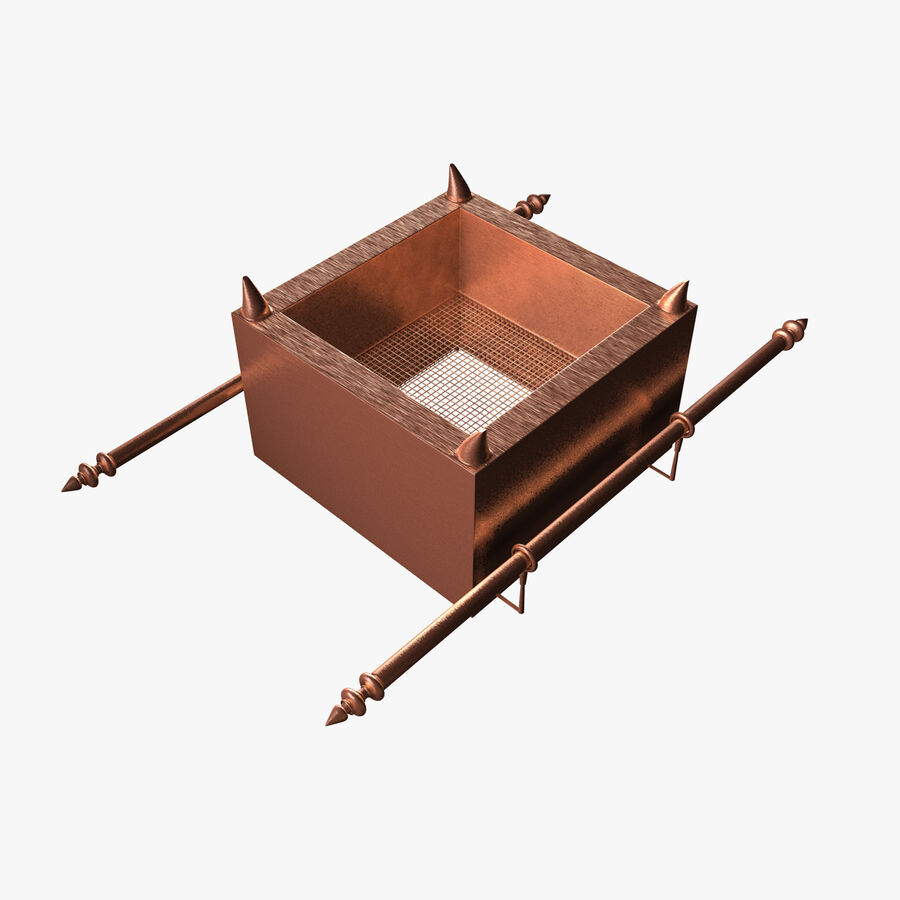
The bronze altar of burnt offering was the most important and central feature of the first section of the courtyard. On this altar, in the time of Moses, substitutionary sacrifices were offered for the sins of the people. The blood of animals was poured out and their bodies were burned in fire, symbolizing judgment. There was no other way to God and to meeting Him further on, in the Holy Place and Most Holy Place, except through this altar.
The altar is a symbol of Christ, who became a substitutionary sacrifice for our sins, making our meeting with God possible. The altar symbolized the demands of a holy and righteous God, which had to be satisfied before He could, in His mercy, meet with man. Every one of our sins demanded the shedding of blood and a payment, which was accomplished once for all in Jesus, if only we believe it and receive it into our lives. Christ gave up His entire life as a sacrifice for each one of us.
The altar measured 5 by 5 cubits, symbolizing that God’s grace could be experienced in this place – something we, too, experience in Christ. Halfway up the altar (at a height of 1.5 cubits) was a grating on which the sacrifices and the fuel for burning them were placed. This grating was at the very same height as the Mercy Seat (the covering of the Ark of the Covenant), where God’s glory dwelt. The sacrifice of redemption was thus on the very same level as His mercy (the Throne of Mercy – the Mercy Seat).
The altar was also square in shape, symbolizing the four Gospels and the four corners of the earth. Salvation is intended for the whole world.
BACK THEN: God was willing, but people knew that a spotless sacrifice had to be offered and blood shed for every sin. That blood was a symbol of people’s justification before God and the renewal of their relationship with Him.
TODAY: Jesus proved to be that innocent, spotless sacrifice, offered for the sins of each one of us. Once for all, His sacrifice washes away our sins and cleanses us when we receive it and believe. This sacrifice never needs to be repeated. (Heb 10:10; Rom 4:25)
“Who was delivered for our offences, and was raised again for our justification.” – Rom 4:25
3. The Bronze Laver (in the Courtyard)

The bronze laver (Exod 38:8) was made from the polished bronze mirrors belonging to women. These women served at the entrance to the tent of meeting. This tells us quite a bit about the kind of identity we should have. We can look into our own mirror and see a false image of ourselves, or we can look and see who we truly are in God’s eyes, as we stand before Him.
The priests bathed their entire bodies when they were consecrated (Exod 29:4). After their consecration, the priests had to wash their hands and feet every time they entered the Tabernacle or approached the bronze altar to minister – otherwise they would die. (Exod 30:19-21)
The laver had no specified dimensions, which means that God has the power to cleanse us at any time. The absence of dimensions also speaks of the work of the Holy Spirit in this place – work that cannot be limited by anything. It is He who leads us both into ministry to people and into God’s presence. Without Him we are not able to do anything. Every time the priests entered the Holy Place or went to the altar of burnt offering, they had to wash their feet and hands.
This piece of the Tabernacle is a symbol of water baptism, which was begun by John the Baptist and later continued by Jesus and the apostles. Today, we too baptize all those who have come to believe in the work of Jesus. The next step after coming to believe in Jesus is always immersion in water baptism, which not only symbolizes cleansing, but above all, death to our fleshly, old way of life, and rising up to a new spiritual life with God.
Water baptism is often connected with baptism in the Holy Spirit, which fills us, gives us power, and equips us for service before God. Without this baptism, we will not be fully effective in serving God. Everything we do must be an act carried out in the Holy Spirit. The Spirit and water often went together, as at the wedding in Cana of Galilee, where Jesus turned 6 waterpots of water into wine, which symbolizes the Holy Spirit (John 2:6-10). Without the Holy Spirit we are not able to meet God’s standards or live in the fruit and gifts of the Spirit.
BACK THEN: The priests had to wash themselves in order to be clean before entering the sanctuary or ministering at the altar.
TODAY: Believers in Christ are cleansed and saved by His blood. When we turn our lives around, we are baptized by immersion in water, in order to die symbolically and practically to this world and live for God. We also have the ability to come to Him at any time.
“But if we walk in the light, as he is in the light, we have fellowship one with another, and the blood of Jesus Christ his Son cleanseth us from all sin.” – 1 John 1:7
4. The Holy Place and the Table of Showbread
The Holy Place
Only the priests had the opportunity to enter the Holy Place daily, to serve God there. It is one thing to serve lost people outside who are searching for truth, ministering to them in the fruit and gifts of the Holy Spirit, and quite another to come before God to receive strength and wisdom from Him, and to know Him and be in relationship with Him. We need both of these experiences in order to live a balanced life. We need to know that on this earth we are only ambassadors, and that we don’t really belong to this world but to God and His Kingdom. Knowing this, we need to stay continually connected to our Lord and King, serving Him and fulfilling His will.
The Holy Place symbolizes the church, which is God’s embassy on earth, where every believer can grow and serve God, both individually and as a whole community. Every believer has access to this place through the same curtain, which symbolizes Christ. This curtain differed from the curtain at the gate of the courtyard only in that it hung on 5 posts instead of four – because it is only through grace that one can enter God’s Kingdom, not through one’s own merit and works.
The Holy Place contained three items: the table of showbread, the seven-branched golden lampstand, and the altar of incense. In this section there was no possibility of sitting down; all activities were performed standing, indicating the temporary nature of this ministry and the fact that we are merely God’s ambassadors and pilgrims on this earth.
BACK THEN: Only the priests could enter this place, and they did so every day.
NOW: Today, every believer in Jesus is a priest and has access to God, thanks to the sanctification made possible by His shed blood (Heb 9-10).
The Table of Showbread

The table of showbread stood in the Holy Place on the right – the north side – facing the golden lampstand. This is the first mention of a table anywhere in the Bible. A table naturally brings to mind food, relationship, and friendship, so in this case it spoke of God’s supernatural provision and the meeting of our needs. Only the priests had access to the table.
The table stood at the same height as the Ark of the Covenant, meaning that fellowship with God at the table stood on the very same level as His Throne of Grace. Our fellowship with God consists of feeding on and abiding in His Word – our spiritual food. Every day, the Israelites ate bread from heaven – the manna that God sent down to them.
The table had two crowns, which symbolize Christ, who is our King both here on earth and in Heaven. He is the head of the Church, but He also sits on the throne and reigns in Heaven as well. He received a crown of thorns before His crucifixion, but today He wears a crown of glory in Heaven.
The table was also mobile, having poles for carrying it, which speaks of the fact that God’s provision is always with us – His Word instructs us in every place.
In the Bible, Jesus is called the bread of life:
“I am that bread of life. Your fathers did eat manna in the wilderness, and are dead. This is the bread which cometh down from heaven, that a man may eat thereof, and not die. I am the living bread which came down from heaven: if any man eat of this bread, he shall live for ever: and the bread that I will give is my flesh, which I will give for the life of the world.” – John 6:48-51
Bread symbolizes the Word of God, true food from Heaven. It had to be fresh at all times (it was replaced every Sabbath, that is, every week), because our knowledge of the Word, our revelation, should always be fresh. We should not rely on past experiences with God and on our old knowledge, but should keep discovering and getting to know Him anew all the time.
The priests ate bread sprinkled with incense, bread that had been examined and set before God. Only what pleases God can be eaten, can be received, by us as well.
“And when the tempter came to him, he said, If thou be the Son of God, command that these stones be made bread. But he answered and said, It is written, Man shall not live by bread alone, but by every word that proceedeth out of the mouth of God.” – Matt 4:3-4
This bread was made from the finest quality white flour, without leaven, which symbolized sin. Jesus, however, as the perfect bread from heaven, was without sin.
On the table, 12 loaves were arranged in careful order, symbolizing the 12 tribes of Israel. Our own order and arrangement also brings glory to God. Dogs usually fight over bones. Sometimes there are more bones than fresh food in churches, which is why people end up fighting.
BACK THEN: The priests baked and set out fresh loaves of bread, later to eat them. This was their daily food.
TODAY: Believers in Jesus are the priests, and they should feed on the Word of God. Christ today is the bread of life (John 9:5; 6:48-51)
5. The Golden Lampstand

The Golden Lampstand, also called the base for the lamps, since at the end of each branch there was an oil lamp. The central section of the lampstand formed the trunk, while the others on either side formed the branches. In John chapter 15, we read that Jesus is the vine and we are the branches. This is a good picture of how the lampstand functions. Jesus is the head – the trunk placed at the center – while the branches of the lampstand symbolize the church, made in the likeness of Christ.
“I am the vine, ye are the branches. He that abideth in me, and I in him, the same bringeth forth much fruit: for without me ye can do nothing.” – John 15:5
“The mystery of the seven stars which thou sawest in my right hand, and the seven golden candlesticks. The seven stars are the angels of the seven churches: and the seven candlesticks which thou sawest are the seven churches.” – Rev 1:20
No wood was used to make the lampstand; it was made entirely from a single piece, a single lump of gold. Christ is one with His church. The hammering out of the whole lampstand speaks of the sufferings and trials that Christ experienced, and that we experience too.
Only two items in the entire Tabernacle had no specified dimensions: the laver and the golden lampstand. The laver represents the Holy Spirit, and the golden lampstand represents the church, joined together under the power of the Holy Spirit, limited by nothing.
The golden lampstand, like the table of showbread, was placed to the side within the Holy Place, and the two faced one another. The successive steps that lead us to God were arranged in a straight line, like the 3 curtains, the altar of burnt offering, the laver, the altar of incense, and the Ark of the Covenant (7 items). They spoke of what God has prepared for those who come to Him. The other items placed to the sides pointed to our privileges as well as our responsibilities.
Our responsibility and privilege is to feed on the fresh Word of God, and to be connected in the church to the work of the Holy Spirit. It is also our responsibility to be a light and to feed others with the Word of God.
It was also our responsibility, as priests, to take care that this fire kept burning at all times. Our task is to clean the lamps of ash (our human nature), so that they give off a brighter light, and to keep refilling the reservoirs with oil, just as in the story of the 10 virgins (Matt 25). The new life we receive from God requires our attention and care at all times. We are entirely dependent on the Holy Spirit and on the work of Jesus, and without Him we are unable to bear fruit.
“Then shall the kingdom of heaven be likened unto ten virgins, which took their lamps, and went forth to meet the bridegroom. And five of them were wise, and five were foolish. They that were foolish took their lamps, and took no oil with them: But the wise took oil in their vessels with their lamps. While the bridegroom tarried, they all slumbered and slept. And at midnight there was a cry made, Behold, the bridegroom cometh; go ye out to meet him. Then all those virgins arose, and trimmed their lamps. And the foolish said unto the wise, Give us of your oil; for our lamps are gone out. But the wise answered, saying, Not so; lest there be not enough for us and you: but go ye rather to them that sell, and buy for yourselves. And while they went to buy, the bridegroom came; and they that were ready went in with him to the marriage: and the door was shut.” – Matt 25:1-10
Three Lights
Three kinds of lighting were present throughout the tabernacle of Moses.
- Natural sunlight was present outside the tabernacle and in the courtyard. It symbolized our knowledge and understanding, which we base on the natural world and what it reveals.
- The light of the lampstand, whose source was burning oil, a symbol of the Holy Spirit. This light came from God’s fire. In this place we no longer rely on our natural knowledge and understanding, but on the knowledge and power of the Holy Spirit. It is He who leads us and gives us wisdom that comes from Heaven. Only in this light could ministry be carried out in the Holy Place, at the bread and at the altar of incense. We need to walk in His knowledge and words, and not in our own earthly way of thinking, just as David said in 2 Sam 22:29
- The light coming from the glory of God. In this place there was neither natural nor artificial light – only that which came from God.
Jesus Himself said that He is the light of the world:
“Then spake Jesus again unto them, saying, I am the light of the world: he that followeth me shall not walk in darkness, but shall have the light of life.” – John 8:12
We too should be light for this world:
“Ye are the light of the world. A city that is set on an hill cannot be hid. Neither do men light a candle, and put it under a bushel, but on a candlestick; and it giveth light unto all that are in the house. Let your light so shine before men, that they may see your good works, and glorify your Father which is in heaven.” – Matt 5:14-16
Light is very often identified with the knowledge we carry through life, with the way we understand God’s truths and message. Our understanding determines whether we will see God’s promises, contained in His Word, come to pass (the table of showbread), and whether we will see God’s power at work in our prayers (the altar of incense). If our understanding is faulty, our whole life will be in darkness.
“The light of the body is the eye: if therefore thine eye be single, thy whole body shall be full of light. But if thine eye be evil, thy whole body shall be full of darkness. If therefore the light that is in thee be darkness, how great is that darkness!” – Matt 6:22-23
BACK THEN: the lampstand was responsible for lighting the room. The priests made sure this fire never went out
TODAY: Christ is the light of the world, and together with Him we shine in this world
6. The Altar of Incense

Throughout the whole tabernacle there were seven steps leading from the wilderness to the Most Holy Place – from the earthly reality to heaven:
- The entrance gate – coming to know Jesus
- The altar of burnt offering – reconciliation with God and forgiveness of sins
- The laver – water baptism and separation from this world
- The Golden Lampstand – spiritual illumination
- The table of showbread – provision
- The altar of incense – the ministry of intercession
- The Ark of the Covenant – fellowship with God
On the altar of incense, incense was burned, laid on constantly glowing coals. This altar, like all the other items in the tabernacle, was sprinkled with the blood of the sacrifices from the altar of burnt offering.
The rising fragrance of the incense speaks of the value of the blood and of the prayer brought before God’s presence. The incense was made of three ingredients, and like everything else in the tabernacle, it speaks of the person of the Savior. The redemptive work of Jesus in the New Testament likewise consisted of three parts: a perfect life, a substitutionary death, and a victorious resurrection. These three elements formed a complete whole, and none of them can be left out. Incense could not be made for oneself or for one’s own personal purposes, but only for use before God.
The priests were responsible for burning incense and also for tending the lamps, adding oil, and trimming the wicks on the lampstand, and they carried out these tasks more often than replacing the bread on the table. The lamps also represented being a witness before people, so this went hand in hand with our life of prayer and intercession.
This altar was set in a straight line together with the altar of burnt offering, the laver, and the Ark of the Covenant. We see this same arrangement in Revelation 8:3. This tells us that Christ is continually interceding for us. In the same way, following His example, we too should intercede for others. The placement of this altar also tells us that our prayers are directed to the Father through Jesus, who is our mediator.
“By so much was Jesus made a surety of a better testament. And they truly were many priests, because they were not suffered to continue by reason of death: But this man, because he continueth ever, hath an unchangeable priesthood. Wherefore he is able also to save them to the uttermost that come unto God by him, seeing he ever liveth to make intercession for them.” – Heb 7:22-25
The altar had horns, which spoke of the power of prayer. Jesus likewise has power to remove sins (Heb 9:26), to lay down His life and take it up again (John 10:18), as well as power to keep us from falling (Jude 24). The altar also had a crown, in the form of a molding around the top, which kept the glowing coals from falling off the altar. This speaks of the fact that Christ is now crowned with glory and majesty (Heb 2:9). A sinner needs a Savior, and a believer needs a Priest. It is Christ who is our priest, ministering to us and interceding for us.
It’s worth comparing the two altars of the tabernacle to one another:
| The Bronze Altar of Burnt Offering | The Golden Altar of Incense |
|---|---|
| Outside the tent | Inside the tent |
| Wood overlaid with bronze | Wood overlaid with gold |
| Had no crown – Christ humbled | Had a crown – Christ exalted |
| The place of offering physical sacrifices | The place of bringing spiritual prayers and worship |
| Christ as Savior | Christ as Priest |
| Christ dying for the world | Christ interceding for believers |
| Access for sinners | Access for the saints |
| PURPOSE: Salvation | PURPOSE: Ministry |
BACK THEN: prayers were raised at this altar of incense, and special sweet-smelling incense was burned there.
TODAY: as believers in Jesus, we intercede for others, and our prayers are a sweet fragrance to God
7. The Most Holy Place and the Ark of the Covenant
The Curtain to the Most Holy Place
As I wrote earlier, each of the three curtains marked out a certain degree of revelation, a degree of access, to what lay hidden beyond. This third curtain, however, differed from the others, since cherubim were embroidered on it, showing that the place beyond it was a spiritual place. We already know these cherubim from the very beginning of the Bible, where, after Adam and Eve sinned, God placed cherubim to guard access to the Garden of Eden. They signify the absolute impossibility of returning, by our own strength, to the state pictured by that “paradise.” These same cherubim were also found on the curtain over the Ark of the Covenant.
“So he drove out the man; and he placed at the east of the garden of Eden Cherubims, and a flaming sword which turned every way, to keep the way of the tree of life.” – Gen 3:24
In the descending heavenly Jerusalem we again see, newly placed, the garden of Eden with its river and tree of life (Rev 22:2).
So, as its name suggests, a curtain covers something located behind it. Moses had a veil over his face in order to cover the glory of God radiating from his countenance. In 2 Cor 3:13-16; 4:3-6 we read of a veil of unbelief over hearts that covers the light of the gospel of the glory of Christ. This curtain not only covered God’s glory in the Most Holy Place, but also prevented the priests from coming into God’s presence. Only the high priest, once a year, could go beyond it, and no one else.
The letter to the Hebrews explains that this curtain is a symbol of the body of Jesus Christ (Heb 10:19-20). Jesus, as the Word made flesh, took on the likeness of sinful flesh (Rom 8:3), and this flesh, like a curtain, covered the glory of His divine character. Yet through the body of Jesus we could see that glory going forth and touching people, healing and working miracles. As a man, He came to a wedding in Cana of Galilee, but as one united with the Holy Spirit, He turned water into wine. As a man He went up the mountain with three disciples, but on that mountain they saw His glory and His divinity. God’s majesty was always within Him, but it was covered by the veil of flesh and soul.
Our bodies, too, are a veil that hides God’s face from us. The apostle Paul wrote that, for him, to leave the body means to be with the Lord (2 Cor 5:8). Death is the tearing of the veil, allowing us to experience God without limitation.
As we wrote earlier, the curtain had 4 colors, which spoke of Christ. This means that Jesus, and no one else, makes it possible for us to pass beyond every curtain. The very fact that this curtain was 10 cubits high also tells us that this access is given to us through the fulfillment of the law and the redeeming blood of Jesus, and not through our own merits. It was only through this curtain that the high priest could enter the place where God’s glory was, where the Throne of Mercy stood. Christ is the only way to the Father; only He perfectly fulfilled the law and became the way to the Father.
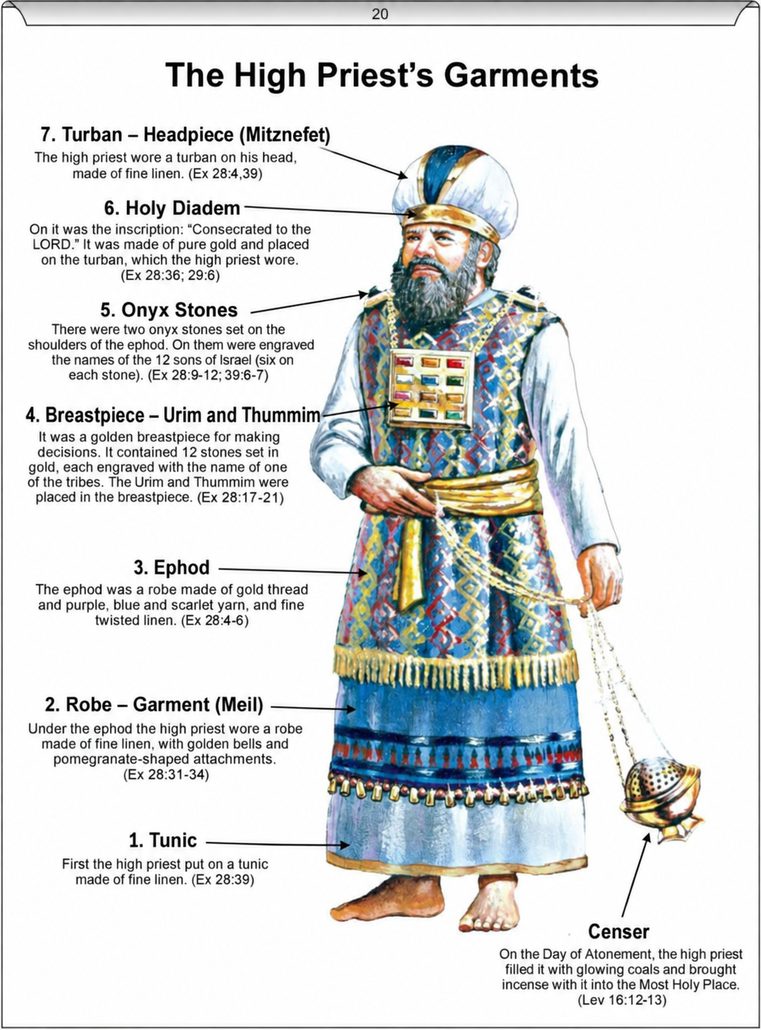
Only the high priest, as the representative of the people, could go beyond this curtain once a year, on the Day of Atonement. Drawing back the curtain was like rejecting the Son of God and condemning Him to death by crucifixion. When the high priest went beyond the curtain, he had a rope tied to his leg so that he could be pulled out if he fell dead before God’s presence. He also had bells hanging from the hem of his robe, along with pomegranates, which made a sound indicating that the high priest was still alive. These bells and pomegranates represented walking in the gifts and fruit of the Holy Spirit. If we walk in them, it means we are not spiritually dead.
No one could go beyond the curtain empty-handed – only with blood. Christ went beyond that curtain with His own blood (Rom 3:25; 1 John 2:2), in order to open, once for all, the way to the Father for us.
“For Christ is not entered into the holy places made with hands, which are the figures of the true; but into heaven itself, now to appear in the presence of God for us: Nor yet that he should offer himself often, as the high priest entereth into the holy place every year with blood of others; For then must he often have suffered since the foundation of the world: but now once in the end of the world hath he appeared to put away sin by the sacrifice of himself. And as it is appointed unto men once to die, but after this the judgment: So Christ was once offered to bear the sins of many; and unto them that look for him shall he appear the second time without sin unto salvation.” – Heb 9:24-28
The curtain was completely torn on the day Jesus died on the cross, from the top down, symbolizing that it was God who did this. One account tells that the priests tried to sew the curtain back together, but it was not possible. They had to give up, because no thread or material could rejoin the two pieces, since it was such a thick and heavy curtain. Some Jewish writers mention that it was woven so precisely, tightly, and strongly that even two teams of oxen pulling in opposite directions could not tear it. Yet God accomplished it.
“Jesus, when he had cried again with a loud voice, yielded up the ghost. (After Jesus’ death) And, behold, the veil of the temple was rent in twain from the top to the bottom; and the earth did quake, and the rocks rent.” – Matt 27:50-51
BACK THEN: It separated the Holy Place from the Most Holy Place, where the Ark of the Covenant rested. It separated a sinful people from a holy God. Only the high priest, and only once a year, could go beyond it.
TODAY: Believers in Jesus can come before God’s face in prayer. Through the sacrifice and shed blood of Jesus, we as believers today have access to God. Jesus, as our high priest, entered the Most Holy Place with His own blood, in order to justify us. The curtain was torn when He gave up His life for us.
The Most Holy Place and the Ark of the Covenant

God, in fact, commanded that the Ark of the Covenant and the Mercy Seat (the covering of the Ark) be made first. God began with this most important item, because what matters most must come first. The Ark of the Covenant was the only piece of furniture in the Most Holy Place. We find it again in the heavenly sanctuary as well (Rev 11:19).
The Most Holy Place was a small room, cube-shaped, 10 by 10 by 10 (in cubits), symbolizing the place of God’s holy, perfect law. It was there, in this part of the tabernacle, that God dwelt, and His glory hovered over the Ark of the Covenant, as well as over the whole tabernacle, in the form of a cloud by day and a pillar of fire by night. Let’s remember that the New Jerusalem, which will come down from heaven to earth, will also have this same cube shape.
God’s presence was visible in the pillar of cloud by day and the pillar of fire by night (Exod 40:38). The tabernacle – the tent – was meant to be a special place where the fire rested. All of this was GOD’S plan, tailored to the revelation He Himself was giving. The tabernacle Moses built contains many prophetic pictures of Jesus, including how we are to approach God and relate to Him (Heb 8:1-5).
The Ark of the Covenant and the Mercy Seat (the covering of the Ark) were God’s throne on earth, the place where His glory dwelt (Exod 40:34-35). It was God who came to dwell among His people – who led them, taught them, provided for them, healed them, protected them… No Israelite could enter and look upon the Ark of the Covenant. It was simply not possible, and all the setting up, taking down, and carrying of the tabernacle was handled by priests and Levites specially assigned to this task, set apart for God. Only the priests could carry the Ark, which means that only believers have a proper knowledge of Christ. Truth is not our own human thoughts and imaginings, but God’s biblical revelation, coming from our heavenly Father. Having a right picture of Christ is one of the most important things in a believer’s life.
The Ark was “mobile” – it could be carried – but it also had its permanent place. Believers, too, are pilgrims on this earth. They have a place here, but they truly come from heaven, and that is where their real home is.
All the items in the Tabernacle spoke of some aspect of the work of Jesus Christ, whereas the Ark of the Covenant itself revealed His person. Not what He did, but who He was. The Ark represented Jesus – His presence and who He was and is. What God does matters, but who He is matters even more. More important than knowing His generous hand is knowing Him personally, in relationship.
The Ark of the Covenant stood exactly at the center of the entire Israelite camp. God must always be at the center of everything we do. Everything begins with God the Father, happens through the Son, and is brought to completion by the Holy Spirit. God created everything through the Son (John 1:1-3; Col 1:16; Heb 1:2). Through Him the world was created, and through Him it is redeemed and saved. All who make use of His work will be saved. Jesus is always at the center – even when He hung on the cross, He was crucified in the middle. When He was a small boy of 12, His parents found Him in the temple, in the midst of the teachers (Luke 2:46). After the resurrection, Jesus appeared in the midst of the Church, in the house and upper room where the believers were staying (John 20:19; Matt 18:20). In Revelation we also see Him among the golden lampstands – the churches. In all things He must be first (Col 1:18). Does Jesus hold the central place in our hearts and lives today? We also recommend the article on the discovery of the Ark of the Covenant.
The Contents of the Ark
Three things were placed in the Ark as a testimony, as proof of God’s work. Each of these things spoke of what Christ accomplished and what He gave to His people. They were:
- The two tablets of the Law (the Law of Moses). The fulfilled law of God and its requirements = THE WAY (the way we are to walk)
- The manna in a golden jar. God’s provision and spiritual food = THE TRUTH (the truth that must be known)
- Aaron’s rod that budded. God’s leading and ways, which give life = THE LIFE (the life in which we are to grow)
Jesus said of Himself that He is the way, the truth, and the life. The apostle John still saw the Ark of the Covenant in Heaven, with its contents.
“Jesus saith unto him, I am the way, the truth, and the life: no man cometh unto the Father, but by me.” – John 14:6
THE TWO TABLETS OF THE LAW. These tablets contained the 10 primary commandments out of the entire law that God gave the Israelites (Exod 20:1-17). This is the law that humanity was never able to keep and fulfill. Here it symbolizes Jesus, who alone was able to do so.
“Think not that I am come to destroy the law, or the prophets: I am not come to destroy, but to fulfil” – Matt 5:17
“For Christ is the end of the law for righteousness to every one that believeth.” – Rom 10:4
THE JAR OF MANNA. Inside the Ark there was a golden jar containing manna. The word manna carries various meanings. We call it bread; in Chaldean it means “this is a portion,” and in Hebrew it literally means “what is it?” Manna certainly spoke of Christ as the bread of life (John 6:31-38). Manna was (Exod 16; Num 11):
- Small. Christ did not appear significant, since He “made himself of no reputation” (Phil 2:7)
- Grain-like, round
- White. Speaks of the righteousness and purity of this food
- “Like frost”
- Similar to coriander seed
- In taste it was like fresh oil
- It had the taste of a wafer made with honey
- It looked like the resin of bdellium (a precious beryl crystal)
Manna was food that was valuable, sufficient, tasty, nourishing, suited to everyone, and reliable (it never ran out). Manna took the place of all other food.
“Which had… the ark of the covenant overlaid round about with gold, wherein was the golden pot that had manna, and Aaron’s rod that budded, and the tables of the covenant” – Heb 9:4
AARON’S ROD THAT BUDDED. It is a symbol of the priesthood chosen by God. It was a dead rod, yet it budded and put forth blossoms and ripe almonds. Of Christ, we can say that He was dead and came to life. He is the resurrection and the life. The budding rod points to the resurrection of Jesus and to His ascension (His full revealing). Almonds are a symbol of the fruit that the work of Christ produced (He brought many sons to glory).
The Crown of the Ark
The Ark had a golden molding (Exod 25:11), which was a sign of the exalted Christ – the King. This molding also held the covering of the Ark (the Mercy Seat) in place, keeping it from shifting. The crown kept the Mercy Seat immovable. 50,700 people from Israel fell dead for having lifted the cover and looked inside the Ark. No one can look into the Ark and remain alive if the Mercy Seat is removed. Because the Law inside the Ark can bring only death. Yet God’s mercy literally towers over the judgment that lies beneath it. Our Savior reigns in grace, and coming to Him we experience that grace instead of God’s judgment. Nothing can condemn us before Christ (Rom 8:1).
The Mercy Seat
We can also call it the covering, the lid of the Ark. The throne of grace, or the place of atonement. This plate was made entirely of pure gold. It was the only seat in the entire Tabernacle, because Christ is our rest and our peace. He also spoke the words “it is finished” on the cross, and afterward sat down on the throne of God together with the Father. It was also in this place that God’s glory, His presence, dwelt.
The Mercy Seat was also covered with the blood of the sacrifice on the Day of Atonement by the High Priest (Lev 16:14). Man could not receive grace from God without the shedding of blood and payment for sin. That is why Jesus shed His blood for us, once for all.
Two items – the golden lampstand and the Mercy Seat – were made in a similar way. The lampstand was made from a single piece of gold and had no set dimensions. It symbolized Christ and His people (the church). The covering of the Ark had only two dimensions – width and length – but no dimension of depth or height. Who can measure the height and depth of God and His mercy?
“Let us therefore come boldly unto the throne of grace, that we may obtain mercy, and find grace to help in time of need.” – Heb 4:16
The Mercy Seat stood above what was inside the Ark – that is, above the requirements of God’s law as well. God’s mercy literally towers over judgment. Nothing and no one can condemn us before Christ (Rom 8:1). The Mercy Seat, in Hebrew “kapporeth,” means covering. This word signified the covering of sins through an atoning sacrifice.
BACK THEN: The Ark was a chest overlaid with gold on both sides, containing the tablets of the law, Aaron’s rod, and the jar of manna. The lid of the Ark – the mercy seat – was the place where God met with man (Exod 25:10-22).
TODAY: God wants to have a close bond with us. Through Jesus, we today have access to God (John 14:6; Heb 9:4; 10:22).
What Is the Temple Today?
Once Christ accomplished the work of redemption, there was no longer any need for a temple of the old kind. There are only three references in the New Testament to a temple that is currently functioning, or that will function in the future:
- Jesus is the temple, and He says so Himself (John 2:19-21)
- Believers are the temple of the Holy Spirit (e.g., John 4:19-24; 1 Cor 3:16-17; 6:19-20; 2 Cor 6:16; Acts 17:24-26)
- God the Father and Jesus are the temple in the city of New Jerusalem, which will come down from Heaven (Rev 21:22)
Today it is the bodies of believers that are called temples of the Holy Spirit. Jesus Himself also spoke of Himself as a temple. It should be remembered that believers are also called the body of Christ, or in other words, the church (the Ekklesia), that is, the assembly of believers. Christ Himself, meanwhile, is the head of His body – the church. Let’s look at a few passages:
“Jesus answered and said unto them, Destroy this temple, and in three days I will raise it up. Then said the Jews, Forty and six years was this temple in building, and wilt thou rear it up in three days? But he spake of the temple of his body” – John 2:19-21
“Know ye not that ye are the temple of God, and that the Spirit of God dwelleth in you? If any man defile the temple of God, him shall God destroy; for the temple of God is holy, which temple ye are.” – 1 Cor 3:16-17
“What? know ye not that your body is the temple of the Holy Ghost which is in you, which ye have of God, and ye are not your own? For ye are bought with a price: therefore glorify God in your body, and in your spirit, which are God’s.” – 1 Cor 6:19-20
“And what agreement hath the temple of God with idols? for ye are the temple of the living God; as God hath said, I will dwell in them, and walk in them; and I will be their God, and they shall be my people…” – 2 Cor 6:16
“God that made the world and all things therein, seeing that he is Lord of heaven and earth, dwelleth not in temples made with hands; Neither is worshipped with men’s hands, as though he needed any thing, seeing he giveth to all life, and breath, and all things; And hath made of one blood all nations of men for to dwell on all the face of the earth…” – Acts 17:24-26
“The woman saith unto him, Sir, I perceive that thou art a prophet. Our fathers worshipped in this mountain; and ye say, that in Jerusalem is the place where men ought to worship. Jesus saith unto her, Woman, believe me, the hour cometh, when ye shall neither in this mountain, nor yet at Jerusalem, worship the Father. Ye worship ye know not what: we know what we worship: for salvation is of the Jews. But the hour cometh, and now is, when the true worshippers shall worship the Father in spirit and in truth: for the Father seeketh such to worship him. God is a Spirit: and they that worship him must worship him in spirit and in truth.” – John 4:19-24
Even in the New Jerusalem, which will come down from Heaven to earth, there will be no temple “of the old kind”:
“And I saw no temple therein: for the Lord God Almighty and the Lamb are the temple of it” – Rev 21:22
Today, God’s temple is every believer and the body of Christ – the church
The Personal Priesthood of Believers
God does not dwell today in temples of stone, but in a person who has been born again of the Spirit of God and believes in the work Jesus accomplished on the cross. We are the temple of the Holy Spirit, and we too are made up of three parts:
- The body, which is a picture of the courtyard, where the priests ministered to the people who came to God. This too is our task today – to serve others.
- The soul (thoughts, will, emotions), which is a picture of the Holy Place, where we carry out our service to God. We take care that His light burns within us (the golden lampstand), we feed on His Word (the table of showbread), and we pray and intercede for others (the altar of incense)
- The spirit, which is a picture of the Most Holy Place, where we meet with God and His glory. His glory transforms us:
“Now the Lord is that Spirit: and where the Spirit of the Lord is, there is liberty. But we all, with open face beholding as in a glass the glory of the Lord, are changed into the same image from glory to glory, even as by the Spirit of the Lord.” – 2 Cor 3:18
So every believer is a priest ministering before God, and as a mature believer united with God, needs nothing beyond the Holy Spirit, who leads him – just like Philip, who was one of the seven deacons and also an evangelist:
“Then the twelve called the multitude of the disciples unto them, and said, It is not reason that we should leave the word of God, and serve tables. Wherefore, brethren, look ye out among you seven men of honest report, full of the Holy Ghost and wisdom, whom we may appoint over this business. But we will give ourselves continually to prayer, and to the ministry of the word. And the saying pleased the whole multitude: and they chose Stephen, a man full of faith and of the Holy Ghost, and Philip [without the qualifier used for Stephen], and Prochorus, and Nicanor, and Timon, and Parmenas, and Nicolas a proselyte of Antioch: Whom they set before the apostles: and when they had prayed, they laid their hands on them.” – Acts 6:2-6
“And the angel of the Lord spake unto Philip, saying, Arise, and go toward the south unto the way that goeth down from Jerusalem unto Gaza, which is desert. And he arose and went: and, behold, a man of Ethiopia, an eunuch of great authority under Candace queen of the Ethiopians, who had the charge of all her treasure, and had come to Jerusalem for to worship, Was returning, and sitting in his chariot read Esaias the prophet. Then the Spirit said unto Philip, Go near, and join thyself to this chariot. And Philip ran thither to him, and heard him read the prophet Esaias, and said, Understandest thou what thou readest? And he said, How can I, except some man should guide me? And he desired Philip that he would come up and sit with him. The place of the scripture which he read was this, He was led as a sheep to the slaughter; and like a lamb dumb before his shearer, so opened he not his mouth: In his humiliation his judgment was taken away: and who shall declare his generation? for his life is taken from the earth. And the eunuch answered Philip, and said, I pray thee, of whom speaketh the prophet this? of himself, or of some other man? Then Philip opened his mouth, and began at the same scripture, and preached unto him Jesus. And as they went on their way, they came unto a certain water: and the eunuch said, See, here is water; what doth hinder me to be baptized? And Philip said, If thou believest with all thine heart, thou mayest. And he answered and said, I believe that Jesus Christ is the Son of God. And he commanded the chariot to stand still: and they went down both into the water, both Philip and the eunuch; and he baptized him. And when they were come up out of the water, the Spirit of the Lord caught away Philip, that the eunuch saw him no more: and he went on his way rejoicing. But Philip was found at Azotus: and passing through he preached in all the cities, till he came to Caesarea.” – Acts 8:26-40
“And the next day we that were of Paul’s company departed, and came unto Caesarea: and we entered into the house of Philip the evangelist, which was one of the seven; and abode with him.” – Acts 21:8
We see that Philip was led 100% by the Holy Spirit. He had no one with him, nor did he ask anyone’s permission about whether he should go somewhere or do something. He was like the “wind” (from Jesus’ conversation with Nicodemus), submitted to the will of the Holy Spirit – he taught, evangelized, and baptized whomever the Holy Spirit put in his path. Even so, Philip was certainly part of a larger community of believers and certainly had relationships with them. We see that the apostles prayed for his calling and laid hands on him.
The Holy Spirit gives us the ability to function in the gifts and fruit that come from Him:
“But the fruit of the Spirit is love, joy, peace, longsuffering, gentleness, goodness, faith, Meekness, temperance: against such there is no law.” – Gal 5:22-23
“But the manifestation of the Spirit is given to every man to profit withal. For to one is given by the Spirit the word of wisdom; to another the word of knowledge by the same Spirit; To another faith by the same Spirit; to another the gifts of healing by the same Spirit; To another the working of miracles; to another prophecy; to another discerning of spirits; to another divers kinds of tongues; to another the interpretation of tongues: But all these worketh that one and the selfsame Spirit, dividing to every man severally as he will.” – 1 Cor 12:7-11
God has given us the Holy Spirit – in other words, an “anointing,” a spiritual anointing, just as in the Old Testament the appropriate people were anointed with oil for service. Oil was a symbol of the Holy Spirit.
“But ye have an unction from the Holy One, and ye know all things.” – 1 John 2:20
“But the anointing which ye have received of him abideth in you, and ye need not that any man teach you: but as the same anointing teacheth you of all things, and is truth, and is no lie, and even as it hath taught you, ye shall abide in him.” – 1 John 2:27
The tabernacle of Moses was only a shadow of things to come, which we have available to us today. It could be said that the Old Tabernacle rested on a fleshly, physical service to God, while the New Temple rests entirely on the Holy Spirit. Without the Holy Spirit and the work of Jesus on the cross, we can do nothing, just as Jesus said:
“Abide in me, and I in you. As the branch cannot bear fruit of itself, except it abide in the vine; no more can ye, except ye abide in me. I am the vine [the shaft of the lampstand], ye are the branches [its arms, made in my likeness]. He that abideth in me, and I in him, the same bringeth forth much fruit: for without me ye can do nothing.” – John 15:4-5
Our ministry is closely tied to abiding in Christ and in the Holy Spirit, and is the fruit of that relationship. Every believer is called to care for their spiritual life and closeness with God, to grow and to keep learning. We are also called to be a witness, to proclaim the good news, to teach, and to minister to people in the world through the gifts of the Holy Spirit.
Priesthood in the Body of Christ
We are the temple of the Holy Spirit, but Jesus and God the Father are also that temple. Christ, through the Holy Spirit, is in us, but we are also in Christ! We should also be part of His body and belong to His body. His body is the church, and He Himself is the head of the church.
“…Which he wrought in Christ, when he raised him from the dead, and set him at his own right hand in the heavenly places, Far above all principality, and power, and might, and dominion, and every name that is named, not only in this world, but also in that which is to come: And hath put all things under his feet, and gave him to be the head over all things to the church, Which is his body, the fulness of him that filleth all in all.” – Eph 1:20-23
“And he is the head of the body, the church: who is the beginning, the firstborn from the dead; that in all things he might have the preeminence” – Col 1:18
So we can be led and minister through the Holy Spirit, yet God has also called us to be part of something larger – the body of Christ – and, through it, to function in unity and cooperation with one another.
“Now there are diversities of gifts, but the same Spirit. And there are differences of administrations, but the same Lord. And there are diversities of operations, but it is the same God which worketh all in all.” – 1 Cor 12:4-6
So we have already spoken of the working of the Holy Spirit in us and through us. God the Father can likewise act sovereignly, but in the same way our Lord Jesus calls us to particular places within His body – the church:
“For as the body is one, and hath many members, and all the members of that one body, being many, are one body: so also is Christ” – 1 Cor 12:12
“Now ye are the body of Christ, and members in particular. And God hath set some in the church, first apostles, secondarily prophets, thirdly teachers, after that miracles, then gifts of healings, helps, governments, diversities of tongues.” – 1 Cor 12:27-28
“And he gave some, apostles; and some, prophets; and some, evangelists; and some, pastors and teachers; For the perfecting of the saints, for the work of the ministry, for the edifying of the body of Christ: Till we all come in the unity of the faith, and of the knowledge of the Son of God, unto a perfect man, unto the measure of the stature of the fulness of Christ: That we henceforth be no more children, tossed to and fro, and carried about with every wind of doctrine, by the sleight of men, and cunning craftiness, whereby they lie in wait to deceive; But speaking the truth in love, may grow up into him in all things, which is the head, even Christ: From whom the whole body fitly joined together and compacted by that which every joint supplieth, according to the effectual working in the measure of every part, maketh increase of the body unto the edifying of itself in love.” – Eph 4:11-16
So Jesus establishes, within His body – the church – certain ministries, offices, whose task is to:
- Prepare and equip believers for service, for ministry
- Build up the body of Christ throughout the world
- Establish unity of faith within the Church
- Bring the Church to maturity
- Bring the Church to the fullness of Christ
In the Bible we see that both house churches and apostolic churches, such as those in Jerusalem and Antioch, functioned side by side. There were more house churches – local ones – and they were regularly supported by the apostolic churches.
“Now there were in the church that was at Antioch certain prophets and teachers; as Barnabas, and Simeon that was called Niger, and Lucius of Cyrene, and Manaen, which had been brought up with Herod the tetrarch, and Saul. As they ministered to the Lord, and fasted, the Holy Ghost said, Separate me Barnabas and Saul for the work whereunto I have called them. And when they had fasted and prayed, and laid their hands on them, they sent them away. So they, being sent forth by the Holy Ghost, departed unto Seleucia; and from thence they sailed to Cyprus…” – Acts 13:1-4
“Greet Priscilla and Aquila my helpers in Christ Jesus: Who have for my life laid down their own necks: unto whom not only I give thanks, but also all the churches of the Gentiles. Likewise greet the church that is in their house. Salute my wellbeloved Epaenetus, who is the firstfruits of Achaia unto Christ.” – Rom 16:3-5
“Salute the brethren which are in Laodicea, and Nymphas, and the church which is in his house. And when this epistle is read among you, cause that it be read also in the church of the Laodiceans; and that ye likewise read the epistle from Laodicea.” – Col 4:15-16
“Paul, a prisoner of Jesus Christ, and Timothy our brother, unto Philemon our dearly beloved, and fellowlabourer, And to our beloved Apphia, and Archippus our fellowsoldier, and to the church in thy house” – Phlm 1:1-2
The forms and places in which the church functioned varied, and they are not nearly as important as the people who are called, filled with the Holy Spirit, and led by God.
The whole tabernacle spoke of Christ, of our service in Him, and of His work within us:
- The entire fence symbolized His arms, which touch and take care of people. They surround us with grace (the number 5) and His righteousness (the white linen)
- The gate, which represents entering into Christ and being found in Him, having no righteousness of our own, as the apostle Paul says
- The courtyard (50×50), which represented ministering to people in the gifts of the Holy Spirit, whom Jesus sent to us. The number 50 speaks of the day of Pentecost.
- The altar of burnt offering, symbolizing the final and sufficient sacrifice of Jesus, offered for our sins
- The laver, meaning His cleansing, water baptism, through which we separate ourselves from this world and begin to live for God
- The Holy Place – the place where we serve God, keep God’s fire burning, keep His light within us, and tend the oil of the Holy Spirit (the lampstand); where we feed on His Word, whether in the form of the Bible or His word revealed to us (the table of showbread), and where we pray and intercede (the altar of incense)
- The Most Holy Place, symbolizing our relationship with God, His guidance (the pillar of fire and the cloud), authority (God’s throne), and grace (the Mercy Seat).
The New Jerusalem
“And I saw a new heaven and a new earth: for the first heaven and the first earth were passed away; and there was no more sea. And I John saw the holy city, new Jerusalem, coming down from God out of heaven, prepared as a bride adorned for her husband. And I heard a great voice out of heaven saying, Behold, the tabernacle of God is with men, and he will dwell with them, and they shall be his people, and God himself shall be “WITH THEM, AND BE THEIR GOD”” – Rev 21:1-3
Besides the second coming of Jesus, the Bible also speaks prophetically of the arrival of the “New Jerusalem” – the city where all believers will dwell together with God. According to the description given in Revelation 21-22, it will be a perfect cube, patterned after the Most Holy Place. We will literally dwell in the glory of God, in unbroken closeness with Him. A similar picture of such a situation is found in the story of Samuel.
“And ere the lamp of God went out in the temple of the LORD, where the ark of God was, and Samuel was laid down to sleep; That the LORD called Samuel: and he answered, Here am I.” – 1 Sam 3:3-4
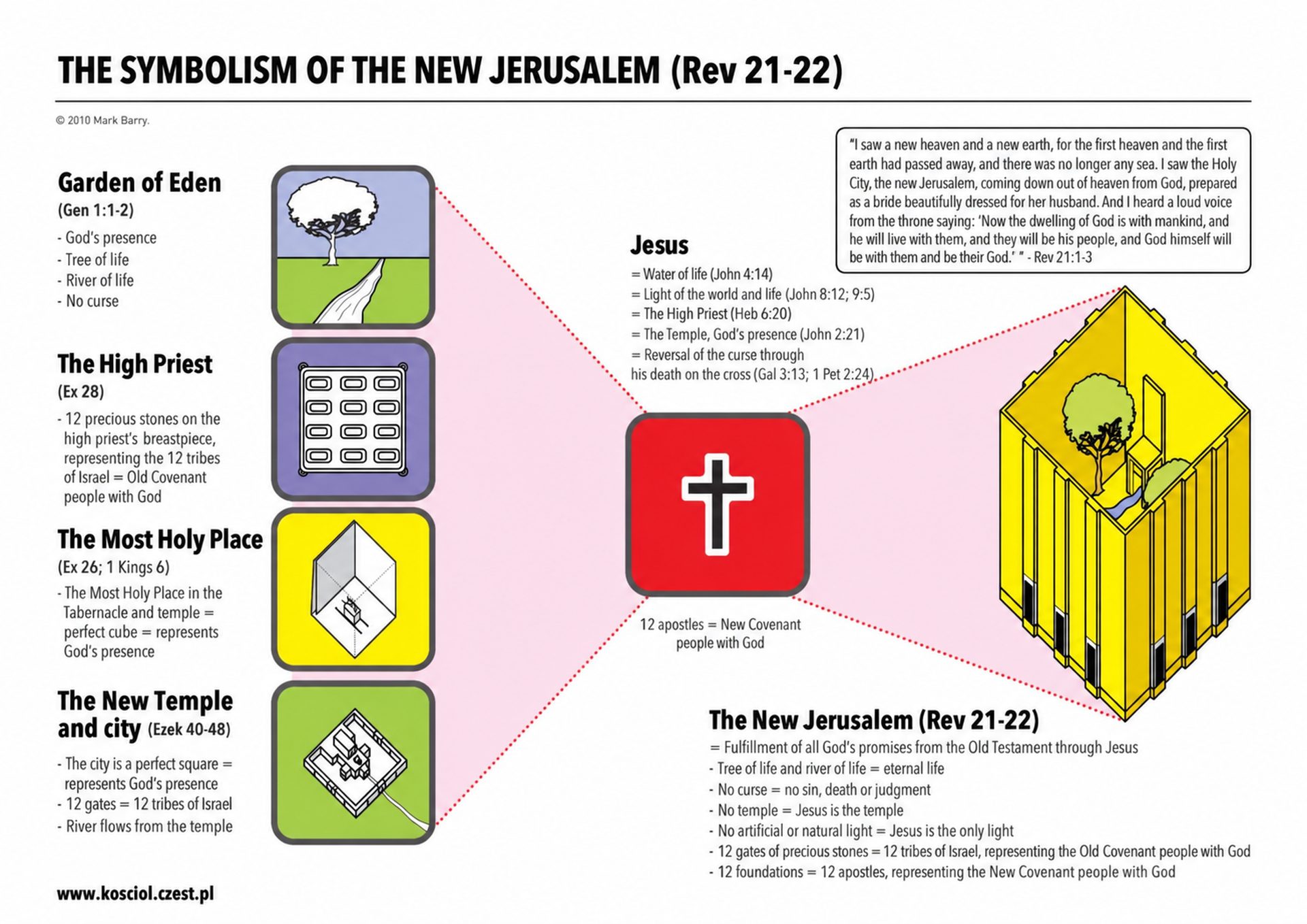
God will bring all these elements together into a single whole, both from the Old and the New Covenant. All the promises will finally be fulfilled in Christ, and their reflection will be seen in the New Jerusalem, as the illustration shows. Then, in renewed bodies, we will be able to see God face to face.
The Old Covenant (12 tribes of Israel = the Old Covenant between people and God):
- = The Garden of Eden (Gen 1-2): where God’s presence dwelt, along with the tree of life, the river of life, and no curse of any kind.
- = The garments of the High Priest (Exod 28): 12 stones on the breastplate, representing the 12 tribes of Israel – that is, the Old Covenant between people and God
- = The Most Holy Place (Exod 26; 1 Kings 6): which was a perfect cube and represented God’s presence
- = The New Temple and city (Ezek 40-48): The city is a perfect square and represents God’s presence. There are also 12 gates there, representing the 12 tribes of Israel, along with a river flowing out from the temple.
Jesus Christ (12 apostles = the New Covenant between people and God):
- = The water of life (John 4:14)
- = The light of the world and of life (John 8:12; 9:5)
- = The High Priest (Heb 6:20)
- = The temple, God’s presence (John 2:21)
- = The reversal of the curse through redemption on the cross (Gal 3:13; 1 Pet 2:24)
The New Jerusalem (the fulfillment of all God’s promises from the Old and New Covenants, through Jesus):
- The tree and river of life = eternal life
- No curse = no sin, death, or judgment
- No temple = Jesus is the temple
- No artificial or natural light = Jesus is the only light
- 12 gates / precious stones = the 12 tribes of Israel, representing the Old Covenant between people and God
- 12 foundations = the 12 apostles, representing the New Covenant between people and God
Jesus said that He goes to prepare a place for us in the heavenly Jerusalem and that He will return for us:
“In my Father’s house are many mansions: if it were not so, I would have told you. I go to prepare a place for you. And if I go and prepare a place for you, I will come again, and receive you unto myself; that where I am, there ye may be also.” – John 14:2-3
Based in part on the book “The Tabernacle – God’s Plan for Humanity” – H.B. McGowan