

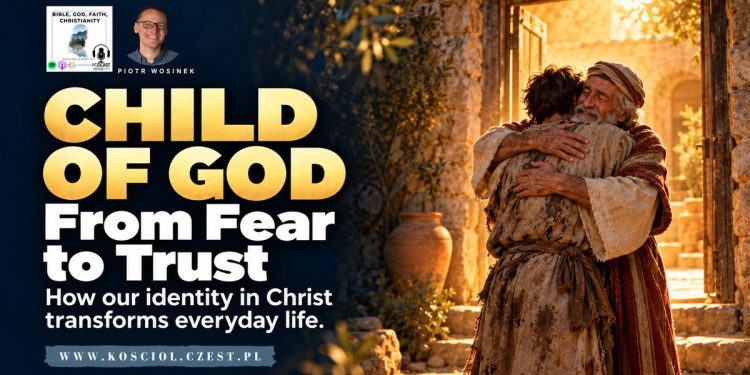
A child of the King does not have to earn a place in the Father’s house. In Christ, they are already accepted and are learning to live as His child. Yet many believers still think like slaves: they hide their mistakes, count their achievements, compare themselves with others and fear that if they fail, they will lose their place. This teaching shows the way from fear to trust, so that we can think like a child of the King, not like a slave.
“You did not receive a spirit of slavery that makes you live in fear again. You received the Spirit of adoption, by whom we cry, ‘Abba, Father!’” – Romans 8:15.
Watch on YouTube
The video is recorded in Polish. An English audio track or English subtitles are available: click the settings icon (⚙) in the YouTube player and choose “Audio track” or “Subtitles/CC”.
Listen to the Podcast
The Main Thought: A Child of the King Has a Place in the Father’s House
Our standing before God changes in a moment, but our way of thinking changes gradually. Whoever has received Jesus is no longer a slave but a son or daughter. Even so, the mind often stays in the old house. A slave asks, “How much must I do so they do not throw me out?” A child of the King asks, “What is my Father doing, and how can I be with Him?”
This teaching follows seven steps. First we will see why we run away from God. Then we will recognise that we think like slaves. We will see the gospel in a parable, where the Father runs out to meet his son, and in a story where a king seats a crippled man at his table. Next we will stand on the foundation of what God has done in Jesus, see how a child of the King lives on a Monday morning, and finally choose a concrete response.
If the subject of identity is new to you, start with the teaching “Identity in Christ Is Our Life” (in Polish).
Why Do We Run Away from God?
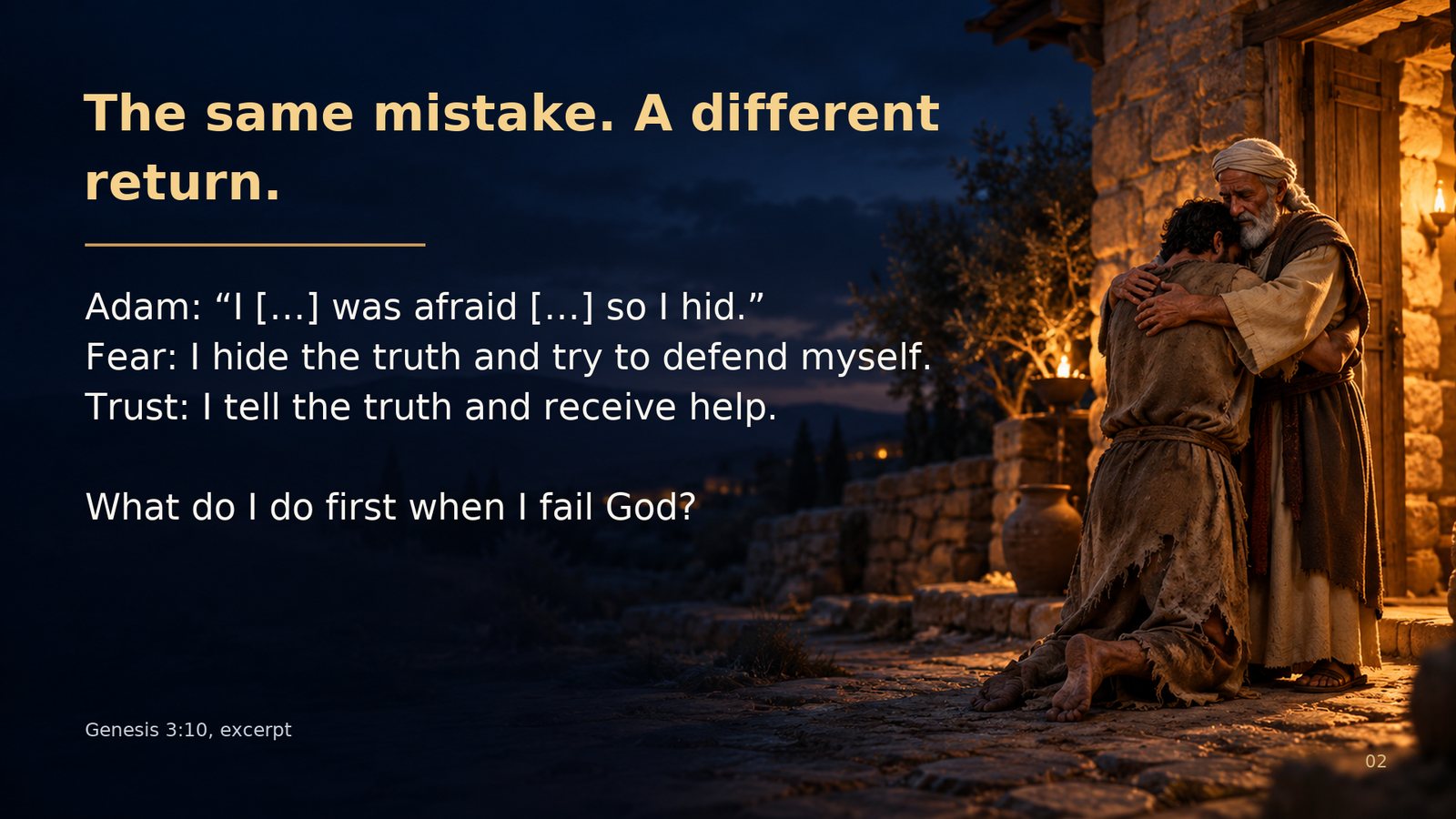
Imagine a child who comes home from school with the worst possible grade. In one home, the child is afraid to tell the truth, so he schemes, hides and lies. In another, he knows the conversation will be hard, but his parents will help him put it right. The same bad grade, yet a completely different homecoming. The difference is not in the grade but in what the child thinks of his parents.
This is not a new problem. The first man did exactly the same thing.
Then the LORD God called to Adam and asked him, “Where are you?” He answered, “I heard Your voice in the garden and was afraid because I was naked. So I hid.”
— Genesis 3:9–10
The first reaction after sin was fear and hiding. Notice God’s first question. It is not “What have you done?” but “Where are you?” God seeks man (read more in “The God Who Seeks Man”).
Jesus speaks about the same thing in His conversation with Nicodemus.
For God did not send His Son into the world to condemn the world, but so that the world might be saved through Him. (…) This is the verdict: Light has come into the world, but people loved darkness rather than light because their deeds were evil. Everyone who does evil hates the light and does not come into the light, for fear that their deeds will be exposed. But whoever lives by the truth comes into the light.
— John 3:17, 19–21
God loves and sends His Son not to condemn but to save. And yet people do not come. Not because God pushes them away, but because they fear that what they have done will come to light. The problem is not in God’s heart but in our fear of the light. The way out is simple, though not easy: come into the light, that is, tell the truth.
When I let God down, what do I do first? Do I hide like Adam? Do I try to fix myself first so that I “deserve” it? Or do I come at once and tell the truth?
Remember this: God asks “Where are you?” because He is looking for you, not because He wants to condemn you. We are the ones who run, because we are afraid. But even after we come to God, the old way of thinking often stays in our heads. We left slavery, but we sometimes still think like slaves.
Two Ways of Thinking: the Slave and the Child of the King
When the set time had fully come, God sent His Son (…) that we might receive adoption to sonship. Because you are His sons, God sent the Spirit of His Son into our hearts, the Spirit who calls out, “Abba, Father.” So you are no longer a slave, but God’s child; and since you are His child, God has made you also an heir.
— Galatians 4:4–7
God changes our status in a single moment: from slave to son and daughter. Our thinking changes gradually, through the renewing of the mind (Romans 12:2). The new position is a gift. The new way of thinking is something we learn step by step.
This is what the two mentalities look like:
| Slave mentality (poverty) | Mentality of a child of the King |
|---|---|
| I must earn it | I am accepted, so I can learn |
| There is never enough | The Father has enough for everyone |
| Another’s success threatens me | I rejoice in my brother’s success |
| Every comment is a verdict on me | Every comment is help for growth |
| I constantly need someone’s approval | I already know who I am to the Father |
| I cannot rest or receive a gift | I rest and receive without “settling the account” |
| I hide my mistakes | I admit them and put things right |
| I wait for someone to decide for me | I take responsibility and act with God |
An important caveat: a “poverty mentality” is not the same as having little money. Poverty does not prove a lack of faith, and wealth does not prove maturity. A person can have a great deal and think like a slave, or have little and live as a child of the King. What matters is who you rely on, not your bank balance.
Israel: They Left Egypt, but Egypt Did Not Leave Them
Israel spent about four hundred years in slavery in Egypt. God sent Moses, who had been raised in Pharaoh’s court and knew what dignity was. After the ten plagues, God brought the people out of Egypt in a single night and led them through the Red Sea (Exodus 1–14). Barely a month into their freedom, the food ran out in the wilderness.
If only we had died by the LORD’s hand in Egypt! There we sat around pots of meat and ate all the food we wanted, but you have brought us out into this desert to starve this entire assembly to death.
— Exodus 16:3
Freedom is hard, and slavery sometimes seems “safer”. The Israelites remembered the pots of meat and forgot the whips. Even so, God gave them manna every day (Exodus 16:4). The Father feeds even His grumbling children.
The people reach the border of the Promised Land. Moses sends twelve spies to explore the land for forty days. They return with a cluster of grapes so large that two men carry it on a pole. Everyone saw the same land and the same fruit, but ten saw giants, and only two, Joshua and Caleb, saw God (Numbers 14:6–9).
We saw the Nephilim there (the descendants of Anak come from the Nephilim). We seemed like grasshoppers in our own eyes, and we looked the same to them.
— Numbers 13:33
Notice the order: first “in our own eyes”, and only then in the eyes of others. The way I see myself shapes how I behave, and that is how others begin to see me. The people answered with tears: “Wouldn’t it be better for us to go back to Egypt?” (Numbers 14:3). The result was forty years in the wilderness. Only Joshua and Caleb and the next generation entered the land (Numbers 14:30–31).
It happens the same way today. Someone is offered a place of service or a new job and immediately thinks, “That’s not for me.” Sometimes that is humility. But often it is the grasshopper in the head. Humility says, “I cannot do it on my own.” The grasshopper says, “God cannot use me.”
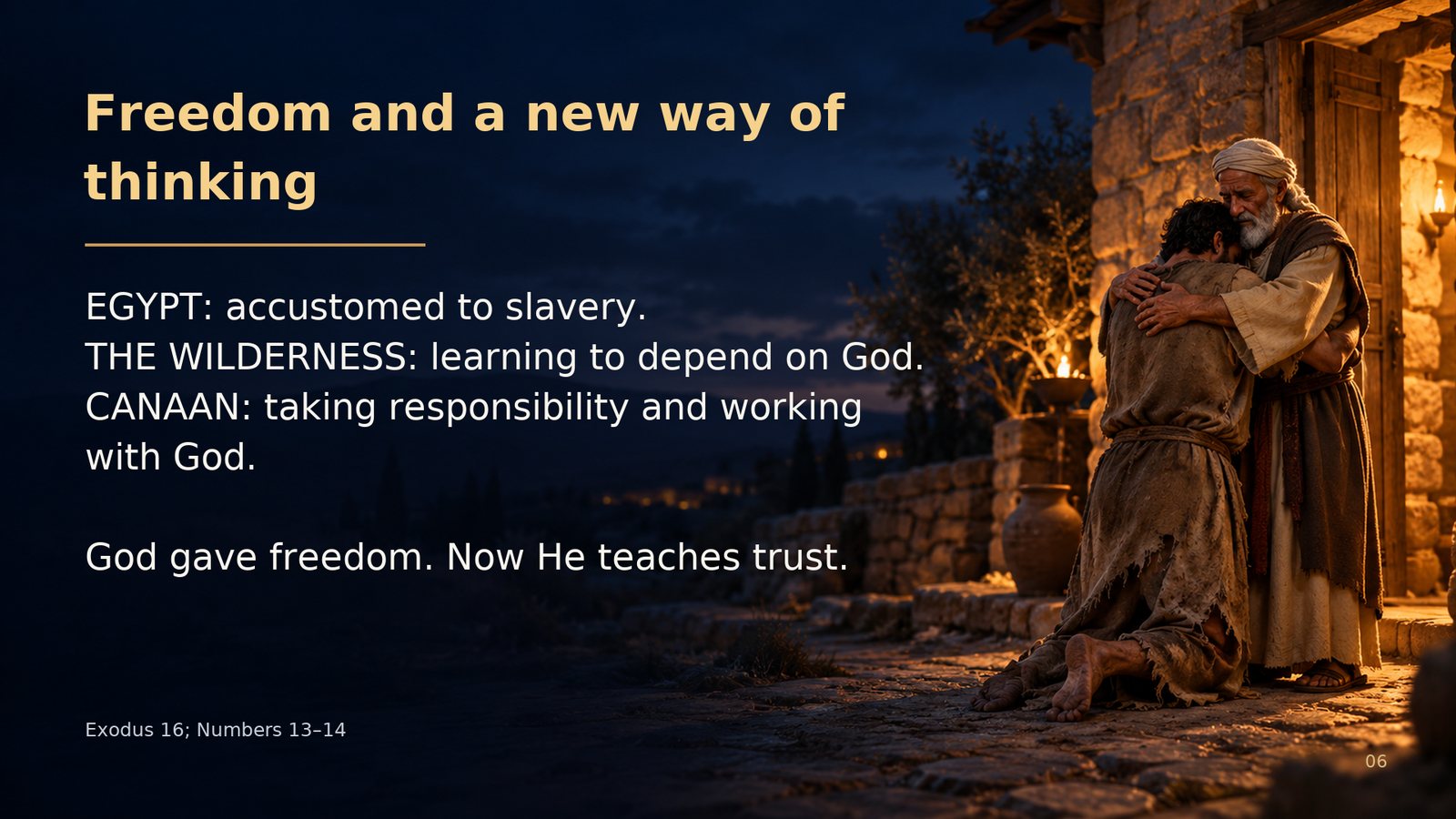
Learning to trust has three stages. This is a picture of a road, not a ranking of people:
| Stage | How you think there |
|---|---|
| 1. Egypt | “I never have enough.” Oppression and habit. I live as the world dictates. “Nothing will change.” |
| 2. The wilderness | “Barely enough.” From manna to manna. I depend on the leader, and rules matter more than relationship. |
| 3. Canaan | “Abundance.” I take responsibility, discover my calling and act together with God. |
Remember: God leads us out of slavery in a single day, but then He teaches us to think “like free people” for the rest of our lives. Israel was God’s people, yet thought like slaves. Jesus told a story in which both attitudes live under one roof: in one family, with one father, in two sons.
The Father and Two Sons
Jesus told this parable when tax collectors and sinners were gathering around to hear Him, and the Pharisees muttered, “This man welcomes sinners and eats with them” (Luke 15:1–3). Luke 15 contains three stories about being lost: a lost sheep, a lost coin and a lost son. Each ends the same way, with joy over the one who comes back. Two groups were listening to Jesus: sinners, whom the younger son represents, and the religious, whom the older son represents.
The Younger Son Leaves… and Returns
The younger son wants his father’s wealth but not his father. He looks for freedom and ends up as the servant of a stranger, a slave to sin. For a Jew, feeding pigs was rock bottom. Jesus does not pretend that sin is harmless. Sin has consequences. But then the son comes to his senses.
I will set out and go back to my father and say to him: Father, I have sinned against heaven and against you. I am no longer worthy to be called your son; make me like one of your hired servants.
— Luke 15:18–19
“He came to his senses” means that he tells the truth about himself and blames no one. This is the beginning of repentance, coming into the light of John 3:21. But notice: he returns to the Father with a plan to be a slave. He thinks, “I will work it off.”
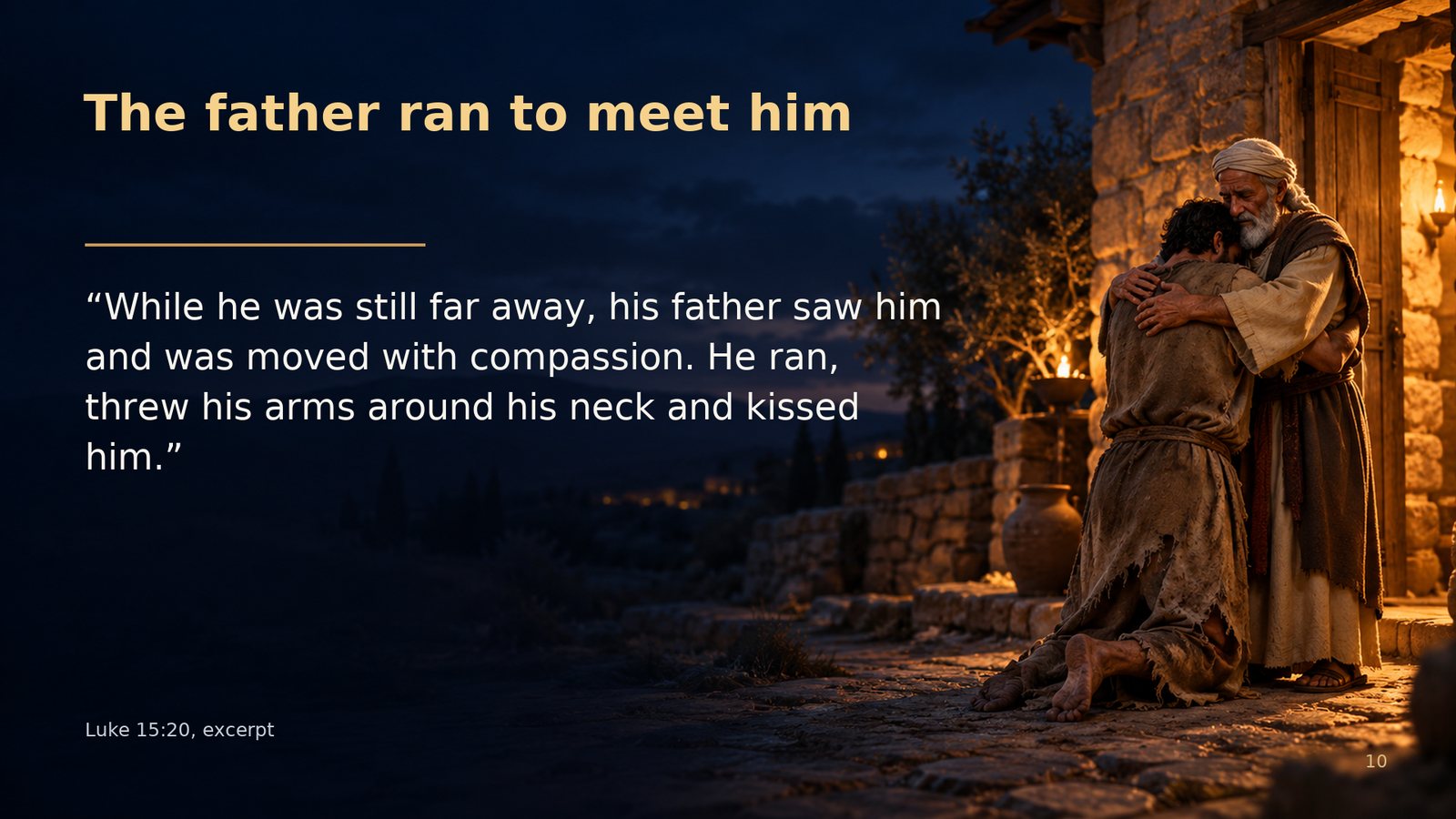
But while he was still a long way off, his father saw him and was filled with compassion for him; he ran to his son, threw his arms around him and kissed him. (…) But the father said to his servants, “Quick! Bring the best robe and put it on him. Put a ring on his finger and sandals on his feet. Bring the fattened calf and kill it. Let’s have a feast and celebrate. For this son of mine was dead and is alive again; he was lost and is found.”
— Luke 15:20, 22–24
The father was moved, ran, embraced and kissed his son before the son said a single word. The son begins his speech but never finishes it. The line about being a hired servant never comes out in verse 21, because the father interrupts him. The robe, the ring, the sandals and the feast are the marks of a son, not of a worker. The father says, “This son of mine.”
Compare two prayers. The slave’s prayer: “Lord, I will be better this week, and then I will come to You.” The prayer of a child of the King: “Father, I did wrong. I need Your grace and I want to put it right.” We come to God for forgiveness and strength to change, not with proof that we have already changed.
The Older Son Was Near the House, Yet Felt Like a Stranger
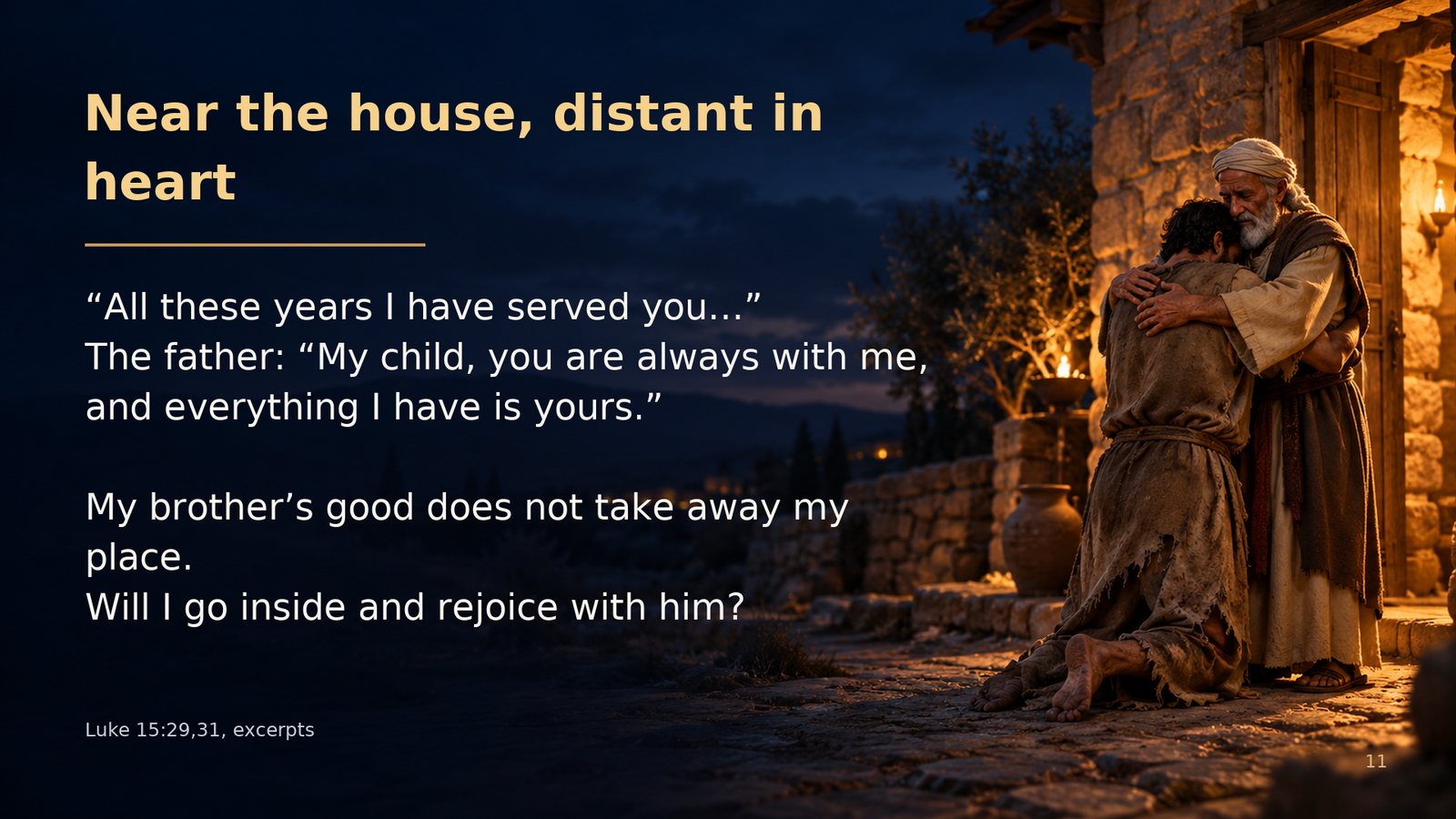
But Jesus was also speaking to the Pharisees. The older son works, obeys and is always at hand. These are good things. But when his younger brother returns, the slave inside him comes out.
Look! All these years I’ve been slaving for you and never disobeyed your orders. Yet you never gave me even a young goat so I could celebrate with my friends. But when this son of yours who has squandered your property with prostitutes comes home, you kill the fattened calf for him!
— Luke 15:29–30
He counts the years, compares himself and feels overlooked. He speaks of “this son of yours”, and the father corrects him: “this brother of yours.” The older son had everything but thought he had not even been given a young goat. This is the poverty mentality inside the Father’s house, the belief that you do not deserve it.
My son, you are always with me, and everything I have is yours. But we had to celebrate and be glad, because this brother of yours was dead and is alive again; he was lost and is found.
— Luke 15:31–32
The Father goes out to the older son too. Jesus does not say whether the older son went inside. That question is left for us. Sometimes someone in church receives something (help, a new place of service), and a voice in me says, “Nobody noticed me.” Yet the good that comes to my “brother” does not take my place in the Father’s house.
Remember: both sons were really far away, one in a foreign country, the other in his own home. The Father went out to both. This parable has a counterpart in a true story from the Old Testament, which shows what grace looks like when someone thinks the worst of himself.
Mephibosheth: from Lo Debar to the King’s Table
Saul was Israel’s first king. His son Jonathan was David’s closest friend, and they made a covenant (1 Samuel 20:14–17). Saul and Jonathan died in battle. In those days a new king often wiped out the family of the previous one so that no one would claim the throne.
Jonathan son of Saul had a son who was lame in both feet. He was five years old when the news about Saul and Jonathan came from Jezreel. His nurse picked him up and fled, but as she hurried to leave, he fell and became disabled. His name was Mephibosheth.
— 2 Samuel 4:4
Mephibosheth was crippled through no fault of his own. He was hiding because he feared the new king. He lived in Lo Debar, which means roughly “no pasture”, “a place where there is nothing”. Years pass and David is now king. He asks, “Is there anyone still left of the house of Saul to whom I can show God’s kindness for Jonathan’s sake?” (2 Samuel 9:1).
It is the king who seeks out Mephibosheth, not Mephibosheth who seeks the king. Exactly like the father who runs. And when Mephibosheth stands before David and falls on his face, he hears:
Don’t be afraid, for I will surely show you kindness for the sake of your father Jonathan. I will restore to you all the land that belonged to your grandfather Saul, and you will always eat at my table.
— 2 Samuel 9:7
The king’s first words are “Do not be afraid.” Grace begins where fear ends. Mephibosheth answers, “What is your servant, that you should notice a dead dog like me?” (verse 8). His status had changed, but his picture of himself had not. It is the same problem as the “grasshopper” and the “hired servant”.
Mephibosheth received his place not because of his legs but because of David’s covenant with Jonathan. Scripture says he ate at David’s table “like one of the king’s sons” (verse 11). His legs were still lame, but hidden under the king’s table.
So it is with us. We do not sit at the King’s table because of ourselves but because of the covenant in Jesus. The King looks at the covenant, not at our legs. But what do we base our confidence on that we are God’s children? Not on feelings and not on results, but on the Word.
The Foundation: Who I Am as a Child of the King
Yet to all who did receive Him, to those who believed in His name, He gave the right to become children of God — children born not of natural descent, nor of human decision or a husband’s will, but born of God.
— John 1:12–13
We do not become God’s children by repeating positive sentences about ourselves. The foundation is receiving Jesus and believing in Him. It is a gift, not a reward. If you have not yet entrusted your life to Jesus, this invitation is for you, today. You do not have to become better first.
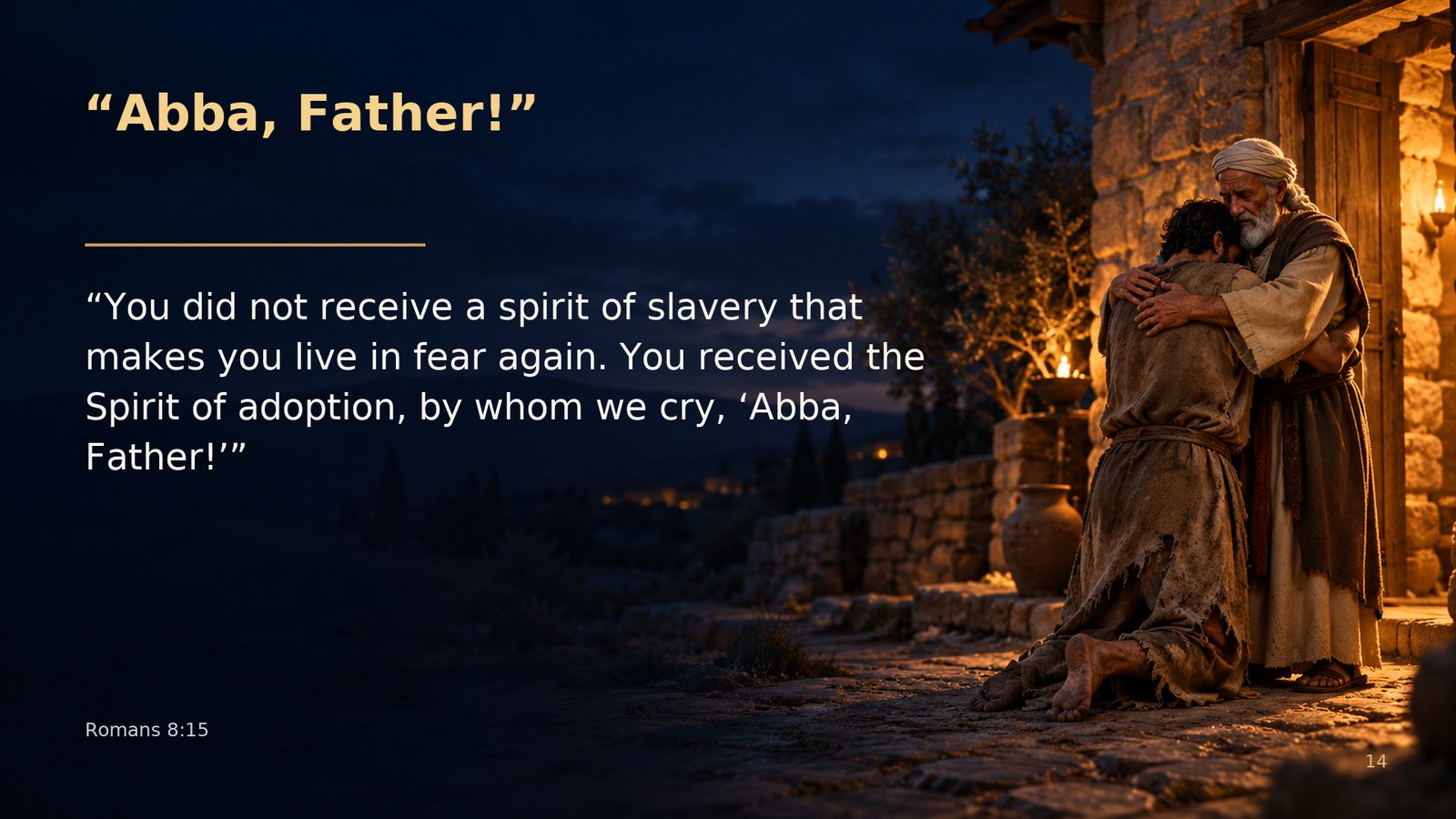
You did not receive a spirit of slavery that makes you live in fear again. You received the Spirit of adoption, by whom we cry, “Abba, Father!” The Spirit Himself testifies with our spirit that we are God’s children. Now if we are children, then we are heirs: heirs of God and co-heirs with Christ, if indeed we share in His sufferings.
— Romans 8:15–17
The spirit of slavery leads to fear, and the Spirit of sonship leads to the cry “Father”. “Abba” is the Aramaic word a child used for his father: close and full of respect. The Holy Spirit Himself confirms within us that we are God’s children. Inheritance does not mean a life without suffering. It means that in suffering I am not an orphan.
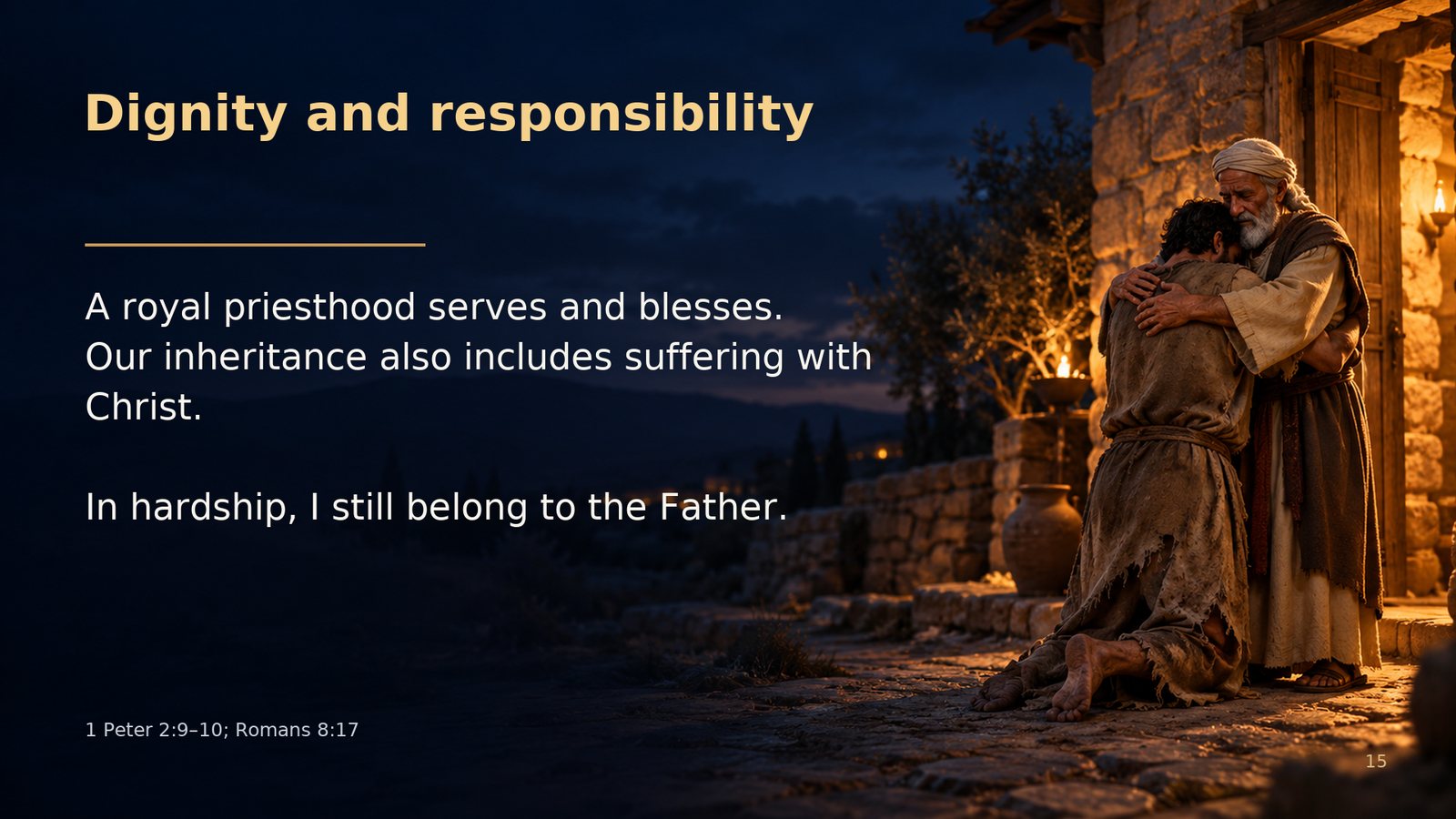
But you are a chosen people, a royal priesthood, a holy nation, God’s special possession, that you may declare the praises of Him who called you out of darkness into His wonderful light.
— 1 Peter 2:9
“Out of darkness into light” is exactly the road of John 3. A royal priesthood means dignity and responsibility, not a title for exalting ourselves. A king is recognised by the fact that he serves and blesses, not by the fact that he demands.
Remember: my identity does not rest on my feelings or results but on what God has done in Jesus.
How a Child of the King Lives Every Day
We have the foundation. Now comes the most important question: what does this look like on Monday morning, at home, at work and in church? Our reactions show how we see ourselves. Here are four typical situations:
| Situation | The slave’s reaction | The reaction of a child of the King |
|---|---|---|
| Someone corrects me | I defend myself, list my merits, take offence | “What exactly did I miss?” The remark is about my behaviour, not my worth |
| Someone is doing better | I belittle them and envy them in silence | I tell the Father what I long for and congratulate my brother |
| I need to apologise | “I’m sorry, but you also…” | I apologise without “but” and forgive, because I have been forgiven |
| Time to rest | “If I stop working, I will stop being needed” | I do my part and end the day in peace |
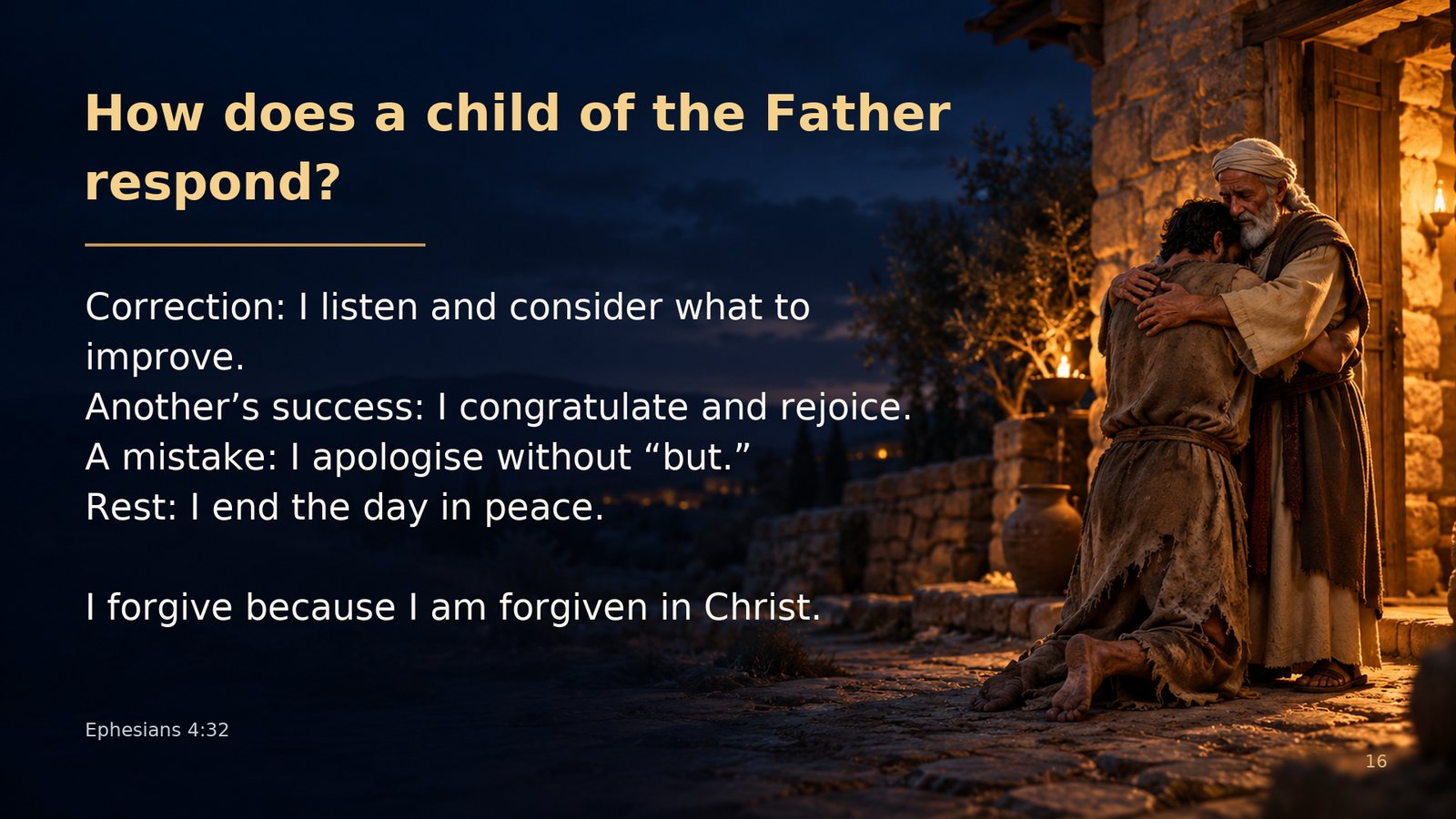
Be kind and compassionate to one another, forgiving each other, just as in Christ God forgave you.
— Ephesians 4:32
A child of the King forgives because he himself has been forgiven. He apologises without “but”, because his worth does not depend on who was right.
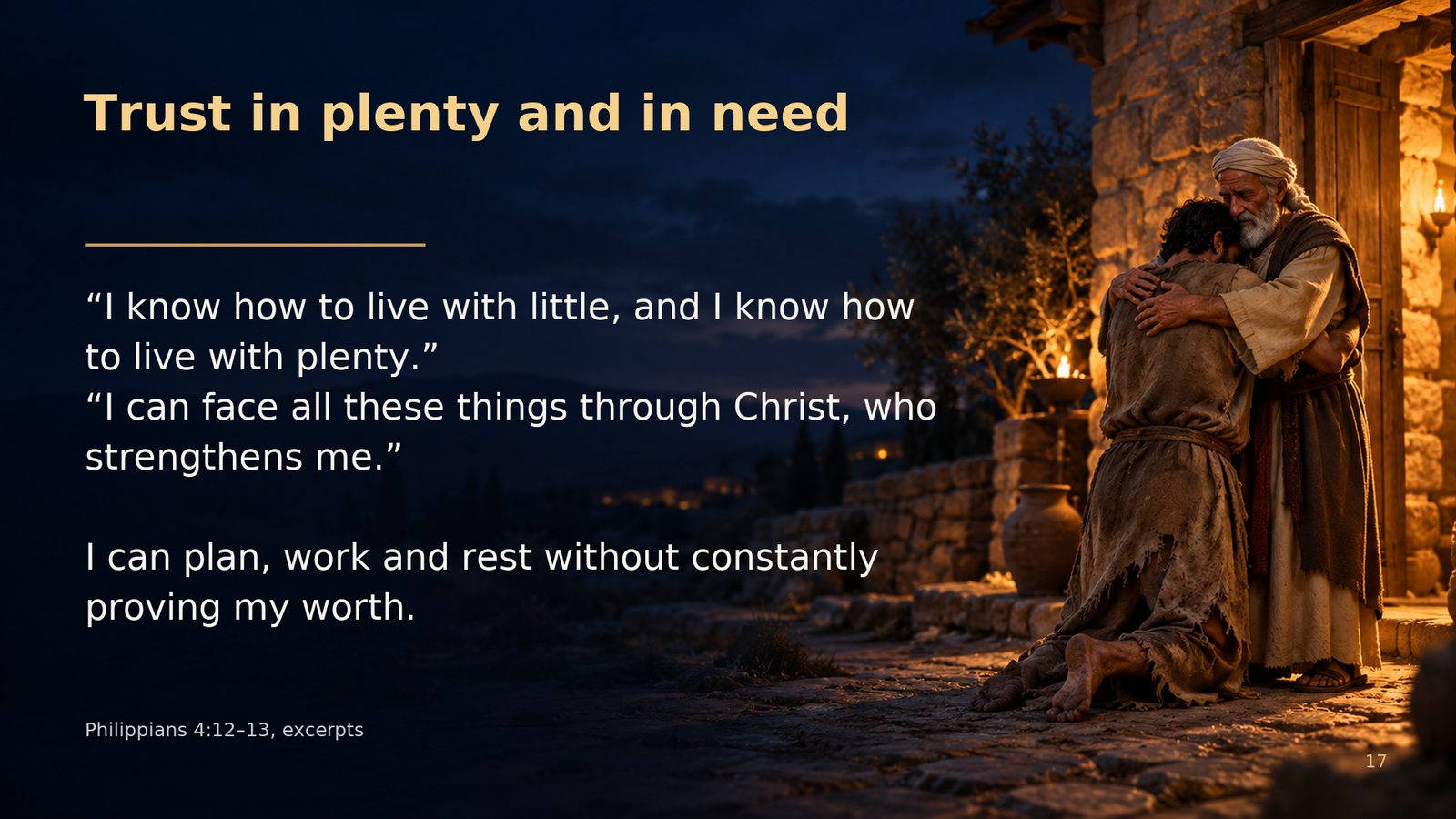
I know what it is to be in need, and I know what it is to have plenty. I have learned the secret of being content in any and every situation, whether well fed or hungry, whether living in plenty or in want. I can do all this through Him who gives me strength.
— Philippians 4:12–13
Paul writes this from prison. A child of the King can be poor and not think like a beggar. He can look for a better job, save and plan. He can also receive a gift without feeling forced to repay it at once. He does not have to agree with every opinion, he can set a boundary, and he does not treat every difference of opinion as an attack on himself.
Someone will ask: if I am accepted, why does God keep correcting me? Because that is what a good father does.
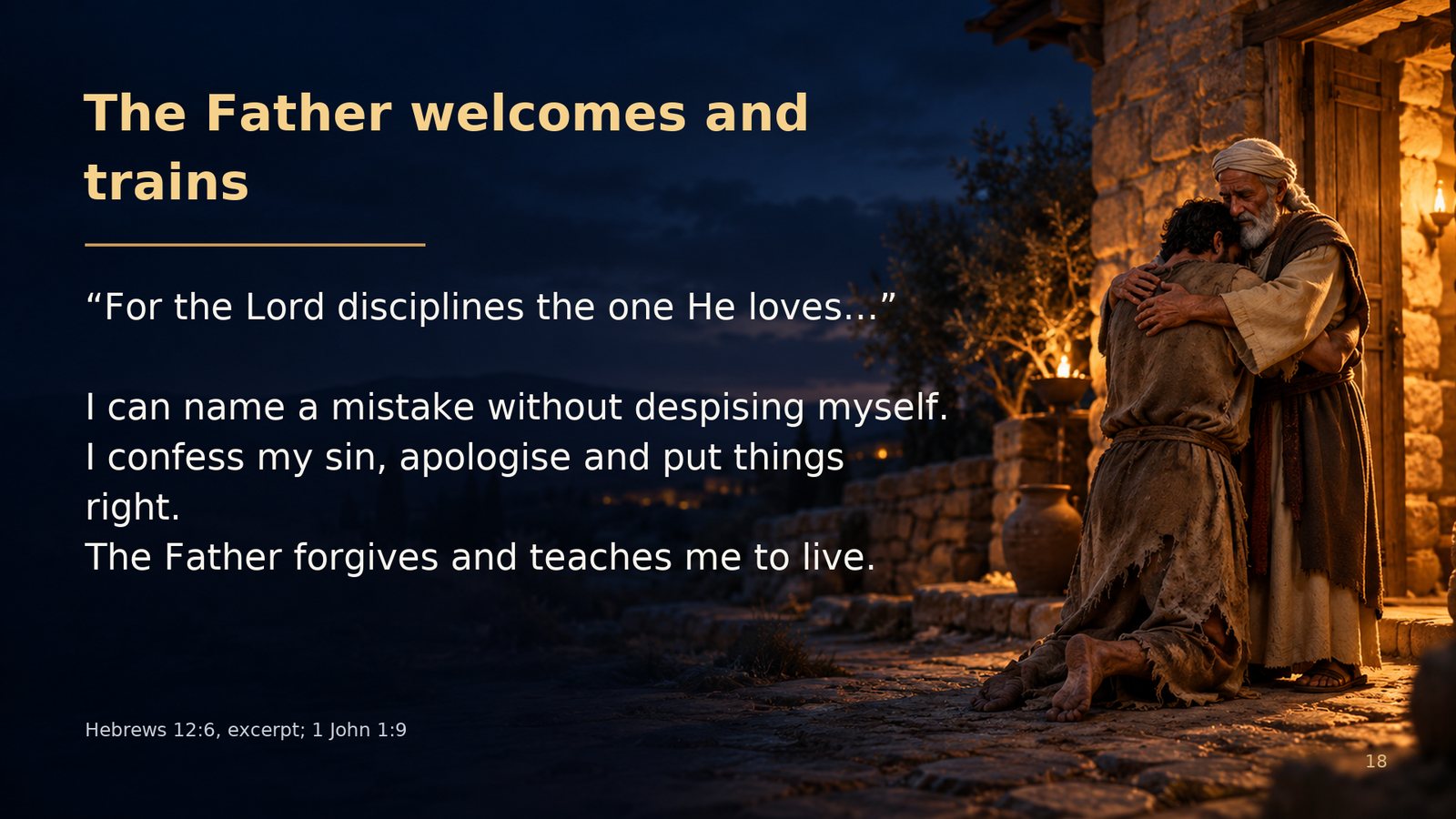
My son, do not make light of the Lord’s discipline, and do not lose heart when He rebukes you, because the Lord disciplines the one He loves, and chastens everyone He accepts as His son.
— Hebrews 12:5–6
Acceptance and training are the same relationship. A good father does not leave his child in what destroys him. This does not mean that every illness or loss is a punishment for a specific sin. Accusation says, “You are hopeless, go hide” (like Adam). The Father’s correction says, “You did wrong. Come into the light, tell Me about it, put it right.”
If we confess our sins, He is faithful and just and will forgive us our sins and purify us from all unrighteousness.
— 1 John 1:9
To confess means to agree with the truth. I do not make excuses. Then I act: I give back, I set the lie straight, I apologise, I ask for help. Grace gives the courage for these steps. That way I can receive correction without hiding my guilt and without despising myself.
The Response: Coming into the Light
We began with Adam hiding among the trees and with people who do not come into the light. Let us end by each of us taking one step towards the light today. But first, pause for a moment at the mirror.
Mini-Test: Slave or Child of the King?
Rate each statement quietly: 0 = never, 1 = sometimes, 2 = often. No one has to show their results.
| No. | Statement |
|---|---|
| 1 | After I fall, I first try to fix myself and only then come to God. |
| 2 | When someone else succeeds, I feel that something is passing me by. |
| 3 | Criticism hurts me for a long time, and I immediately start defending myself. |
| 4 | It is hard for me to accept a gift without quickly “giving something back”. |
| 5 | I feel guilty when I rest. |
| 6 | I think: “God can use others, but not me.” |
| 7 | I put off important decisions until someone tells me what to do. |
| 8 | In my mind I keep counting how much I have already done for God and people. |
| 9 | It is hard for me to say “I’m sorry” without adding “but”. |
| 10 | I fear that if I fail, I will lose my place in the church or with God. |
- 0–6 points: you largely think like a child of the King. Thank God and help others.
- 7–13 points: you are “in the wilderness”. God has already brought you out, and now He is teaching you to think like a free person.
- 14–20 points: there is still plenty of Egypt in your head. This is not a verdict but a map. The Father runs out to you as well.
This is not a “saved / unsaved” test but a mirror. The full test (80 statements) is available here, in Polish: Test na mentalność ubóstwa i Królestwa. It is worth repeating in a few months.
One Step for This Week
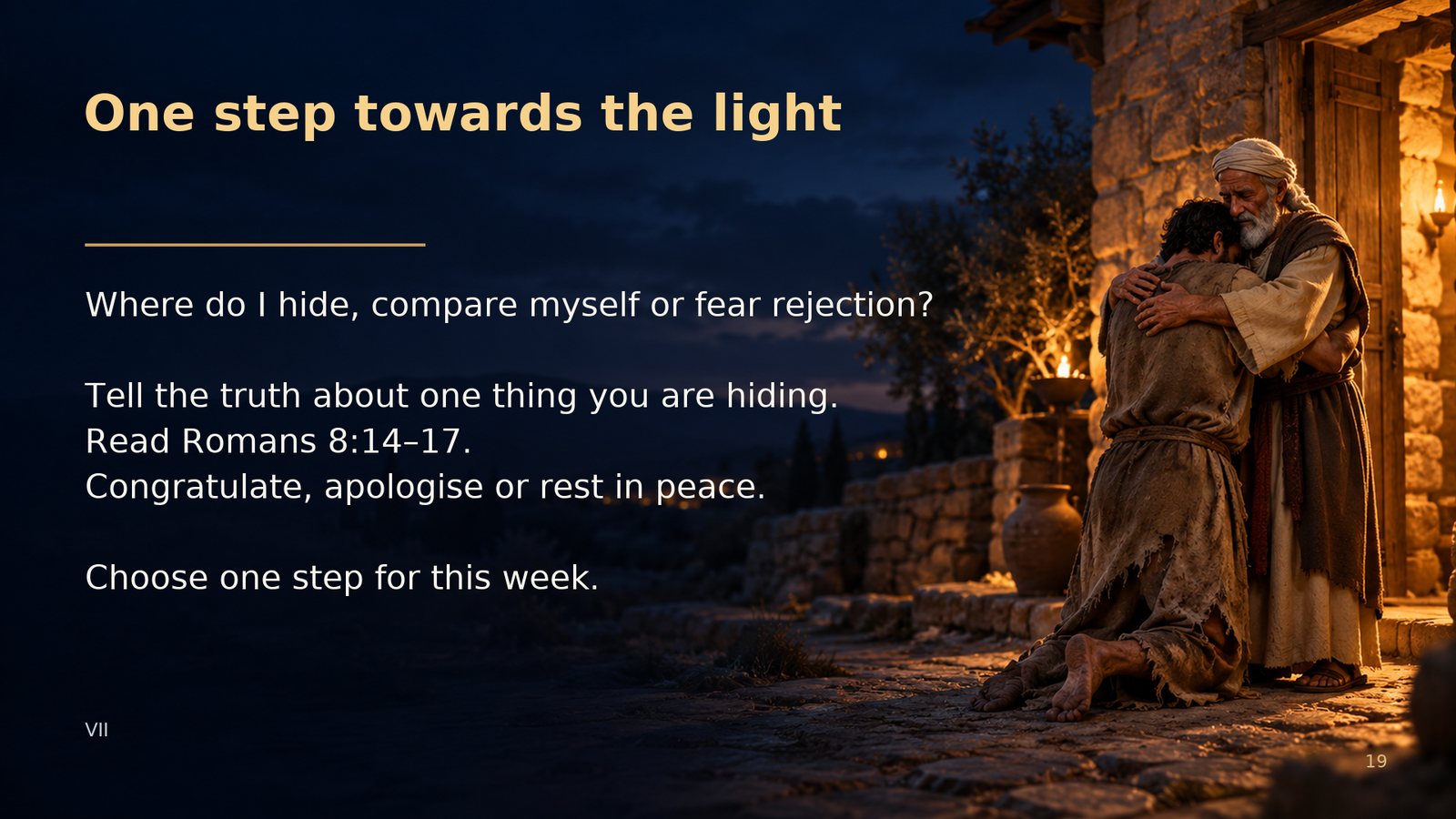
Choose one of four steps:
- Come into the light: tell God or a trusted person the truth about one thing you are hiding.
- Name your fear before the Father: “I am afraid I will fail and lose my significance. Help me to rely on You.”
- Return to the truth: read Romans 8:14–17 and pause at the word “Abba”.
- Take one step as a child: sincerely congratulate someone, apologise without “but”, or finish work at a sensible hour.
Closing: We Come Full Circle
Adam hid among the trees, and God asked, “Where are you?” People run from the light because they fear exposure, and God sent His Son not to condemn but to save. The younger son returned asking for a worker’s place, and the Father ran out to meet him. The older son stood outside the house with a list of his merits, and the Father went out to him as well. Mephibosheth came as a “dead dog” and sat at the table like a king’s son.
The question for today is this: will I come into the light, go inside and sit at the table as a child of the King?
Say it aloud: I do not have to earn a place in the Father’s house. In Christ I am accepted, and I am learning to live as His child.
Prayer
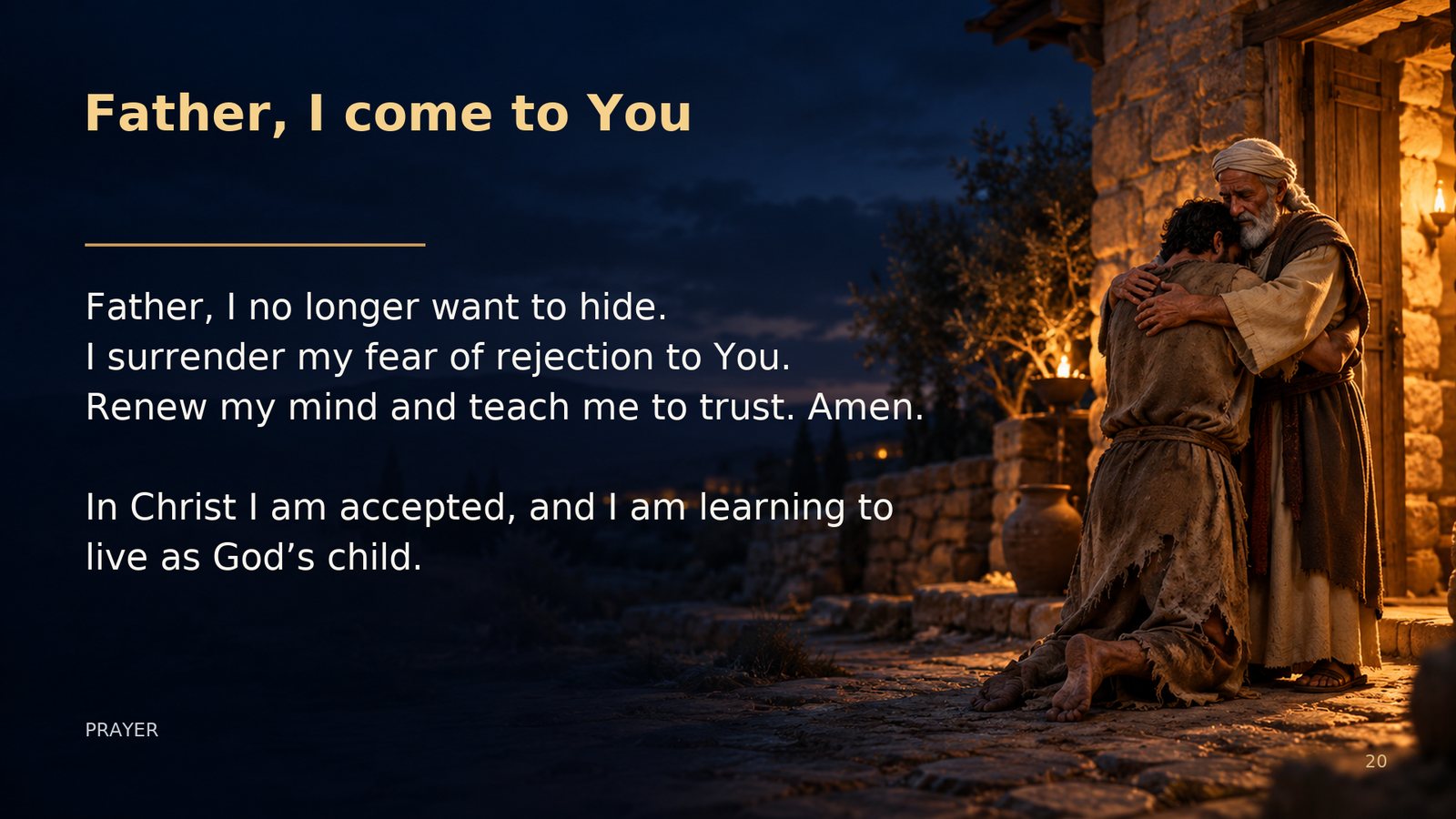
Father, thank You that You so loved the world that You gave Your Son. I no longer want to hide from You. I come into the light with the truth about my life. I surrender to You my fear of rejection and my slave’s way of thinking. Renew my mind. Show me who I am in Christ. Teach me to receive correction, to take responsibility and to rejoice in the good of others. Show me one step I can take today, and give me strength to take it. Amen.
If being afraid of God and holy reverence for God sometimes blur together for you, read also “The Fear of God Guards Our Holiness and Leads Us to Friendship with God” and “Do Not Be Afraid — God Is with You in a World of Uncertainty”.
Questions for Group Discussion
- What most often makes me “hide” from God?
- Where am I today: in Egypt, in the wilderness or in Canaan? How do I know?
- Which son am I closer to today? Why?
- Which “grasshopper sentence” or “dead dog sentence” do I say about myself most often?
- How can I tell humility from false modesty?
Materials Used in This Teaching
- P. Wosinek, “Test on the Poverty and Kingdom Mentality” (in Polish), kosciol.czest.pl
- Thematic inspiration: K. Vallotton, B. Johnson, “The Supernatural Ways of Royalty” (Polish edition: “Królewski styl”, Wydawnictwo Dawida)
Scripture quotations are given in modern English and are partly condensed; where marked with (…), words are omitted. This teaching is an original work, not a summary of a book.