

The fear of God is not terror before Him, but reverence for Him and a dread of living far from Him. It guards our holiness and leads us into friendship with God. “But as He who called you is holy, you also be holy in all your conduct, because it is written, ‘Be holy, for I am holy'” – 1 Peter 1:15–16.
Watch on YouTube
Listen to the Podcast
The Main Idea of This Teaching
The fear of God is not fear of punishment, but reverence for a holy God and a desire never to live far from Him. In the Bible you will meet two expressions — the fear of God and the fear of the Lord — and both mean the same thing.
It is the fear of God that guards our holiness, because it teaches us to love what God loves and to hate the evil that destroys people. And it is the fear of God that leads to friendship with Him, because “the secret of the LORD is with those who fear Him” (Ps 25:14). We will go through it step by step: from who God is, to the everyday habits of the heart that let us live close to Him.
Introduction
Today there are many wrong ideas about holiness. Some people make saints for themselves and pray to them. Others try to sanctify themselves by their own effort or look for “holy places.” For some, holiness is a list of prohibitions; for others, a gloomy and severe way of life reserved for pastors and the “super-spiritual.” There are also those who think holiness must be earned, that it is enough to show it on Sunday, or that it can be achieved by our own strength. And on the other side stand those who suppose that grace means how we live does not matter.
Most of these ideas begin with man and what he must do, rather than with God. The Bible begins with Him. Where did God lead the Israelites out of Egypt to? Not only to the promised land. He Himself said: “I brought you to Myself” (Exod 19:4). The goal of leaving Egypt was not a place, but a Person. It is easy to swap them: we want blessings, solved problems, a tangible sense of God’s presence. It is much harder to seek God for His own sake.
Pursue peace with all people, and holiness, without which no one will see the Lord.
— Hebrews 12:14
In the teaching “Sanctified Once for All — Transformed Every Day” we talked about what Jesus has already done for us. In the teaching on priorities in the life of a believer we looked at how our life should be ordered. Today we ask about the posture of the heart that protects this holiness and lets it mature: the fear of God.
1. God Is Holy!
Everything begins with God, not with our efforts. The Hebrew word “kadosh,” which we translate as “holy,” means set apart — for God, for life with Him — different, unlike anyone else. That is why holiness is not a list of prohibitions, but a response to who God is.
At Sinai, Israel met God first in His holiness: fire, thunder, a mountain no one was allowed to climb. And yet at the very heart of that holiness are His love and grace:
And the LORD passed before him and proclaimed, “The LORD, the LORD God, merciful and gracious, longsuffering, and abounding in goodness and truth, keeping mercy for thousands, forgiving iniquity and transgression and sin…”
— Exodus 34:6–7
It was similar with Isaiah. At first he pronounced “woe” on others — the proud and the drunkards (Isa 5). Only when he saw God in His glory did he cry out differently:
Holy, holy, holy is the LORD of hosts! (…) Woe is me, for I am undone! Because I am a man of unclean lips.
— Isaiah 6:3, 5
Whoever truly sees God also sees himself — and no longer needs to compare himself with others. But Isaiah’s story does not end there. He was not left in guilt: the seraph cleansed him, and the Lord asked, “Whom shall I send?” An encounter with the Holy One ends in cleansing and mission. Only God can cleanse us — it is enough that we come to Him.
When did you last stop to see who God is — and not only what He has done for you?
2. A Holy People: Our Position and Our Pursuit
If God is holy, what does it mean that we are to be holy? Scripture speaks about it in two ways, and both are true. First, we are already sanctified: by Jesus’ one sacrifice we have been set apart for God once for all (Heb 10:14). It cannot be earned — it is grace. Second, we are to pursue holiness (Heb 12:14), cleanse ourselves from all filthiness (2 Cor 7:1), and become holy in all our conduct (1 Pet 1:15).
A simple picture helps. A married man is a husband from his wedding day — that is his position. A wedding ring earned nothing; it only gave a position, but it commits him to something: his behavior should confirm that position. It is the same in Christ: our position is a gift, and our life is to express it.
Work out your own salvation with fear and trembling; for it is God who works in you both to will and to do for His good pleasure.
— Philippians 2:12–13
So pursuing holiness is not an attempt to earn acceptance. It is the response of people who have already been accepted. Forgiveness and justification are given freely, and sanctification is a process in which we cooperate with the Holy Spirit. We do it, but not alone — it is God who works in us both to will and to do.
Am I pursuing holiness out of a feeling that I must earn it, or out of gratitude for what I have already received?
3. What the Fear of God Is — and What It Is Not
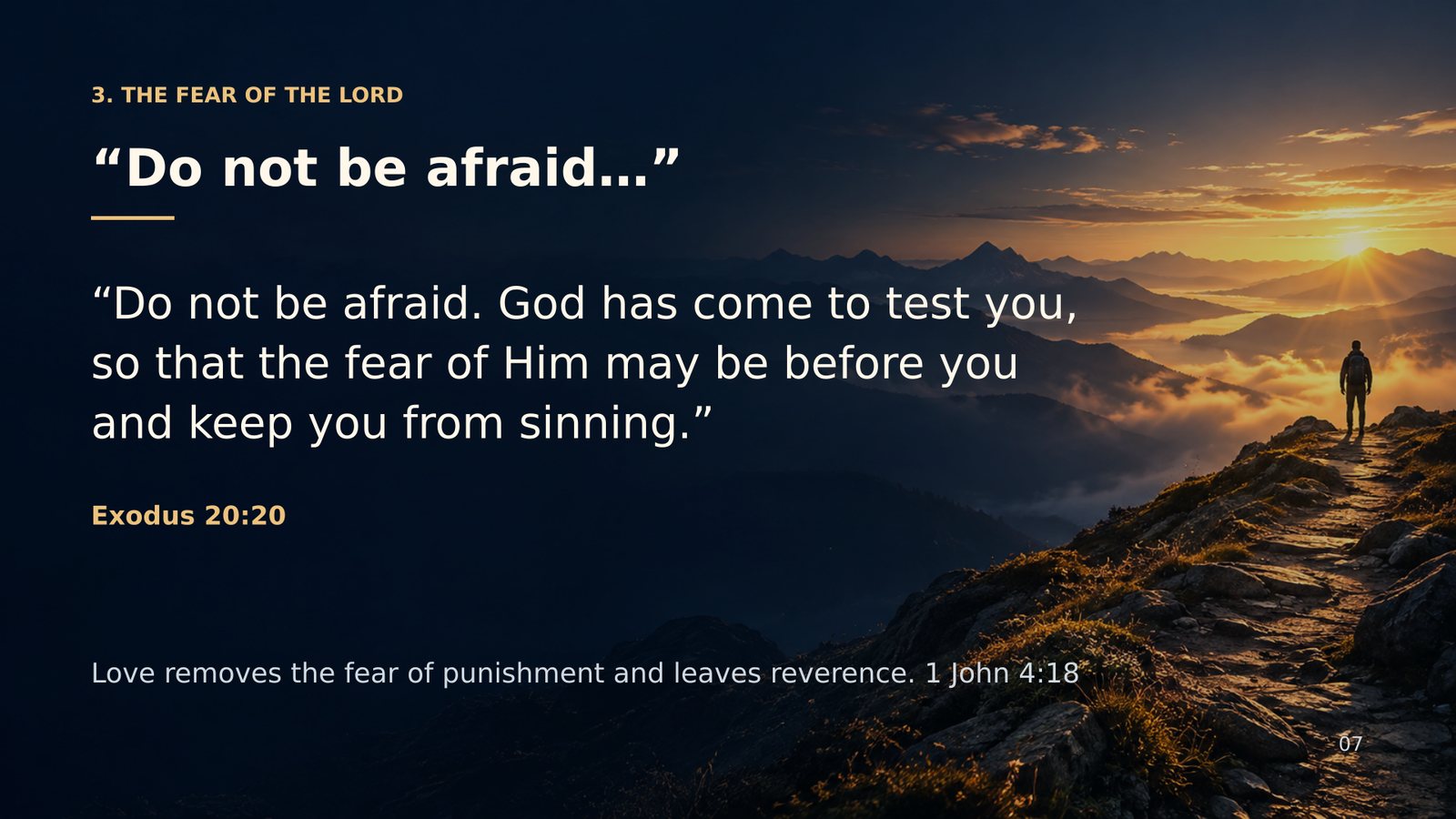
Here we come to a word that sounds unsettling to many: fear. At Sinai the people trembled and fled from the mountain. Then Moses said something that sounds like a contradiction:
Do not fear; for God has come to test you, and that His fear may be before you, so that you may not sin.
— Exodus 20:20
“Do not fear” — and yet “that His fear may be before you.” Moses distinguishes two kinds of fear:
| Being afraid of God | The fear of God |
|---|---|
| Runs away from God (the people leave the mountain). | Draws near to God (Moses enters the darkness where God is). |
| Has something to hide — like Adam, who hides after sinning. | Has nothing to hide, because it lives in the light. |
| Is afraid of punishment. | Is afraid of losing closeness with God. |
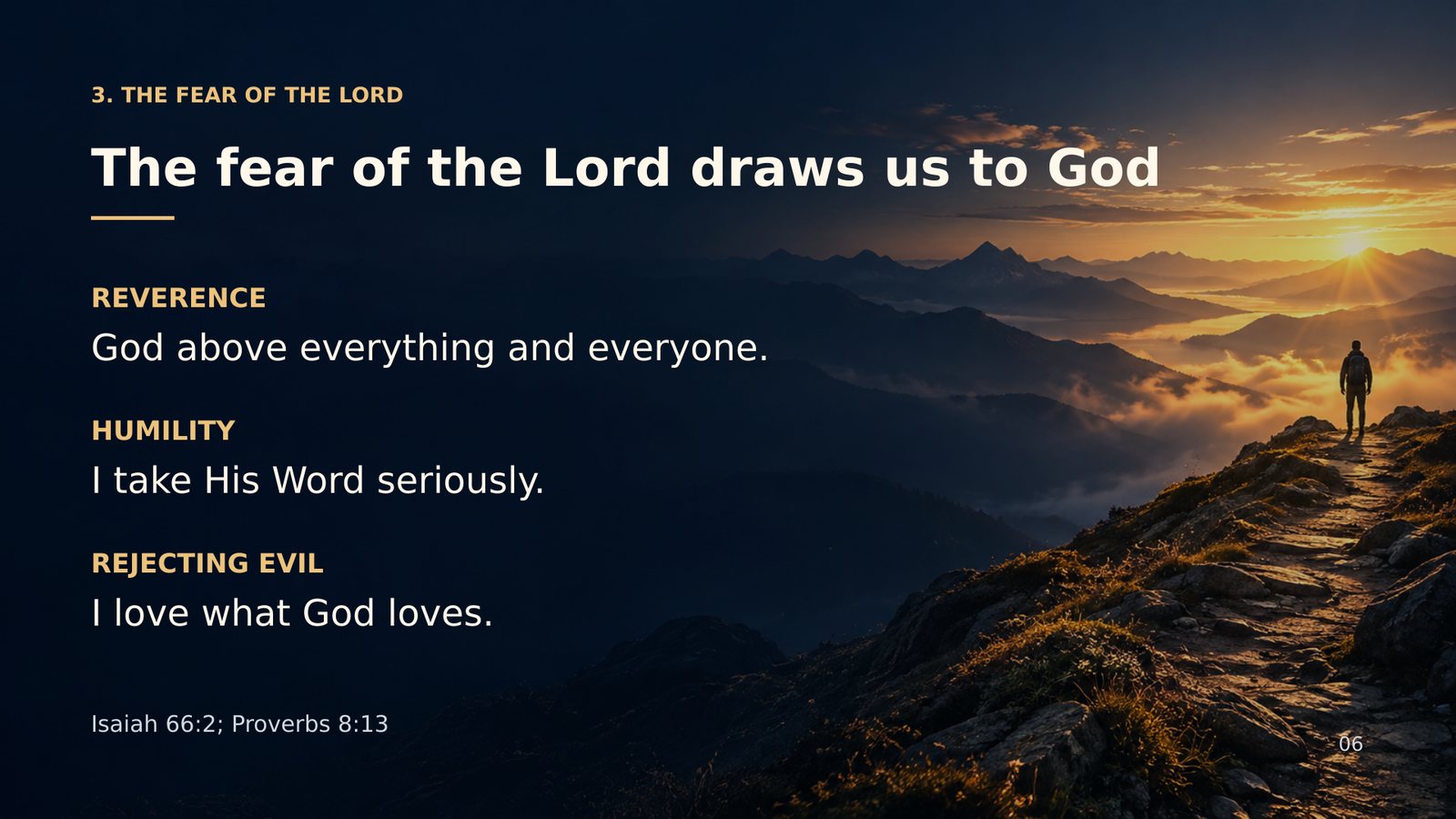
What does the fear of God consist of? First of all, reverence and worship — putting God above everything and everyone. Then humility and trembling before His Word: “on this one will I look… who trembles at My word” (Isa 66:2). And loving what God loves and hating what He hates: “the fear of the LORD is to hate evil” (Prov 8:13).
Two things are worth watching here. God is our Father and friend, but not a “buddy”: “Let us serve God acceptably with reverence and godly fear. For our God is a consuming fire” (Heb 12:28–29). On the other hand, fear and love are not opposites. “Perfect love casts out fear, because fear involves torment” (1 John 4:18) — love removes the fear of punishment, but it does not remove reverence.
And this is not a truth of the Old Testament only. The “Spirit of the fear of the LORD” rested on Jesus, and His delight was in the fear of the LORD (Isa 11:2–3); He was heard because of His godly fear (Heb 5:7). The first Church walked in the fear of the Lord and, at the same time, in the comfort of the Holy Spirit (Acts 9:31) — both at once.
When I come to God, do I have something to hide — or something I keep covering up?
4. The Narrow Road: Two Ditches
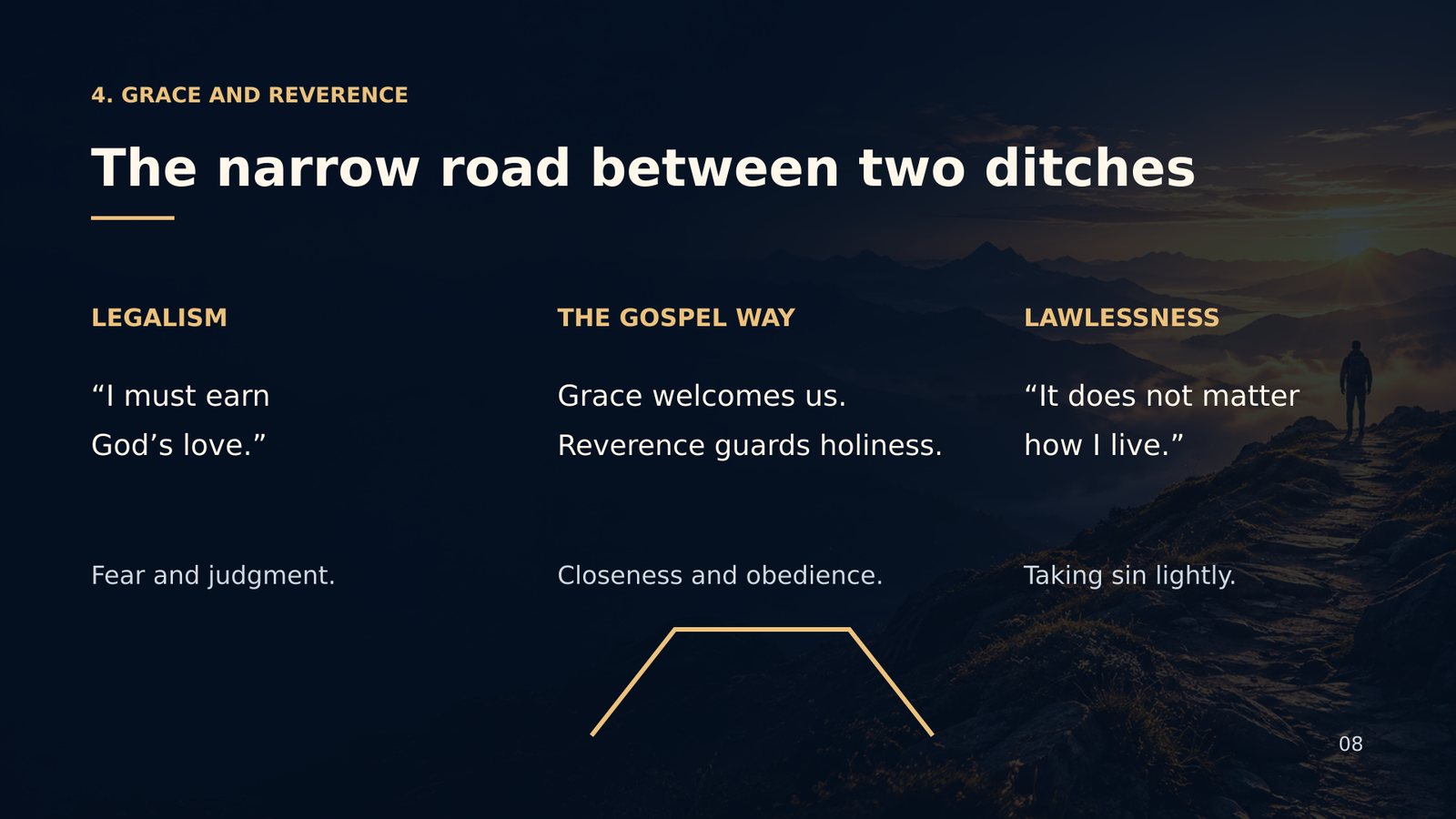
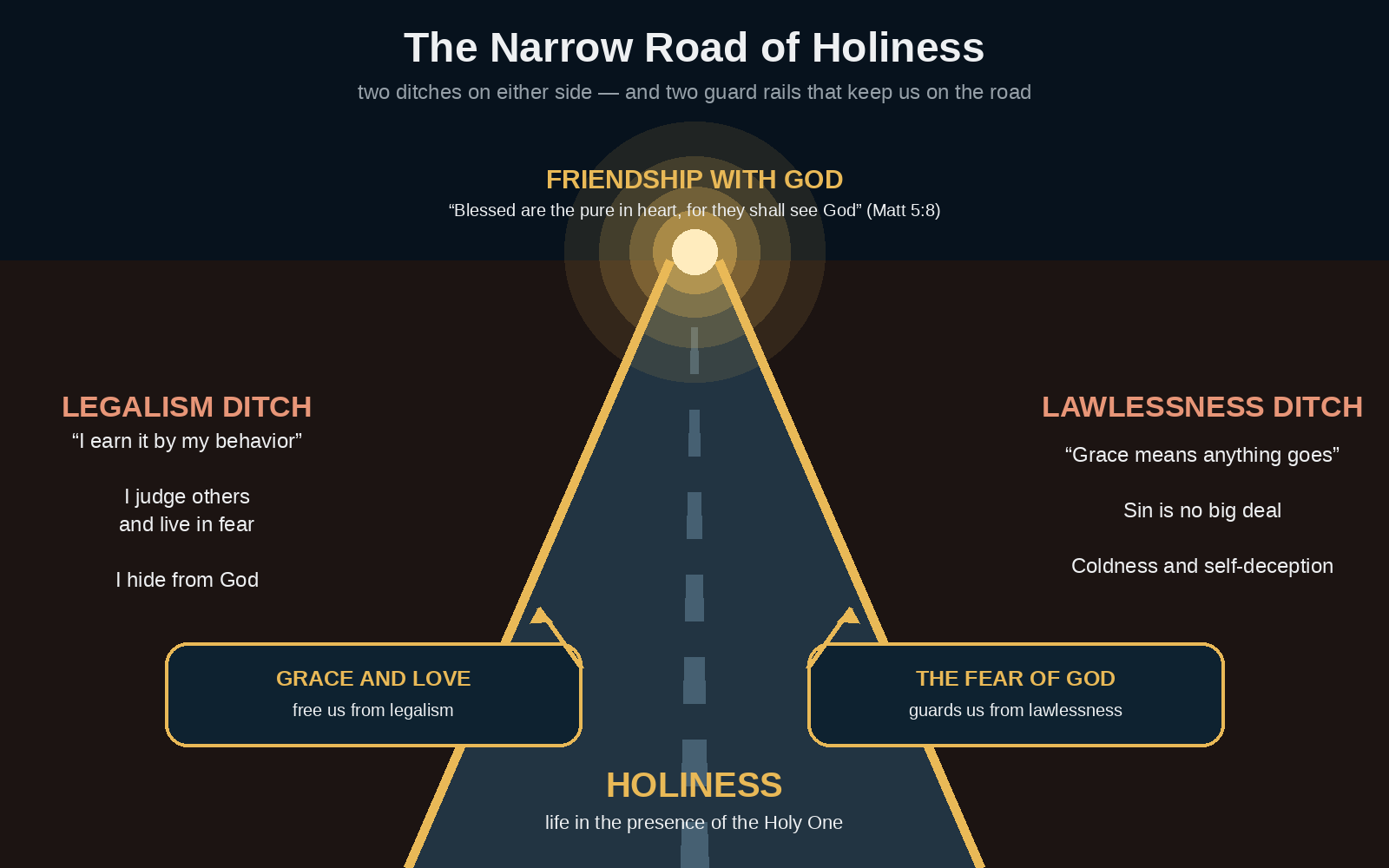
The road of holiness is narrow and has a ditch on both sides: legalism and lawlessness. Grace and the fear of God together keep us on the road.
The First Ditch: Legalism
In this ditch a person thinks, “I earn God by my behavior.” He lives in fear, judges others, and hides from God. The remedy is God’s grace and love: “There is therefore now no condemnation to those who are in Christ Jesus” (Rom 8:1).
The Second Ditch: Lawlessness
On the other side waits the temptation: “Since God has forgiven me, it does not matter how I live.” Sin stops being serious, and coldness and self-deception grow. Yet sin is exactly lawlessness — living without submission to God’s word (1 John 3:4). Here the remedy is the fear of God: “by the fear of the LORD one departs from evil” (Prov 16:6). Grace is not permission to sin; it teaches us to deny ungodliness (Titus 2:11–12; Rom 6:1–2).
One thing must be stressed: the fear of God hates evil, but not people. Sometimes someone says, “I fear God, that is why I hate those sinners.” That is not the fear of God. God loves those people so much that He died in their place (Rom 5:8). He hates what destroys them.
Which ditch do I usually fall into: harshness and judging, or carelessness and comfort?
5. Five Tests: The Fear of God in Practice
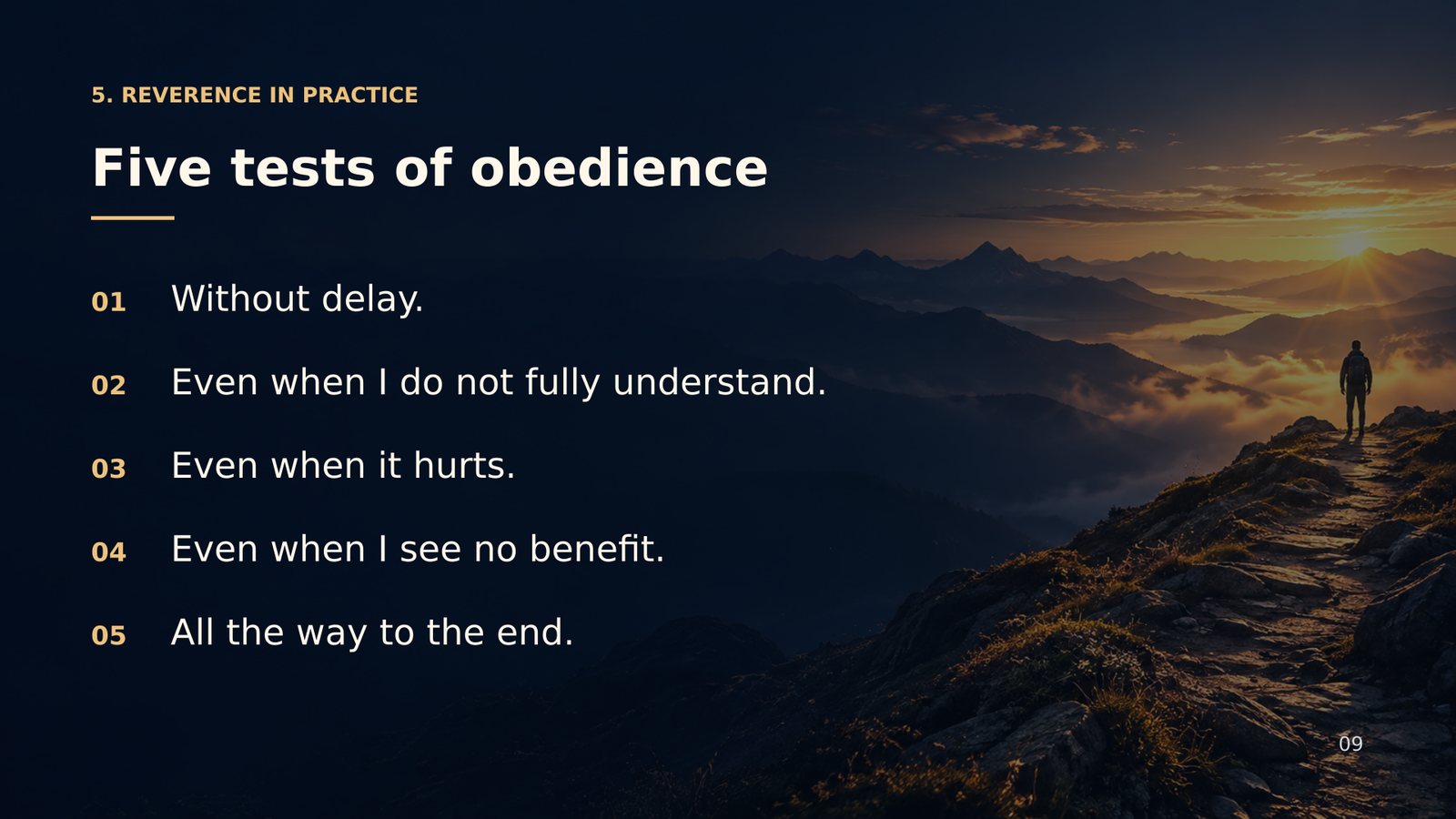
The fear of God is not only a feeling — it can be seen in life. Abraham heard from the angel: “Now I know that you fear God” (Gen 22:12). How could that be seen? By how he obeyed. We can point to five marks of such obedience:
| Test | Question | Biblical example |
|---|---|---|
| 1. Immediately | Am I putting off something God has already told me? | Abraham rose early in the morning (Gen 22:3); “I made haste, and did not delay” (Ps 119:60). |
| 2. When it makes no sense | Do I obey only what I understand? | Abraham — a three-day journey with no explanation; “Whatever He says to you, do it” (John 2:5). |
| 3. Even when it hurts | Do I obey even when it costs me? | Forgiving someone who has deeply wounded us (Col 3:13). |
| 4. When there is no visible benefit | Do I obey only when it pays off? | The three young men: “But if not… we do not serve your gods” (Dan 3:18). |
| 5. All the way to the end | Do I finish what God has assigned? | Saul did almost everything — and heard: “to obey is better than sacrifice” (1 Sam 15:22). |
The Fear of God Reaches Our Motives
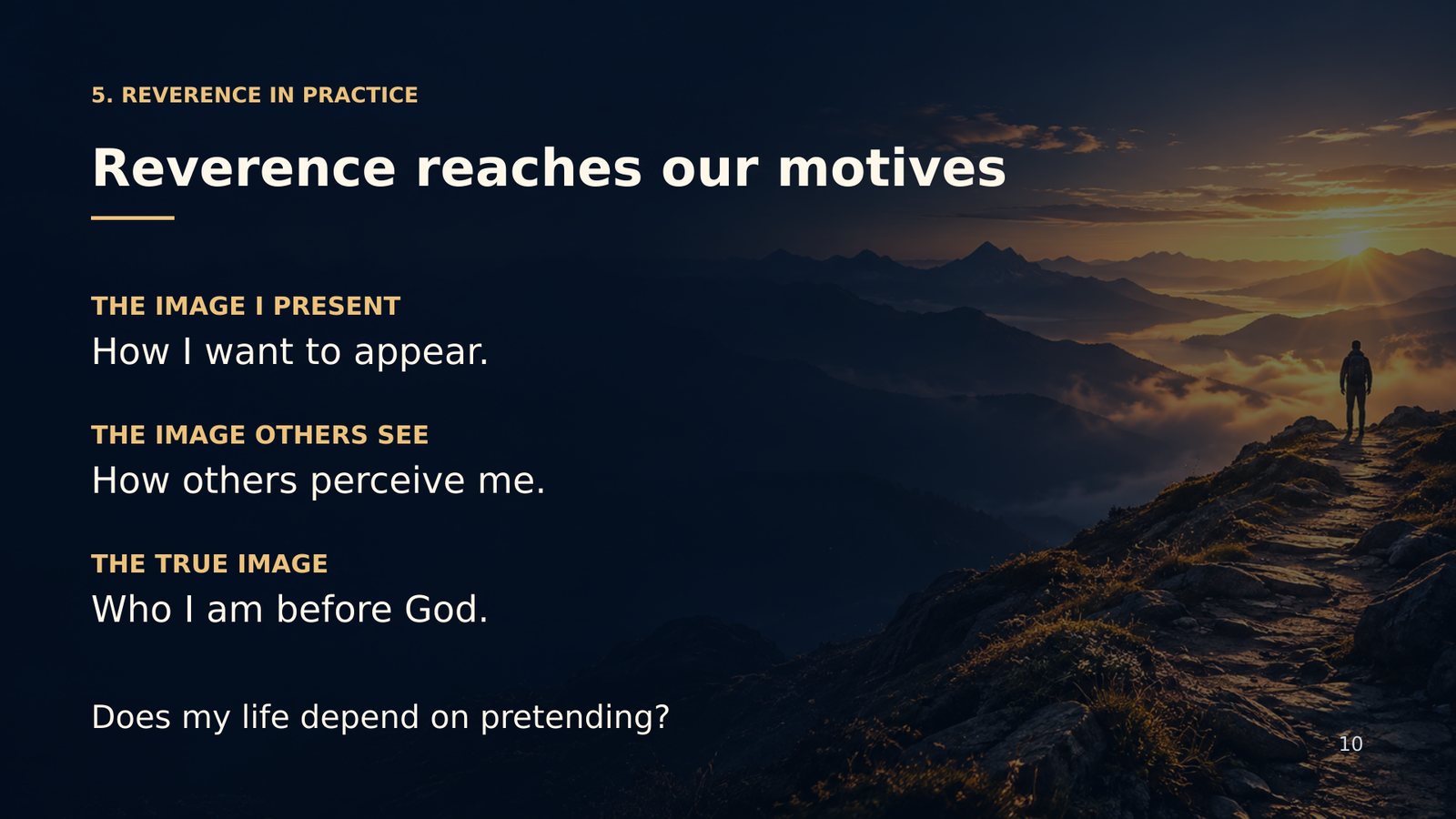
The fear of God reaches even deeper — to our motives. Ananias and Sapphira did nothing wrong by giving money. What was wrong was the pretending: they wanted to look like bigger givers than they were (Acts 5:1–11). So it is worth asking which image we show in our lives. There is the image I present — what I show to others. There is the image others see — what others think of me. And there is the true image — who I really am, and what God sees.
The fear of God keeps us in touch with the true image. A person who fears God does not need to perform.
Which of the five tests do I avoid the most, and why? Does the image I present differ from the true one?
6. A Living Temple
For you are the temple of the living God (…). Therefore, having these promises, beloved, let us cleanse ourselves from all filthiness of the flesh and spirit, perfecting holiness in the fear of God.
— 2 Corinthians 6:16 – 7:1
This passage ties together everything we have said: God dwells among His people, so we cleanse ourselves, and holiness matures “in the fear of God.” Before meeting God at Sinai, the people were to “wash their clothes” (Exod 19:10) — to leave behind the dirt of Egypt. We, too, are still learning to leave behind what belongs to the old life. So we care for our body, thoughts, and relationships as the place where God lives.
Not every sin is punished at once, but that does not mean nothing is happening. The absence of immediate judgment is God’s patience: “the goodness of God leads you to repentance” (Rom 2:4). Whoever turns patience into permission deceives himself (Eccl 8:11). In practice this means that when we come to God, it is worth coming ready to obey and without pretending.
What in my body, thoughts, and habits needs to change?
7. Holiness Leads to Friendship with God
The secret of the LORD is with those who fear Him, and He will show them His covenant.
— Psalm 25:14
You can know a lot about God and not know Him. I know a great deal about a president, but he does not know me, and I cannot talk to him as a friend. God invites us to something more than information.
Israel knew God’s acts, but Moses knew His ways (Ps 103:7) — some saw miracles; the other knew what God desires. Abraham and Moses are called friends of God (Isa 41:8; Exod 33:11). Before destroying Sodom, God says: “Shall I hide from Abraham what I am doing?” (Gen 18:17).
Jesus says the same to His disciples: “You are My friends IF you do whatever I command you” (John 15:14) — and adds that He no longer calls them servants, because He has made everything known to them (John 15:15). Moses, for his part, did not want the promised land without God’s presence: “If Your Presence does not go with us, do not bring us up from here” (Exod 33:15). It is worth asking: do I want the gifts, or the Giver?
Friendship with God is not a reward for perfection. Abraham and Moses were not without sin. This is a good answer to the question of whether the fear of God kills closeness: on the contrary, it creates it. Closeness without reverence becomes excessive familiarity, and reverence without closeness becomes mere religion.
What would change in my relationship with God if I sought Him more for His own sake than for His gifts?
8. Everyday Holiness
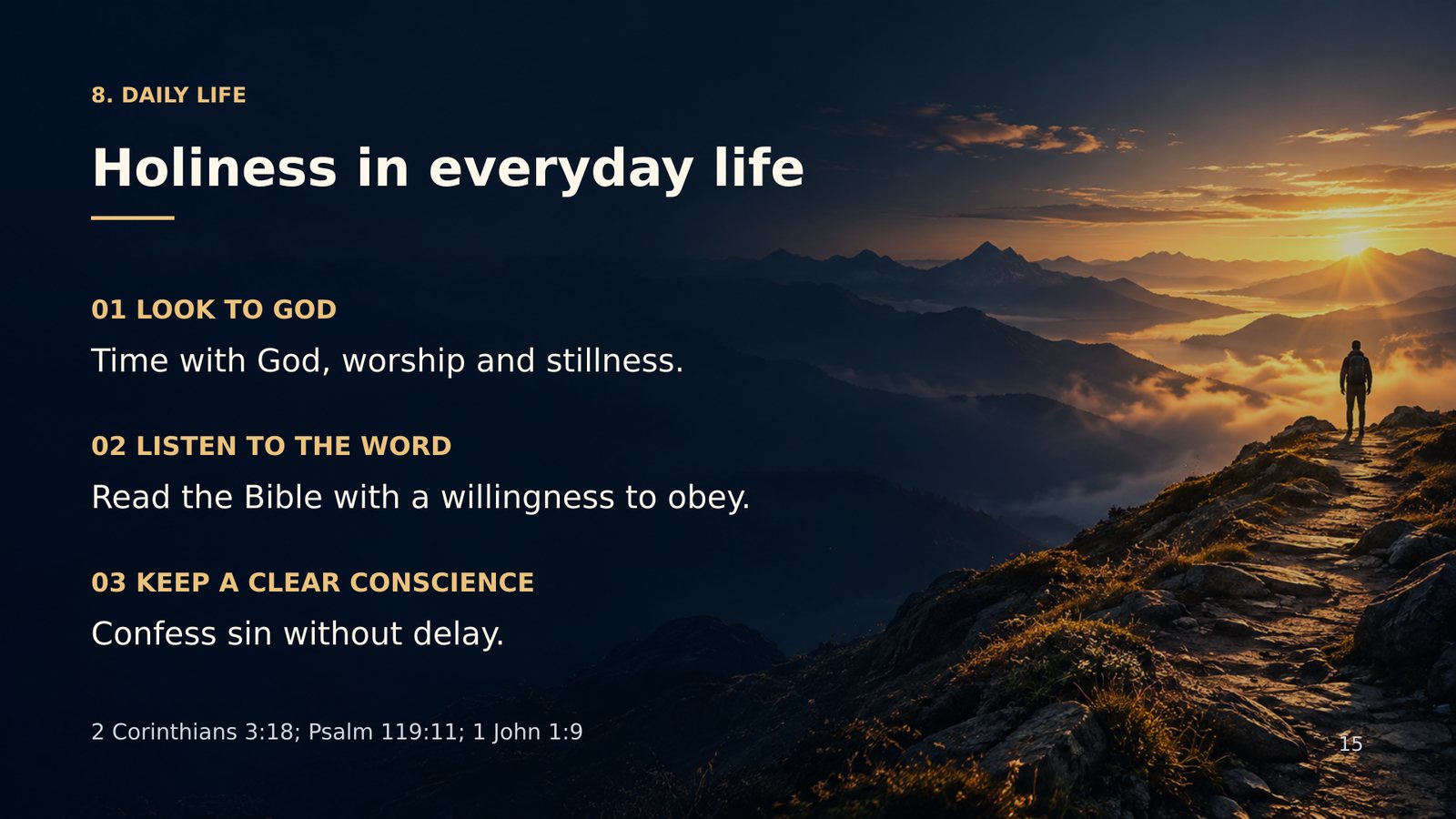
Holiness is not a one-time burst of effort, but a few simple habits of the heart, built by the power of the Spirit. Here are six of them.
Look to God. “But we all, with unveiled face, beholding as in a mirror the glory of the Lord, are being transformed into the same image” (2 Cor 3:18). Time with God, worship, and stillness change us more than the effort of fighting ourselves.
Tremble at the Word. “Who trembles at My word” (Isa 66:2). Read the Bible to listen, not only to know: “Your word I have hidden in my heart, that I might not sin against You” (Ps 119:11).
Clear your conscience at once. Do not put off confessing sin: “If we confess our sins, He is faithful and just to forgive us our sins and to cleanse us” (1 John 1:9). Ask the Spirit to search your heart (Ps 139:23–24).
Turn away from evil. “Do not be wise in your own eyes; fear the LORD and depart from evil” (Prov 3:7). Name what is your “tolerated” sin today, and cut off its access.
Do not delay obedience. Choose one thing you know God is speaking about, and do it this week.
Walk with community. “Exhort one another daily… lest any of you be hardened through the deceitfulness of sin” (Heb 3:13). People who speak the truth in love protect holiness.
This Does Not Happen in Your Own Strength
The New Covenant is a promise, not only a demand. God says: “I will put My fear in their hearts so that they will not depart from Me” (Jer 32:40) and “I will put My Spirit within you and cause you to walk in My statutes” (Ezek 36:27). So we pray: “Lord, give me the fear of You.”
What God Gives to Those Who Fear Him
God gives them wisdom and knowledge (“The fear of the LORD is the beginning of wisdom,” Prov 9:10), direction in life (“Who is the man that fears the LORD? Him shall He teach in the way He chooses,” Ps 25:12), a Father’s mercy (“As a father pities his children, so the LORD pities those who fear Him,” Ps 103:13), and protection and refuge (“In the fear of the LORD there is strong confidence, and His children will have a place of refuge,” Prov 14:26).
He also gives freedom from the fear of people: “The fear of man brings a snare” (Prov 29:25), and “The LORD of hosts, Him you shall hallow; let Him be your fear” (Isa 8:13). The fear of God swallows lesser fears.
Conclusion: The Fear of God and Holiness in a Few Sentences
Solomon, who had everything, finally concluded that the heart of life fits into one sentence:
Let us hear the conclusion of the whole matter: Fear God and keep His commandments, for this is man’s all.
— Ecclesiastes 12:13
Let us sum it up. God is holy — start by looking at Him, and reflect Him in your life. You are already sanctified in Christ, so pursue holiness. The fear of God is reverence, respect, and drawing near to God, not terror of Him; together with grace it keeps us on the narrow road, between legalism and lawlessness. It shows in obedience — immediately, despite lack of sense, pain, and profit, all the way to the end — and in pure motives. You are a temple in which God dwells, so take care of that place. And holiness is not the price of friendship with God, but the path to it. Every day: look, listen, cleanse yourself, turn away from evil, and walk in community.
What one step of obedience will you take this week?
Questions for Personal Reflection and Home Groups
- What in my picture of God is closer to a “buddy” than to a Father who is holy?
- Am I pursuing holiness out of a feeling that I must earn it, or out of gratitude?
- Can I be with God and hide nothing? What am I hiding?
- Which ditch do I usually fall into: legalism or lawlessness? What helps me get back on the road?
- Which of the five tests of obedience (immediately, without sense, with pain, without benefit, to the end) is hardest for me?
- Does the image I present differ from the true one? Whom can I tell the truth?
- What “tolerated” sin should I call by its name today?
- Do I seek God’s gifts more, or God Himself?
- What one step of obedience will I take this week?
Closing Prayer
Father, You are holy and You are good. Thank You that in Jesus I am sanctified and accepted. Forgive me when I treated Your word lightly or hid from You. Give me the fear of You — not terror, but reverence and a desire never to live far from You. Teach me to hate evil and to love people. Show me one concrete step of obedience and give me strength to take it right away. Amen.
Materials Used in This Teaching
- John Bevere — “The Awe of God” (sermon transcript, SermonIndex.net)
- John Bevere — “The Awe of God” (summary and reflection questions, Bookey)
- John Bevere — “The Fear of the Lord” (Charisma House)
Bible quotations follow standard English translations; those marked as paraphrase convey the sense of the text. This teaching was prepared in our own words, and ideas drawn from the materials (the two ditches, five tests, three images) are indicated in the text.