


Everyone has priorities — even if they have never named them. The question is whether the priorities in the life of a believer were set by God, or by habits, fears, and the pressure of the surrounding world. Colossians 3:1–4:1 shows an order of growth: from a relationship with Christ, through personal transformation and community, to marriage, children, and work. “But seek first the kingdom of God and His righteousness, and all these things shall be added to you” – Matthew 6:33.
Watch on YouTube
Listen to the Podcast
The Main Idea of This Teaching
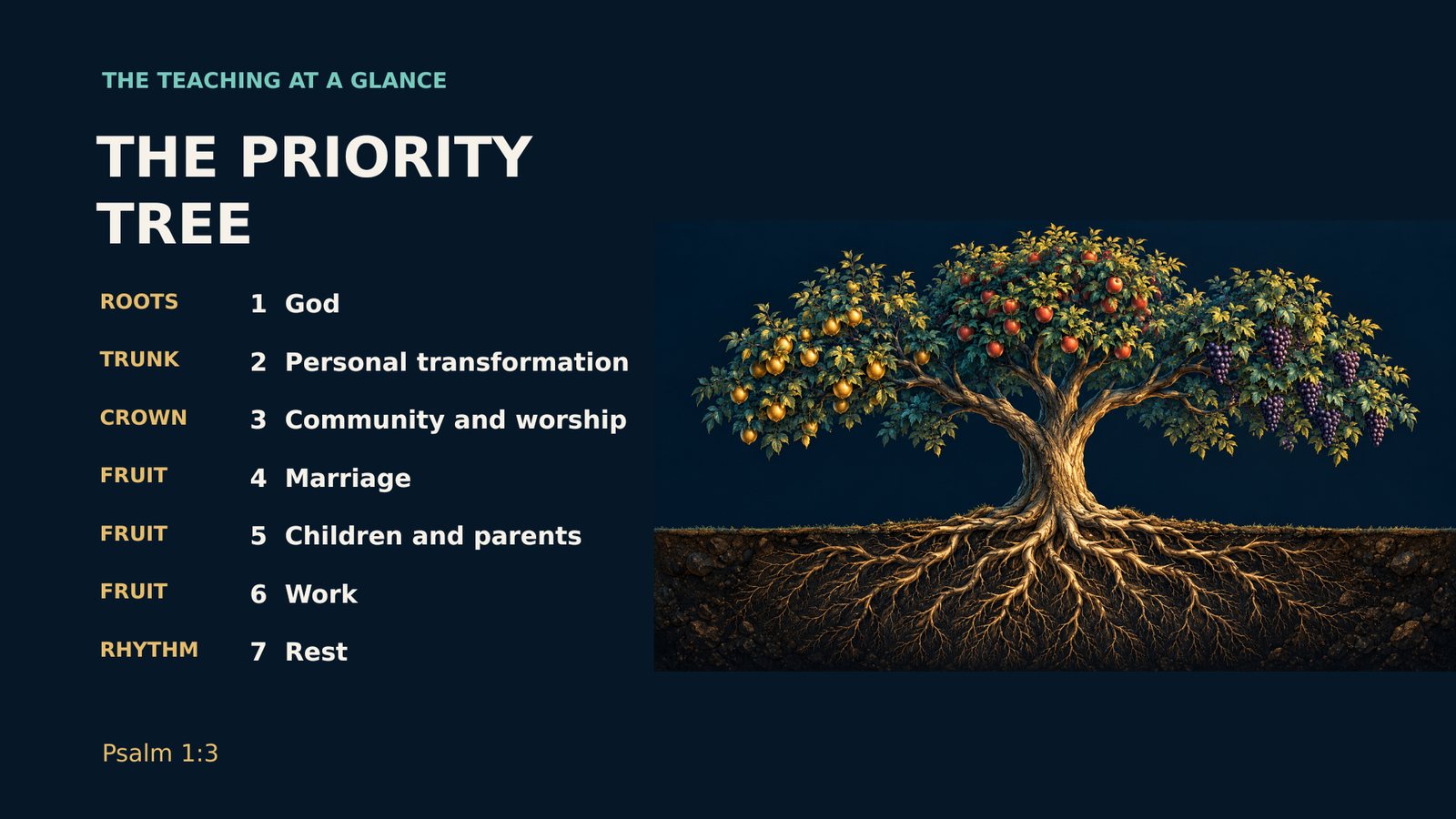
The order of priorities is not a rigid ladder of values but an order of growth — like the tree in Psalm 1:3. The roots are God: the source we cannot see, yet without which nothing else grows. The trunk is personal transformation. The crown is community and worship — the place where transformation takes shape among people. From the crown come the fruits that others can see: marriage, children, and work. Rest is the seasons, without which no tree bears fruit forever. When fruit tries to exist without roots, it begins to wither.
He shall be like a tree planted by the rivers of water, that brings forth its fruit in its season, whose leaf also shall not wither.
— Psalm 1:3
Introduction
Each of us has 24 hours a day and a similar amount of energy to spend.
- The question is NOT: “do we have priorities?” — because we always have them, even unconsciously.
- The question is: are they priorities set by God? Or ones that set themselves through our habits, fears, the pressure of our surroundings, pleasure, or comfort?
The same principle applies to:
- an adult with a family and a job,
- a teenager with school and a phone in hand.
Only the names change; the mechanism stays identical. In this teaching we focus mainly on adults — on married couples with children.
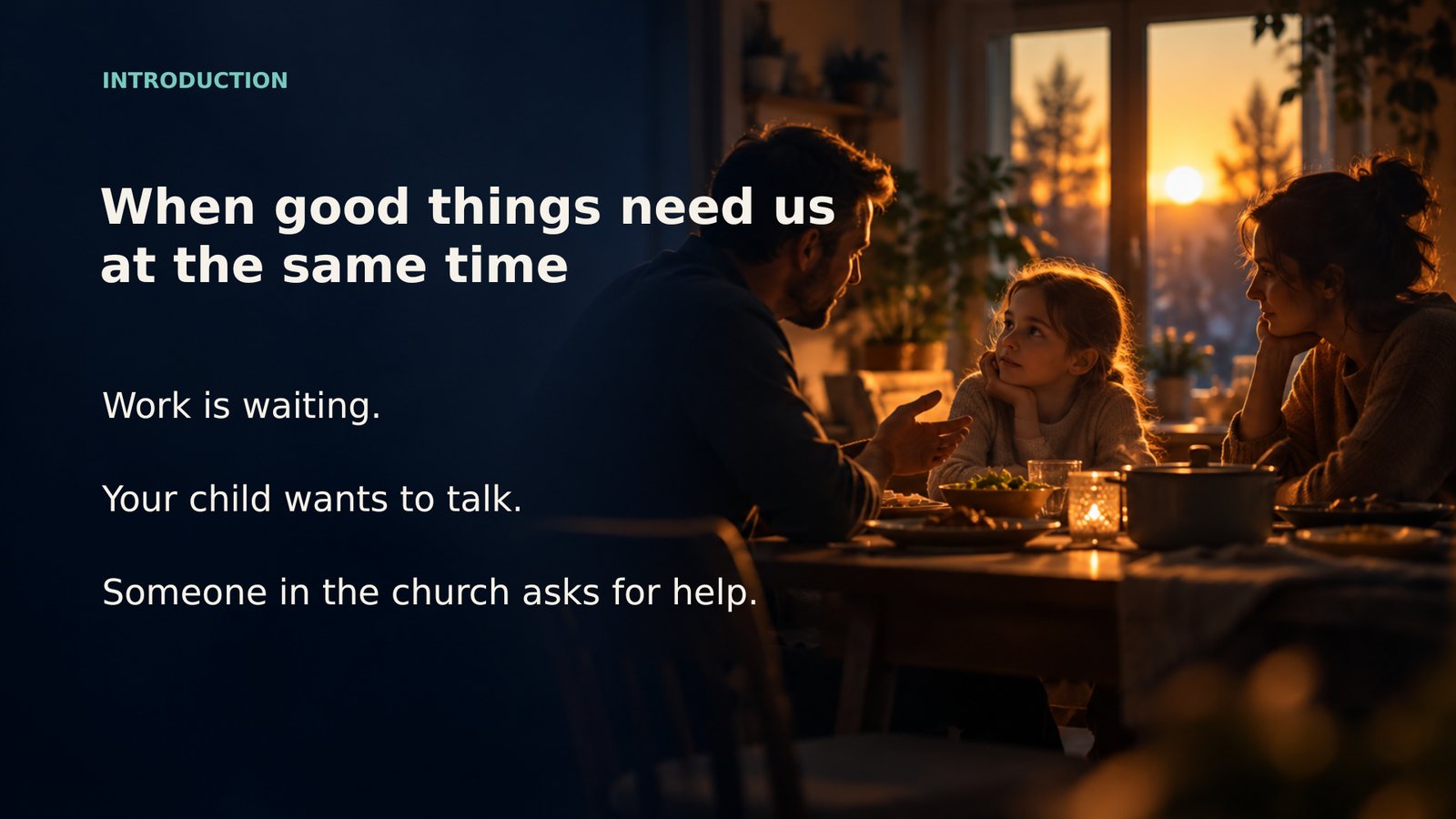
Everything in our lives can be good and important. Work is waiting. A child wants to talk. Someone asks for help in the community.
- The question is NOT: “What is important?” Because “GOOD” can be the enemy of the BEST!
- The question is: “What will I do when important things collide at the same time?”
That is when it shows how well our lives are put in order.
But seek first the kingdom of God and His righteousness, and all these things shall be added to you.
— Matthew 6:33
In the previous teaching, “Sanctified Once for All — Transformed Every Day”, we talked about who we are because of Jesus. Today we ask how this new life becomes visible in practice — on Monday morning.
Biblical Foundation
In the New Testament we find two passages that speak about the same order of priorities:
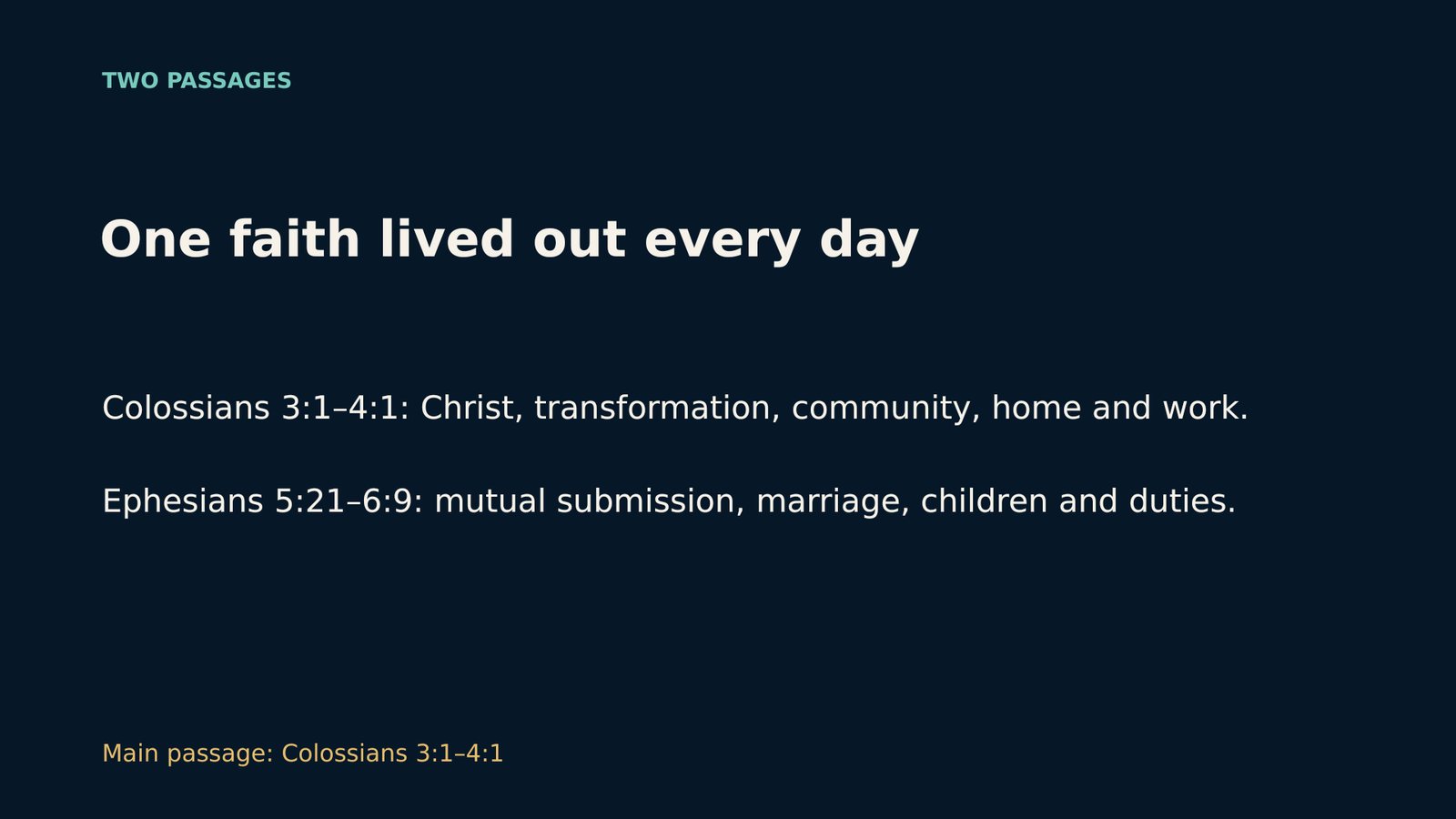
Colossians 3:1 – 4:1
The passage moves in turn through: focus on Christ (3:1–4) → personal transformation (3:5–11) → community and worship (3:12–17) → marriage (3:18–19) → children and parents (3:20–21) → work (3:22–4:1).
Ephesians 5:21 – 6:9
A parallel passage: marriage — where Paul directly connects it with the relationship between Christ and the Church (5:22–33) → children and parents (6:1–4) → work (6:5–9).
Passage to Read Aloud: Colossians 3:1 – 4:1
Note: the text below is a free paraphrase meant to help understanding, not a translation. For careful study, also read the passage in your own Bible translation.
3:1–4 — 1. GOD: Christ is your life
1–2 Since God has given you a share in the new life of Christ, do not live as if your world ended with what you can see and gain here. Set your heart on Christ, who is with God, at His right hand. Learn to look at your life from His perspective.
3–4 Your old life has died. Your real life is now hidden and secure with Christ in God. Today not everyone can see what God has begun in you. But when Christ, who is your life, appears in full, then you too will appear with Him in glory.
3:5–11 — 2. MY SPIRITUAL GROWTH, personal transformation: Do not go back to your old life
5–7 So leave no room in yourselves for what belongs to the old life: sexual immorality, impurity, passions that take control of you, evil desires, and greed. Greed is especially dangerous, because what a person longs to possess can take God’s place in the heart. Such a life meets God’s opposition. You once walked that road yourselves — but that was then.
8–9 Now put away also outbursts of anger, malice, insulting others, and words you ought to be ashamed of. Stop lying to one another. You have already left behind the old self and its way of life.
10–11 God has clothed you in a new life and keeps renewing you, so that you know Him better and better and more and more clearly resemble your Creator. In this life the old labels do not decide who matters: Greek or Jew, circumcised or uncircumcised, someone regarded as a foreigner or a barbarian, Scythian, slave or free. Now what matters most is Christ. He is everything, and He is present among His people.
3:12–17 — 3. COMMUNITY AND WORSHIP: How to treat people when you belong to Christ
12 You are people chosen by God, who belong to Him and are loved by Him. So let others experience from you compassion, kindness, humility, gentleness, and patience.
13–14 Do not write one another off because of every weakness. If someone has a legitimate complaint against another, learn to forgive — as the Lord forgave you. And over all of this let there be love. Without it even good qualities remain separate; it is love that binds them into one whole.
15 When tension arises in your hearts and relationships, let the peace of Christ guide your decisions. You were, after all, called to be one body. And cultivate gratitude.
16 Give the word of Christ a permanent place among you. Let it shape you as you teach and admonish one another with wisdom. Sing psalms, hymns, and spiritual songs to God (WORSHIP) — from hearts full of gratitude.
17 And when the gathering ends and you return to ordinary matters, remember: every word and every deed also belongs to your life with Jesus. Do everything in His name, giving thanks to God the Father through Him.
3:18–19 — 4. MARRIAGE
18 Wives, in your relationship with your husbands take an attitude of submission that fits life with the Lord.
19 Husbands, love your wives. Do not let closeness turn into harshness, bitterness, and unkind treatment.
3:20–21 — 5. CHILDREN AND PARENTS
20 Children, listen to your parents. This attitude pleases the Lord.
21 Fathers, do not provoke and overwhelm your children, so that they lose courage and grow dim inside.
3:22–4:1 — 6. WORK: Honesty and justice at work
22 You who are slaves, carry out your duties toward your earthly masters honestly. Not only when someone is watching and you can make a good impression. Be sincere in what you do, remembering that you live before the Lord.
23–24 Whatever your task is, put your heart into it. Do not work as if only human opinion ultimately counted. Remember the Lord: from Him you will receive an inheritance. It is Christ the Lord whom you are truly serving.
25 And if someone does wrong, he will bear responsibility for it. God does not turn a blind eye to injustice because of someone’s position.
4:1 And you who are masters (employers), provide your slaves with just and fair treatment. Do not forget for a moment that you also have a Master over you — in heaven.
Ephesians 5:21 – 6:9 — to Read and Compare
Earlier Paul speaks about a life filled with the Spirit, worship, and gratitude (Eph 5:18–20). Now he shows what this life looks like in relationships. This is homework: read this passage and compare it with Colossians 3.
5:21 — The thought Paul begins with
21 For Christ’s sake, do not always put yourselves above others. Submit to one another, remembering whom you serve together.
5:22–33 — Marriage
22–24 Wives, take an attitude of submission toward your husbands, as toward the Lord. Paul calls the husband the head of the wife and compares this relationship to Christ, who is the Head of the Church — His body, which He saves. As the Church acknowledges Christ, so wives are to relate to their husbands throughout their shared life.
25 Husbands, hear what is entrusted to you: love your wives as Christ loved the Church. He held nothing back for Himself. He gave His own life for her.
26–27 Christ did this to cleanse and sanctify the Church by the washing with water connected with the word. He wants to present her to Himself full of glory — without stain or blemish.
28–30 This is exactly how husbands should love their wives: as their own bodies. Whoever loves his wife is not caring for a stranger. He is caring for the person with whom he has become one. After all, a person feeds and cherishes his own body. So Christ cares for the Church, and we belong to His body.
31–32 That is why Scripture says that a man leaves his father and mother and is joined to his wife, and the two become one flesh. This is a profound mystery. Paul also sees in it a picture of the bond between Christ and the Church.
33 So let every husband love his wife as himself, and let the wife show respect to her husband.
6:1–4 — Children and parents
1–3 Children, listen to your parents as people who belong to the Lord. This is right. God said, “Honor your father and mother.” He attached to this commandment a promise: that it will go well with you and you will live long on the earth.
4 And you, fathers, remember that raising children is more than giving orders. Do not treat your children in a way that makes anger keep growing in them. Help them mature by teaching them, setting boundaries, and pointing them to the way of the Lord.
6:5–9 — Slaves and masters
5–6 You who are slaves, carry out your duties toward your earthly masters sincerely and with proper seriousness, remembering Christ. Do not work diligently only when someone is watching. As people who belong to Christ, do from the heart what is God’s will.
7–8 Serve with goodwill. Remember that the Lord sees the good you do, even when people do not notice it. He will repay it to each one — slave and free person alike.
9 And you, masters, treat them with the same honesty. Stop using threats. Both you and they have one Master in heaven. He does not regard a person as worth more merely because he holds power over someone.
The Story of Jethro and Moses
Then Jethro, Moses’ father-in-law, took Zipporah, Moses’ wife, after he had sent her back… and came with his sons and his wife to Moses in the wilderness, where he was encamped at the mountain of God.
— Exodus 18:2–5
Involvement in “serving” God:
- can sometimes push family, marriage, children, and loved ones into the background,
- even a man leading an entire nation (Moses) could lose his priorities,
- his FATHER-IN-LAW had to correct him.
But if anyone does not provide for his own, and especially for those of his household, he has denied the faith and is worse than an unbeliever.
— 1 Timothy 5:8
Seven Priorities in God’s Order
The order is not a rigid ladder of values but an order of growth:
- when we are connected to God in a personal relationship (1) and
- let Him transform us (2), and in the process
- learn from other believers in community and in a true spiritual family (3) —
- then, and only then, can we be a real example in our marriage (4),
- for our children (5),
- at work (6), and in the world around us.
- Then we can rest (7).
1. God — Christ Is My Life

Everything begins here, because everything else grows out of this. It is not about taking part in religious events but about a personal, living relationship with God and putting Him first in every situation — not only on Sunday morning.
You shall love the LORD your God with all your heart, with all your soul, and with all your mind. This is the first and great commandment.
— Matthew 22:37–40
“Christ, who is our life” (Col 3:4) — not an addition to life, but its very source.
2. My Spiritual Growth — Personal Transformation

A relationship with God that changes nothing in us is incomplete. Right after speaking of Christ as our life, Paul turns to practical matters: putting off the old way of life and putting on the new. This is not a one-time act — it is a process that continues every day.
You have put off the old man with his deeds, and have put on the new man who is renewed in knowledge according to the image of Him who created him.
— Colossians 3:9–10
Am I actually letting Him change my habits, reactions, and character, before I even enter into a relationship with another person?
3. Community and Worship — Where We Learn to Love People
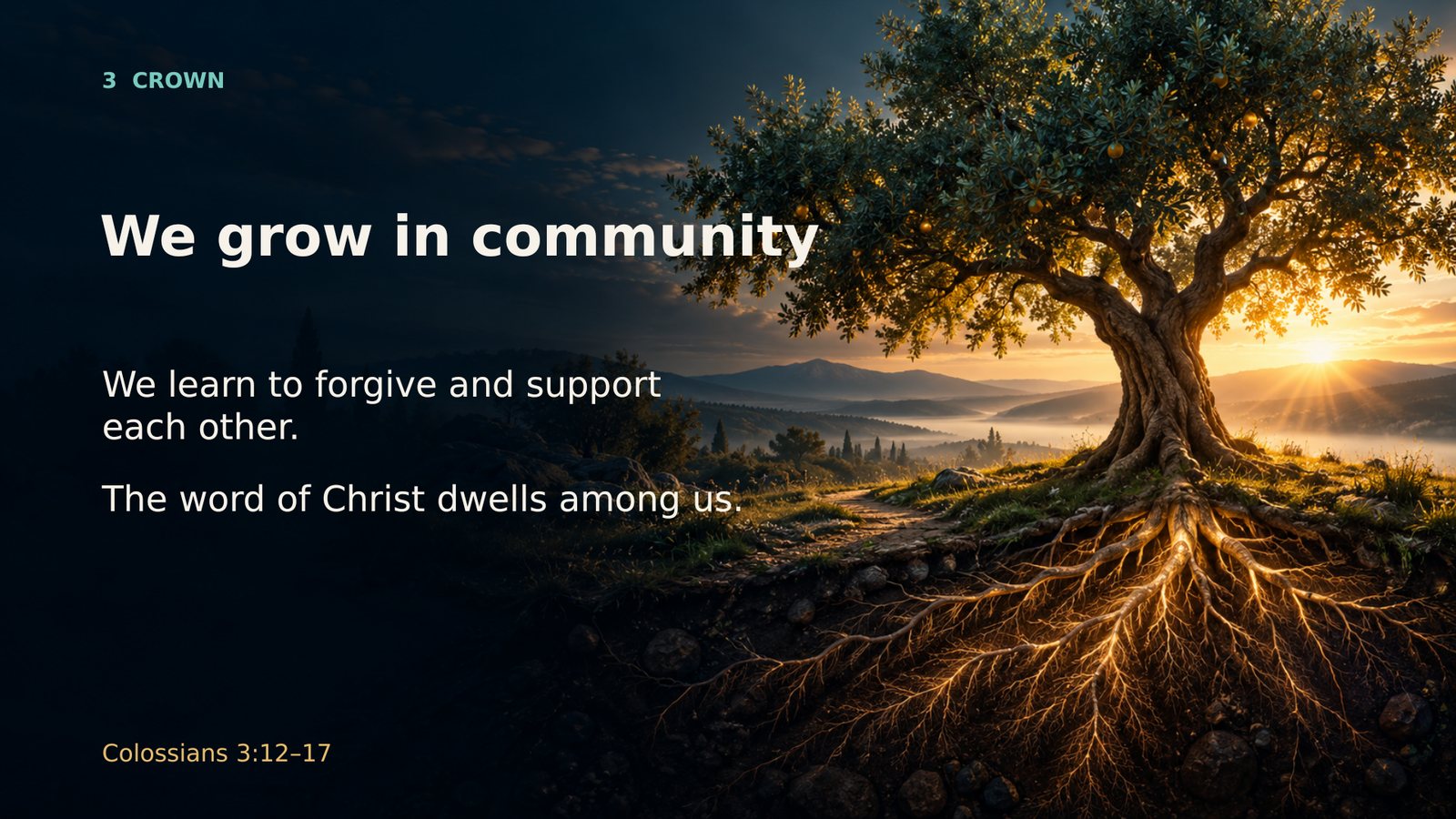
Before we carry our transformation into our home and workplace, we learn to practice it among other believers: how to bear with one another, forgive, show compassion, and be grateful.
Therefore, as the elect of God, holy and beloved, put on tender mercies, kindness, humility, meekness, longsuffering; bearing with one another, and forgiving one another.
— Colossians 3:12–13
…not forsaking the assembling of ourselves together… but exhorting one another.
— Hebrews 10:25
Jesus explicitly criticized using religious obligations as an excuse to avoid caring for those closest to us:
But you say, “If a man says to his father or mother, Whatever profit you might have received from me is Corban”… then you no longer let him do anything for his father or mother, making the word of God of no effect through your tradition.
— Mark 7:11–13
The biblical timeline of the temple — because it explains what “the church” really is:
- Moses’ Tabernacle — a portable tent in the wilderness; God dwells among a wandering people (Exod 25:8; 35–40).
- Solomon’s Temple — the first permanent building in Jerusalem, around 960 BC (1 Kings 6–8), destroyed in 586 BC.
- Zerubbabel’s Temple (the Second Temple) — rebuilt after the exile (Ezra 6:15), later expanded by Herod; it stood in Jesus’ day and was destroyed in AD 70.
- Jesus as the temple — “He was speaking of the temple of His body” (John 2:19–21).
- Our body as a temple — “your body is the temple of the Holy Spirit who is in you” (1 Cor 6:19–20; 1 Cor 3:16).
- The Church (the community) as a temple together — “the whole building, being fitted together, grows into a holy temple in the Lord” (Eph 2:21); “you also, as living stones, are being built up a spiritual house” (1 Pet 2:5).
- The New Jerusalem — the end of the need for a temple: “But I saw no temple in it, for the Lord God Almighty and the Lamb are its temple” (Rev 21:22).
Three physical buildings, then a clear turn: Jesus → me → all of us together → the end of the need for a building, because God dwells directly among His people. So when we gather as a church, we do not go “to the temple” — the temple meets the temple.
4. Marriage

Only now — after we have taken root in God, let Him change us, and learned to love people in community — are we truly ready to bring the same attitude into the closest relationship we have: marriage. We will not be an example anywhere if our home does not function properly.
Wives, submit to your own husbands, as to the Lord… Husbands, love your wives, just as Christ also loved the church… “For this reason a man shall leave his father and mother and be joined to his wife, and the two shall become one flesh.”
— Ephesians 5:22–33
For if a man does not know how to rule his own house, how will he take care of the church of God?
— 1 Timothy 3:5
The passage about a wife’s submission is not permission to control another person or to cause harm. It must never be used to justify abuse. If someone at home is suffering harm, they need protection and help — not a sermon telling them to endure!
For people who are not married, this point does not mean their lives are worth less, or that “family” looks the same for everyone. In 1 Corinthians 7:32–35 Paul shows that one’s state in life changes the shape of daily obligations — the shared calling to love remains, but not everyone has an identical weekly schedule.
5. Children and Parents

The same fruit of transformation and community is visible in our relationship with our children — a daily one that requires patience and consistency, not just good intentions.
Children, obey your parents in all things, for this is well pleasing to the Lord. Fathers, do not provoke your children, lest they become discouraged.
— Colossians 3:20–21
If someone says, “I love God,” and hates his brother, he is a liar.
— 1 John 4:20
6. Work — Honesty and Justice
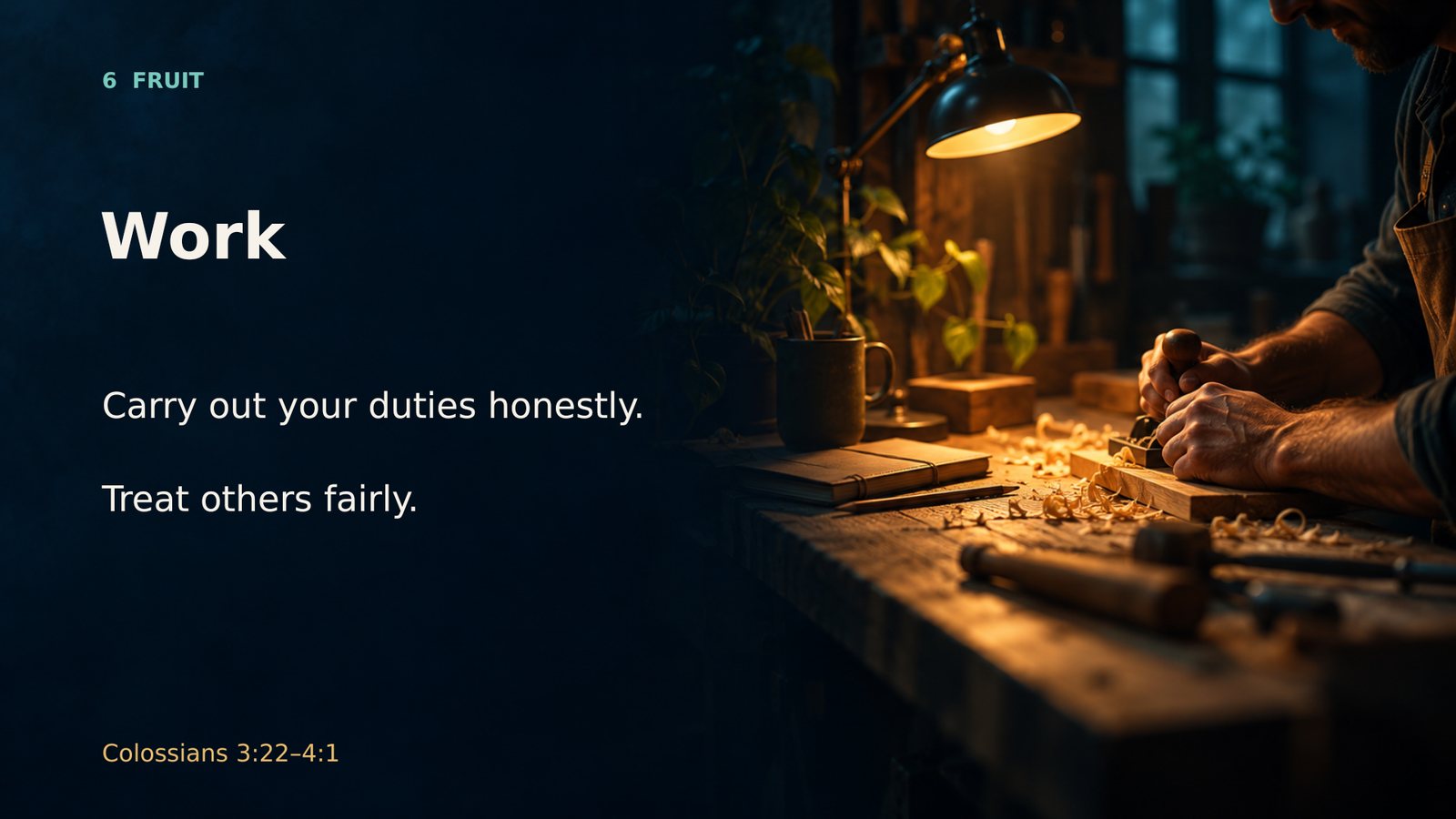
Work is not a result of sin — Adam worked in Eden before the fall. It is God’s gift, and the place where the fruit of our transformation and community becomes visible to people who do not necessarily come to church with us: in honesty, diligence, and fair treatment of others.
And whatever you do, do it heartily, as to the Lord and not to men… But he who does wrong will be repaid for what he has done, and there is no partiality.
— Colossians 3:23–25
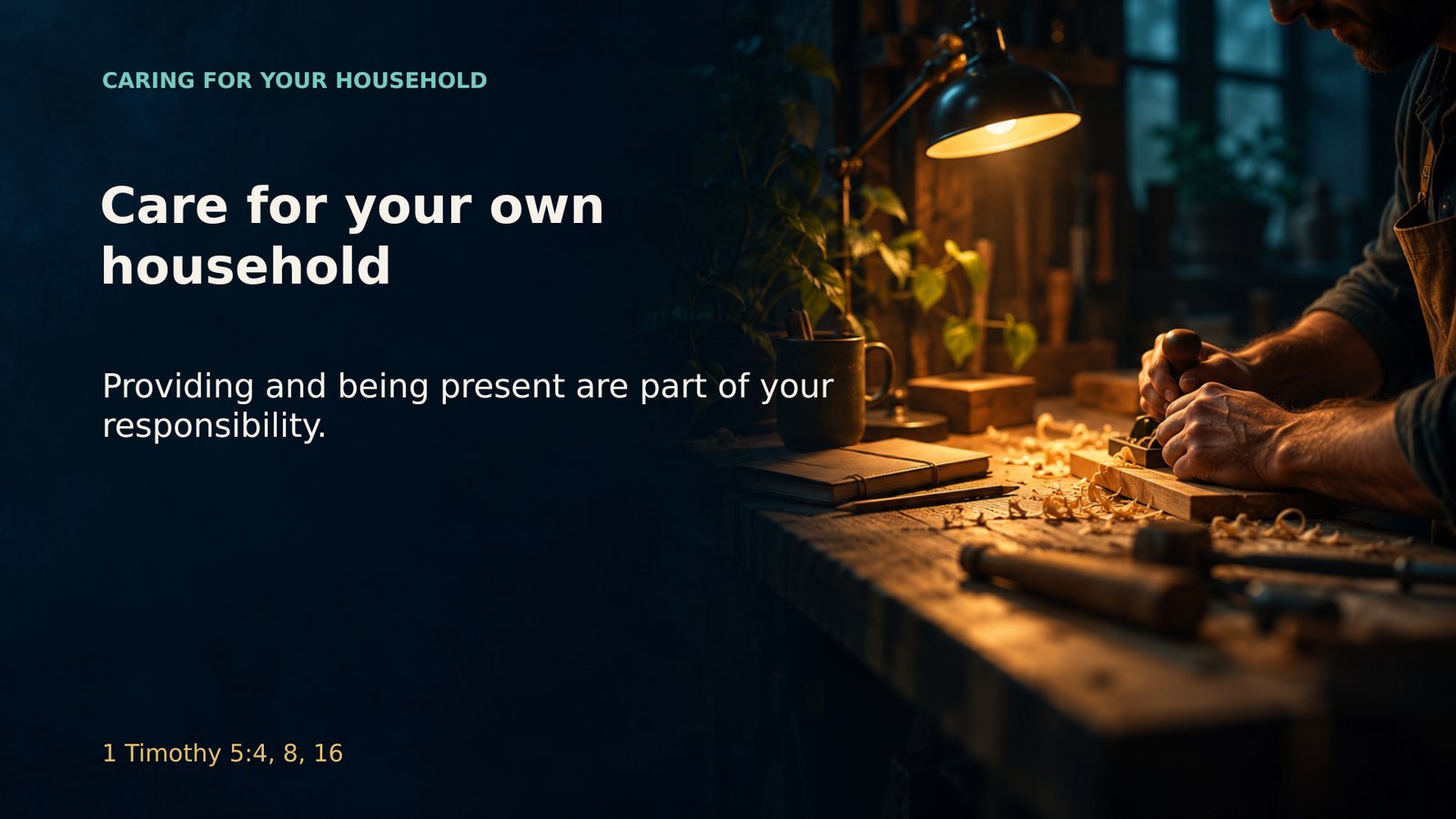
It is also the place where we provide for our family — and the Bible treats neglecting this exceptionally seriously:
But if anyone does not provide for his own, and especially for those of his household, he has denied the faith and is worse than an unbeliever.
— 1 Timothy 5:8 (cf. vv. 4, 16)
This is one of the sharpest statements in the entire New Testament. Work is not more important than God, transformation, or community — but neglecting the family in the name of “providing for it financially” is a false solution: in the end it takes away from the family exactly what it was meant to serve.
7. Rest
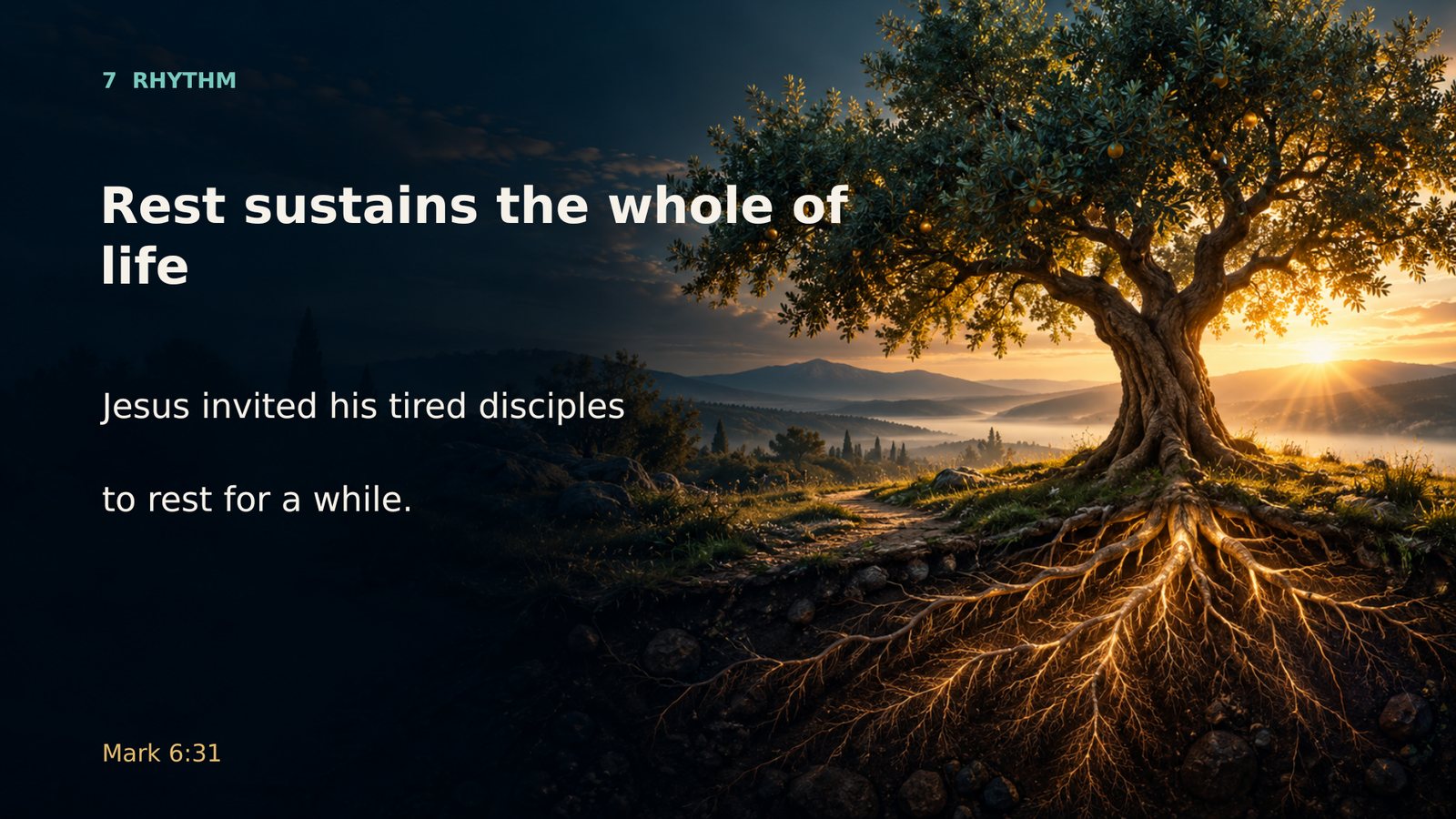
God wrote rest into His commandments as a command, not a suggestion. Even Jesus, in the middle of intense ministry, told His disciples to stop. It is a rhythm without which even the best-ordered life — rooted in God, being transformed, surrounded by community, and bearing fruit at home and work — sooner or later withers.
Come aside by yourselves to a deserted place and rest a while.
— Mark 6:31
What Happens When We Swap the Order?
Let us see what happens when the root (God), the trunk (transformation), and the crown (community) lose their place to the fruit (marriage, children, work) — or when fruit tries to exist without roots. Below are some pictures from research and from the Bible.
A. Community and Ministry Before Family
The swap looks like spirituality, yet it can be an escape from responsibility disguised as sacrifice.
- 80% of pastors admit that their ministry has negatively affected their family — 33% call it outright a “threat.”
- 91% have experienced burnout in ministry, and 40% are at high risk of burnout.
- 26% have had serious marital problems during ministry, and 10% have divorced.
- 80% of the adult children of pastors have sought professional help for depression.
Many of them leave the faith, feeling that they “lost their parents to the church.”
Sources: Pastoral Care Inc. (pastoralcareinc.com/statistics), Soul Shepherding (soulshepherding.org/pastors-under-stress), Barna Group (barna.com/research/healthy-pastors-relationships).
Ministry vs. Wife — the Story of Yonggi Cho
The story of David Yonggi Cho (1936–2021), founder of the Yoido Full Gospel Church in Seoul — for years the largest congregation in the world — shows how this looks in practice. He himself told how wrong priorities nearly brought his family to ruin, despite enormous spiritual success.

Right after the wedding, Cho began leaving almost at once for evangelistic campaigns: on Sunday he preached in his church, on Monday he set off, and he came home only for weekends — bringing his laundry for his wife to do. This went on for six months, while he was consumed by the ambition to become an evangelist. At first his wife ran to the door to greet him and cooked good meals. But as month after month nothing changed, she sank into depression: she stopped greeting him, often cried, and even the meals got worse. She was shy and never told him what was wrong.
Finally his mother-in-law came to him: “You will lose her if you keep treating her this way.” Cho was shocked — he had given his wife an apartment, food, and clothes. What more could he do?
Son, you do not understand. You have brought nothing into your home. You brought a person into your home. And a person cannot live on rice, clothes, and money alone. She needs love, appreciation, and fellowship.
— Yonggi Cho’s mother-in-law
Cho’s first reaction was defensive: “This is from the devil! I am working for the Lord. Why should she demand so much affection and care from me?” But as his wife kept fading, he went to pray and told God plainly that if he had to choose between ministry and his wife, he would choose ministry. Then — as he tells it — he heard in his heart: “You are badly mistaken in your priorities. Until now you have put God first, the church second, yourself third, and your wife last.” The order he was given was: God, then himself (because he must live a holy life to carry out the ministry), his wife, his children, and the church last.
You can build a huge church, but if your home is destroyed, you will lose your ministry. Having fellowship with your wife is more important than building a church, because the whole church depends on your home life. […] If your children rebel and get into trouble, like the prodigal son, who will listen to you?
— David Yonggi Cho
Cho put it very strongly, placing the church dead last. In our order, community is the place where we learn to love people before we bring that love home (3) — but the conclusion is the same: ministry that wrecks your own home stops being good ministry. Notice also why Cho puts himself second: not out of selfishness, but because without personal transformation and a holy life (2) there is nothing to give to the family.
Story based on David Yonggi Cho’s own account; translation abridged and edited.
B. Work Before God and Family
- Divorce among workaholics is 40% more frequent than in the rest of the population (Dr. Bryan Robinson, UNC Charlotte).
- Spouses of workaholics experience marital estrangement and expectations of about 9.5 more hours of work per week.
- Children of workaholics show more anxiety, depression, and feelings of loneliness (2024 study).
Sources: Robinson, Workaholism and Family Functioning (Springer); Manhood Journey, “3 Ways Being a Workaholic Impacts Your Family.”
C. Family and Children as an Idol, Before God
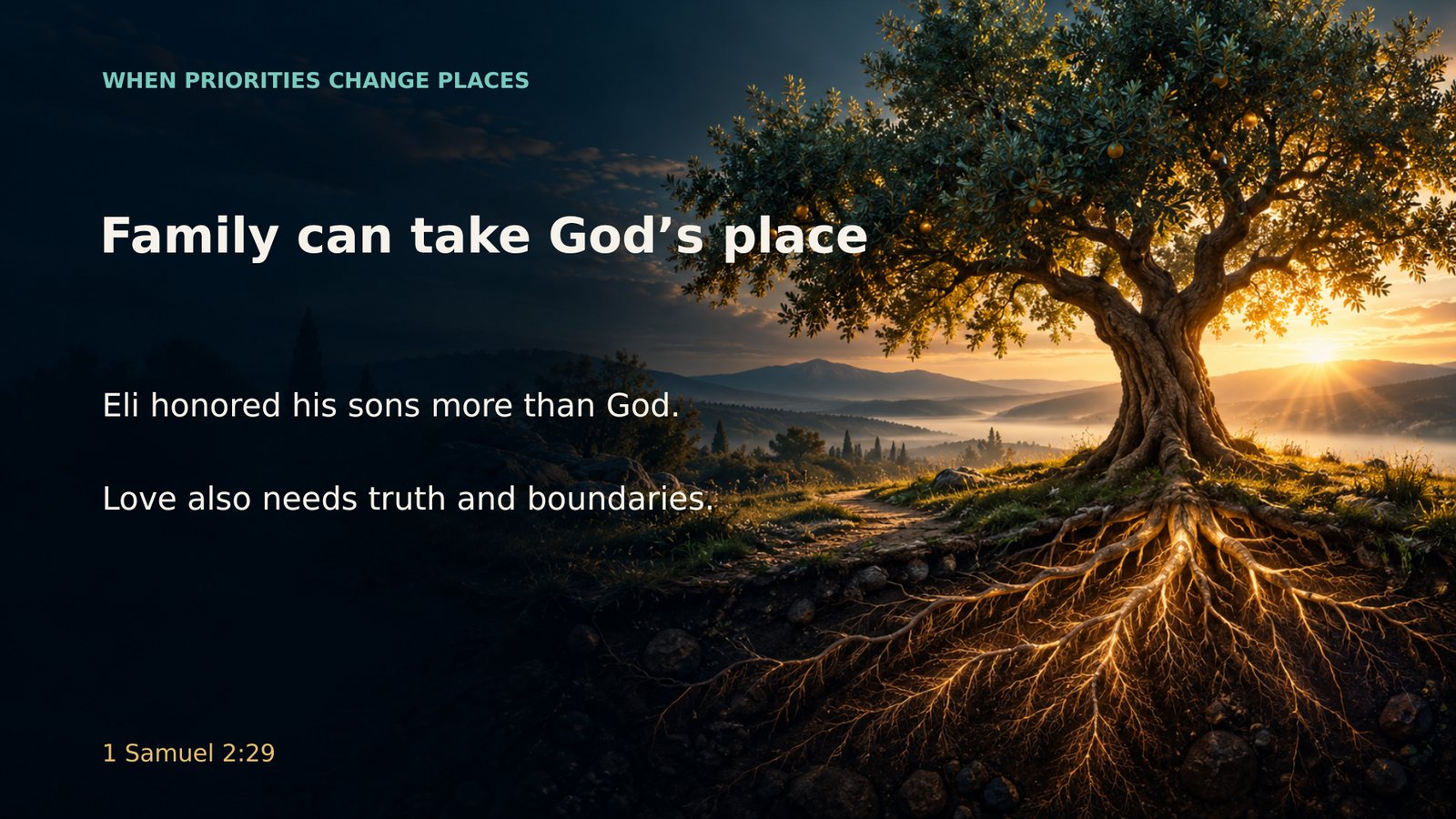
The Bible also warns against the opposite extreme. The priest Eli honored his sons more than God — he did not rebuke their sin, because “peace and quiet” at home mattered more to him than God’s justice. He lost both his sons and the priesthood.
…and honor your sons more than Me…
— 1 Samuel 2:29 (paraphrase)
D. God Left Out Entirely
- Among adults raised in families where faith was “very important,” 55% themselves profess faith as adults (Pew Research).
- In two-parent families, 55% of children regularly attended worship services, compared with 36% in single-parent families.
Source: Pew Research Center, “How are US parents raising their children, religiously?” (2025).
E. The Polish Picture: How Much Time Is Really Left for the Rest?
The Statistics Poland (GUS) study “Daily Time Budget of the Population in 2023” shows the average structure of the day for Poles aged 15 and over:
- housework and care: 15.0% of the day,
- paid work: 12.8% of the day,
- use of mass media (media, internet, TV): 10.1% of the day,
- social life and entertainment: 4.4% of the day,
- volunteering, helping others, and religious practices combined: 0.6% of the day.
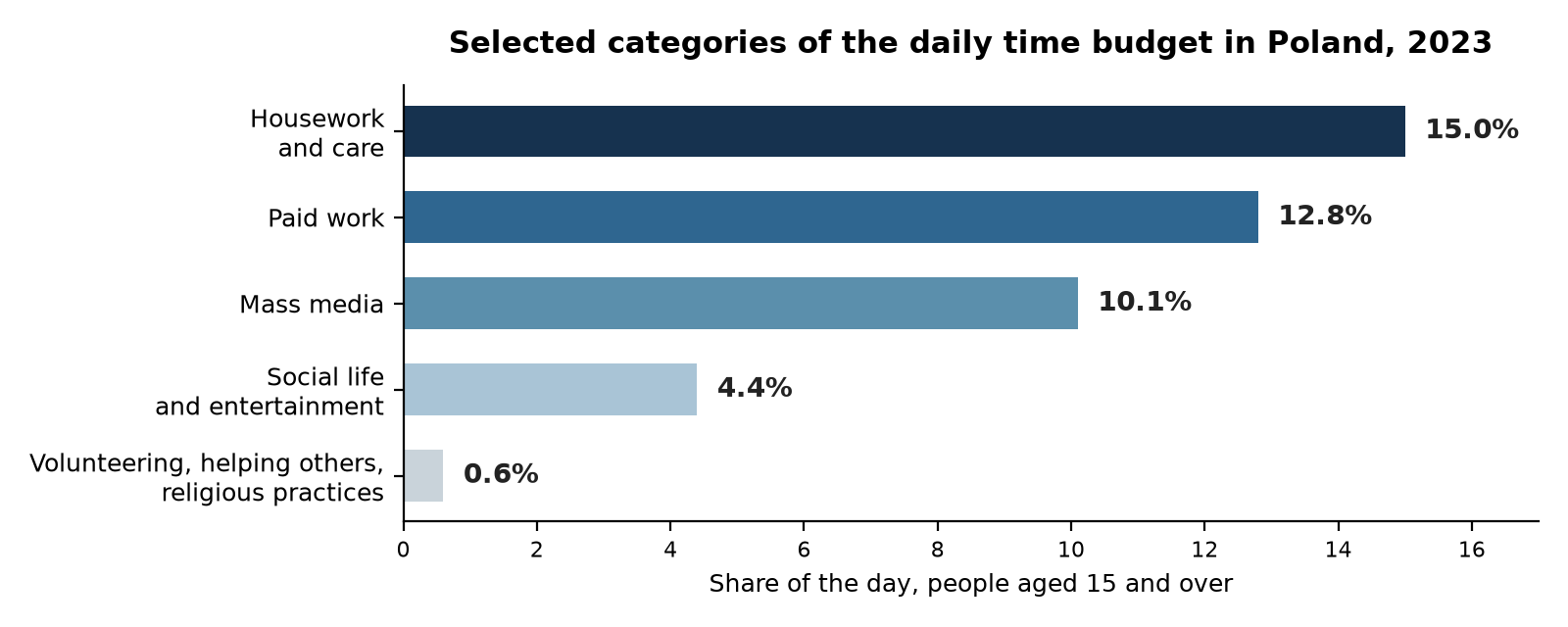
An important caveat: these are averages for the whole surveyed population (including people who are not employed) and they do not measure the quality of a marriage, personal prayer, or involvement in church — one should not conclude from them that “a Pole devotes only 0.6% of the day to God.” Yet these numbers show something worth reflecting on: the statistical resident of Poland spends more time in front of a screen (10.1%) than on any community or spiritual activity (0.6%) — more than 16 times as much.
Source: GUS (Statistics Poland), “Daily Time Budget of the Population in 2023,” revised signal information, table 1, stat.gov.pl.
Real-Life Situations — and the Correction
Not every difficulty is proof of wrongly set priorities. Still, it is worth recognizing recurring patterns of choice:
Work Takes Christ’s Place
You get a lucrative assignment that requires hiding the truth from a client. You tell yourself: “first I will provide for my family, I will deal with my conscience later.” Correction: you refuse the dishonest condition and look for an honest way to earn a living.
Ministry Pushes Out Marriage

You are at every meeting at church, yet for weeks you have been postponing the conversation you promised your spouse. The community sees activity, while at home loneliness grows. Correction: you hand some tasks to others and set a regular, non-negotiable time for your spouse.
Work Pushes Out the Children
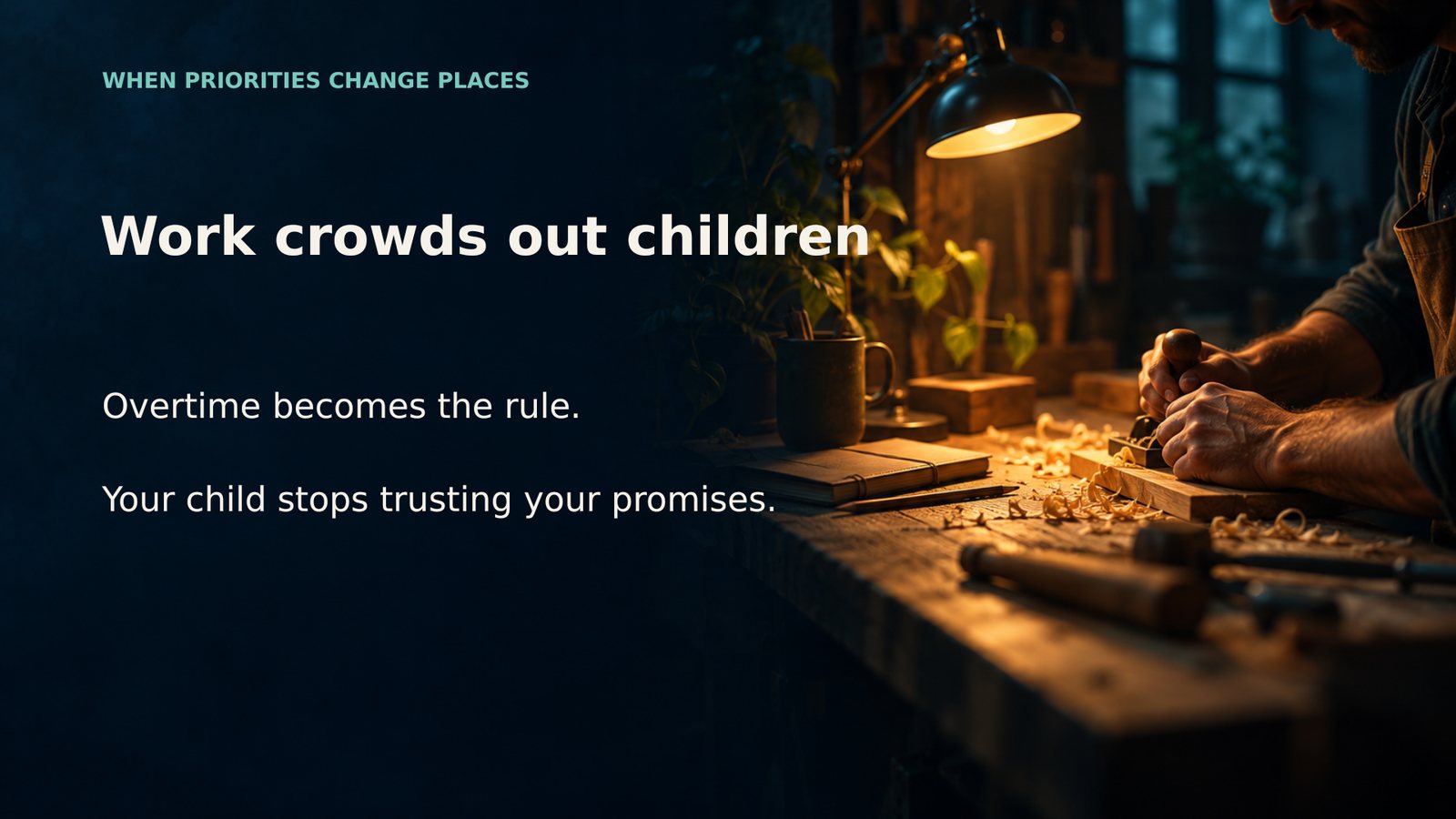
Overtime that was meant to be an exception becomes the rule; several times you cancel the time you promised your child. They may stop believing promises, even when they hear that you are doing it “for the family.” Correction: you name the necessary scope of work and protect specific, already-promised appointments.
In none of these examples does the word “first” by itself solve the matter at once — we have to look at the duty, the motivation, the long-term pattern, and the people who bear the cost of our decisions.
Four Questions When Duties Collide
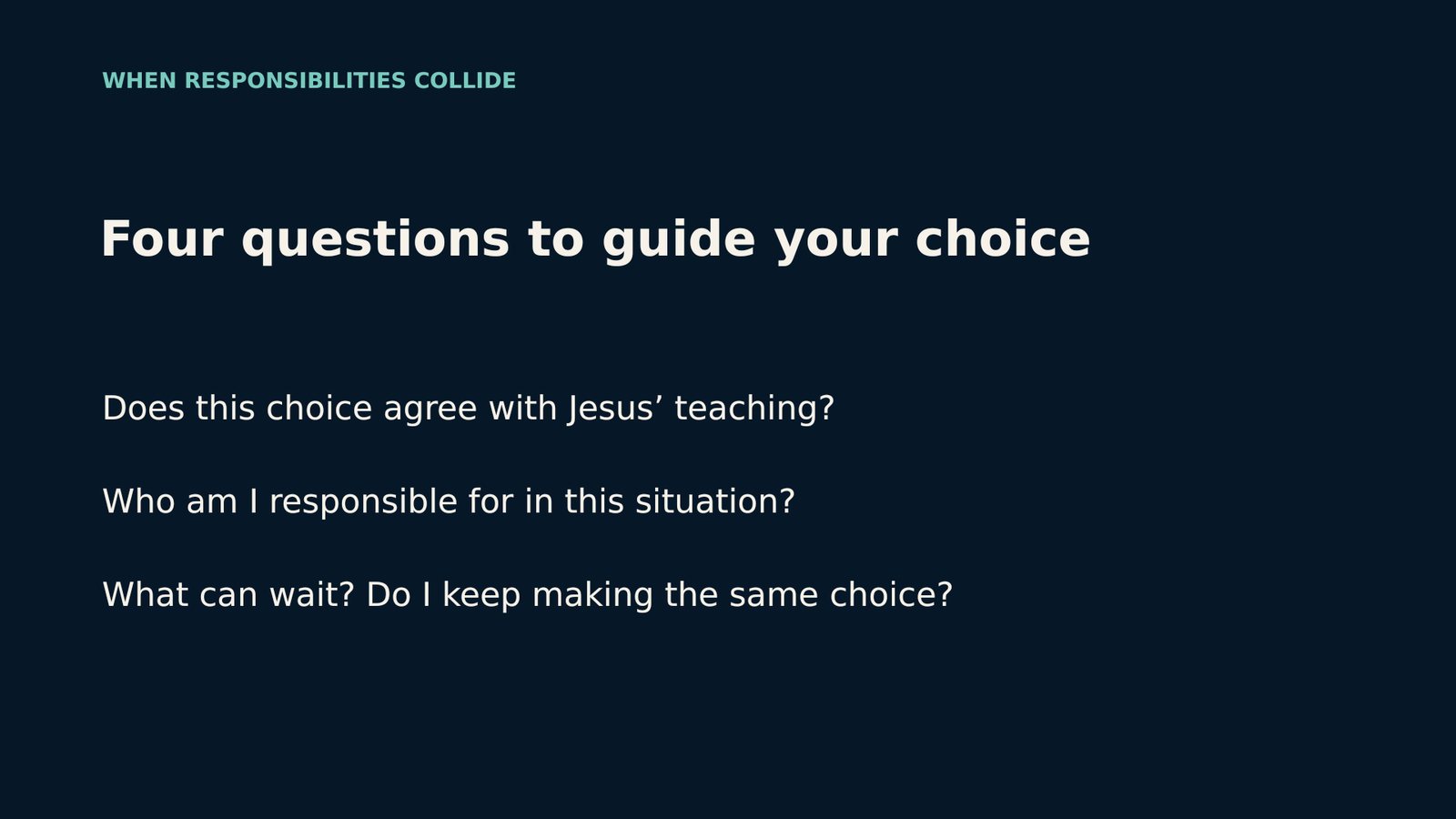
Sooner or later the calendar will put two good priorities in the same hour. Four honest questions help then:
- Does this choice agree with Jesus’ teaching? No “priority” justifies deceit, harm, or neglect of a person who depends on me.
- Who am I responsible for in this matter? I cannot solve every problem in the world, but for certain people I carry my own irreplaceable responsibility.
- What can wait? What is a one-time moment? The urgency of a phone notification is not yet a measure of its importance.
- Do I keep choosing the same way? One exceptional, difficult night does not mean wrong priorities. But if for months those closest to me get the leftovers of my time and strength, the rhythm has to change.
Questions for Personal Reflection
General — About Priorities
- If I were honest, what really takes first place in my week — not in my declarations, but in my calendar?
- Is my “service to God” sometimes an escape from the harder work in my own home?
- If I died tomorrow, what would my last 30 days show about what was truly most important to me?
- Whom or what would I sacrifice first if I had to choose today under time pressure — and is that in line with God’s order?
- What one step can I take this week to restore the right order?
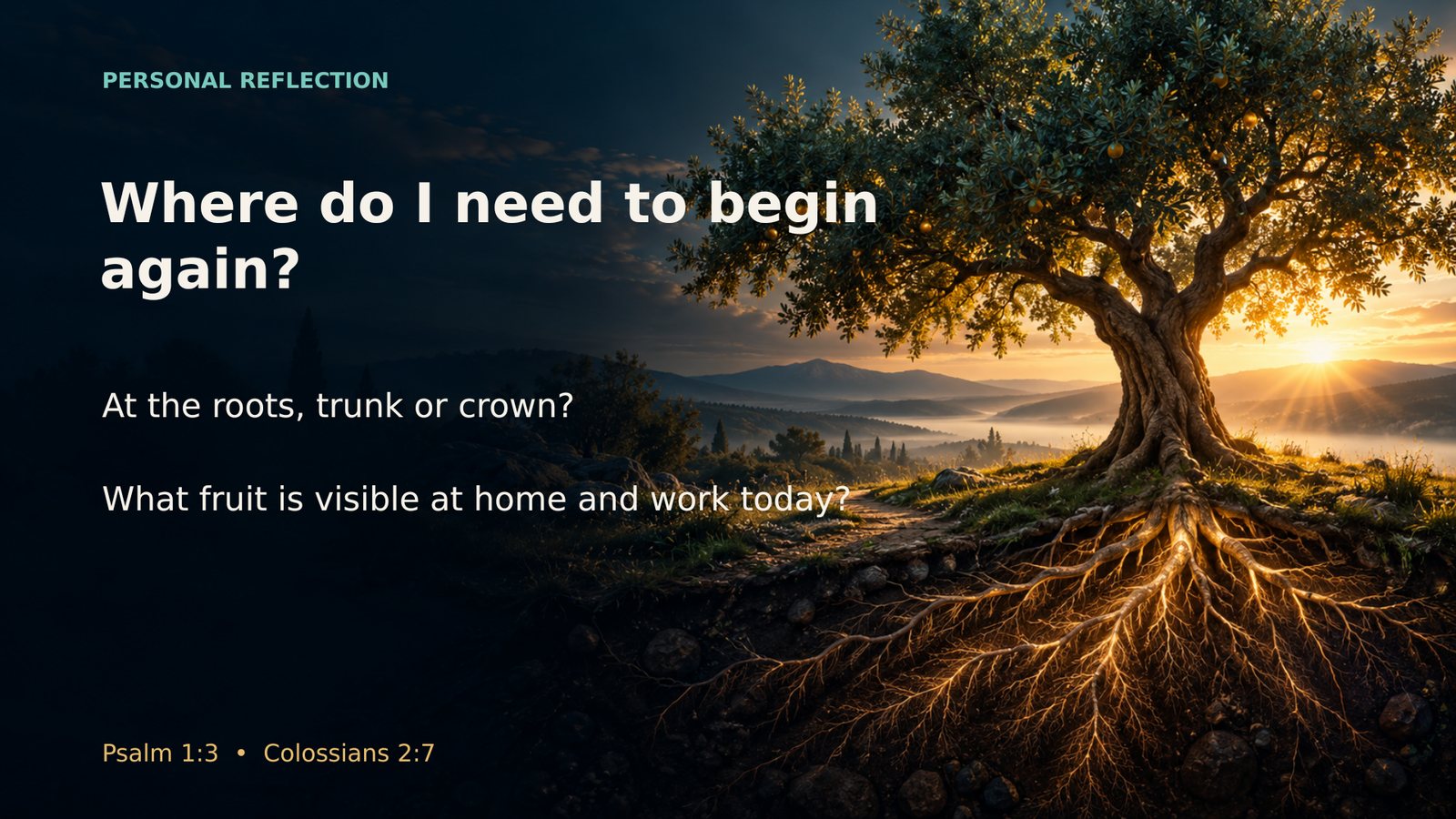
- If marriage, my relationship with my children, or honesty at work is fruit and not the problem itself — where do I really need to start: at the root (relationship with God), the trunk (personal transformation), or the crown (community)?
- How many times a day do I reach for my phone before I even think about God?
- Do the friends I spend the most time with draw me closer to God, or away from Him?
Related to the Temple Theme
- Do I treat my body and mind as a temple of the Holy Spirit, or as something I can manage entirely my own way?
- If I am a living temple myself, how does that change the way I treat other believers — who are also temples?
- Do I come to the church meeting as “to a building for something,” or with the awareness that the temple is meeting the temple?
- What would I change in my lifestyle if I truly believed that God already lives in me — and does not merely “visit me” on Sunday?
- (for younger people) Does what I watch, listen to, and think about fit the fact that my body is God’s temple?
Closing Prayer

Father, forgive us each time we let something take Your place — whether work, a phone, grades, or even our own family or service for You. Teach us again the right order: first You, then those You have entrusted to us. Show us where in our lives something is out of place, and give us the courage to put it back in order. In Jesus’ name. Amen.
Sources and Further Reading
- Pastoral Care Inc. — Statistics for Pastors — pastoralcareinc.com/statistics
- Soul Shepherding — Pastor Stress Statistics — soulshepherding.org/pastors-under-stress
- Barna Group — How Healthy Are Pastors’ Relationships? — barna.com/research/healthy-pastors-relationships
- Bryan E. Robinson — Workaholism and Family Functioning (Contemporary Family Therapy, Springer)
- Manhood Journey — 3 Ways Being a Workaholic Impacts Your Family — manhoodjourney.org
- Pew Research Center — How are US parents raising their children, religiously? (2025) — pewresearch.org
- David Yonggi Cho — his own account of ministry and marriage (abridged translation)
- GUS (Statistics Poland) — Daily Time Budget of the Population in 2023 (revised signal information) — stat.gov.pl
The readings from Colossians 3:1–4:1 and Ephesians 5:21–6:9 are a free paraphrase prepared for this teaching. Other Bible quotations follow standard English translations.