

How do you get peace back when life, people, and the future stir up fear? God says: “Do not be afraid, for I am with you” – Isaiah 41:10. Do not be afraid in a world of uncertainty.
Watch on YouTube
Listen to the Podcast
Quotes on courage and fear
- Nelson Mandela — “Courage is not the absence of fear, but the triumph over it.” A courageous person isn’t someone who feels no fear, but someone who overcomes it.
- Mark Twain — “Courage is resistance to fear, mastery of fear — not absence of fear.”
- Franklin D. Roosevelt — “The only thing we have to fear is fear itself.” Roosevelt was talking about the fear that paralyzes action — the Bible goes further and shows that God gives us not only courage, but His own presence.
- Oswald Chambers — “If we fear God, we fear nothing else, whereas if we do not fear God, we fear everything else.” A true fear of God puts every other fear in its proper place.
- Susan Jeffers — “Feel the fear and do it anyway.” Don’t wait for the fear to disappear — learn to act in spite of it.
- Eleanor Roosevelt — “You must do the thing you think you cannot do.”
A world full of information, a heart full of worry
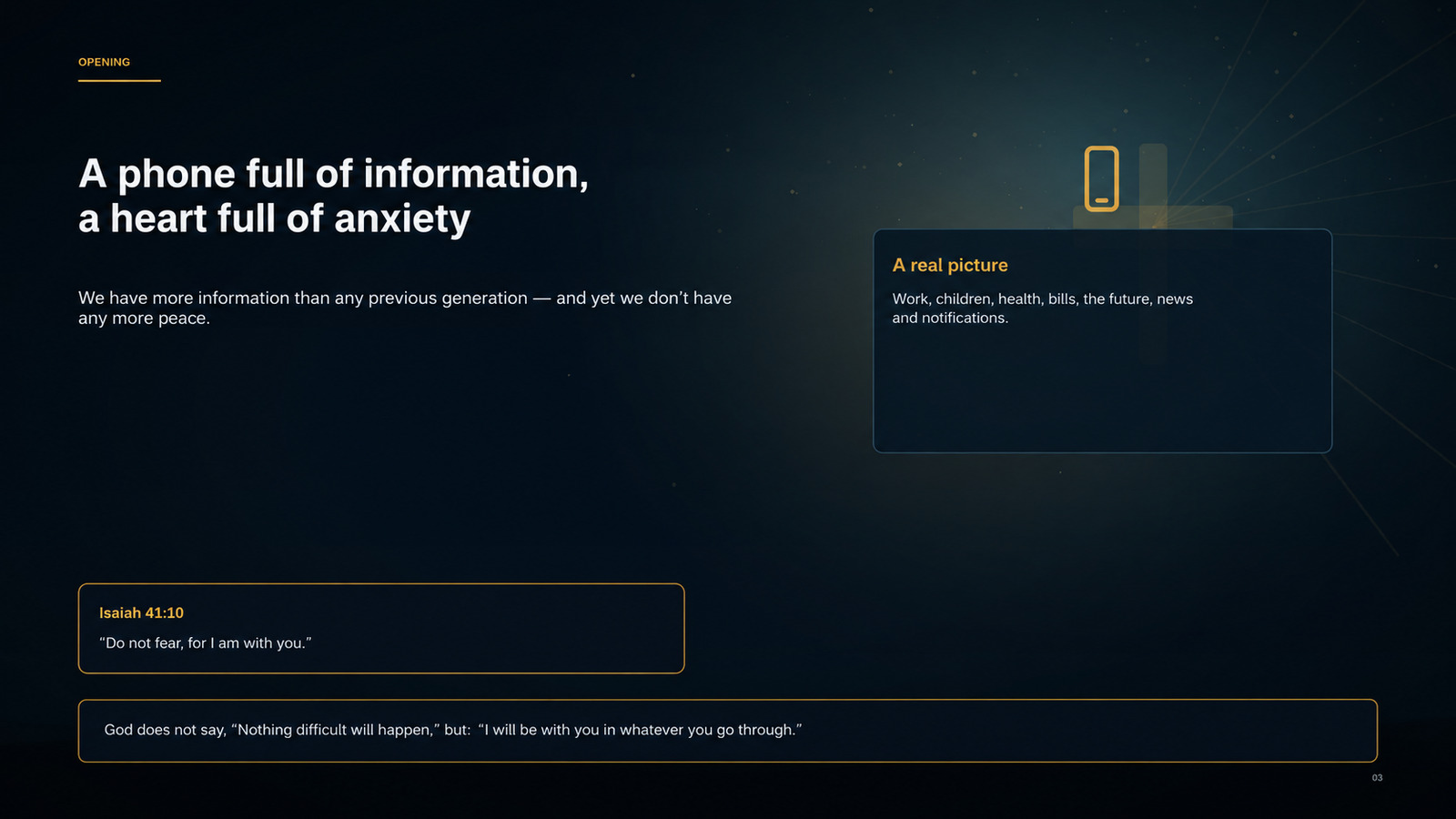
Today we have access to more information than any generation before us — and yet it hasn’t given us more peace. Sad, negative news, price increases, warnings about global warming, floods, disasters, financial crises, reports of war, and accidents — we read all of this the moment we wake up. You can have a phone full of information and a heart full of fear.
What will happen to my job if the company starts laying people off? What will happen with my child, who has seemed sad lately and won’t talk about it? What will happen with the loan payment if interest rates rise? What will happen if the test results aren’t good? None of these things have happened yet, and still the heart races as though they already had.
And God says to us: “Do not be afraid, for I am with you.” That sentence doesn’t mean “nothing difficult will happen” — it means: “Do not be afraid, because I will be with you in whatever you are going through.” Let’s pause for a moment on fear itself — because the Bible doesn’t pretend it isn’t there.
1. Fear is real, but it doesn’t have to rule us
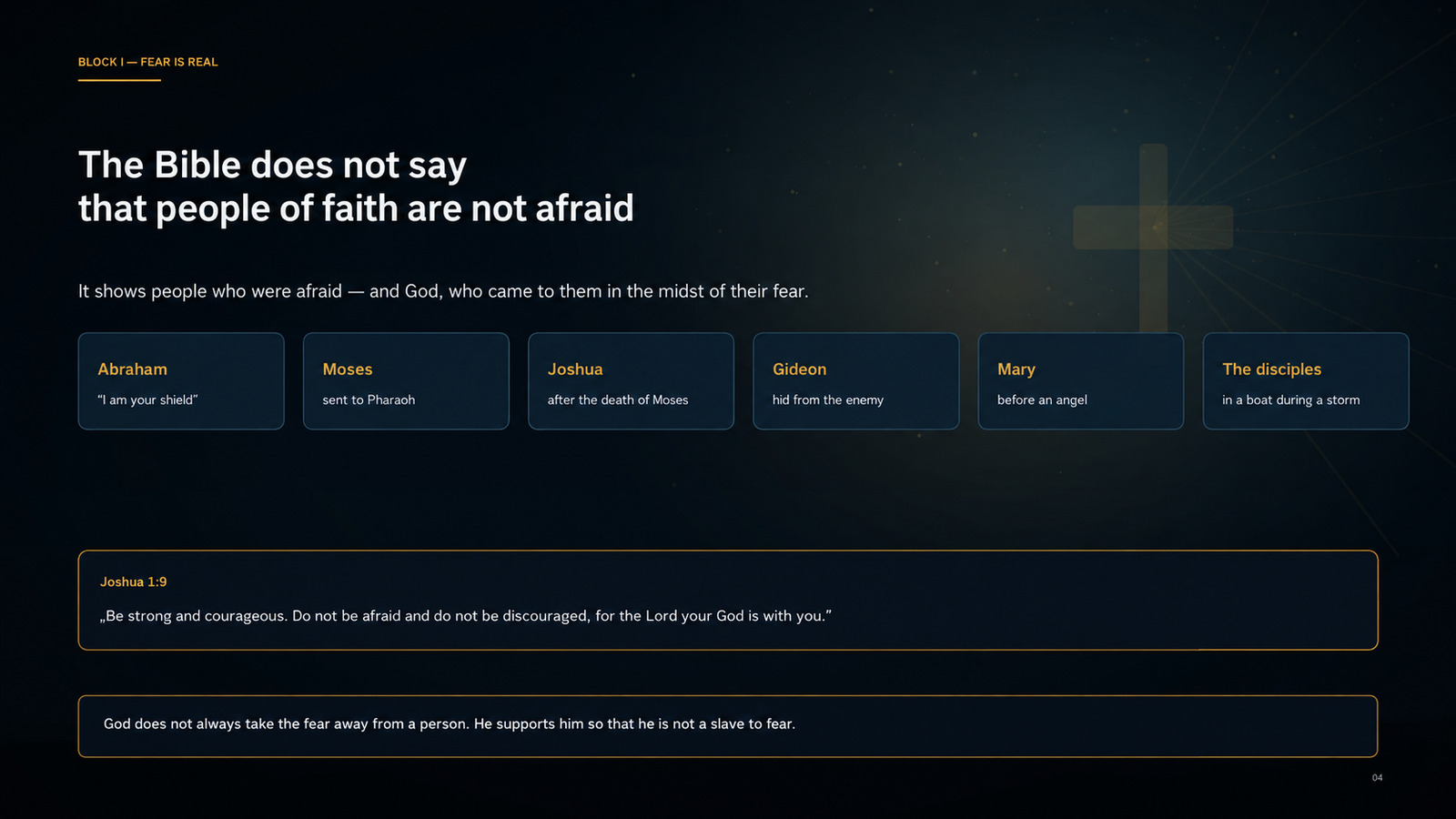
We shouldn’t condemn or accuse people for being afraid — and certainly not accuse them of lacking faith. Sometimes fear is born out of exhaustion, prolonged stress, illness, a difficult childhood, or simply a genuinely hard situation. The Bible doesn’t pretend that a person of faith never feels afraid. It shows us people who were afraid — and it shows us a God who comes to them right in the middle of that fear.
Abraham was afraid, when God told him: “Do not be afraid, Abram, I am your shield.” Moses was afraid, when he was sent to Pharaoh. Joshua was afraid, taking up leadership after Moses’ death. Gideon was afraid, threshing wheat in hiding from his enemies. Mary was afraid, when the angel stood before her. The disciples were afraid, on the storm-tossed lake.
“Have I not commanded you? Be strong and courageous. Do not be frightened, and do not be dismayed, for the Lord your God is with you wherever you go.”
— Joshua 1:9
God doesn’t say this to Joshua because the situation wasn’t threatening — Joshua really did have the conquest of a foreign land ahead of him, and the death of his mentor behind him. God says it because He Himself is greater than Joshua’s reasons to be afraid. God doesn’t shame a person for being afraid. He strengthens them so that they won’t be a slave to fear.
Fear often has wide eyes, vivid imagination, and strong feelings, but little grounding in reality. Fear can be a real emotion, but it is never the last word about reality.
2. Where does fear come from? — from losing control
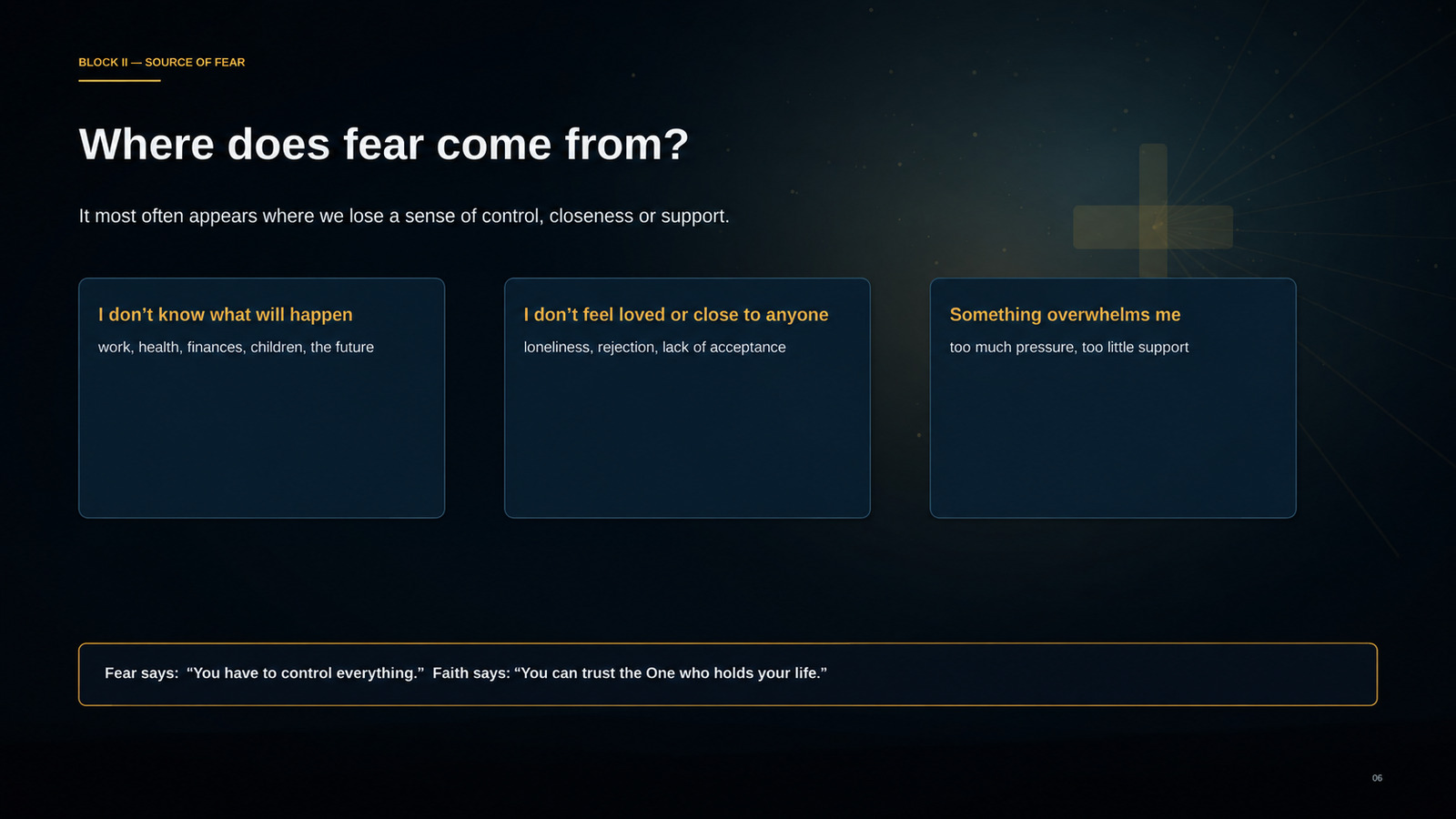
Fear most often shows up in three places. First, when you don’t know what will happen next — whether you’ll manage, whether someone will leave you, whether you’ll have enough money to make it to the end of the month, whether your health will improve, whether your children will choose a good path, whether God will really come through in time. And yet God cares for us — you can trust Him. Second, when you don’t feel loved and close to anyone — when you think “nobody loves me, I’m alone” — and yet perfect love drives out fear. Third, when something is too much for you and no one is supporting you.
Fear says: you have to control everything, or it will all fall apart. Faith says: you don’t control everything, but you can trust the One who holds your life in His hands.
| Control | Trust |
|---|---|
| Seeks certainty about every circumstance | Finds security in God |
| Has to know “what’s next” in order to calm down | Knows that “God is walking alongside” and that’s enough for today |
| Treats uncertainty as a threat | Treats uncertainty as a place where we learn to rely on God |
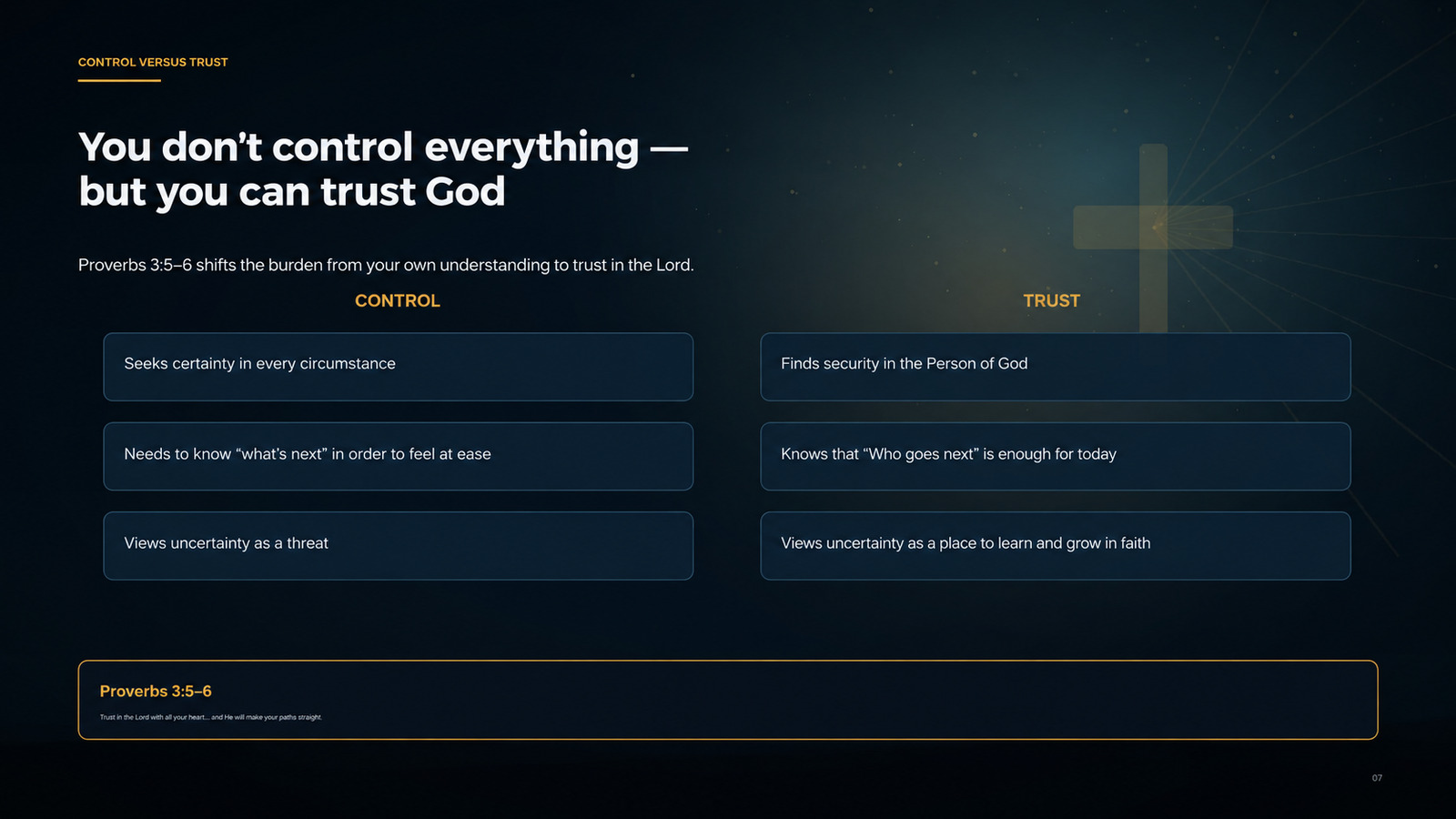
“Trust in the Lord with all your heart, and do not lean on your own understanding. Remember Him in all your ways, and He will make your paths straight.”
— Proverbs 3:5–6
Think about the end of the month: the bills arrive, the price of electricity goes up, and the paycheck is the same as always. Christianity doesn’t mean we suddenly know the answer to every one of those variables. It means we know Who is walking with us through that table full of bills.
The uncertainty of tomorrow does not cancel out God’s faithfulness today!
3. God doesn’t always remove the valley — He walks us through it
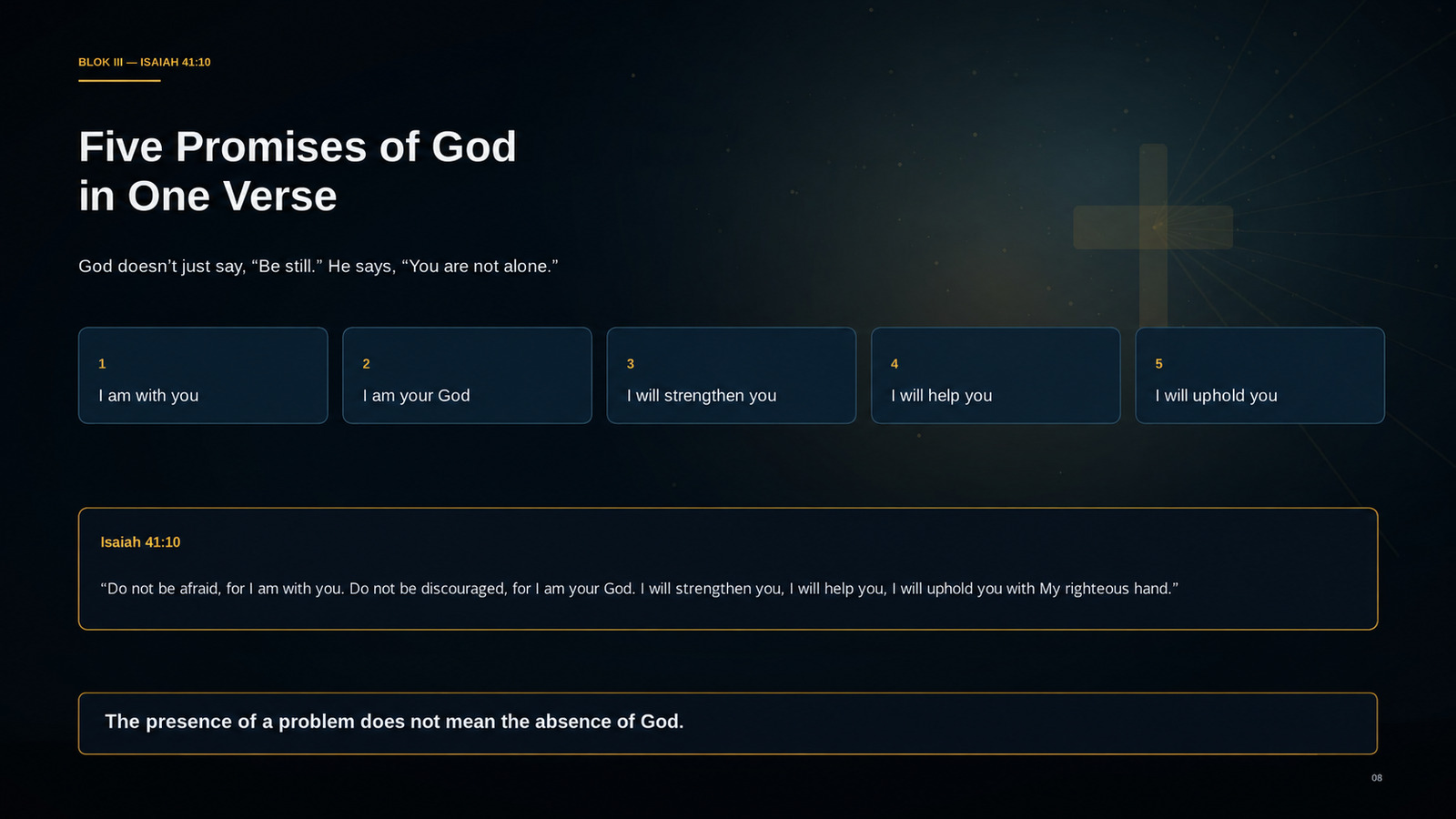
“Fear not, for I am with you; do not anxiously look about you, for I am your God. I will strengthen you, I will help you, I will uphold you with My righteous right hand.”
— Isaiah 41:10
In this single verse we find five promises: I am with you. I am your God. I will strengthen you. I will help you. I will uphold you. God doesn’t say, “calm down.” He says, rather: “You are not alone, I am with you!”
David said something similar:
“Even though I walk through the valley of the shadow of death, I fear no evil, for You are with me; Your rod and Your staff, they comfort me.”
— Psalm 23:4
David doesn’t say, “There is no more valley.” He says, “Even in the valley, I am not alone.” Many people think: if God loves me, I shouldn’t have any problems; since I’m having a hard time, maybe God has left me; since I’ve prayed and things are still hard, maybe God isn’t working. But the presence of a problem doesn’t mean the absence of God.
4. A peace the world cannot give
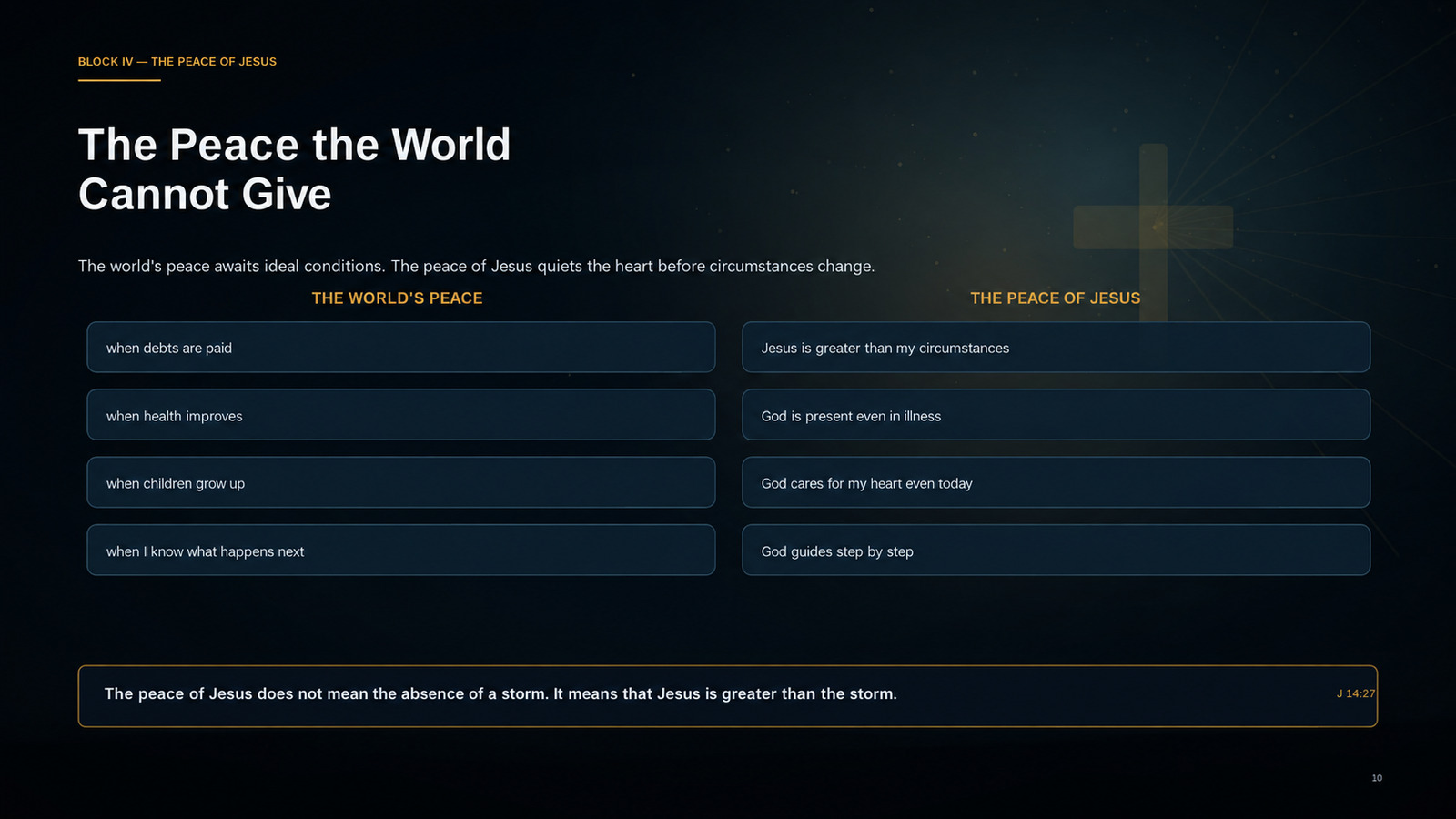
“Peace I leave with you; My peace I give to you; not as the world gives do I give to you. Let not your heart be troubled, nor let it be fearful.”
— John 14:27
The peace the world offers is almost always conditional: I’ll be at peace once I pay off my debts; I’ll be at peace once the kids get their act together; I’ll be at peace once my health improves; I’ll be at peace once I know what’s next. The world’s peace is always waiting for tomorrow. Jesus’ peace doesn’t mean there’s no storm — it means Jesus is bigger than the storm.
The disciples in the boat
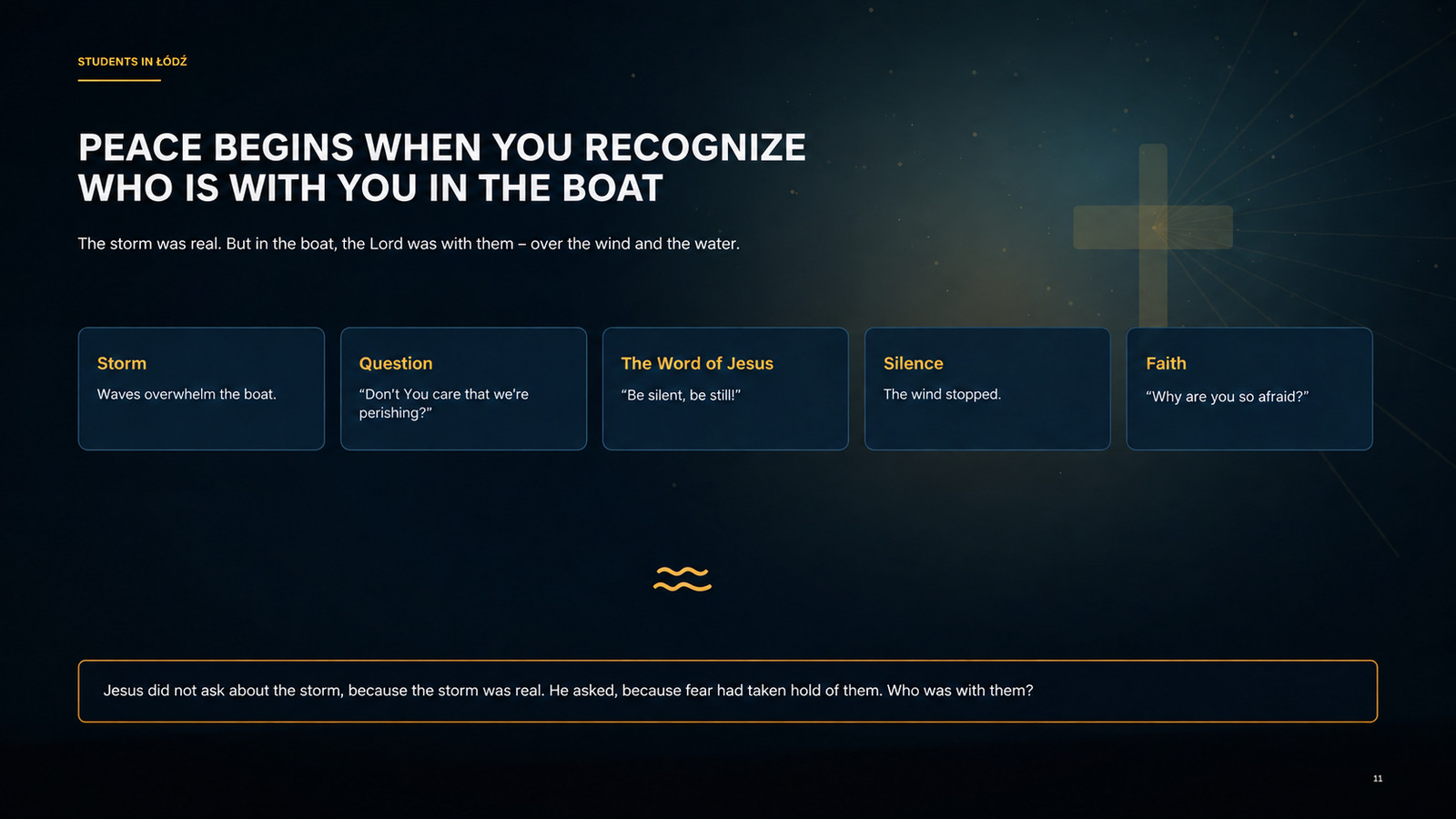
The disciples are sailing across the lake in a boat together with Jesus when a violent storm suddenly breaks out. Waves are swamping the boat, and Jesus is asleep. Terrified, the disciples wake Him with a note of complaint in their voices:
“Teacher, do You not care that we are perishing?”
— Mark 4:38
It’s a very human question: “God, do You even care?” Jesus answers by using His authority — the power of God:
“Hush, be still!”
— Mark 4:39
The wind died down and it became perfectly calm. Then Jesus asks the disciples a question:
“Why are you so afraid? Do you still have no faith?”
— Mark 4:40
The storm was real — the waves really were swamping the boat. The disciples had, right there in the boat with them, someone who is Lord over wind and water, and fear blinded them to that for a moment. They also had a word from Jesus: “Let us go across to the other side!” So they had both a promise and an authority with them — and yet they were still afraid.
Peace doesn’t begin when we understand the storm, but when we recognize Who is with us in the boat.
5. What overcomes fear? A spirit of power, love, and a sound mind
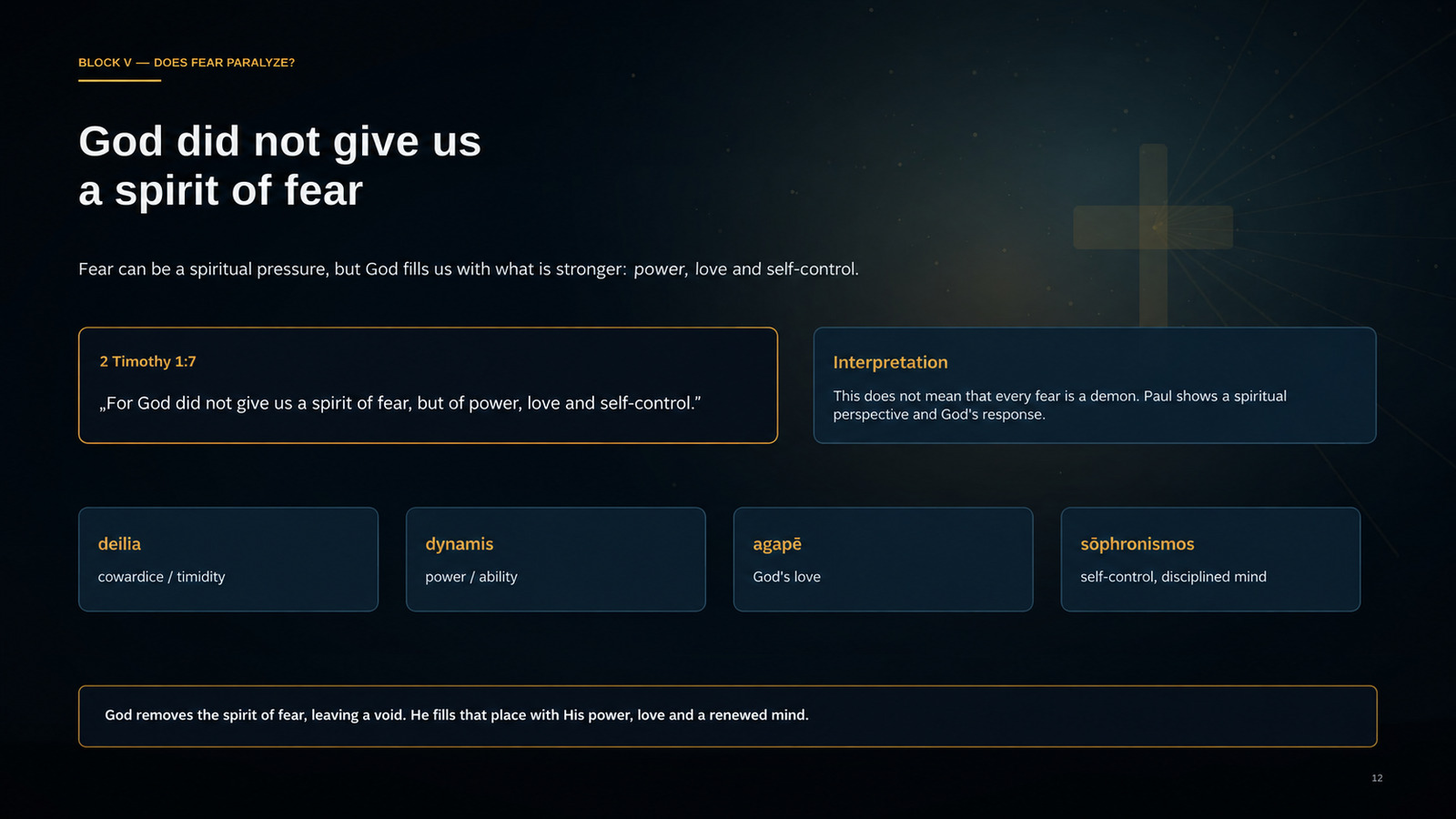
Fear can also be a spiritual matter
The apostle Paul wrote this letter to Timothy — a young leader of the church in Ephesus who struggled with timidity and intimidation in ministry.
“God gave us a spirit not of fear but of power and love and a sound mind.”
— 2 Timothy 1:7
Fear can become something more than just an emotion. It is a spiritual pressure that doesn’t come from God, and that God doesn’t want for His children. God doesn’t remove a spirit of fear and leave emptiness in its place — He fills that place with His power, His love, and a renewed mind.
Power — you don’t have to manage on your own strength
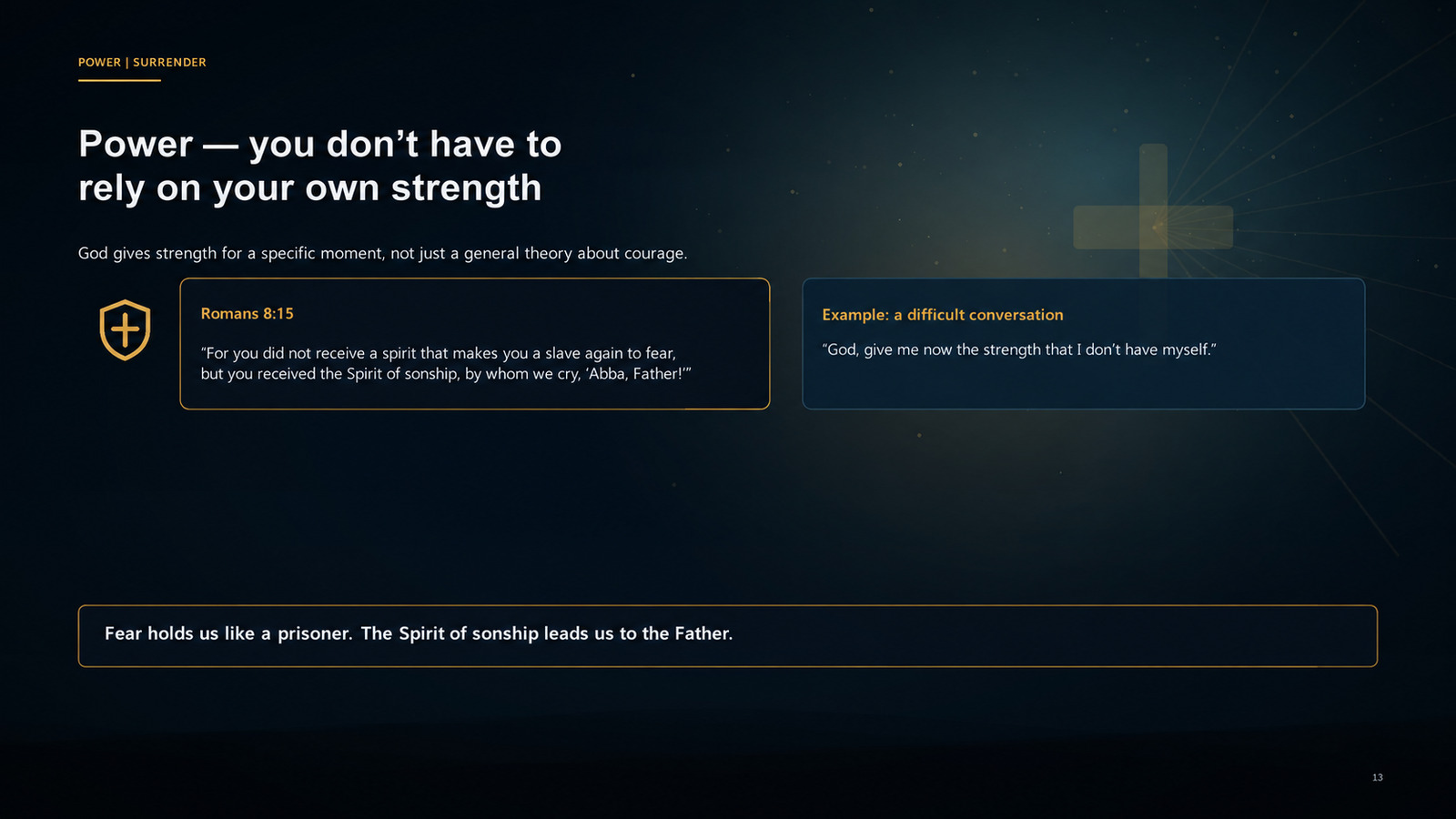
We have the power of the Holy Spirit and the authority God gave us to trample on every power of the enemy.
“For you did not receive a spirit of slavery to fall back into fear, but you have received the Spirit of adoption as sons, by whom we cry, ‘Abba! Father!'”
— Romans 8:15
Fear often holds us like slaves, making us afraid of the next conversation, the next decision, the next phone call. But we have a Father in Heaven — His strength, His support, and His authority.
Love — it removes the foundation fear stands on
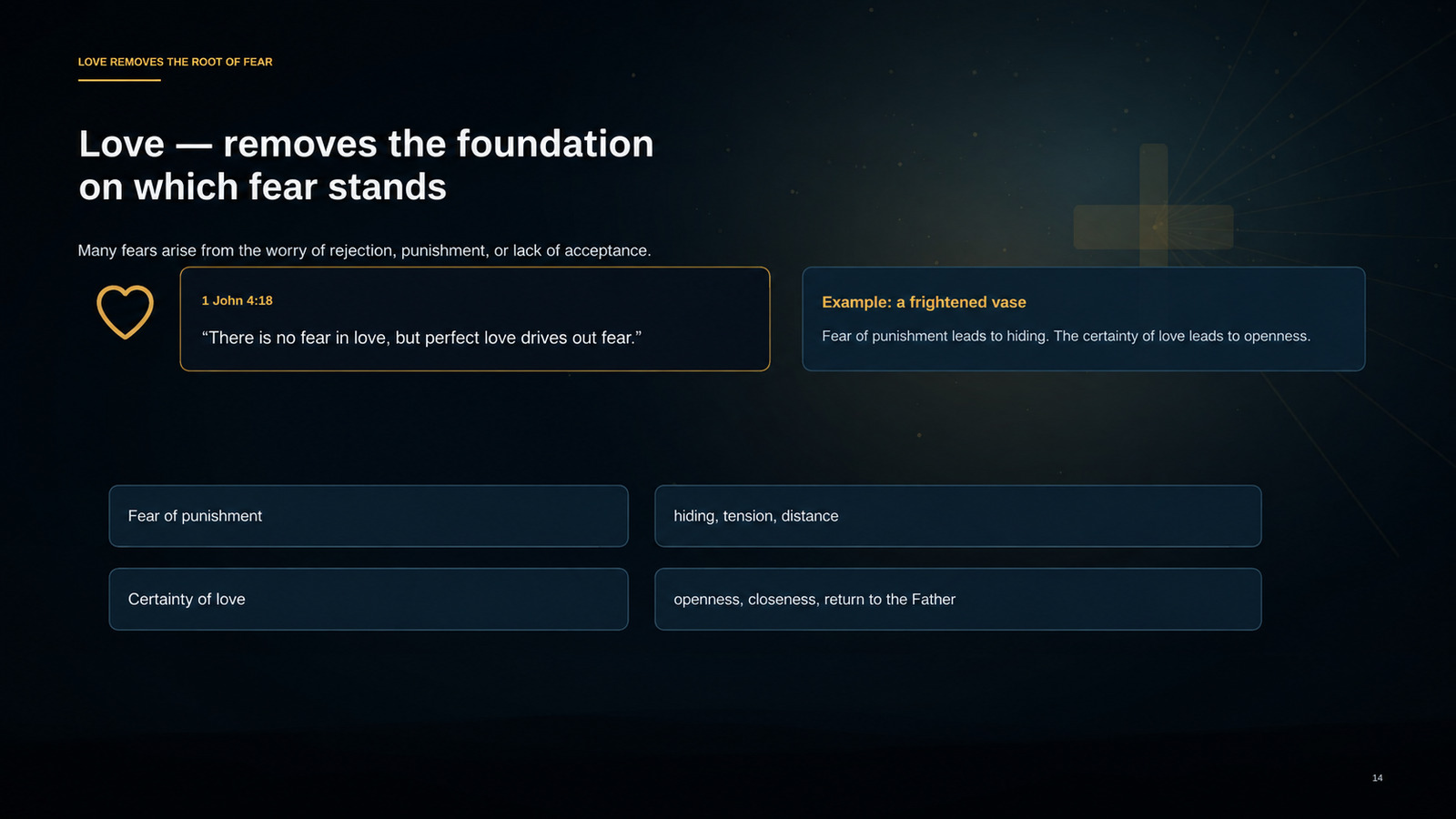
A great deal of fear is born out of a dread of rejection and punishment, or out of a lack of acceptance.
“There is no fear in love, but perfect love casts out fear. Whoever fears has not been perfected in love.”
— 1 John 4:18
The more we come to know just how unconditionally the Father loves us, the less room is left in our hearts for a fear of rejection — including rejection by God Himself. Fear of punishment leads to hiding. Confidence in love leads to honesty. The less we fear His reaction, the more easily we come to Him just as we really are — including with our fear.
A sound mind — a mind that doesn’t give in to the wrong thoughts
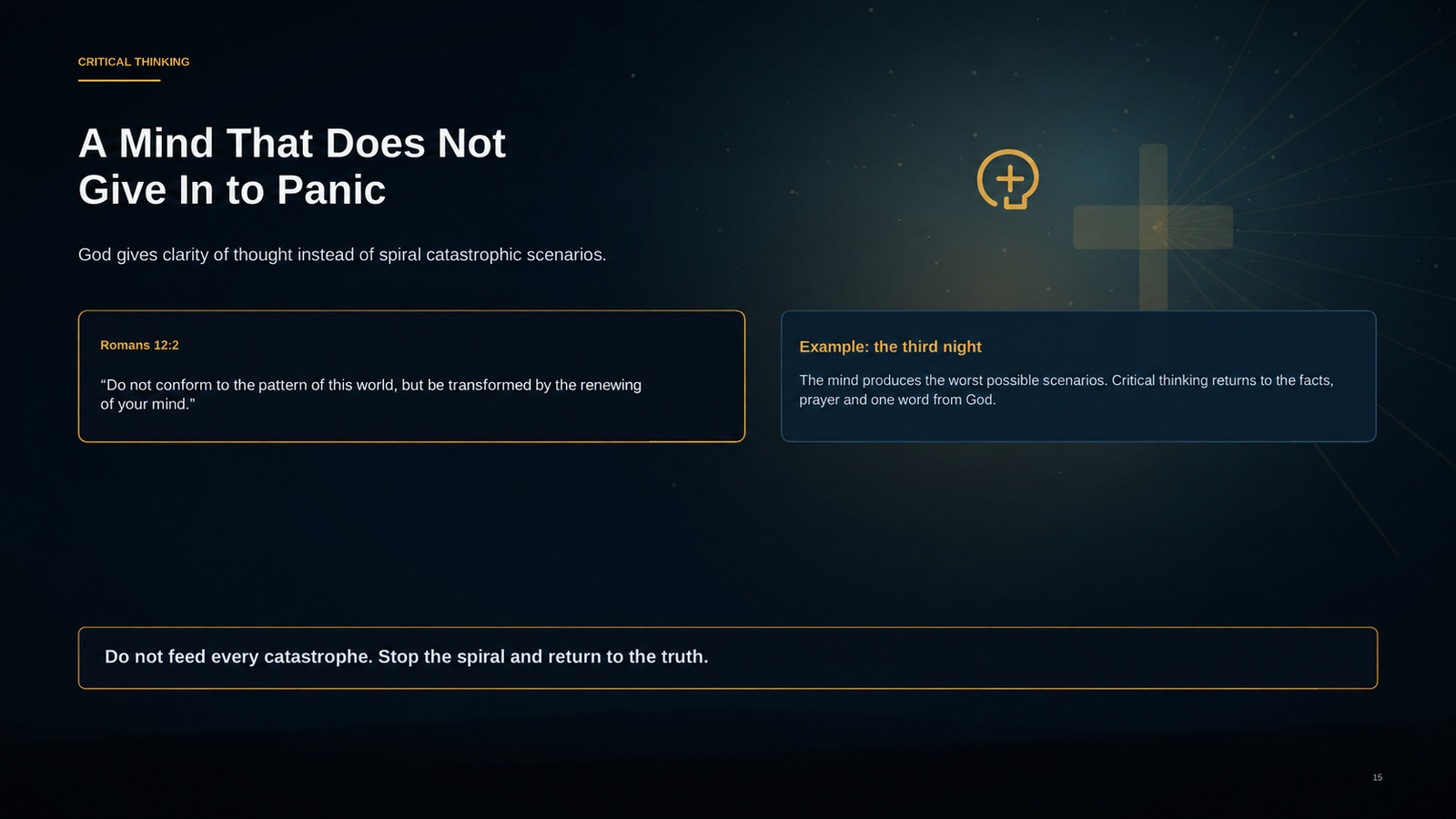
God gives us a sound, disciplined mind — the ability to think clearly instead of spiraling into catastrophic scenarios.
“Do not be conformed to this world, but be transformed by the renewal of your mind.”
— Romans 12:2
The Holy Spirit also brings peace
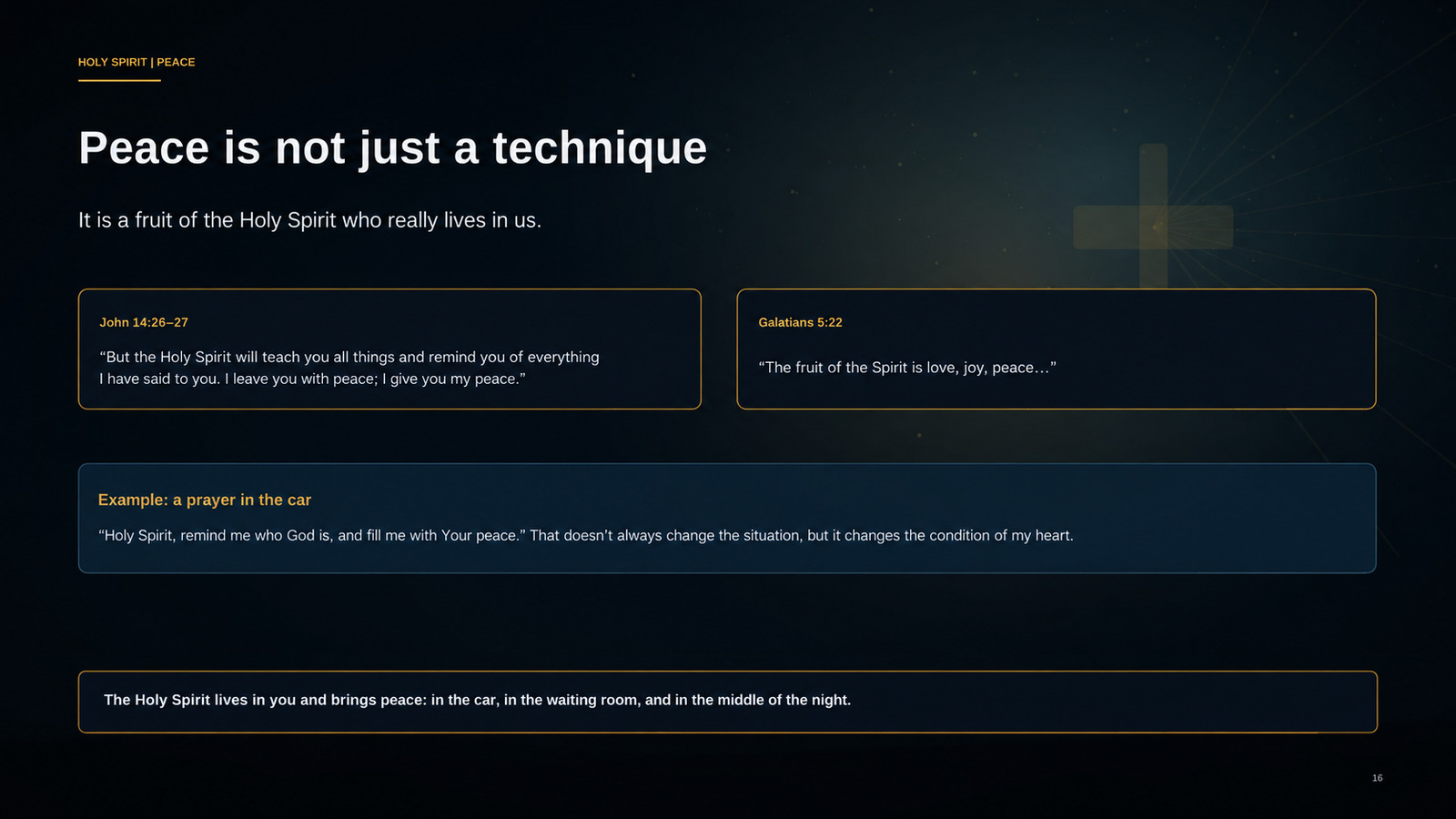
Jesus speaks of the Holy Spirit and of peace in the same breath, in the same conversation with His disciples:
“The Helper, the Holy Spirit, whom the Father will send in my name, he will teach you all things and bring to your remembrance all that I have said to you. Peace I leave with you; my peace I give to you.”
— John 14:26–27
It’s no accident that the word “peace” appears right after the promise of the Holy Spirit. Peace is the fruit of God truly dwelling within us.
“The fruit of the Spirit is love, joy, peace, patience, kindness, goodness, faithfulness.”
— Galatians 5:22
The Holy Spirit doesn’t only give strength for ministry. He lives in you and brings you peace day to day: in the car, in the waiting room, in the middle of the night, and in the middle of your problems.
6. What to do when fear comes: the practice of prayer
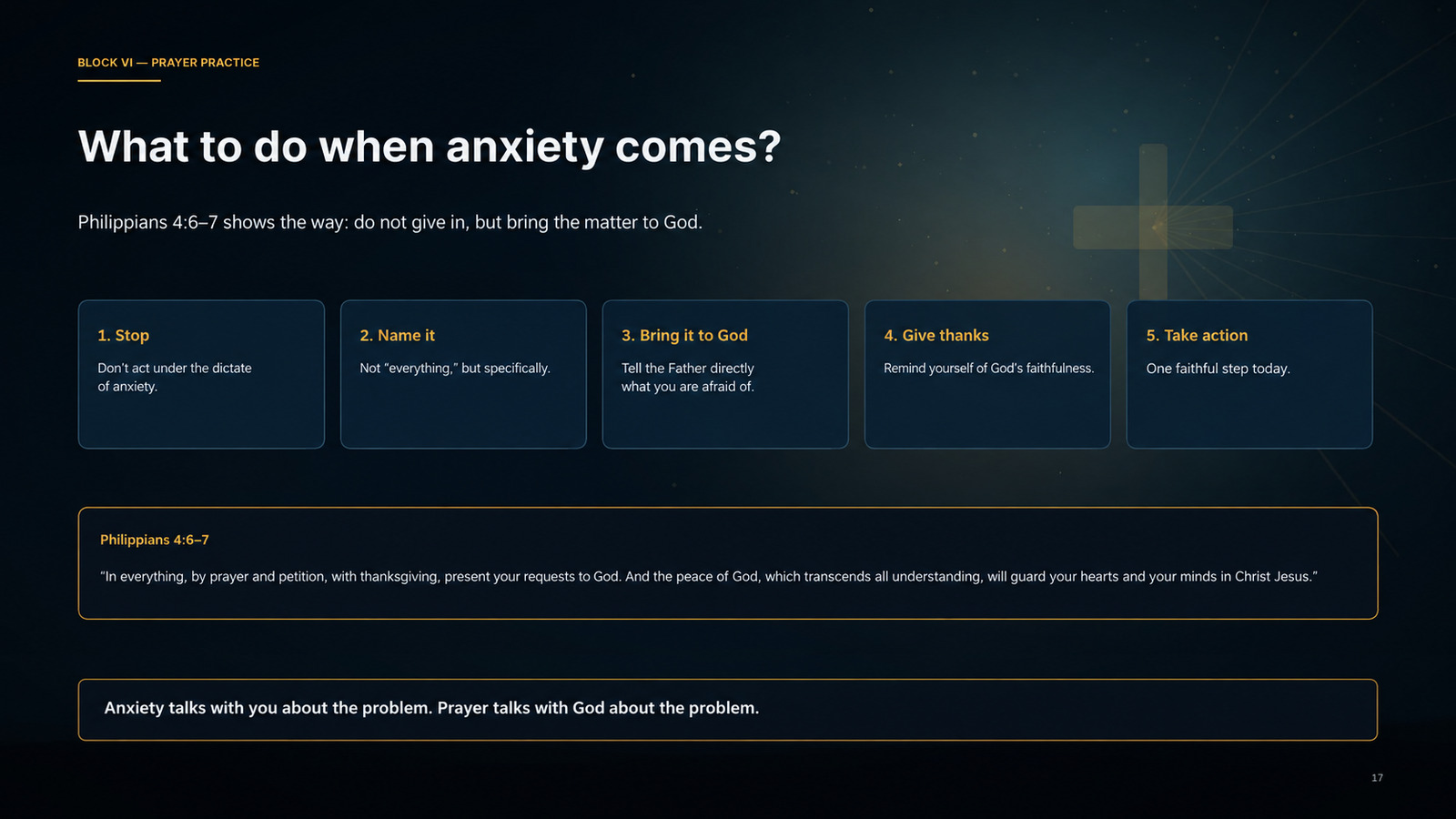
“Do not be anxious about anything, but in everything by prayer and supplication with thanksgiving let your requests be made known to God. And the peace of God, which surpasses all understanding, will guard your hearts and your minds in Christ Jesus.”
— Philippians 4:6–7
The Bible doesn’t say, “Pretend you don’t have a problem.” It says, “Bring that problem to God” — or use the authority you already have.
Five steps for when fear comes
| Step | What to do |
|---|---|
| 1. Stop | Tell yourself: “This is fear. I don’t have to act on its orders.” You don’t have to react the instant you feel afraid. |
| 2. Name what you’re afraid of | Not a vague “I’m afraid of everything,” but something specific: I’m afraid of running out of money, I’m afraid of being alone, I’m afraid of the test results, I’m afraid of failing. |
| 3. Bring it to God in prayer | Don’t just analyze it by yourself, and don’t just search the internet for answers. Come to the Father first and tell Him plainly what you’re afraid of. |
| 4. Add thanksgiving, or use your authority | Thank Him for something He has already done before. Thanksgiving doesn’t deny the problem — it reminds you that the problem isn’t bigger than God. He has already conquered fear on your behalf and given you authority! |
| 5. Take one step of obedience | Fear paralyzes you and makes you wait for complete clarity about the future. Do the one thing you know you need to do today: make the call, apologize, sort out one thing, rest, return to the Word. |
Fear talks to you about the problem. Prayer talks to God about the problem.
Conclusion — faith shifts the center of the question
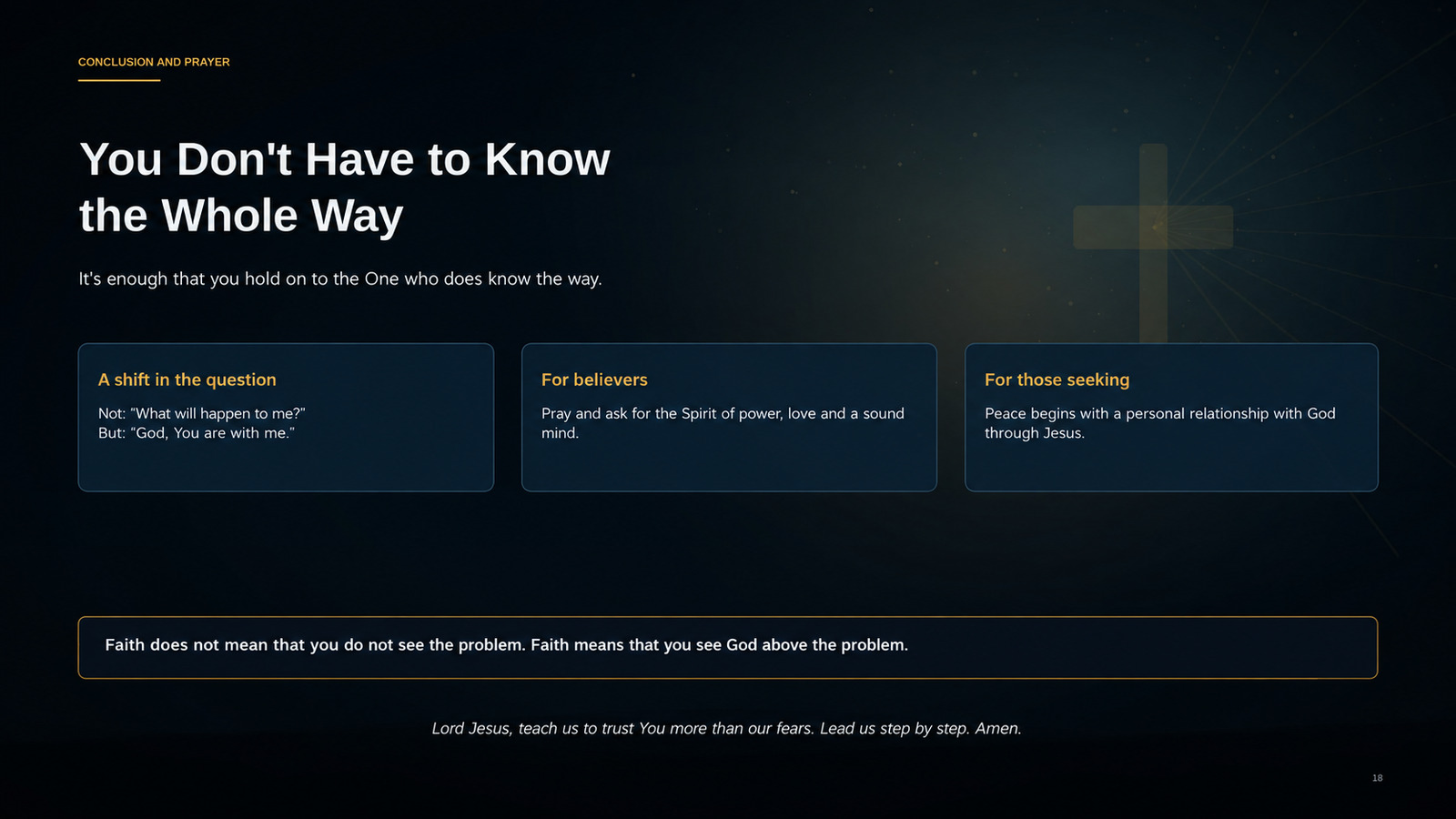
Not “What will happen to me?” but “God, You are with me — lead me one step at a time.” Faith doesn’t mean I don’t see the problem. Faith means I see God above the problem.
Maybe you’re carrying a burden, a worry, a fear you’ve held for a long time while smiling on the outside. Maybe you’re afraid for your health, for your child, for your job, for whether you’ll manage. Today God isn’t shaming you for that. He says: “Do not be afraid. I am with you.” You don’t have to know the whole road — it’s enough to hold on to the One who knows that road.
A call to respond
For believers: name before Him what you are afraid of, and ask to be filled with a spirit of power, love, and a sound mind.
For those still seeking: be reconciled with God. Jesus came, died, and rose again so that you wouldn’t have to live separated from the Father. You can come to Him today just as you are.
Closing prayer
Lord Jesus, we come to You with our fear, our tension, and our uncertainty. We don’t want to pretend that nothing touches us — we want to bring You what we’re really carrying in our hearts.
Thank You that You don’t leave us alone. Thank You that You are with us in the valley, in the storm, in our questions, and in our everyday lives. Thank You for the Holy Spirit, who lives in us and brings power instead of helplessness, love instead of the fear of rejection, and a sound mind instead of panic.
Teach us to trust You more than we trust our fears. Lead us step by step. In the name of Jesus. Amen.