


An analysis of Prof. Marcin Majewski’s four-part series “The Best and Worst Polish Bible Translations,” of translation theory principles, critical texts, and publishers’ materials. Information and availability current as of September 1, 2026. Numbers with the letter S denote specialist items, and E denotes editions or projects that cannot be directly compared with a full general-purpose translation (more on this below).
| Number of translations and editions | Hours of Prof. Majewski’s lectures | Entries in the main ranking |
|---|---|---|
| 15 | 4 h 48 min | 11 |
Table of Contents
- The 90-second answer
- What exactly was analyzed
- What “faithful to the original” means
- Our ranking’s methodology
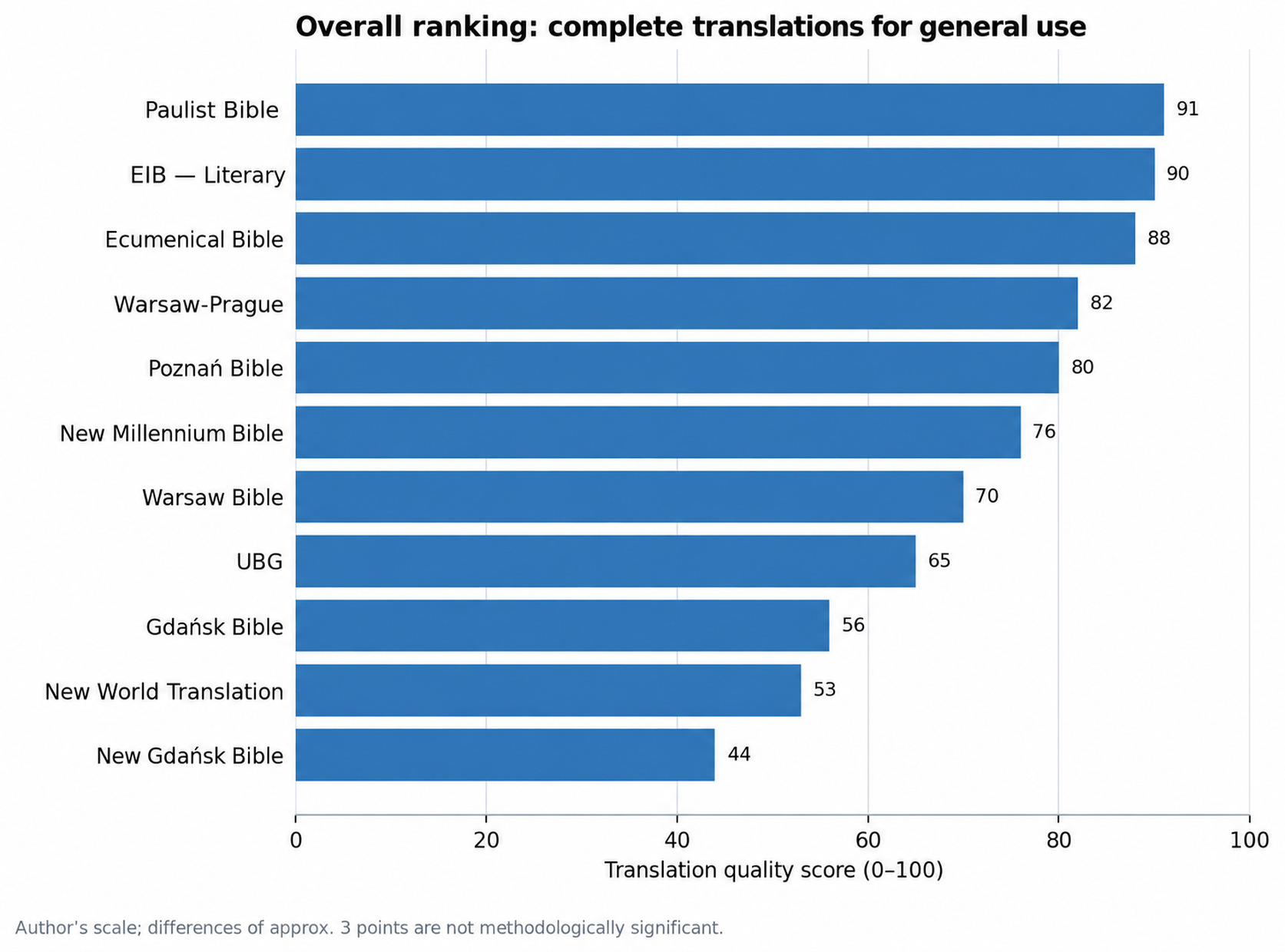
- The main 2026 ranking
- Five tests on specific passages
- Gen 14:22 — the oath idiom
- Matt 5:5 — praeis
- Matt 5:39 — antistēnai tō ponērō
- Ezek 34:16 — guard or destroy
- Col 1:16–17 — “all things” or “all other things”
- Profiles of 16 translations and editions
- 1. Biblia Paulistów (the Paulist Bible — Holy Scripture of the Old and New Testament)
- 2. EIB — Literary Translation (SNP)
- 3. Biblia Ekumeniczna (the Ecumenical Bible)
- S1. EIB — Literal Translation (SNPD6)
- 4. Biblia Warszawsko-Praska (the Warsaw-Praga Bible)
- 5. Biblia Poznańska (the Poznań Bible)
- S2. Biblia Pierwszego Kościoła (the Bible of the First Church)
- 6. Biblia Tysiąclecia (the Millennium Bible), 5th edition
- E1. Biblia Jerozolimska (the Jerusalem Bible) — Polish study edition
- 7. Biblia Warszawska (the Warsaw Bible)
- 8. Uwspó&322;cze&347;niona Biblia Gda&324;ska (the Modernized Gdańsk Bible, UBG)
- 9. Biblia Gdańska (the Gdańsk Bible)
- 10. The New World Translation of the Holy Scriptures
- E2. Nowy Przekład Dynamiczny (the New Dynamic Translation, NPD)
- 11. Nowa Biblia Gdańska (the New Gdańsk Bible, NBG)
- E3. FireBible — the Bible for Charismatics
- A tool outside the ranking: the interlinear translation
- How to buy: one, two, or three Bibles
- The final answer
- See also
- Sources and bibliography
The 90-second answer
The shortest answer: if you want to buy one complete Bible for daily reading in 2026, choose the Biblia Paulistów (Paulist Bible). If you read within an evangelical setting, or care most about the most natural Polish text built on a very modern base, choose the EIB literary translation (SNP). For serious study, add the literal EIB alongside it. In an interdenominational group, choose the Biblia Ekumeniczna (Ecumenical Bible).
There is no single “most faithful translation” independent of purpose. Faithfulness to individual words, faithfulness to idiom, faithfulness to literary genre, and comprehensibility can call for different solutions. An overly literal translation can distort meaning just as effectively as an overly loose paraphrase. The safest practice is two complementary translations plus textual footnotes.
Our podium: 1) Biblia Paulistów — 91/100; 2) EIB literary — 90/100; 3) Biblia Ekumeniczna — 88/100. Differences of up to about 3 points should be treated as the same quality class, not as mathematical proof of superiority.
Best choice by use case
| Use case | Best choice | Why |
|---|---|---|
| One Bible for most readers | Biblia Paulistów | the best balance of meaning, language, and apparatus |
| Evangelical reader | EIB literary (SNP) | natural Polish, a modern textual base, 66 books |
| Word and syntax study | EIB literal (SNPD6) | explicit variants and preserved structure |
| Interdenominational group | Biblia Ekumeniczna | 11 churches and a shared text |
| Catholic liturgy | Biblia Tysiąclecia V | the binding reference text |
| Catholic study Bible | Biblia Jerozolimska | the BT V text plus an extensive apparatus |
| Septuagint / the early Church | Biblia Pierwszego Kościoła | the OT translated from Greek — a unique perspective |
| First contact with biblical language | NPD as an aid | very communicative, but interpretive and incomplete |
| Pentecostal / charismatic setting | FireBible | the EIB literary text + commentary on the gifts of the Spirit and healing |
Editorial choices; the criteria and limitations are described in later sections.
What exactly was analyzed
The starting point was Prof. Marcin Majewski’s four-part series “The Best and Worst Bible Translations.” The collected recordings run to about 4 hours 48 minutes in total. The automatic transcripts used for the analysis contain roughly 54,800 words. We traced the entire line of argument: the Hebrew and Greek examples, the author’s reservations, the ranking placements, and the recommendation to use more than one translation.
Majewski’s series is a subjective, popularizing ranking, not a peer-reviewed monograph comparing every verse. The author himself repeatedly notes this. That’s why his list has been kept separate, while our ranking applies an explicit scale and separates three distinct categories: a general-purpose translation, a study edition, and a philological tool. If you’re just starting out and wondering how to even approach reading the Bible, see our separate guide The Bible – How to Read and Study It?
Prof. Marcin Majewski’s ranking — from 14 to 1
| Place | Translation / tool |
|---|---|
| 14 | Nowa Biblia Gdańska |
| 13 | New World Translation |
| 12 | Biblia Gdańska |
| 11 | Nowy Przekład Dynamiczny |
| 10 | Biblia Warszawska |
| 9 | Biblia Tysiąclecia |
| 8 | Biblia Jerozolimska |
| 7 | the interlinear translation |
| 6 | Biblia Poznańska |
| 5 | Biblia Warszawsko-Praska |
| 4 | Biblia Ekumeniczna |
| 3 | the Septuagint + Remigiusz Popowski’s NT / Biblia Pierwszego Kościoła |
| 2 | EIB — literary translation |
| 1 | Biblia Paulistów |
Source: the complete four-part video series by Prof. Marcin Majewski [S1–S4]. Order reconstructed from the recording transcripts.
Why we don’t copy this list unchanged
- The Polish edition of the Jerusalem Bible uses the BT V text; the commentary is a separate layer. It therefore cannot receive an independent score for the translation itself.
- The interlinear translation is a tool, not a natural Polish text meant for reading. Its “literalness” is not automatically a correct interpretation.
- Biblia Pierwszego Kościoła translates the OT from the Greek Septuagint. It is excellent for its purpose, but it does not compete directly with translations of the Hebrew Masoretic text.
- NPD is not yet a complete Bible; in the main ranking of full translations it should not occupy a place without a clear label.
- EIB has two related translations serving different functions; both deserve discussion, but they should not be lumped into one entry.
What a Bible translation “faithful to the original” means
“The original” does not mean a single preserved book signed by its author. The autographs have not survived. Translators reconstruct the earliest attainable form of the text based on manuscripts and ancient translations. For the NT, the critical Nestle-Aland 28 edition remains the standard; for the Hebrew Bible, scholars use the BHS and the gradually published BHQ, which documents variants of the Masoretic text, the Dead Sea Scrolls, the Septuagint, and other witnesses.
This leads to four levels of faithfulness:
- textual — was a well-attested reading of the source chosen, and were important variants noted?
- semantic — do the Polish words carry the right meaning in context?
- pragmatic — does the idiom perform the same act in Polish (e.g., an oath, a ban on retaliation)?
- literary — do poetry, narrative, law, and letters sound like their proper genre, rather than one flat register?
Eugene Nida’s classic distinction between formal and dynamic/functional equivalence describes a continuum, not a “faithful–unfaithful” scale. The 1987 interconfessional guidelines explicitly require both a critical Hebrew and Greek base and language that is comprehensible and suitable for public reading.
A second, complementary framework is Ernst-August Gutt’s relevance theory. Instead of asking “how many words of the original were preserved,” Gutt asks whether the translation gives the reader sufficient contextual effects for a reasonable amount of interpretive effort — that is, whether the reader naturally arrives at the right conclusion, without having to guess at the author’s intention. This lens explains why a very literal translation of an idiom (e.g., “I raise my hand” in Gen 14:22) can be textually faithful and yet communicatively unreliable: the reader loses the meaning without extra effort that the original audience never had to make.
Our ranking’s methodology
| Criterion | Weight | What we examine |
|---|---|---|
| Textual and semantic faithfulness | 40% | the base text, variants, meaning in context |
| Idioms and the function of statements | 20% | whether the Polish reader understands the act and logic of the text |
| Contemporary Polish | 15% | naturalness, rhythm, readability for public reading |
| Transparency of the project | 10% | authors, principles, documentation of changes and reviews |
| Apparatus and aids | 10% | footnotes, variants, cross-references, maps |
| Availability | 5% | print, e-book, app, audio, purchasability |
Editorial scale of 0–100. It does not measure the percentage of “correct verses.” Results differing by ≤3 points should be treated as the same level.
How we calculate the score: three examples
The criteria weights show what counts — but they don’t by themselves show where the final number comes from. Below is a breakdown into three examples, so the result is calculable rather than merely asserted.
| Criterion | Weight | Partial score | Contribution to the result |
|---|---|---|---|
| Textual and semantic faithfulness | 40% | 92/100 | 36.8 |
| Idioms and the function of statements | 20% | 95/100 | 19.0 |
| Contemporary Polish | 15% | 90/100 | 13.5 |
| Transparency of the project | 10% | 90/100 | 9.0 |
| Apparatus and aids | 10% | 95/100 | 9.5 |
| Availability | 5% | 65/100 | 3.25 |
| Total (Biblia Paulistów) | 100% | — | ≈ 91 |
| Criterion | Weight | Partial score | Contribution to the result |
|---|---|---|---|
| Textual and semantic faithfulness | 40% | 90/100 | 36.0 |
| Idioms and the function of statements | 20% | 92/100 | 18.4 |
| Contemporary Polish | 15% | 96/100 | 14.4 |
| Transparency of the project | 10% | 88/100 | 8.8 |
| Apparatus and aids | 10% | 80/100 | 8.0 |
| Availability | 5% | 88/100 | 4.4 |
| Total (EIB — literary) | 100% | — | ≈ 90 |
| Criterion | Weight | Partial score | Contribution to the result |
|---|---|---|---|
| Textual and semantic faithfulness | 40% | 90/100 | 36.0 |
| Idioms and the function of statements | 20% | 84/100 | 16.8 |
| Contemporary Polish | 15% | 80/100 | 12.0 |
| Transparency of the project | 10% | 100/100 | 10.0 |
| Apparatus and aids | 10% | 88/100 | 8.8 |
| Availability | 5% | 88/100 | 4.4 |
| Total (Biblia Ekumeniczna) | 100% | — | ≈ 88 |
The partial scores are the result of our own qualitative analysis, based on passage tests, publishers’ materials, and the Majewski series — they are not data from an external, independent audit. We state them openly precisely so that a ±3-point discrepancy can be traced to a specific criterion rather than treated as an oracle.
The main 2026 ranking
| # | Translation | Points | Best use / note |
|---|---|---|---|
| 1 | Biblia Paulistów | 91 | the best balance |
| 2 | EIB — literary | 90 | the best Polish / evangelical |
| 3 | Biblia Ekumeniczna | 88 | the best interdenominational option |
| 4 | Warszawsko-Praska | 82 | the best single-translator translation |
| 5 | Biblia Poznańska | 80 | the best classic edition with commentary |
| 6 | Biblia Tysiąclecia V | 76 | best for Catholic liturgy |
| 7 | Biblia Warszawska | 70 | the Protestant classic |
| 8 | UBG | 65 | the best modernization of the BG |
| 9 | Biblia Gdańska | 56 | historical value |
| 10 | New World Translation | 53 | readable, but doctrinally risky |
| 11 | Nowa Biblia Gdańska | 44 | the weakest method and Polish |
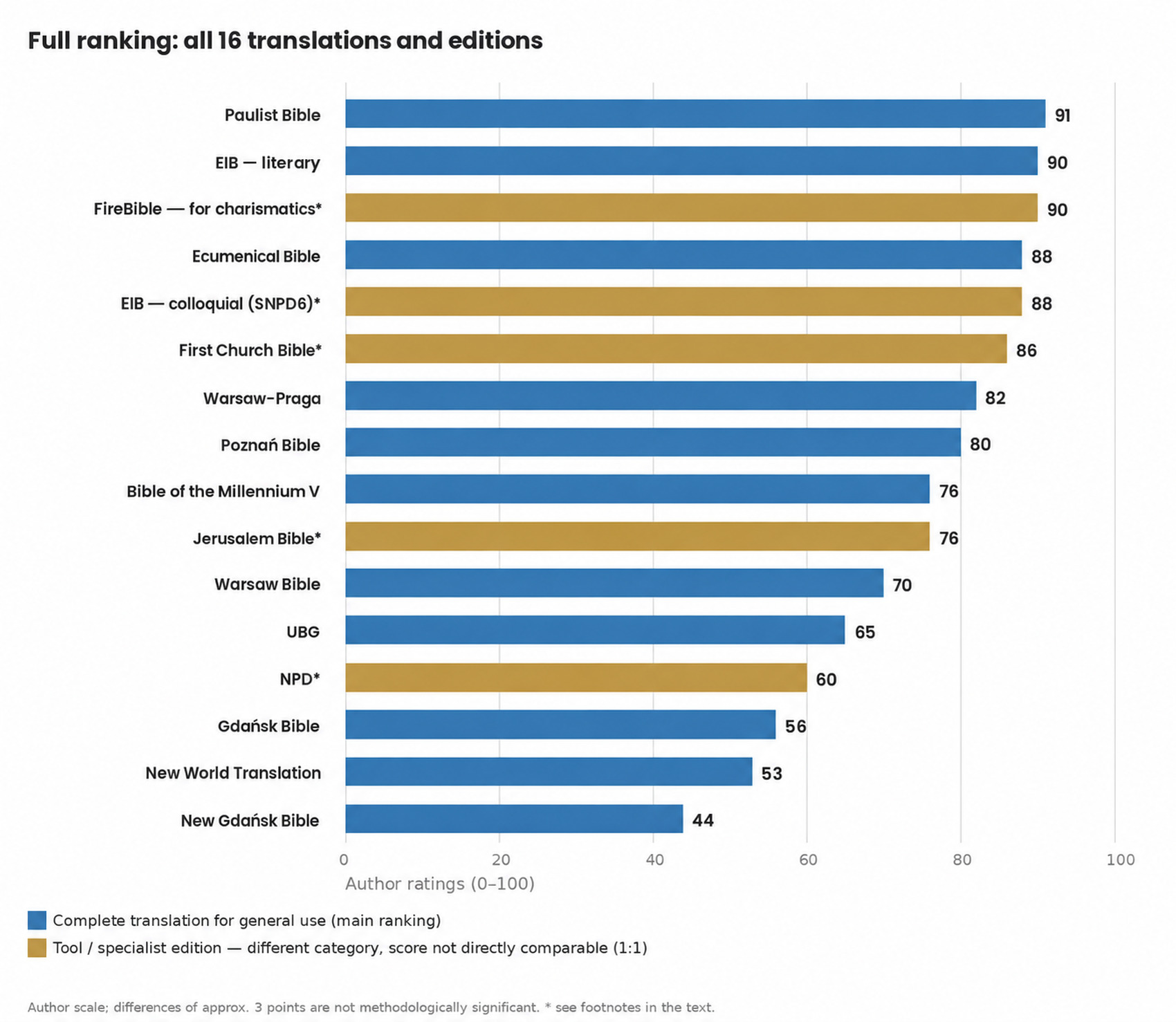
The ranking covers complete, general-purpose translations. Special entries are discussed separately.
Five tests on specific passages
The examples below do not “prove” the overall quality of a translation. What they do show are typical decisions that genuinely change what the reader understands.
Gen 14:22 — the oath idiom
the literal “I raise my hand” preserves the image but does not tell a modern reader that Abram is making a solemn oath. The best translations render the function within the text itself or explain the idiom in a footnote.
Matt 5:5 — praeis
the Polish words for “quiet,” “humble,” and “gentle” are not synonyms. The Greek term combines gentleness with disciplined strength; “gentle” preserves the nuance most fully, “humble” is acceptable, “quiet” can be too narrow. The NBG’s rendering “Rich are the gentle” wrongly alters makarioi (“blessed”).
Matt 5:39 — antistēnai tō ponērō
a literal “do not resist the evil one” can sound like a ban on all resistance whatsoever. The context of the slap, the lawsuit, and forced labor concerns retaliation. The SNP’s “Do not repay evil for evil” clearly conveys the pragmatic sense, though it is an interpretation; it is worth keeping the literal variant in a footnote.
Ezek 34:16 — guard or destroy
the Hebrew verb at this point means to destroy the fat and strong sheep. Majewski points out that the edition of the Biblia Paulistów he discusses has “I will guard.” This is a local error in an otherwise excellent translation, and an example of why a ranking does not exempt a text from textual scrutiny.
Col 1:16–17 — “all things” or “all other things”
the Greek panta means “all things.” The New World Translation adds “other” and repeats the addition, in keeping with a commentary that treats the Son as the first created being. This is a doctrinal interpretation inserted into the main text, not a neutral clarification.
Cf. the Majewski series [S1–S4], the official New World Translation text [S23], and the YouVersion comparisons [S28]. Quotations are limited to short identifying phrases.
Profiles of 16 translations and editions
The following profiles combine information on authorship, textual basis, method, strengths, limitations, and where to buy. Numbers with the letter S denote specialist items, and E denotes editions or projects that cannot be directly compared with a full general-purpose translation.
1. Biblia Paulistów (Holy Scripture of the Old and New Testament)
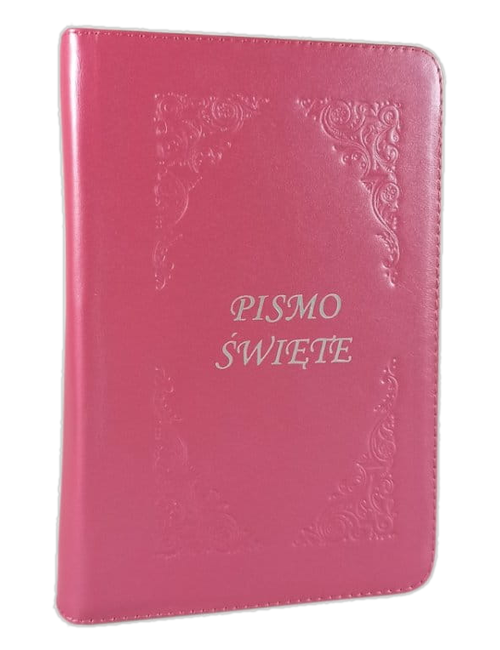
| Status | Complete translation; 73 books |
|---|---|
| First complete edition | 2008 |
| Authors | a team of Polish biblical scholars convened by the Society of St. Paul; about 90 scholars, editors, and linguists |
| Source languages | Hebrew, Aramaic, and Greek |
| Method | functional-semantic, with strong exegetical oversight |
| Scale of the project | 12 years of work; representative edition: 2,784 pages |
| Buy / info | Edycja Świętego Pawła |
This is the best answer to the question: “if I’m going to buy one Bible in Polish that gives me fresh language, the sense of the original, and good aids all at once — what should I choose?” From the outset, the project set out to translate meaning rather than copy Hebrew or Greek word order. In practice, many idioms are already explained within the text itself, while more literal renderings can be relegated to a footnote.
Majewski ranks this translation first, above all for its accurate recognition of idiomatic meaning, its contemporary Polish, and its extensive apparatus. A good example is Gen 14:22: “I raise my hand” is, on its own, an unclear gesture for a modern Pole, whereas in context it is a formula of oath-taking. The Biblia Paulistów brings out the function of the statement. Likewise in Matt 5:5, the choice of “gentle” is closer in meaning to the Greek praeis than the traditional but narrower “quiet.”
The translation is not infallible. Majewski points to Ezek 34:16: in the edition he discusses, “I will guard” is supposed to correspond to a Hebrew verb that at this point means “I will destroy.” This is a good caution: even the best team can make a local error, which is why a score of 91/100 does not mean 91 percent error-free verses.
Strengths
- a very good balance between meaning and natural Polish sentences
- commentary, marginal notes, parallel texts, maps, and a dictionary in one volume
- the full Catholic canon and easy availability in many formats
- high usefulness for daily reading, catechesis, and public reading
Limitations
- in places, interpretation is built into the text more heavily than in formal-equivalence translations
- the Catholic canon and imprimatur may not suit every setting
- for word or syntax study, it needs to be set alongside a literal translation and the source text
Verdict: The overall 2026 winner. The best “one Bible” purchase for most Polish readers; for study, it’s worth adding the literal EIB or an interlinear.
2. EIB — Literary Translation (SNP)
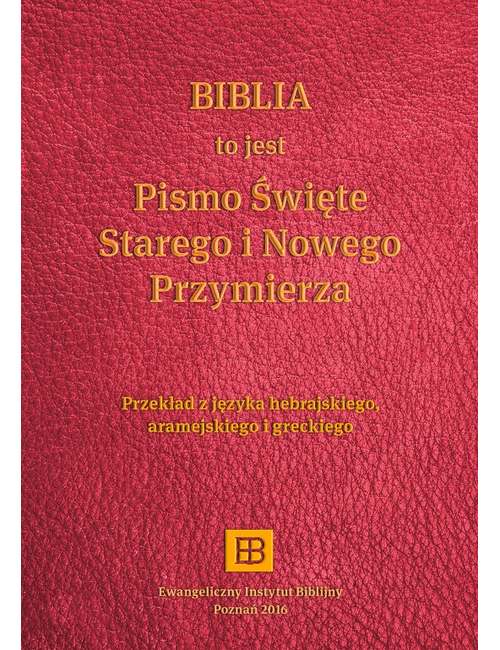
| Status | Complete translation; 66 books |
|---|---|
| Edition | digital 2016; popular print edition 2018 |
| Translators | Piotr Zaremba; Anna Haning (part of the NT) |
| Source languages | Hebrew, Aramaic, and Greek |
| Textual basis | including NA28, the Dead Sea Scrolls, the Aleppo Codex, the Samaritan Pentateuch |
| Statistics | over 80,000 cross-references; PDF edition 1,537 pages |
| Buy / read | FEIB — digital and print editions |
EIB calls its project a “dual translation”: the literary version is meant to sound fluent and natural, while a parallel literal version reveals the structure of the original. This is methodologically very sound. A reader doesn’t have to expect a single text to be Polish literature and a quasi-interlinear at the same time.
The SNP is today the most serious competitor to the Biblia Paulistów. It has a newer, explicitly documented textual base, a very good sentence rhythm, and works beautifully for reading aloud. In Matt 5:39 it chooses “Do not repay evil for evil,” conveying the sense of the ban on retaliation instead of leaving the Polish reader with the ambiguous “do not resist the evil one.” In Matt 5:5 it has “humble” — a possible rendering, though “gentle” better preserves an important nuance of the Greek word.
The author and publisher work within an evangelical setting, but the text is not a simple copy of confessional slogans. It is worth remembering, however, that the size of the team and the review mechanism are narrower than in the Biblia Paulistów or the Biblia Ekumeniczna. FEIB itself recommends reading the literary and literal versions together.
Strengths
- the most contemporary and fluent Polish among the top contenders
- a transparently documented textual base
- a logical pairing with a literal translation
- very good availability — digital, app, and print
Limitations
- a Protestant canon — without the deuterocanonical books
- the literary version sometimes spells out logical relationships
- a smaller diversity of voices on the team than in interdenominational projects
Verdict: The best choice for an evangelical reader and the best Polish text for public reading. In the overall ranking it loses to the Biblia Paulistów only narrowly — a 1-point difference is not substantively decisive.
3. Biblia Ekumeniczna (the Ecumenical Bible)
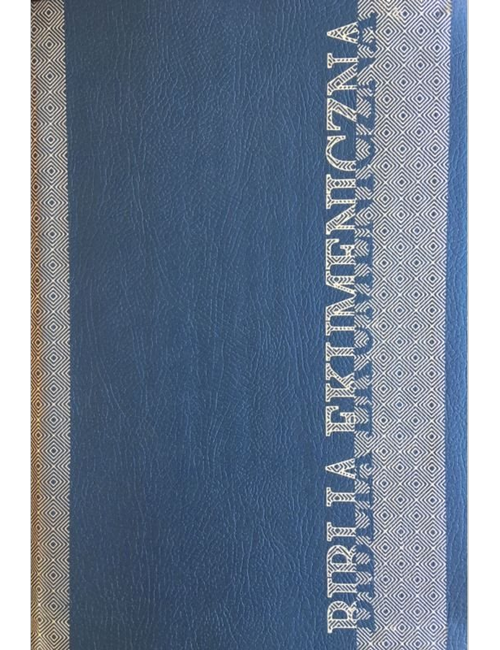
| Status | Complete translation with the deuterocanonical books |
|---|---|
| Complete edition | 2018; earlier portions from 2001 |
| Authors | translators and editors from 11 churches; a project of the Bible Society and the Polish Ecumenical Council |
| Time invested | over 20 years |
| Principle | faithfulness to the source text and contemporary Polish acceptable across denominational lines |
| Edition statistics | 2,408 pages; per the publisher’s description, over 30,000 footnotes and 50,000 cross-references |
| Buy | Liga Biblijna |
The greatest value of the Biblia Ekumeniczna is mutual oversight. Every translation decision had to be intelligible and defensible to biblical scholars from different traditions, which limits the risk of a single doctrine becoming a hidden filter over the whole text. This model matches the shared guidelines of the Catholic Church and the United Bible Societies: a critical source text, collaboration among the team, reviewers and consultants, and explicit variants in the footnotes.
The language is contemporary, but calmer and less “authorial” than the SNP. That’s an asset in interdenominational worship, dialogue, and group work. Sometimes the compromise weakens literary vividness or retains a traditional term where a bolder translation of meaning would be clearer. Yet this is not mediocrity: a shared, common text is the project’s intended achievement.
An important chronological note: 2001 refers to the New Testament, not the complete Bible. The single-volume edition of the whole appeared in 2018. This is a common error in online comparisons.
Strengths
- the best confessional neutrality on the Polish scene
- a broad team and multi-stage review
- a complete edition with the deuterocanonical books
- a very good text for mixed groups and dialogue
Limitations
- compromise can, in places, smooth out an individual book’s style
- less recognized in liturgy and everyday circulation than the BT
- the large study volume isn’t the most convenient to carry
Verdict: The best interdenominational choice. When the goal is a shared table for Catholics, Orthodox, and Protestants, it takes first place in its category.
S1. EIB — Literal Translation (SNPD6)
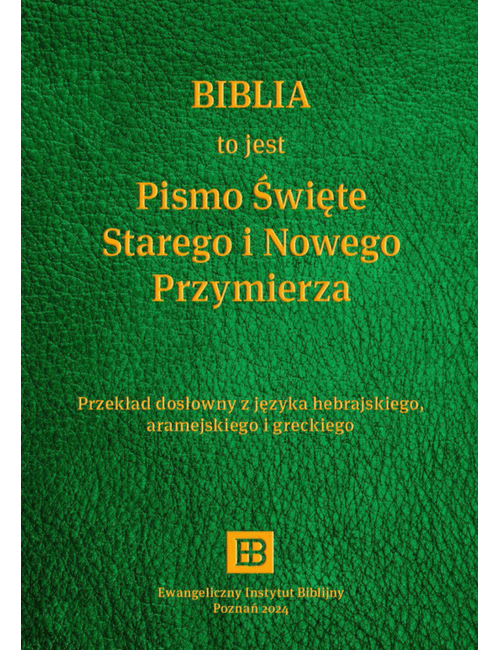
| Category | a study tool; complete translation of 66 books |
|---|---|
| Current edition | 6th, 2024 |
| Translator | Piotr Zaremba |
| Volume | 2,552 pages + a 679-page supplementary publication |
| Method | preserving the correspondence of parts of speech and syntax, insofar as Polish allows |
| Buy / read | FEIB |
The SNPD6 is the most practical Polish bridge between an ordinary translation and working with Hebrew and Greek. The publisher openly does not market it as the most beautiful Bible for continuous reading. Its job is to show what’s happening in the sentence structure, the variants, and the footnotes.
Its own score of 88/100 concerns its study function, not a ranking of texts for general reading. Literalness is not automatically greater faithfulness: a word-for-word rendering of an idiom can faithfully carry the words while unfaithfully carrying the meaning. That’s why the best use is to compare the SNPD6 with the SNP, the Biblia Paulistów, or the Biblia Ekumeniczna.
Strengths
- the best tool set available in Polish
- very explicit variants and documented corrections across editions
- an up-to-date textual base
- useful for preachers, students, and translators
Limitations
- the phrasing is often unnatural — in line with the project’s purpose
- it does not replace knowledge of the source languages
- a Protestant canon
Verdict: The best supporting translation for study. It should not win a “one Bible” ranking, because it does a different job.
4. Biblia Warszawsko-Praska (the Warsaw-Praga Bible)
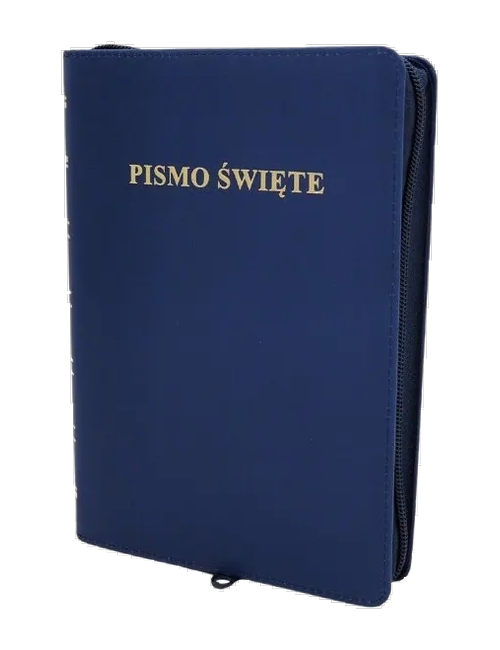
| Status | Complete translation; 73 books |
|---|---|
| Complete edition | 1997 |
| Translator | Bishop Kazimierz Romaniuk |
| Time invested | over 35 years |
| Source languages | Hebrew, Aramaic, and Greek |
| Method | dynamic and communicative |
| Buy | Wydawnictwo M — Biblia Domowa / e-book |
This is a remarkable case: the first complete Polish translation of the whole Bible since Jakub Wujek’s time to be produced essentially by a single translator. As a result it has a consistent voice, rhythm, and coherence. Romaniuk often translates the thought rather than the surface of the sentence, which is why the text works well in pastoral ministry and for a first encounter with the Bible.
Being the work of one person is also a weakness. Every translator has favorite solutions, while a broad team more easily catches idiolect, oversights, and theological shortcuts. Its critical apparatus is more modest than that of the Biblia Paulistów, the Poznań Bible, or the Jerusalem Bible. Even so, it is a serious translation made from the source languages, not a paraphrase.
For today’s reader it still sounds surprisingly fresh. Its position, 4th in the overall ranking, comes from its usefulness and sensible handling of idiom, not from having the most up-to-date textual base.
Strengths
- a coherent style from a single translator
- natural language and a good narrative pace
- the full Catholic canon
- good for beginners and family reading
Limitations
- fewer control mechanisms than in a team translation
- a more modest apparatus of variants
- in some places the interpretation is bold
Verdict: The best Polish single-translator translation for general reading. A good base text, but not the sole one for exegesis.
5. Biblia Poznańska (the Poznań Bible)
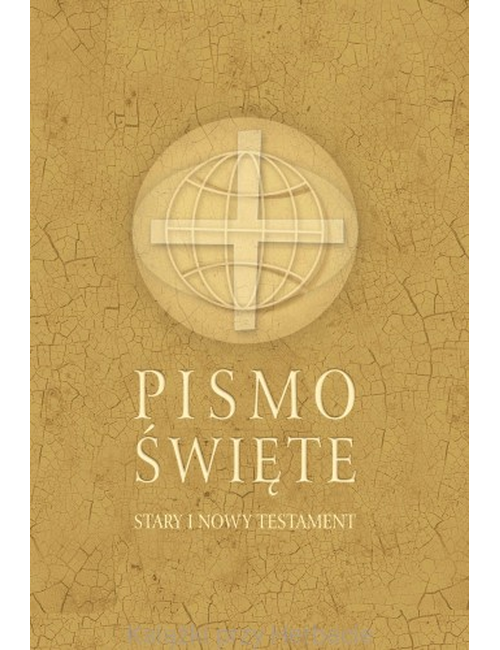
| Status | Complete translation; 73 books |
|---|---|
| First edition | 1973–1975; revised edition 2004 |
| Editors | Fr. Michał Peter (OT), Fr. Marian Wolniewicz (NT), and a team of collaborators |
| Source languages | Hebrew, Aramaic, and Greek |
| Distinguishing feature | very extensive commentary and introductions |
| Buy | Święty Wojciech — Biblia Poznańska |
The Biblia Poznańska is more of a “library with commentary” than a light edition to carry in a bag. Its lasting value lies in extensive introductions, historical notes, and explanations of realia. For a reader without access to a separate commentary, it remains one of the best Polish editions.
The translation itself tends to be explanatory and sometimes shifts interpretation into the main text. From the perspective of the latest textual criticism, the project’s age shows, though the 2004 edition corrected it. The style is less even than in the Warsaw-Praga Bible or the SNP: some books read very well, others retain the academic Polish of the late 20th century.
Majewski places it 6th; in our main ranking it comes 5th, because we separately exclude the BPK and the interlinear from the competition, as they serve different purposes.
Strengths
- the richest traditional commentary in a single-volume Polish translation
- good historical and literary background
- the full canon
- high value for Bible study groups
Limitations
- the language doesn’t sound contemporary everywhere
- its bulk makes it hard to carry daily
- some renderings need checking against a newer translation
Verdict: The best classic Bible with commentary. If commentary matters more to you than the freshest Polish, it may be a better purchase than its 5th-place ranking suggests.
S2. Biblia Pierwszego Kościoła (the Bible of the First Church)
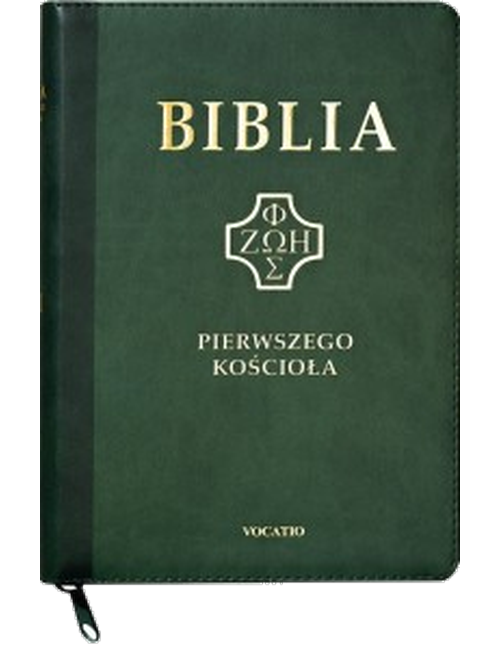
| Category | a specialist translation of the complete Bible |
|---|---|
| Translator | Fr. Prof. Remigiusz Popowski SDB |
| OT basis | the Greek Septuagint, not the Hebrew Masoretic text |
| NT basis | the Greek New Testament text |
| Distinguishing feature | the perspective of the Bible used in the ancient Church; imprimatur |
| Buy | Vocatio — Biblia Pierwszego Kościoła |
The BPK should not be compared one-to-one with translations of the Old Testament from Hebrew. Popowski translates the Greek Septuagint — an ancient translation and textual tradition that the New Testament authors and the first Christians often used. This is exceptionally valuable, but it answers a different question: “what did the Greek Bible of the first communities sound like?”, not “what is the best way to translate the Hebrew Masoretic text?”
The marketing tagline about “the oldest manuscripts used in Jesus’ time” needs a correction. The Septuagint is ancient and can sometimes witness to an older form of the Hebrew text, but it is itself a Greek translation, preserved in various manuscripts. It cannot automatically be called more original in every verse.
Within its own purpose, the BPK deserves 86/100. As the only Bible for studying the Hebrew OT it would be the wrong choice; as a second or third Bible it is priceless.
Strengths
- unique access to the entire Septuagint in Polish
- the consistent style of an outstanding Greek scholar
- excellent for studying OT quotations in the NT
- a complete resource in one volume
Limitations
- the OT is not translated from Hebrew
- its single-author character limits team-based oversight
- the publisher’s promotional shorthand can mislead about the concept of “the original”
Verdict: The best Polish Bible for getting to know the Septuagint and the language of the first Church. A supplement to a Hebrew-based translation, not its replacement.
6. Biblia Tysiąclecia (the Millennium Bible), 5th edition
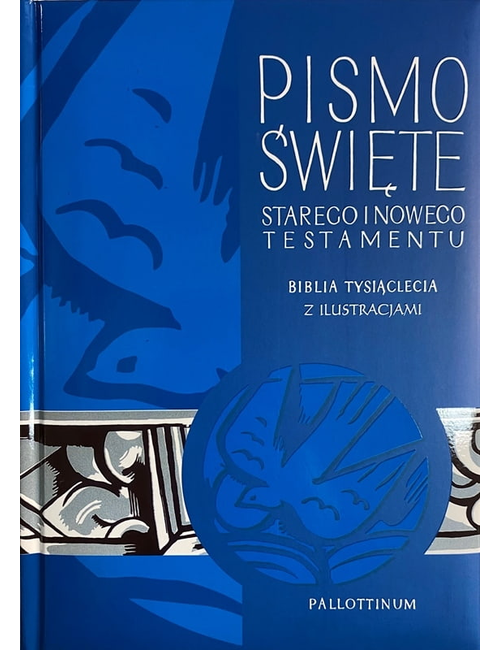
| Status | Complete translation; 73 books; the liturgical text of the Catholic Church in Poland |
|---|---|
| History | 1st edition 1965; 5th edition 1999/2000 |
| Authors | successive teams of Polish biblical scholars under Pallottinum’s editorship |
| Source languages | Hebrew, Aramaic, and Greek |
| Representative edition | 2016, 1,672 pages, ISBN 978-83-7014-882-9 |
| Read / buy | Pallottinum and Biblia.pl |
The Biblia Tysiąclecia is the most important Polish Catholic translation in terms of liturgy, communal memory, and quotability. That, however, is not the same as “best for every purpose.” Its successive editions significantly improved on the first, but the 5th edition still contains Hebraisms, uneven style, and choices shaped by liturgical habit.
Its strength is an enormous social test: the text has been read, commented on, and corrected for decades. Its drawback is the age of its translation base and its caution toward change. In Matt 5:5 the traditional “quiet” is beautiful and familiar, but “gentle” better covers the range of the Greek praeis. In Matt 5:39, “do not resist the evil one” can be read more broadly than the ban on retaliation the context suggests.
The 6th study edition is not yet a complete Bible. In 2025, Volume I appeared, covering the five books of the Pentateuch (593 pages). Pallottinum clearly states that this is a revision of the 5th edition, published in stages and open to feedback. That’s why the 2026 ranking must still concern the complete 5th edition.
Strengths
- irreplaceable for following Polish Catholic liturgy
- the full canon and very wide availability
- recognizable vocabulary and a rich tradition of commentary
- an ongoing revision project
Limitations
- uneven contemporaneity of the language
- some idioms translated too formally
- the 6th edition is so far only partial
Verdict: The best for Catholic liturgy, but not the best as the sole translation for study. In 2026, it’s worth buying the 5th edition and watching how the 6th develops.
E1. Biblia Jerozolimska (the Jerusalem Bible) — Polish study edition
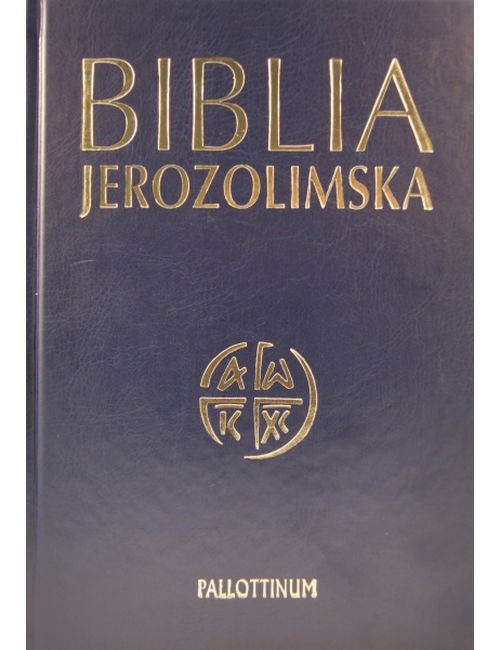
| Category | a study edition, not a separate Polish translation |
|---|---|
| Biblical text | Biblia Tysiąclecia, 5th edition |
| Apparatus | introductions, footnotes, commentary, and marginal notes from La Bible de Jérusalem, Paris 1996 |
| Polish edition | 2006; numerous later bindings |
| Representative edition | 1,810 pages, ISBN 978-83-7014-519-4 |
| Buy | Pallottinum |
The most common ranking mistake: giving the Jerusalem Bible a separate score for the quality of its “translation.” The Polish biblical text is the BT V. What is distinct in its own right is the outstanding apparatus of the École Biblique: introductions to the books, variants, commentary, and a dense network of cross-references.
That’s why we give two scores: the text scores 76/100 — identical to the BT V — while its study function scores 90/100. This is one of the best examples of why translation must be separated from edition. The cover and title may suggest a new version, but Pallottinum’s own website plainly states the source of the text and the commentary.
For a Catholic reader who wants one large volume for serious study and navigating cross-references, this may be a better purchase than the plain BT. For someone looking for more contemporary Polish, it is not.
Strengths
- excellent introductions and cross-references
- high historical, literary, and exegetical value
- the full canon and an imprimatur
- good for preparing to study a book
Limitations
- it is not a separate translation
- the commentary comes from the French tradition and the 1996 edition
- large volume and pricier editions
Verdict: The best Catholic single-volume study edition, but its text should be evaluated exactly as the BT V.
7. Biblia Warszawska (the Warsaw Bible)
| Status | Complete translation; 66 books |
|---|---|
| Complete edition | 1975 |
| Authors | the Bible Translation Commission convened by the British and Foreign Bible Society |
| Source languages | Hebrew and Greek |
| Tradition | the main Polish Protestant translation of the latter half of the 20th century |
| Buy | Liga Biblijna / the Bible Society |
The Biblia Warszawska is the Protestant equivalent of the Biblia Tysiąclecia’s social role: many people pray in its phrases, memorize its verses, and hear it in worship. For 1975 it was modern; half a century later, its date of origin is audible.
Its formal-equivalence tendency can help when comparing words, but it can also be a trap. Hebrew or Greek word order does not always carry the same information into Polish. In Matt 5:39, “do not resist the evil one” is lexically close, but a modern reader may take it as a general ban on offering resistance, whereas the context concerns retaliation and escalation.
There’s no reason to throw the Biblia Warszawska out of your library. It is a stable point of reference and has a huge ecosystem of editions. It should not, however, decide detailed exegesis on its own, when the newer SNP, BE, and SNPD6 are available.
Strengths
- an established, serious register of language
- wide availability and many formats
- important to the history and liturgy of Polish Protestantism
- a good check against dynamic translations
Limitations
- the language and scholarly base are over half a century old
- frequent syntactic calques
- no deuterocanonical books
Verdict: A solid Protestant classic, but for today the better first choice is the SNP or the Biblia Ekumeniczna.
8. Uwspó&322;cze&347;niona Biblia Gda&324;ska (the Modernized Gdańsk Bible, UBG)
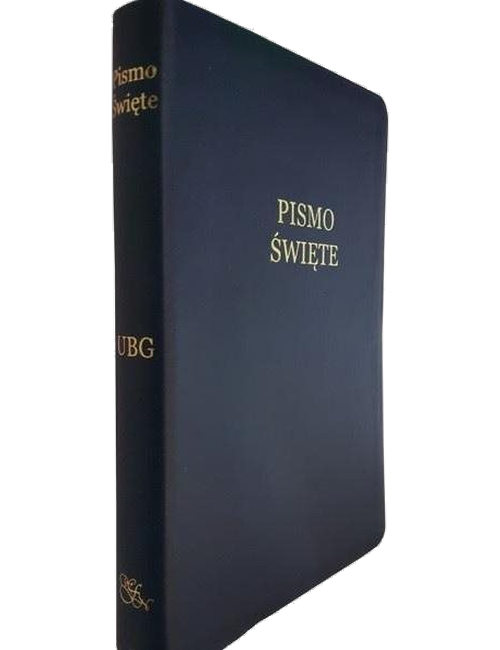
| Status | Complete Bible; 66 books |
|---|---|
| Complete edition | 2017 |
| Authors | the team of the Fundacja Wrota Nadziei |
| Character | a modernization of the Gdańsk Bible, not an entirely new critical translation |
| Textual tradition | the Masoretic text and the Textus Receptus, via the Gdańsk Bible tradition |
| Buy / download | Wrota Nadziei — free files and store |
The UBG performs a clearly defined task: preserving the theology, structure, and tradition of the Gdańsk Bible while removing the most glaring Old Polish. The publisher clearly distinguishes it from the New Gdańsk Bible (NBG). That matters, because the names are often confused.
Its strength is predictability. A reader committed to the Reformation tradition and the Textus Receptus gets a text more readable than the original Gdańsk Bible. The limitation is built into the project: where the Gdańsk Bible has an outdated base or an awkward interpretation, the modernization cannot always freely fix it without departing from the base text.
Faithfulness therefore needs to be defined in two ways: the UBG is faithful to the Gdańsk Bible, but not always to the earliest attainable form of the biblical text. In a modern ranking of critical translations, this must lower its score.
Strengths
- a readable modernization of an important heritage
- free digital availability
- consistent terminology
- good for communities committed to the TR
Limitations
- not a from-scratch translation from the latest critical editions
- dependence on the Gdańsk Bible’s choices
- no deuterocanonical books
Verdict: The best choice within the Gdańsk tradition, but not the best answer to the question of the most faithful translation by modern textual criticism.
9. Biblia Gdańska (the Gdańsk Bible)
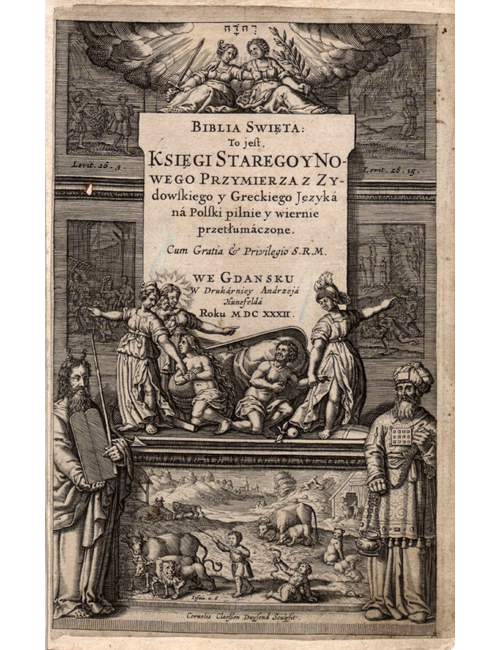
| Status | The historic complete Protestant translation; traditionally 66 books in modern editions |
|---|---|
| Edition | 1632; widely used 1881/1879 revision |
| Authors | a Reformed and Lutheran team; chief editor Daniel Mikołajewski |
| Basis | the Hebrew text of the time and the Greek Textus Receptus |
| 2026 availability | free digital editions; printed reprints and NT editions |
| Read / buy | Wydawnictwo Słowa Czyste |
The Biblia Gdańska is a monument of the Polish language and the foundation of the Protestant tradition. It should not be mocked for its archaisms: it did its job superbly for a 17th-century audience. The problem arises when historical prestige turns into the claim that an older translation must be closer to the autographs.
Modern textual criticism has manuscripts, methods, and editions that the translators of the Gdańsk Bible could not have known. The Textus Receptus contains later variants; Old Polish syntax has shifted the meaning of many words. This is not a moral accusation, but the consequence of four centuries of scholarship and linguistic change.
The Gdańsk Bible has high comparative, liturgical, and literary-historical value. For settling textual disputes on its own in 2026, it is insufficient.
Strengths
- enormous historical and literary significance
- a consistent, elevated register
- public domain and easy digital access
- important for the history of Polish Protestantism
Limitations
- archaic semantics and syntax
- the Textus Receptus rather than a modern critical NT text
- no modern apparatus of variants in the popular editions
Verdict: Read it as a classic and a text of tradition; don’t choose it as the sole Bible for contemporary exegesis.
10. The New World Translation of the Holy Scriptures
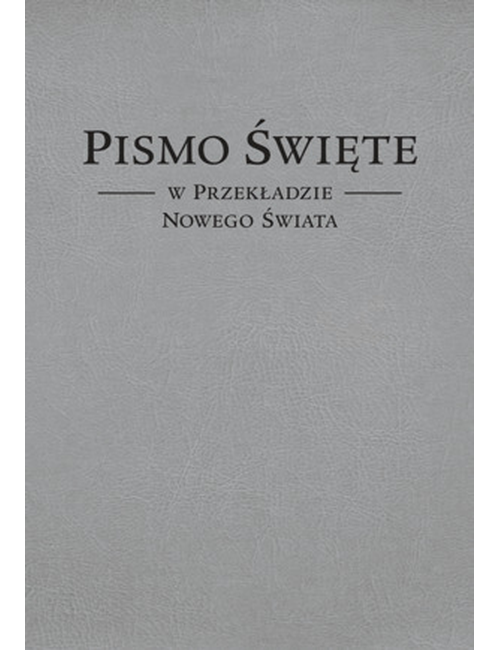
| Status | Complete Bible; 66 books |
|---|---|
| Polish editions | 1997; revised 2018 |
| Authors | the anonymous New World Bible Translation Committee and an anonymous Polish team under Watch Tower supervision |
| Translation chain | the first Polish edition was based on the 1984 English edition; the 2018 revision draws on the 2013 English revision and consultation of the originals |
| Publisher’s statistics | 1,828,521 Polish copies by 2018; the name “Jehovah” appears 7,216 times, including 237 times in the NT |
| Read / obtain | JW.ORG and a local congregation |
Evaluating the New World Translation requires separating two things. First, the text has many successful, clear, and idiomatic sentences; Majewski openly acknowledges this. Second, the official history confirms that the Polish translation was made through the English version, that the teams are anonymous, and that there is strict denominational oversight. This lowers transparency and increases the risk of inheriting interpretations from an intermediate language.
The best-known problem is the insertion of the name “Jehovah” into the NT despite the word’s absence from the surviving Greek NT manuscripts — the publisher itself lists 237 such places. Another example can be checked in the official text of Col 1:16–17: “all other things” appears repeatedly, even though the Greek text has panta, “all things,” without the word “other.” The addition harmonizes the verse with the doctrine that Christ is the first created being; the publisher’s own commentary explains exactly this interpretation.
This doesn’t mean every verse is bad, or that a reader should avoid comparison. It means the New World Translation should not be the sole basis for doctrine. The most honest use: compare it with the BE, the SNP, the Biblia Paulistów, and the Greek critical text.
Strengths
- very contemporary, readable language in the 2018 revision
- an extensive free app, audio, and footnotes
- terminological consistency
- many accurate renderings, independent of the controversial passages
Limitations
- the Polish translation is dependent on the English template
- anonymity and low external transparency of the team
- documented additions of doctrinal significance, e.g. “other” in Col 1
- inserting the name Jehovah into the NT without a Greek counterpart in the surviving manuscripts
Verdict: Useful as a comparison translation and for learning the language of Jehovah’s Witnesses; not advisable as the sole Bible for exegesis or formulating doctrine.
E2. Nowy Przekład Dynamiczny (the New Dynamic Translation, NPD)
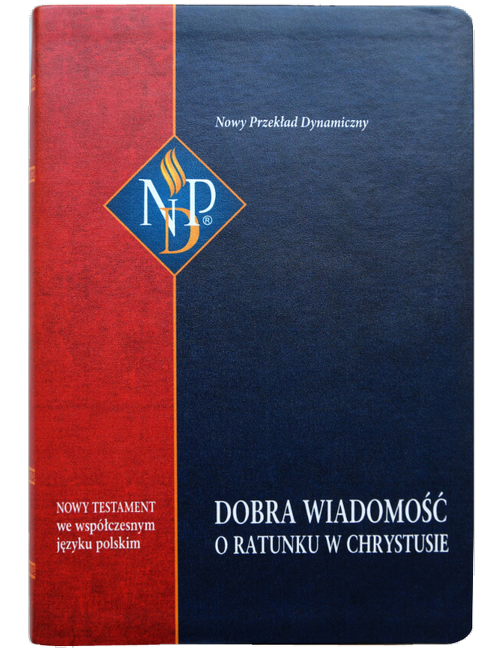
| Status | A complete New Testament; the Old Testament is appearing book by book — the project is not yet a complete Bible |
|---|---|
| Complete NT | Warsaw 2021 |
| Authorship | the NPD editorial team; publisher: Wydawnictwo NPD Piotr Wacławik |
| Method | dynamic, in places explicitly interpretive |
| NT statistics | 1,424 pages + 8 maps; 6,260 footnotes, 15,650 sigla, and 264 comments |
| Buy | Biblia NPD / Vocatio |
The NPD is the most communicative project in this comparison. The publisher itself honestly states that the priority is the main idea, and that the text is in places interpretive in character. That matters: the issue is not dynamism as such, but confusing an explanatory paraphrase with neutral material for analyzing individual words.
The rich apparatus is impressive, but the number of footnotes doesn’t guarantee neutral commentary. The label “non-confessional” is a publisher’s declaration, not a method of verification. Every extensive commentary carries theological decisions. The NPD works excellently for a first encounter, narrative catechesis, and comparison; it is weaker for building an argument on the exact wording of a single verb.
In 2026 the NPD cannot be ranked as a complete Bible: the whole NT is available, but the OT books are being published in stages. That’s why its score of 60/100 for the base-translation function and 85/100 for communication remains outside the main ranking.
Strengths
- exceptional clarity for people outside church language
- a large apparatus of explanations and maps
- honest declaration of its dynamic method
- audio and thematic editions available
Limitations
- the project does not yet cover the whole Bible
- interpretation is often present in the main text
- the commentary isn’t neutral simply because the publisher uses that label
Verdict: The best Polish paraphrase/communicative version as a supporting text. Don’t use it alone to settle doctrine or philology.
11. Nowa Biblia Gdańska (the New Gdańsk Bible, NBG)
| Status | Complete Bible; 66 books |
|---|---|
| Complete edition | 2012 |
| Translator / editing | Władysław Karbowicz; the Silesian Bible Society |
| OT basis | a modernization of the Gdańsk Bible supported, among other things, by Izaak Cylkow’s translation and the Septuagint; not a complete direct translation from Hebrew |
| NT basis | the Textus Receptus |
| Read / buy | Online text and print editions |
The NBG comes last both in Majewski’s ranking and in our main ranking. The reason isn’t denominational: it’s about method and linguistic result. The name suggests a new Bible in the Gdańsk tradition, but the OT was produced by editing existing translations, not through a systematic translation of the whole Hebrew text by a team of Hebraists.
The strangest Polish constructions stand out most. In Matt 5:5 the NBG has “Rich are the gentle,” where the Greek makarioi means “happy/blessed”; the combination creates a meaning absent from the source. Elsewhere, unnatural uses of “noble,” “to worship God to someone,” or elaborate added phrases make reading harder.
Individual verses can be apt, and online access itself makes comparison easier. This doesn’t compensate for the lack of a transparent modern base and unpredictable Polish.
Strengths
- free online text
- a clear TR-tradition identity
- occasionally interesting alternative renderings
Limitations
- unnatural and, in places, incorrect Polish
- the OT was not consistently translated directly from Hebrew
- the Textus Receptus in the NT
- a non-transparent review process
Verdict: Not recommended as a primary Bible. It can serve only as comparative material for studying the history of modern Gdańsk-tradition currents.
E3. FireBible — the Bible for Charismatics
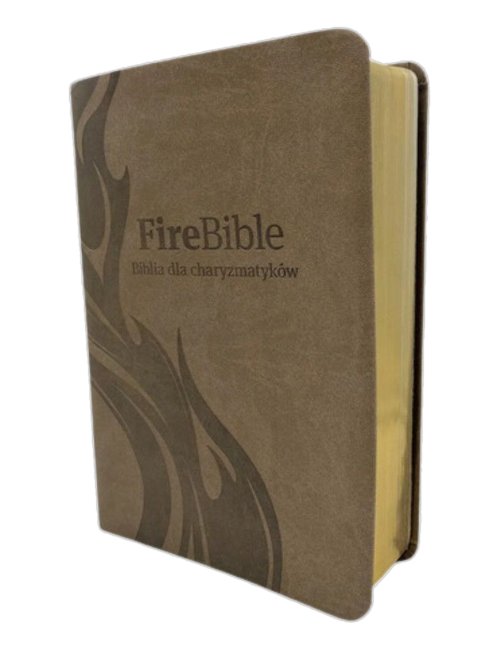
| Status | A study edition — not a separate translation; the text = the EIB literary translation (SNP) |
|---|---|
| First edition | Poland, 2022 |
| Publisher | the Pentecostal Church in Poland / Wydawnictwo Mądra Książka; original concept: Life Publishers International (Full Life Study Bible) |
| Biblical text | identical to the EIB literary translation (SNP), Piotr Zaremba |
| Commentary method | 5 types of notes (explanatory, theological, edifying, ethical, practical) from a Pentecostal/charismatic perspective |
| Scale of the project | about 530 pages of apparatus; 79 articles, 39 maps, over 80,000 cross-references, a concordance |
| Buy | FireBible.pl |
FireBible is the Polish edition of the internationally known Full Life Study Bible project — the first study edition of this scale prepared from a Pentecostal and charismatic perspective. The biblical text itself is not a new translation: it is the same EIB literary translation (SNP) that takes 2nd place in our overall ranking with a score of 90/100. FireBible’s added value lies solely in its commentary layer.
The supporting apparatus really is large: 79 articles, nearly 40 maps, over 80,000 cross-references, and five kinds of notes — including practical notes on healing, spiritual warfare, or baptism in the Holy Spirit. This fills a real gap in the Polish market: there had not previously been a study Bible written explicitly from this theological perspective, even though the Pentecostal and charismatic movement is numerous in Poland.
However, two evaluations need to be kept separate. As a translation, FireBible inherits the EIB literary translation’s score — 90/100 — because it is literally the same text. As a commentary, we do not apply the same point scale as for translations: the theological notes are openly confessional (a Pentecostal perspective), so their value depends on whether the reader shares that theology, not on neutral philological criteria.
Strengths
- a text identical to the well-regarded EIB literary translation (fluent, contemporary Polish)
- a very extensive apparatus: 79 articles, 39 maps, a concordance, over 80,000 cross-references
- the only study edition of this scale in Polish written explicitly from a Pentecostal/charismatic perspective
- useful for leaders and pastors preparing teaching on the gifts of the Spirit
Limitations
- this is not a separate translation — every reservation about the EIB literary translation (profile 2) also applies to the FireBible text
- the commentary is openly confessional — to readers outside the Pentecostal/charismatic tradition it may sound one-sided
- a high price (about 200–230 PLN) and a large, heavy format compared with a plain SNP edition
Verdict: As a translation — the same as the EIB literary translation, 90/100. As a study edition — the richest supporting apparatus available in Polish for a reader from the Pentecostal/charismatic tradition; for everyone else, the text alone is worth recommending, but the commentary is best read consciously as the voice of one particular theological tradition, not a neutral exegetical treatment.
A tool outside the ranking: the interlinear translation
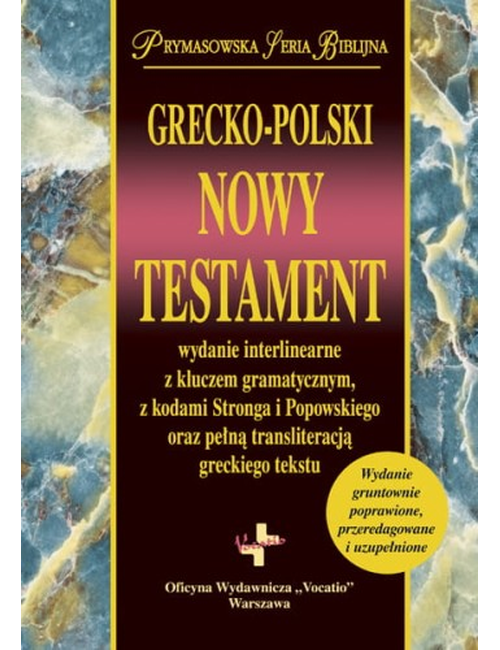
An interlinear sets source-language forms alongside the most mechanical possible equivalents and grammatical information. It is superb for seeing that a single Polish word can hide several different Greek or Hebrew words. It is not, however, a finished translation of a sentence. Word order, the range of meanings, and idioms all require interpretation.
Majewski placed the interlinear at 7th place. In our approach it receives no points, because that would be like scoring a dictionary in a ranking of novels. Best use: the source text + morphological analysis + two ordinary translations + a good lexicon. Worst use: picking from the dictionary’s list of meanings whichever one fits a conclusion already decided in advance.
Rule of thumb: An interlinear helps you ask better questions. On its own it rarely gives a complete answer.
How to buy: one, two, or three Bibles
If you’re buying one
- Biblia Paulistów — the most universal recommendation.
- EIB literary — if you want a Protestant canon and the most fluent Polish.
- Biblia Ekumeniczna — if the text needs to serve a group of different denominations.
If you’re buying two
- Biblia Paulistów + EIB literal: meaning and language versus structure and variants.
- SNP + Biblia Ekumeniczna: evangelical fluency and interdenominational oversight.
- BT V + Biblia Jerozolimska does not give you two translations — it gives you the same text with a different apparatus. If you want a real comparison, let your second Bible be the Biblia Paulistów, the BE, or the SNP.
If you’re buying three
- a fluent translation (Biblia Paulistów or SNP), a control translation (BE), a literal tool (SNPD6 or an interlinear).
- the BPK as a fourth direction, when you’re studying the Septuagint, OT quotations in the NT, or patristics.
You don’t need to buy a print copy right away to get started. If you’d rather listen than read (or just want to try a translation before buying it), check out our roundup Free Audio Bible.
The final answer
The best Polish Bible translation for today, in the sense of the balance between faithfulness, natural language, and usefulness, is the Biblia Paulistów. The most modern alternative — and for many Protestants, the number-one choice — is the EIB literary translation. The safest shared text is the Biblia Ekumeniczna.
The most faithful practice isn’t faithfulness to a single cover. It is the discipline of comparison: when a sentence carries doctrinal weight or reads unusually smoothly, check a second translation, a footnote, and, where possible, the source text. Differences don’t have to weaken trust in the Bible; most often they show where the ancient text is ambiguous, or where Polish forces a choice.
Final recommendation: For most readers: the Biblia Paulistów. For an evangelical setting: the EIB literary translation. For study: always add the EIB literal translation or an interlinear. Don’t build important doctrine on a single Polish wording.
See also
- The Bible – How to Read and Study It?
- Free Audio Bible
- The Bible, Holy Scripture – an Extraordinary Book
- The Apocrypha in Light of the Bible and History
Sources and bibliography
[S1] Marcin Majewski, The Best and Worst Bible Translations — Part I
[S3] Marcin Majewski, Part III
[S4] Marcin Majewski, Part IV — Top 5
[S5] Marcin Majewski, How Translations Change the Bible
[S6] Edycja Świętego Pawła — description of the translation and edition
[S7] EIB — literary translation, description and metadata
[S8] EIB — literal translation SNPD6
[S9] The Polish Ecumenical Council — the Biblia Ekumeniczna has been published
[S10] Biblia Ekumeniczna — publishing metadata
[S11] Vocatio — Biblia Pierwszego Kościoła
[S12] Pallottinum — Biblia Tysiąclecia V
[S13] Pallottinum — Biblia Tysiąclecia VI, study Volume I
[S14] Pallottinum — Biblia Jerozolimska
[S15] Święty Wojciech — Biblia Poznańska
[S16] Wydawnictwo M — Biblia Warszawsko-Praska / Biblia Domowa
[S17] The Polish Ecumenical Council — Biblia Warszawska
[S18] Fundacja Wrota Nadziei — Uwspó&322;cze&347;niona Biblia Gda&324;ska
[S19] Wikimedia Commons — the 1632 title page of the Biblia Gda&324;ska, public domain
[S20] Wydawnictwo Słowa Czyste — Biblia Gda&324;ska 1632
[S21] Nowa Biblia Gda&324;ska — online text
[S22] JW.ORG — the history of the Polish 2018 NWT revision
[S23] JW.ORG — the official text of Colossians 1
[S24] Biblia NPD — the complete New Testament, method, and statistics
[S25] German Bible Society — Nestle-Aland 28
[S26] German Bible Society — Biblia Hebraica Quinta
[S27] Guidelines for Interconfessional Cooperation in Translating the Bible, 1987
[S28] YouVersion — comparisons of short passages across many Polish translations
[S29] Vocatio — the interlinear Greek-Polish New Testament
[S30] FireBible — the Bible for Charismatics, Polish edition
Methodological literature: Eugene A. Nida, Charles R. Taber, The Theory and Practice of Translation, 1969; Ernst-August Gutt, Translation and Relevance, 2nd ed., 2000. Product data, page counts, and availability refer to representative editions checked on September 1, 2026; bindings, prices, and stock levels may change.