

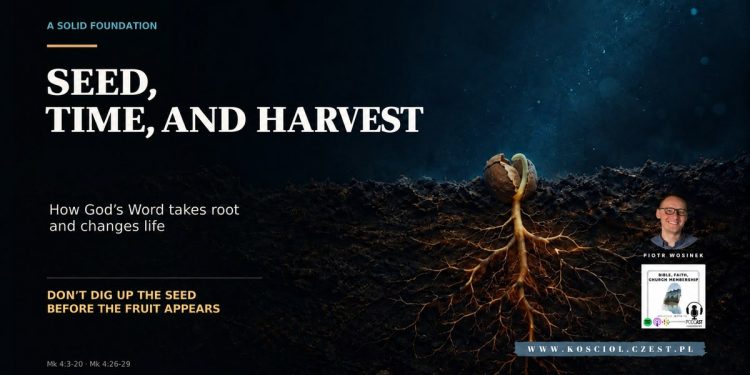
You hold a seed in your hand—a bean, a sunflower seed, or an apple pip. How much fruit can you see in it? None. And yet hidden inside is the potential for an entire future harvest. The Word of God is a seed like that too.
Watch on YouTube
Listen to the Podcast
No one goes out to an empty field in autumn and gets angry at the ground for having no harvest, when they planted nothing in spring. In farming, we understand this principle without any trouble. In our spiritual life we forget it very often—we want peace, yet feed fear in ourselves all week; we want a good relationship, yet nurse a grudge; we want bold faith, yet listen to the Word for five minutes and to the voice of the problem for hours.
You will not see a harvest from what you most desire. The harvest grows from what you actually sow.
“Do not be deceived: God is not mocked, for whatever one sows, that will he also reap. […] And let us not grow weary of doing good, for in due season we will reap, if we do not give up.”
Galatians 6:7–9
The Kingdom of God works like a seed
“The kingdom of God is as if a man should scatter seed on the ground. He sleeps and rises night and day, and the seed sprouts and grows; he knows not how. […] But when the grain is ripe, at once he puts in the sickle, because the harvest has come.”
Mark 4:26–29
Jesus did not compare His Word to information you could jot down in a notebook and never return to. He compared it to a seed—a potential that must be placed in the right environment for the process of life to begin. The Word was not given to us merely so that we would know it, but so that it would live in us and bear fruit.
The kind of seed determines the kind of fruit. If you plant an apple seed, you will not get an orange—and the various beliefs we “sow” in ourselves every day carry very different fruit:
| Belief being sown | Fruit in the heart and behavior |
|---|---|
| “I am alone and everything depends on me” | Fear, controlling people, overload |
| “God does not abandon me and I can trust Him” | Peace, perseverance, trust |
| “People always want to hurt me” | Suspicion, closing off from others |
| “I can speak the truth in love” | Healthy boundaries, reconciliation, mature communication |
| “Nothing will ever change” | Passivity, discouragement, resignation |
| “With God I can take the next step” | Hope, a good future |
In this passage the Greek word automatē appears—”of itself.” A farmer cannot produce life inside a seed with his own hands—he can only plant it, water it, protect it, and wait. Neither can we produce a lasting spiritual transformation by sheer willpower. But we can receive the truth, meditate on it, obey it, and remove what drowns it out. That is not passivity—it is cooperation with the life that God gives.
The heart is the soil
“Listen! Behold, a sower went out to sow. […] And other seeds fell into good soil and produced grain, growing up and increasing and yielding thirtyfold and sixtyfold and a hundredfold.”
Mark 4:3–9
In the parable, neither the sower nor the seed changes—only the condition of the soil changes. The question is not “does the Word have power?” but rather: what happens in my heart with what God is saying to me? The biblical “heart” is not just feelings, but thoughts, beliefs, decisions, and the direction of one’s life—which is why the Book of Proverbs says plainly: “Keep your heart with all vigilance, for from it flow the springs of life” (Proverbs 4:23).
Listening in the biblical sense is more than being present in a room where people talk about God. It involves five levels:
| Level | What happens | Checking question |
|---|---|---|
| I hear | The content reaches me | What was said? |
| I understand | I see the meaning and context | What does this really mean? |
| I receive | I recognize the truth as addressed to me too | What is God showing me? |
| I apply | I make a specific decision | What will I do differently? |
| I persevere | I don’t give up before the fruit appears | How will I protect this truth? |
You can get a good diagnosis from a doctor, take a photo of it on your phone, praise the doctor—and never begin treatment. In the same way, you can have several Bibles at home and still build your life according to entirely different voices. The mere availability of truth changes nothing—it must be received and applied.
Root and time: the most important part is often invisible
When a seed begins to sprout, its first task is not to show itself to the world—first it directs life downward, so that a root can form. Only later does growth become visible above the ground. In our spiritual life there is a similar hidden stage: prayer, meditating on the Word, correcting beliefs, small decisions of obedience. No one applauds at that point, and the result may not yet be spectacular. But that time is not wasted—a root system is forming that will later sustain the fruit.
God often first builds in you what people don’t see, so that later He can entrust you with what they will.
Imagine a farmer who digs up his seed every day, examines it, and puts it back in the ground—his impatience would destroy the very process he wants to see. We do something similar spiritually when one day we embrace God’s promise, and the next day declare that “nothing is working” because there was no immediate result. Faith does not deny the facts—it simply refuses to give visible circumstances the right to have the final word.
| The “instant result” culture | The rhythm of the Kingdom |
|---|---|
| “If it doesn’t work right away, change your method” | “Stay with the truth long enough for it to take root” |
| What counts is the quick result | What counts is lasting fruit |
| Compare your outcome with others | Be faithful at the stage you’re at |
| The hidden stage is a waste of time | The hidden stage builds the capacity for future growth |
Four kinds of soil — four responses to the same Word
“But those that were sown on the good soil are the ones who hear the word and accept it and bear fruit, thirtyfold and sixtyfold and a hundredfold.”
Mark 4:14–20
| Soil | What happens to the Word | Main danger | Response needed |
|---|---|---|---|
| Along the path | It stays on the surface and is taken away | Lack of attention and understanding | Stop, ask questions, reflect |
| Rocky ground | It springs up quickly, but has no root | Shallowness, giving up under trial | Build regularity and perseverance |
| Thorns | It grows, but gets choked | Worries, striving, excess of desires | Remove what steals your light and attention |
| Good soil | It is heard, received, bears fruit | Not trouble-free, but tended | Protect, apply, and persevere |
The soil with thorns is the most deceptive, because the seed really does grow—the problem is not open rebellion, but competition for the attention, time, and energy of the heart. Modern-day thorns include, among others:
- constant notifications and an inability to sit in a few minutes of silence;
- endlessly comparing your own life to other people’s;
- work that has stopped being a task and become a source of identity;
- a worry chewed over every day, but never handed over to God;
- an excess of good activities that leaves no room for what matters most;
- a grudge that keeps retelling the story of the hurt.
Good soil often does not have more space than the rest—it simply has fewer thorns.
How to protect the Word that has been sown
- Pay attention. Whatever you regularly give your attention to gains the chance to grow within you.
- Meditate, don’t just read. Return to a single truth, examine it from different angles, ask questions.
- Speak in agreement with the truth that has been sown. Don’t dig up with your own words what you are trying to root.
- Apply what you say. If the Word speaks about forgiveness, generosity, or reconciliation—take a concrete step with it.
- Stay in community. The seed is personal, but growth doesn’t have to be solitary—we need people who will remind us of the truth when our emotions say something else.
The storm reveals the foundation
“And they woke him and said to him, ‘Teacher, do you not care that we are perishing?’ And he awoke and rebuked the wind and said to the sea, ‘Peace! Be still!’ And the wind ceased, and there was a great calm.”
Mark 4:38–39
Jesus had told the disciples, “Let us go across to the other side”—not “let’s sail out to the middle and perish there.” They had a word, but at the moment of testing, the image of the waves loomed larger in their minds than what they had heard. Fear interpreted Jesus’ silence as a lack of care: “don’t you care at all?” The same thing happens to us when a circumstance becomes the basis for judging God’s character.
The storm doesn’t create the foundation—it reveals it.
| The image of the seed | The image of the house | Shared truth |
|---|---|---|
| The seed is received into the soil | The Word is put into action | Hearing alone is not enough |
| The root grows underground | The foundation is beneath the building | The most important support is often invisible |
| Heat tests the root | The storm tests the foundation | Testing reveals how deep the roots go |
| Fruit appears over time | The house endures through the seasons that follow | The goal is durability, not a momentary effect |
A personal audit of what you’re sowing
Let’s not stop at admiring a good parable—Jesus explained it so that we would recognize the state of our own heart and respond. Instead of choosing ten resolutions, pick one area and honestly finish these sentences:
| Area of life | What am I currently reaping? | What seeds are reinforcing this? |
|---|---|---|
| Relationship with God | ||
| Thoughts and emotions | ||
| Marriage / family | ||
| Relationships in the Church | ||
| Work and finances | ||
| Calling / ministry |
A 7-day exercise: choose one passage that matches the area where you need growth.
- Write the passage down by hand or as a reminder on your phone.
- Read it morning and evening, in the context of the whole paragraph.
- Put into your own words what it reveals about God and about your situation.
- Notice the voice that tries to drown it out.
- Take one small decision in line with the truth.
- Share with someone what you are sowing.
- After seven days, ask not only “did the circumstances change?” but also: “what has begun to change in me?”
Don’t dig up the seed before the harvest
Perhaps today you are looking at some area of your life and still don’t see fruit. The absence of a visible result doesn’t always mean nothing is happening—perhaps a root is forming right now, perhaps a stone needs removing, or perhaps the Word has been choked by a worry that would finally be worth handing over to God. Sow the Word. Guard your heart. Give the roots time. Remove the thorns. Take the next faithful step.
“And let us not grow weary of doing good, for in due season we will reap, if we do not give up.”
Galatians 6:9
Prayer
Father, we thank You for Your Word—it is not empty information, but carries life, truth, and direction. Break up in us whatever has become hard. Remove the stones that keep us from putting down roots. Show us the thorns that have taken up too much space. Give us good and honest hearts—ready to hear, receive, hold fast, and obey. Give us patience for the season of hidden growth, and when the storm comes, remind us of what You said before the storm. In the name of Jesus. Amen.
An important clarification
Not every hardship in life is the result of poor sowing—the Bible acknowledges the suffering of the innocent and persecution, and the principle of sowing and reaping speaks about our responsibility for what we accept and cultivate, not about a right to judge those who suffer. Faith likewise does not deny emotions and facts—it acknowledges their reality, but does not let fear or a momentary picture of the situation have the final word.
If this teaching has touched some area of your heart and you would like to talk, pray together, or simply get to know our community—contact us or find out when and where we meet. If you would like to go deeper into the topic of prayer, also check out our article on prayer that works.