


Sanctification is not an attempt to earn acceptance from God. In Christ, our spirit was sanctified once for all, and through the renewing of the mind that holiness is meant to become visible in our soul, body, choices, and relationships. “For by one offering He has perfected forever those who are being sanctified” – Hebrews 10:14.
Watch on YouTube
Listen to the Podcast
The Main Idea of This Teaching
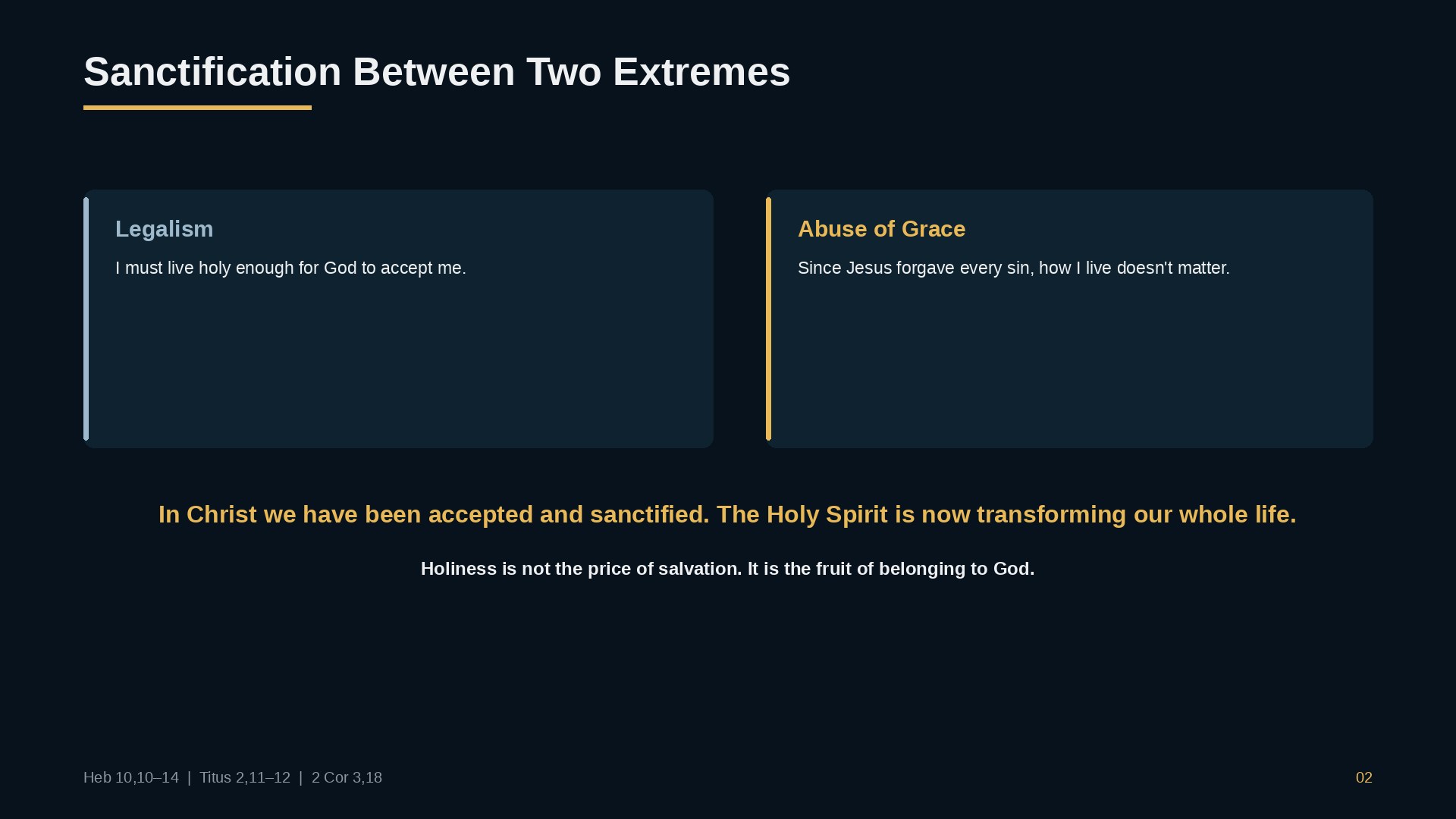
This distinction helps us avoid two extremes. The first makes a person earn God’s acceptance through steadily better behavior — that’s legalism. The second assumes that since Jesus forgave sin, the way we live no longer matters — that’s an abuse of grace. The gospel leads neither to religious fear nor to indifference toward sin. Grace gives us a new identity and the power to live in line with who we have become in Christ. A holy life is not the price of salvation — it is the fruit of belonging to God.
Introduction
When the subject of holiness comes up in church, some people immediately think of rules. Others remember their failures and feel that God must be disappointed with them. Still others hear the word “sanctification” and picture someone who has withdrawn from ordinary life, is always serious, and constantly monitors their own behavior.
Yet the New Testament begins the conversation about holiness somewhere else entirely. It starts with what Jesus did, not with what we are able to do for God. Only once we see Christ’s finished work can we rightly understand the call to a holy life.
Consider two statements. The first says: “I must live a holy enough life for God to accept me.” The second says: “Since Jesus has forgiven all sins, it doesn’t matter how I live.” Both miss the gospel. We do not live holy lives in order to be accepted by God. We learn to live holy lives because in Christ we have already been accepted, justified, and set apart for Him.
A holy life is not the root of salvation. It is its fruit.
Think about the objects used in the temple. Scripture called the altar, the vessels, the garments, the place, and the day holy. None of those objects possessed a moral character. They were holy because they had been set apart from ordinary use and dedicated to God. This shows the first dimension of holiness: belonging. A holy person is above all a person who belongs to God, set apart for Him, to live with Him. Moral transformation is not unimportant, but it grows out of that belonging.
What Holiness and Sanctification Mean
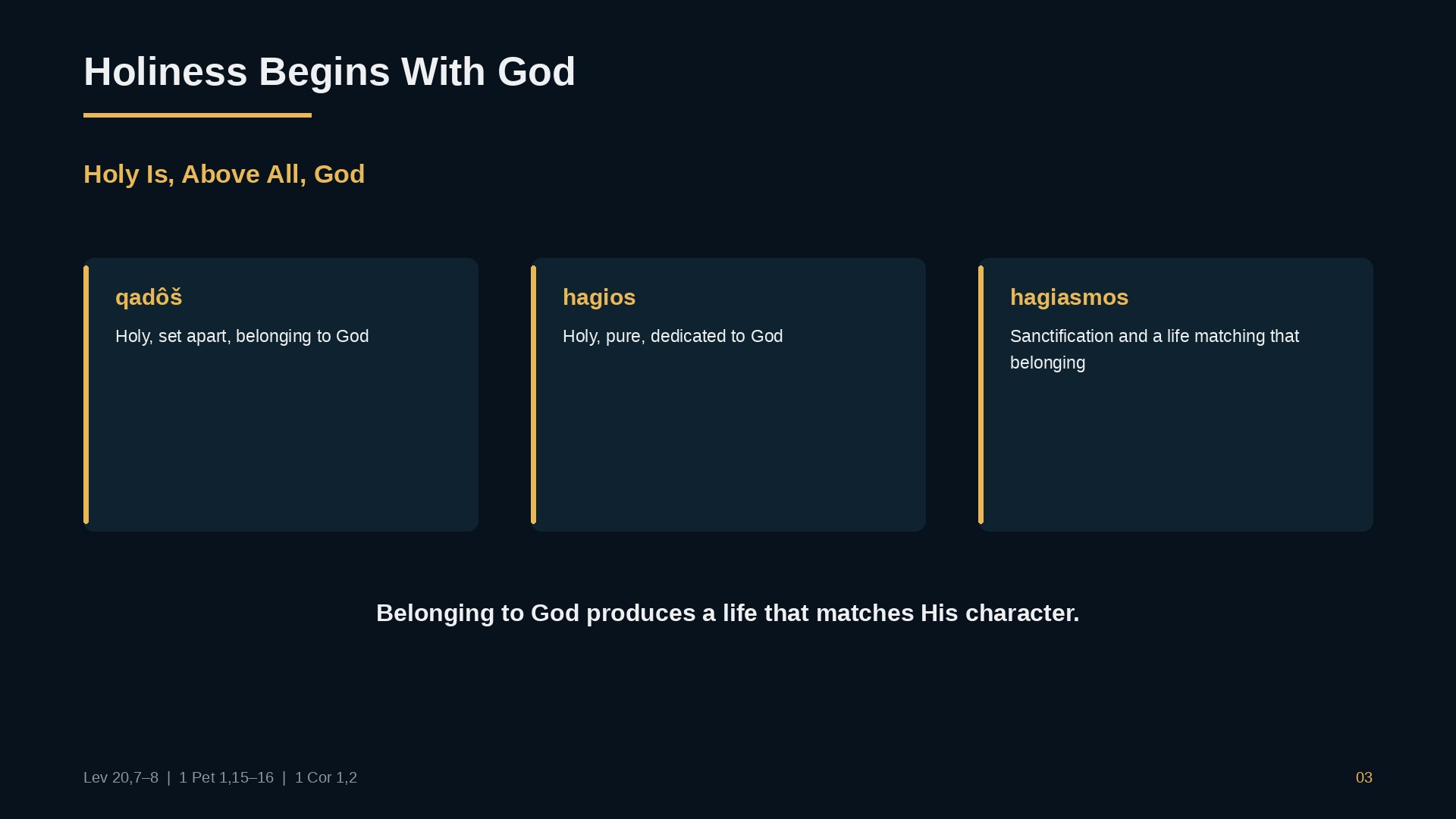
In the Old and New Testaments, words related to holiness cover separation for God, consecration, cleansing, and a life that matches God’s character. Holiness must not be reduced to a list of forbidden things. Holiness begins with God — He is entirely other than creation: pure, good, and undivided in His nature. As we draw near to God, we become like Him, and whatever is dedicated to Him becomes holy through belonging to Him.
In Genesis 2:3 God sanctified the seventh day. In the book of Exodus, the people, the priests, the tabernacle, and its vessels were sanctified. In the New Testament Jesus speaks of the temple that sanctifies the gold, and the altar that sanctifies the gift. These examples show that the basic meaning is not “never make a mistake.” It means being set apart for God. When it comes to a person, this new belonging also results in a cleansed way of living.
In 1 Corinthians 1:2 Paul calls believers “sanctified in Christ Jesus” and “called to be saints.” He writes this to a community marked by divisions, worldliness, immorality, and abuses at the Lord’s Supper. Paul does not call them holy because their behavior had reached perfection. He calls them that because of their position in Christ, and then teaches them how to live in line with that position.
God first tells you who you are in Christ. Then He teaches you how to live according to that truth.
What Sanctification Is
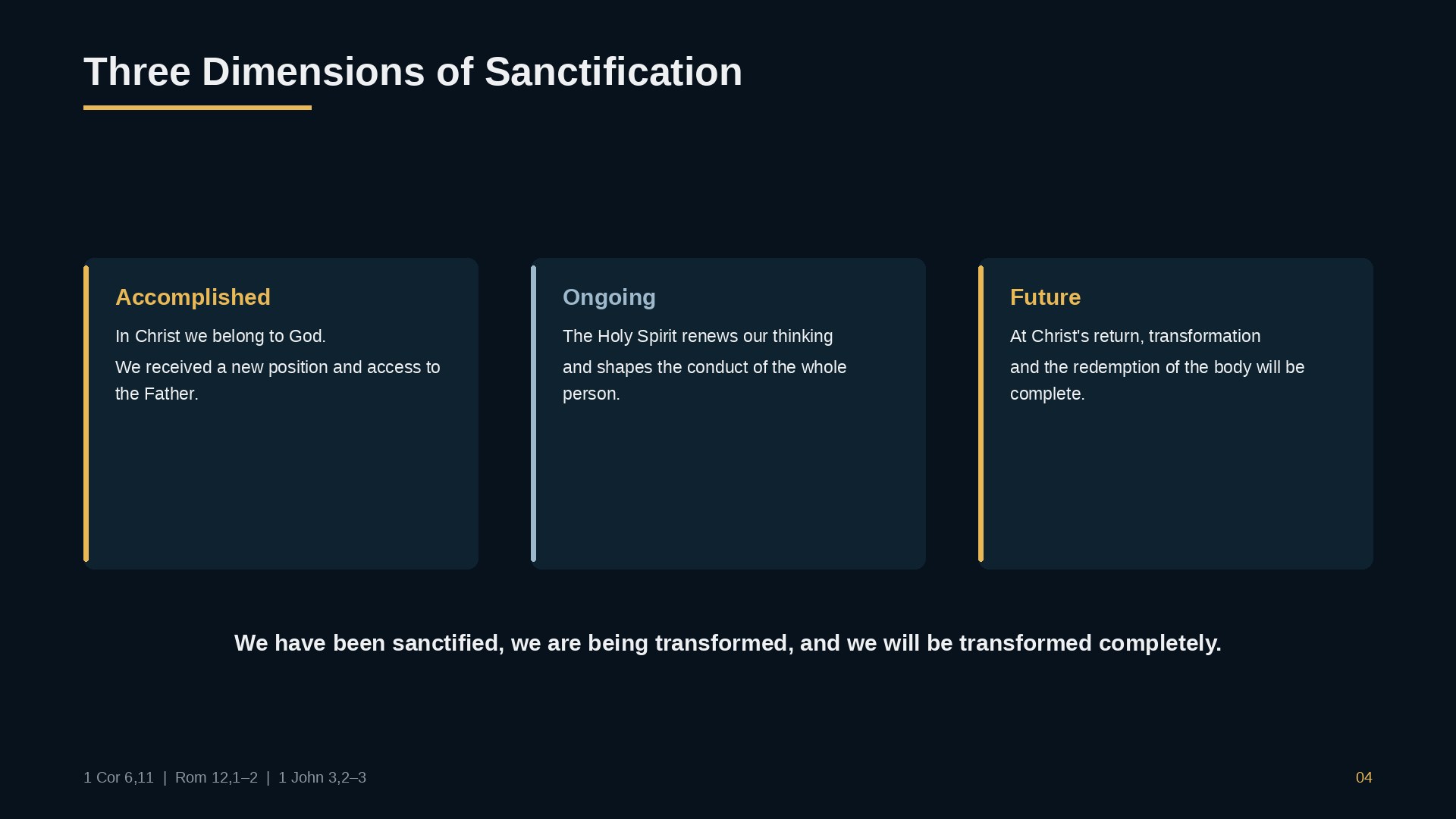
Sanctification is God’s work — what Jesus did for us on the cross. He sanctified and cleansed us, and through the Holy Spirit He gives us power over sin. Through this work a person is separated from the rule of sin, dedicated to God, and enabled to live a life that expresses God’s character. In the New Testament, sanctification has several related dimensions: it is a position received in Christ, since the believer has been washed, sanctified, and justified (1 Corinthians 6:11); it is a reality accomplished through the one sacrifice of Jesus (Hebrews 10:10–14); it is a transformation of how we think and act through the Word and the working of the Spirit (John 17:17; Romans 12:2); and it also has a future fulfillment, when our mortal bodies will be transformed (Romans 8:23; Philippians 3:20–21).
We can therefore speak of sanctification as accomplished, ongoing, and future. Accomplished sanctification speaks of what Christ did in our spirit. Ongoing sanctification concerns the renewing of the soul and the yielding of the body to God. The future fulfillment will come at the resurrection, when redemption reaches the body in its full, visible dimension — we will receive new, transformed bodies.
What Sanctification Is Not
Sanctification is not a system for earning points with God. It is not an attempt to persuade Him to love us, heal us, guide us, or answer our prayers. God accepted us in the Beloved because of Jesus, not on the basis of the outcome of our religious efforts.
Neither is it an external conformity to the style of a particular group. A person can change their clothing, language, and customs and still live in pride, judgment, and fear. Holiness is not about losing your personality or your interests — we don’t have to start living strangely. The Holy Spirit does not create copies of other people. He transforms us into the image of Christ.
Sanctification also does not mean sinless perfection of soul and body right now. If the whole person were automatically transformed the moment we were born again, we would not need the renewing of the mind, discipline, or the call to walk according to the Spirit.
Nor is it indifference toward sin. Grace does not say that sin has become good. It says that Jesus bore its penalty and broke its dominion. The same Paul who taught about the abundance of grace also asked: “Shall we continue in sin so that grace may increase?” and answered decisively: “By no means.”
“What shall we say then? Shall we continue in sin so that grace may increase? By no means!”
— Romans 6:1–2
Justification and Sanctification
Justification and sanctification both flow from the same sacrifice of Christ, but they describe different aspects of salvation. Justification uses the language of the courtroom. It answers the question of our status: do we stand before God as guilty or as righteous? God declares righteous the person who believes in Jesus. This does not happen on the basis of works of the Law, but through faith in Him and in what He accomplished for us.
Sanctification, on the other hand, uses the language of the temple, of belonging, and of transformation. It answers the question: to whom do I belong, and how does that belonging shape my life? In Christ we have been set apart for God. We then learn to think, choose, and act in line with our new identity.
“You were washed, you were sanctified, you were justified in the name of the Lord Jesus Christ and by the Spirit of our God.”
— 1 Corinthians 6:11 (descriptive rendering)
The order matters. Paul does not say, “If you improve enough, maybe one day you will be sanctified.” He announces an accomplished fact to people who still need a great deal of change. Our behavior is meant to mature, but the foundation of that transformation is the finished work of Jesus.
The Old and New Covenant
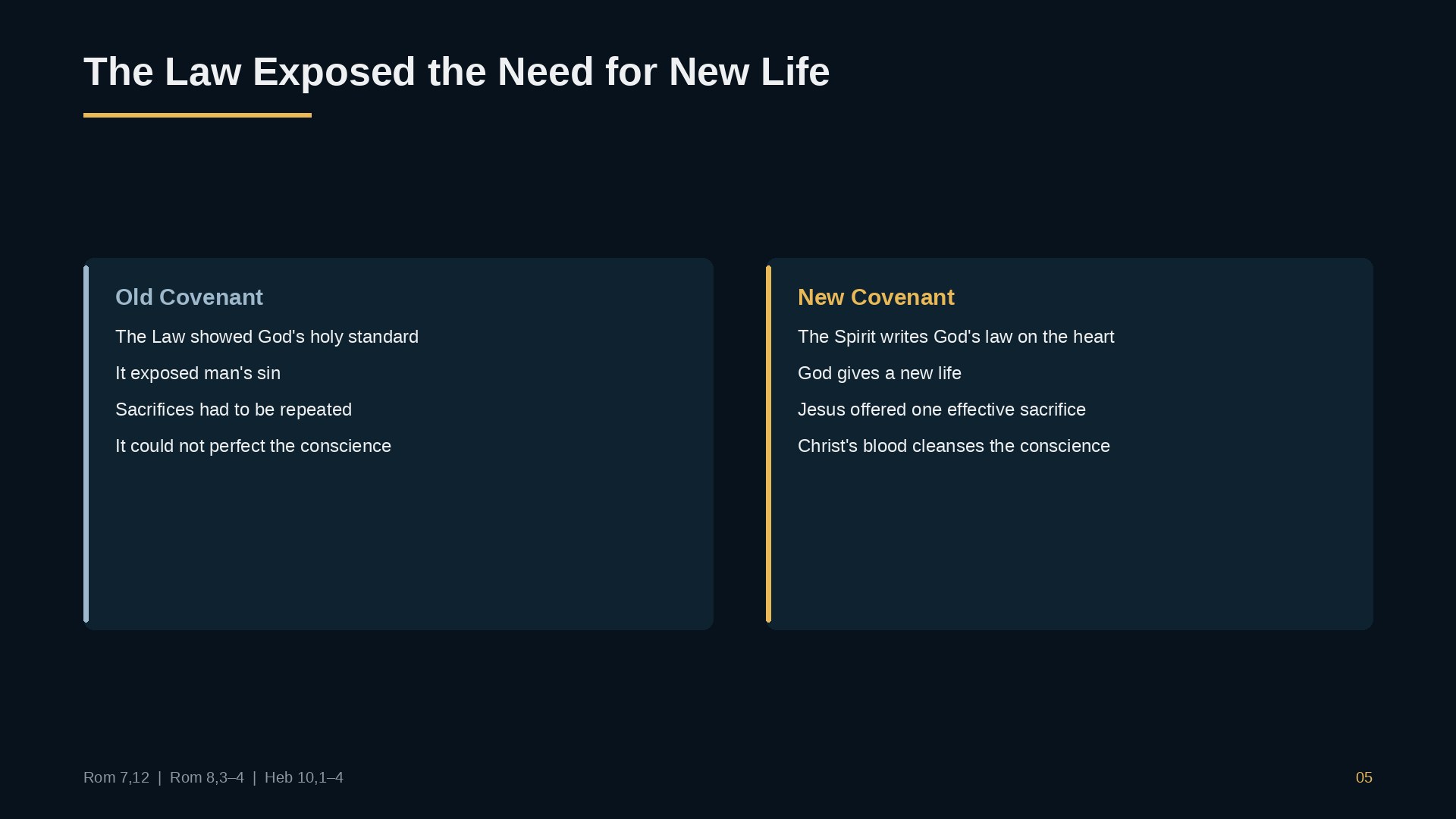
To understand sanctification well, we need to see the difference between the covenants. The Law of Moses was not morally evil — Paul calls the commandment holy, righteous, and good (Romans 7:12). The problem did not lie in God’s standard but in fallen humanity’s inability to fulfill it by its own strength.
The Law exposed sin and took away a person’s illusion of self-righteousness. It was like a perfect mirror: it shows the dirt on your face but cannot wash it off. The Law pointed to the need for a Savior, but it could not give a new spirit, cleanse the conscience once for all, or impart life. The Letter to the Hebrews says that the former system perfected nothing, and its repeated sacrifices only served as a reminder of sins.
The New Covenant does not lower God’s standard. It gives what a person needed in order to live differently: a new heart, a new spirit, the indwelling Holy Spirit, and a perfect sacrifice. Romans 8:2 calls this new reality “the law of the Spirit of life in Christ Jesus.” We no longer live under a system of condemnation — the Holy Spirit works in us from within.
Andrew Wommack strongly warns against mixing the covenants. If a believer says they were saved by grace but bases their day-to-day relationship with God on their own performance, they slip back into a mindset of earning. Then, after a good day, they feel worthy of prayer, and after a bad day, they run from God. The New Covenant allows us to come to the Father on the basis of the blood of Jesus, even when we need correction. The Law told a person what they should be. New birth makes a person a new creation in spirit, and the Holy Spirit enables them to live a new life.
Sanctified Through One Sacrifice
At the heart of this teaching is Hebrews 10. The priests of the Old Covenant stood and offered sacrifices daily, because their work never ended. Jesus, after offering one sacrifice, sat down at the right hand of God. His posture shows that the work was finished.
“By that will we have been sanctified once for all through the offering of the body of Jesus Christ.”
— Hebrews 10:10.14 (descriptive rendering)
“By one offering He has made perfect forever those who are being sanctified.”
These verses join something accomplished with something that continues to unfold in life. We have been sanctified through the sacrifice of Jesus, and at the same time we are people in whom that holiness is meant to become increasingly visible. The basis is not repeating the sacrifice or once again persuading God to forgive us. The basis is the sacrifice offered once for all. The sacrifice of Jesus settled the matter of guilt — our condemnation adds nothing to it.
Wommack relates the language of perfection primarily to our born-again spirit. This does not mean our thoughts, emotions, and behavior are already perfect. It means that the deepest part of our identity has been re-created, united with the Lord, and sealed by the Holy Spirit.
Spirit, Soul, and Body
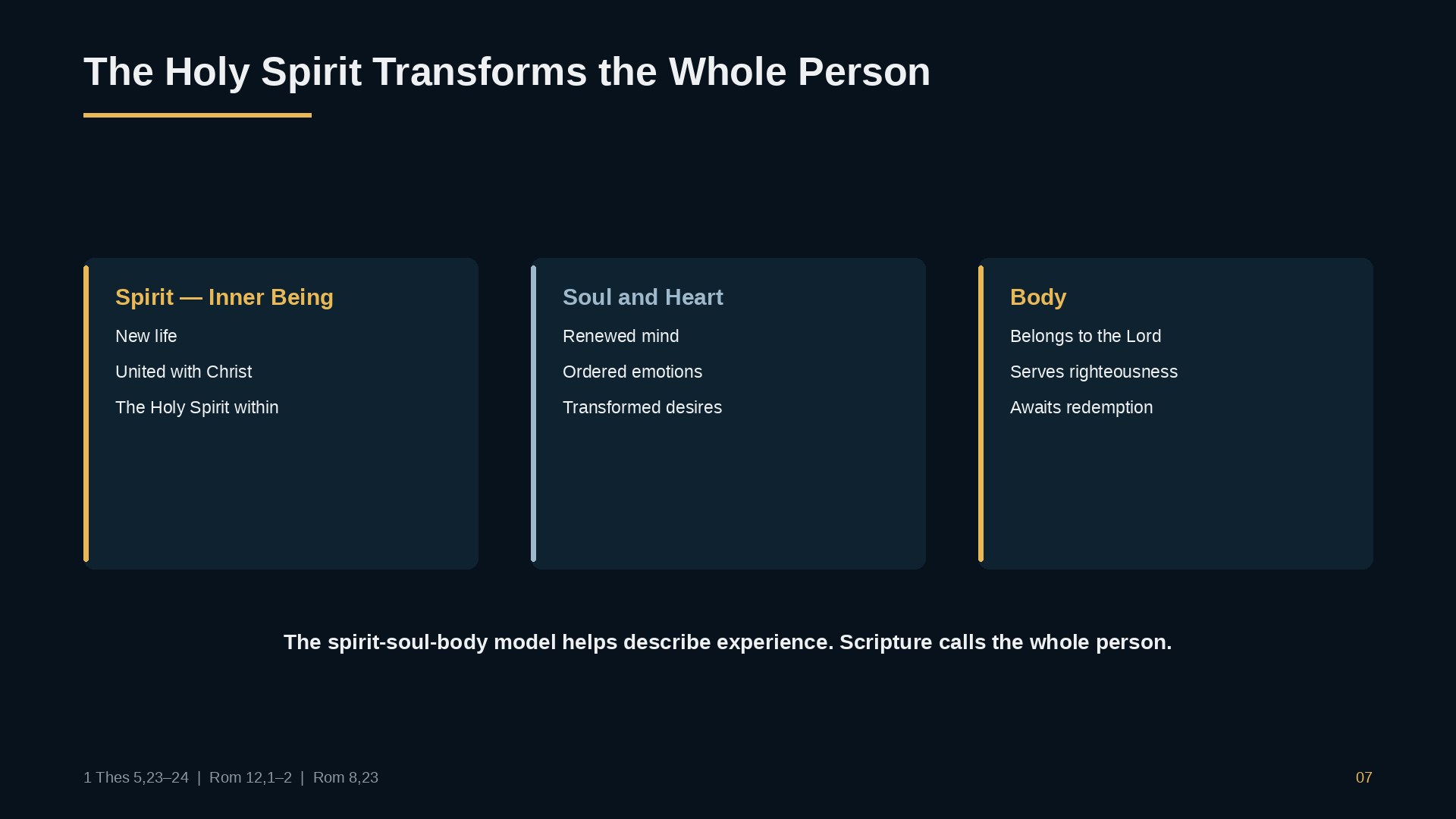
1 Thessalonians 5:23 lists spirit, soul, and body. This distinction helps answer why a person, after being born again, can truly belong to God while still struggling with old thoughts, reactions, and temptations. The spirit-soul-body model helps describe this experience, though Scripture directs its call to holiness to the whole person.
The Spirit — Sanctified and Perfect in Christ
2 Corinthians 5:17 says that a person in Christ is a new creation, and that the old has passed away. This cannot refer to the body, since after conversion it still looks the same. Nor can it refer to every thought and emotion, since those do not change automatically. New creation refers above all to our spirit.
1 Corinthians 6:17 says that whoever is joined to the Lord is one spirit with Him. Ephesians 4:24 describes the new man as created after God in righteousness and true holiness. In this part of the person, we are not trying to become a new creation — we accept by faith the fact that we already are. We do not mature by constantly staring at the old man. We mature by looking into the Word and recognizing the new man God has created.
The Soul — Renewed Through Truth
The soul includes the way we think, the will, the emotions, memory, and learned reactions. A person may receive a new spirit yet still carry patterns of thinking from their old life. They may consider themselves worthless, react in anger, fear rejection, or seek comfort in sin. This does not prove that nothing has changed in them. It shows that their mind needs renewing.
Romans 12:2 does not tell us to be re-created by changing our behavior. It tells us to be transformed by the renewing of our mind. The Word of God works like a mirror in which we see spiritual reality. Our senses show us the weakness of the body and the emotions. The Word reveals what God has already done in our spirit. Renewal is not a one-time feeling — it consists of replacing lies with truth, and then making decisions in line with that truth. When the mind agrees with the spirit, the life of God begins to flow more freely into our emotions and behavior.
The Body — Yielded to God
The body itself is not evil. It can serve sin or righteousness. Paul says we should not offer the parts of our body to sin as instruments of wickedness, but rather offer them to God as instruments of righteousness (Romans 6:12–13). In Romans 12:1 he asks believers to present their bodies as a living sacrifice, holy and pleasing to God.
“Work out your own salvation with fear and trembling, for it is God who works in you, both to will and to work for His good pleasure.”
— Philippians 2:12–13
The body needs discipline, but it is not the source of new life. We do not try to force the body to manufacture spirituality. The spirit, through a renewed mind, directs the body. The full redemption of the body still lies ahead: Romans 8:23 says we wait for the redemption of our body, and Philippians 3:21 promises that our body of humiliation will be transformed to be like Christ’s glorious body. God works in us — that is why we can act and respond with obedience.
How Sanctification Becomes Visible
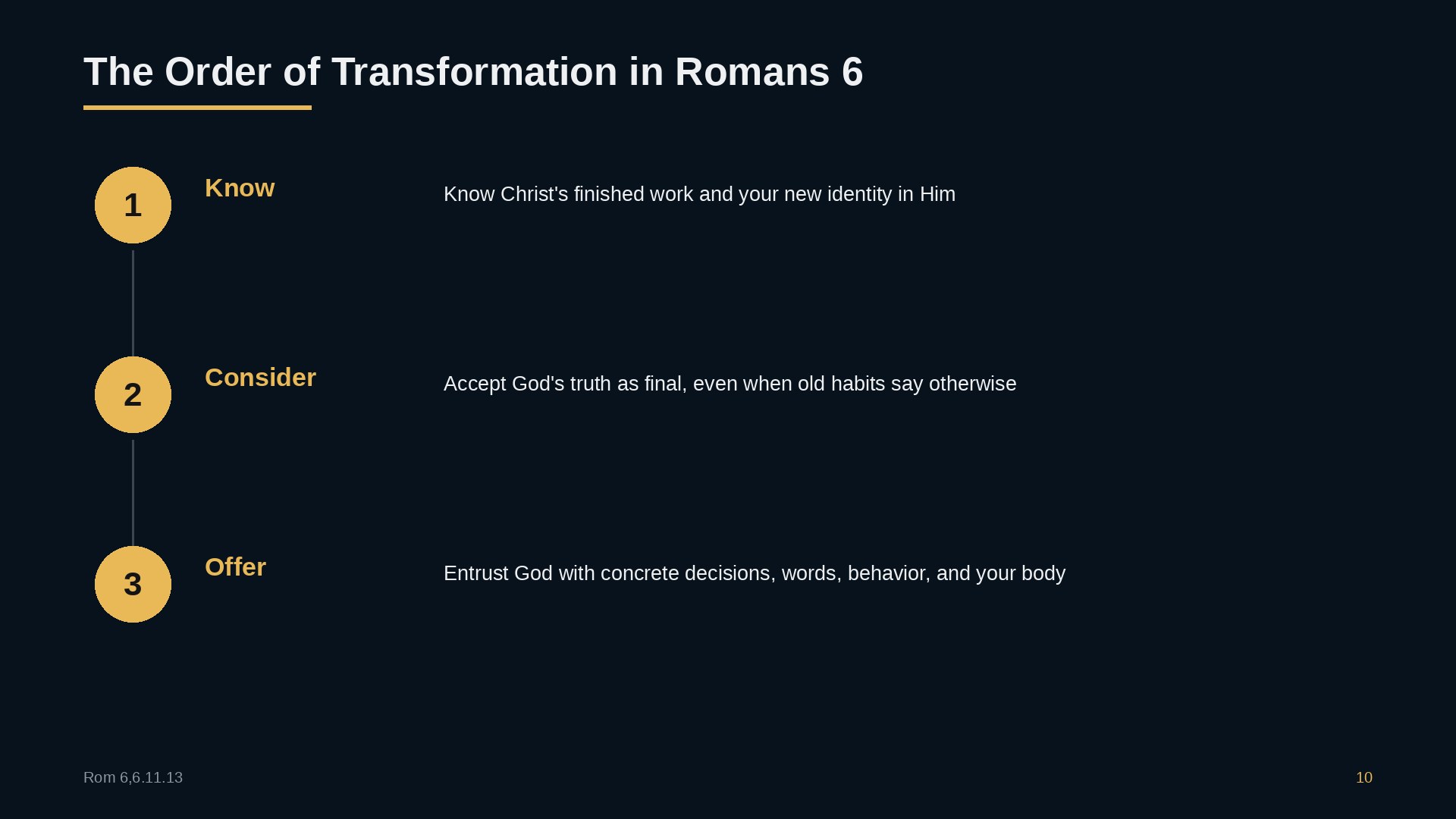
The Christian life does not consist of persuading God to give us holiness. It consists of cooperating with the Holy Spirit so that what we received in Christ penetrates the way we think and act. Galatians 5:16 does not say: “By your own effort overcome every desire of the flesh, and then maybe you will begin to live by the Spirit.” The order is reversed: walk by the Spirit, and you will not carry out the desires of the flesh. Victory comes through focusing on the life of the Spirit, not through constant preoccupation with sin.
This does not mean passivity. Grace does not remove our decisions — it teaches us how to make them from a new place. Romans 6 repeatedly uses three words that describe the practical process of sanctification:
- Know — that the old self was crucified, and know what Christ has already done.
- Consider — this truth to be true even when your emotions say something else.
- Offer — to God your specific decisions, words, relationships, actions, and your body.
This is the practical process of sanctification. We do not build a new identity from scratch. We let the identity we have received govern our everyday life.
The Fruit of the Spirit and the Works of the Flesh
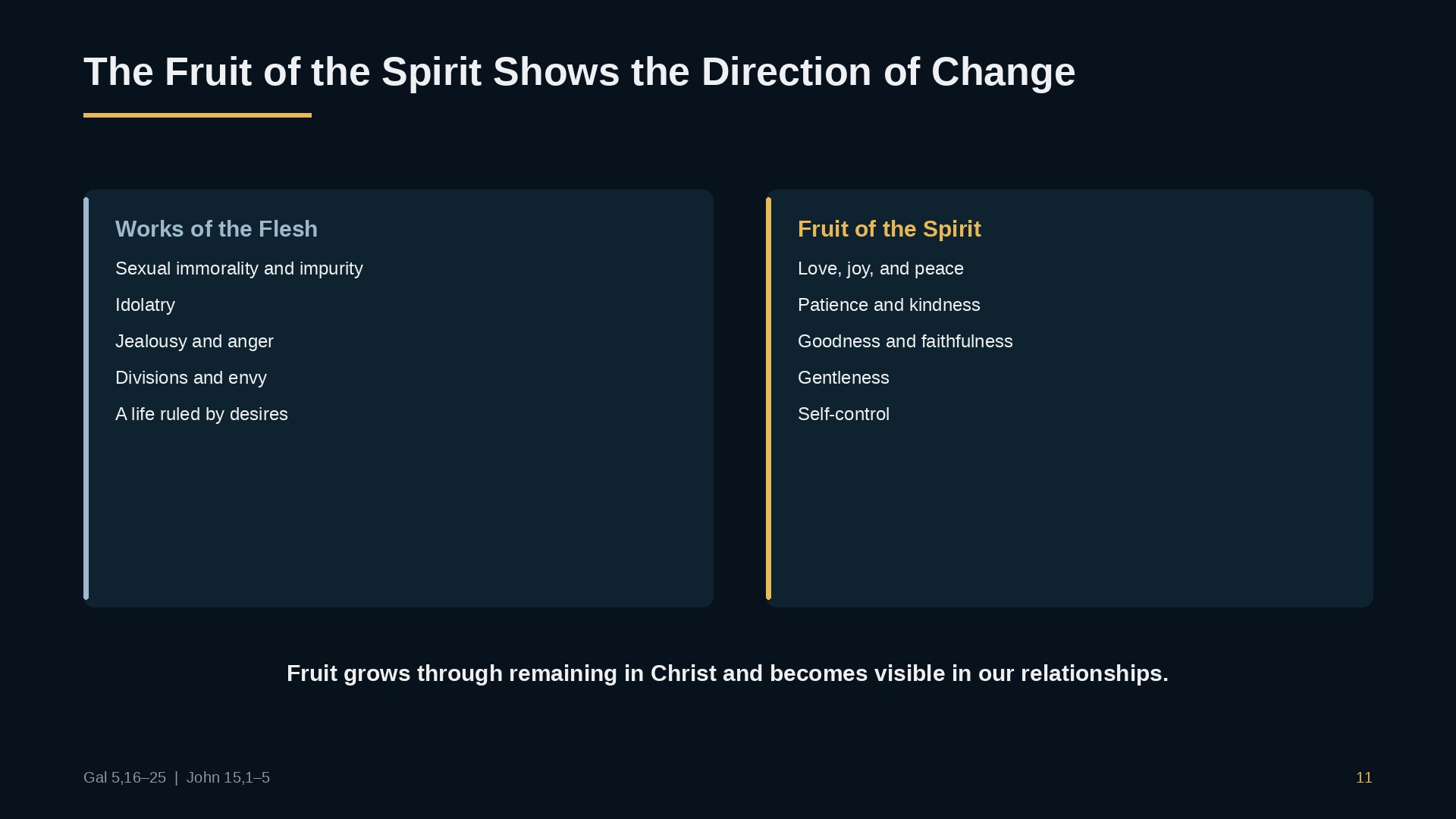
In Galatians 5, Paul contrasts the works of the flesh with the fruit of the Spirit. The works appear in the plural, while the fruit of the Spirit appears in the singular. Love, joy, peace, patience, kindness, goodness, faithfulness, gentleness, and self-control form one life of the Spirit expressed in different ways. This fruit is already present in the born-again spirit, because the believer is united with the Lord and the Holy Spirit dwells within. We do not pray, then, like people entirely lacking love or peace — we learn to draw on what God has already placed in us.
Being filled with the Spirit, however, does not mean every reaction will automatically be mature. A person can have the Holy Spirit and still react according to an unrenewed mind. That is why Paul speaks of walking by the Spirit — walking describes a repeated way of life, not a single spiritual experience.
The Works of the Flesh
The biblical word “flesh” does not always mean the physical body. In this context it describes a natural way of living independent of God. The flesh of a believer covers the area of the soul and the physical when it is not submitted to the truth of the spirit. From it flow, among other things, immorality, jealousy, anger, divisions, drunkenness, and lack of self-control. We do not overcome this by condemning ourselves — condemnation focuses a person on themselves and often reinforces the vicious circle. God shows us the truth so that we can turn around, renew our thinking, and choose obedience.
The Fruit of the Spirit
Fruit grows out of a relationship with the source of life. A branch does not produce grapes through strain, but through remaining in the vine. Jesus said in John 15 that apart from Him we can do nothing. Sanctification is not self-improvement independent of Christ. It is the life of Christ expressed through a person who remains in Him, renews their mind, and responds to the Spirit’s leading.
The best test of maturity is not the number of manifestations we’ve experienced or the amount of knowledge we possess. The question is whether love, peace, patience, and self-control are growing in our relationships. The gifts of the Spirit display His power. The fruit shows the extent to which our character yields to His life. The fruit of the Spirit is not the price of God’s presence — it is the visible result of the Spirit already dwelling in us as we learn to cooperate with Him.
Is Sin Still a Problem
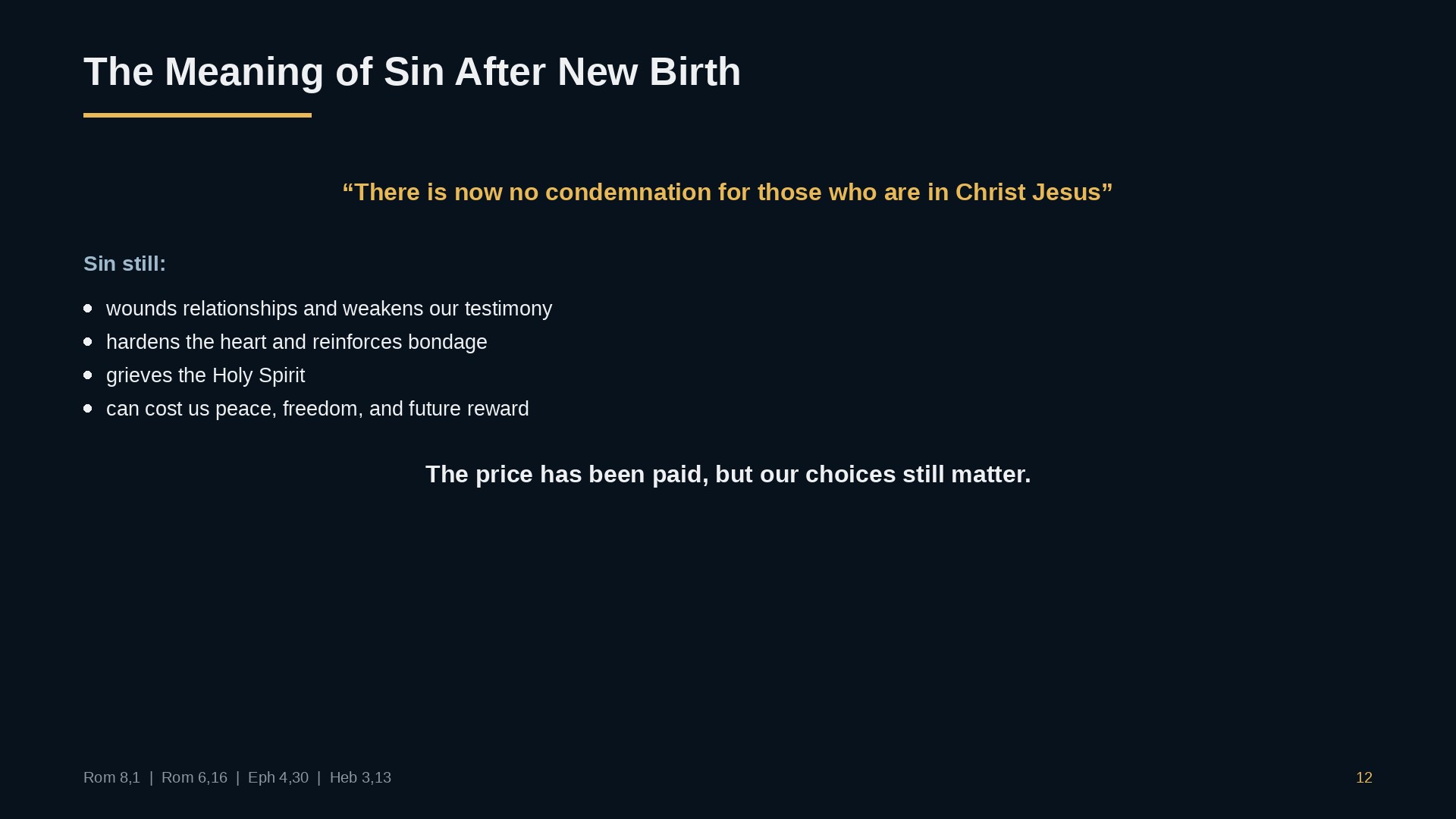
After new birth, sin is no longer the problem that determines our status before God. Jesus bore its penalty, and the believer has been justified. Every sin has been covered by the one sacrifice of Christ: past, present, and future. Jesus does not die again when a believer falls. Our born-again spirit does not alternate every few days between righteous and sinful. Redemption is eternal in nature, and a believer does not need to be born again after every mistake.
That does not mean, however, that sin has become harmless. We must distinguish eternal redemption from the temporal consequences of our choices. Sin still works destructively in the soul, the body, relationships, and our testimony. Romans 6:16 warns that a person becomes a slave of whatever they obey. Ephesians 4:27 says not to give the devil a foothold. Hebrews 3:13 warns against being hardened by sin’s deceitfulness. These warnings were addressed to believers.
- Sin can numb the conscience and make it harder to recognize God’s leading.
- It can build addictions and destructive patterns in the mind and body.
- It can wound a spouse, children, the community, and the people to whom we are a witness.
- It can rob us of peace and confidence — not because God has stopped loving us, but because we have stopped agreeing with the truth.
- It can lead to prolonged hardness of heart and an increasingly conscious drifting away from faith.
The statement that “sin is no longer a problem for God” therefore needs careful explanation. It means that God settled the account of sin in the body of Jesus and does not demand a second payment. It does not mean that sin carries no consequences, or that the Father approves of everything we do.
A Cleansed Conscience
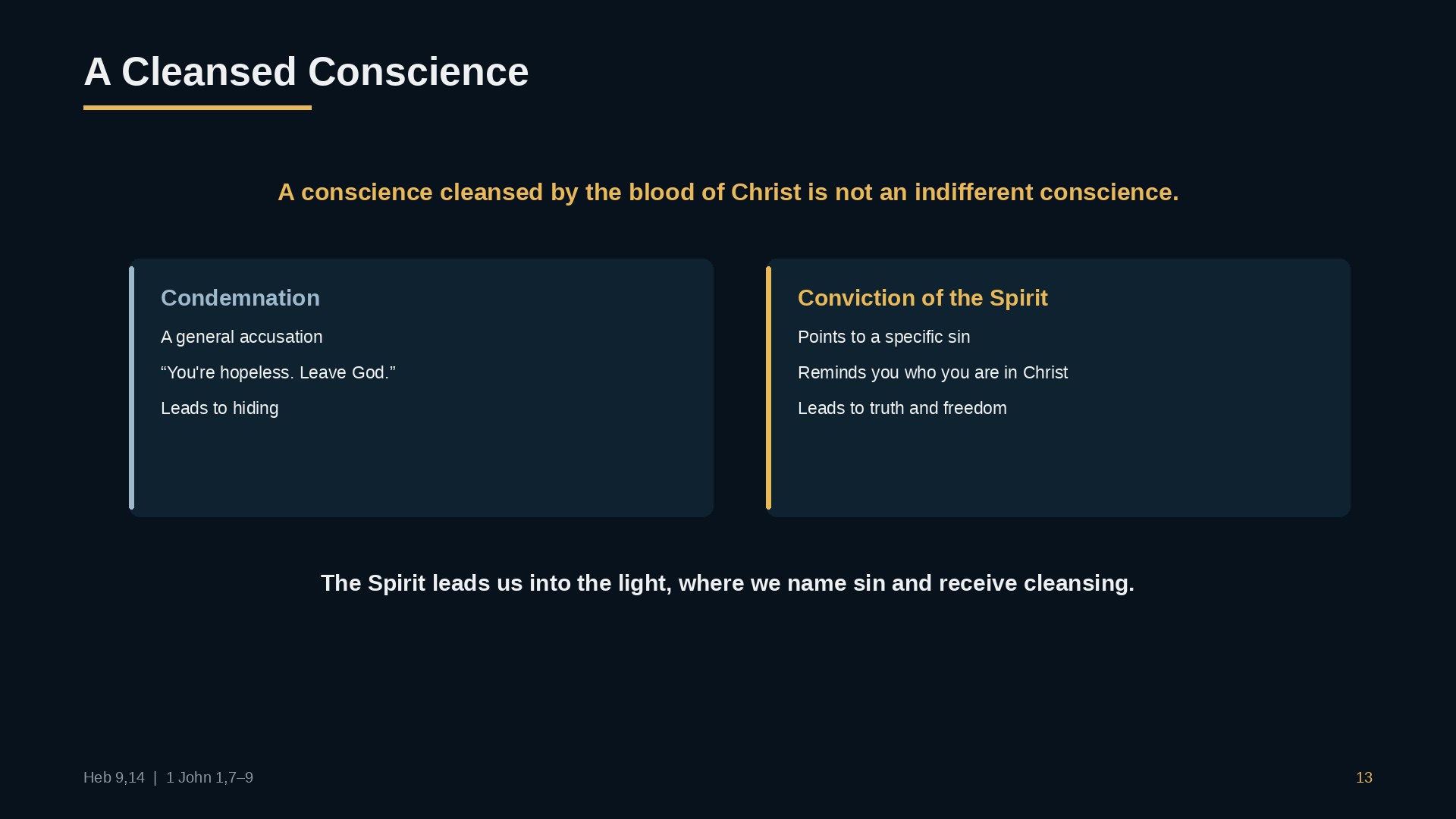
A conscience cleansed by the blood of Christ is not, however, an indifferent conscience. It is worth distinguishing two voices that are easy to confuse. Condemnation is a general accusation — it says, “You’re hopeless, hide from God,” and leads to hiding. The conviction of the Spirit points to a specific sin, reminds you of who you are in Christ, and leads to truth and freedom. The Spirit leads us into the light, where we name sin and receive cleansing.
Repentance and Confessing Sin
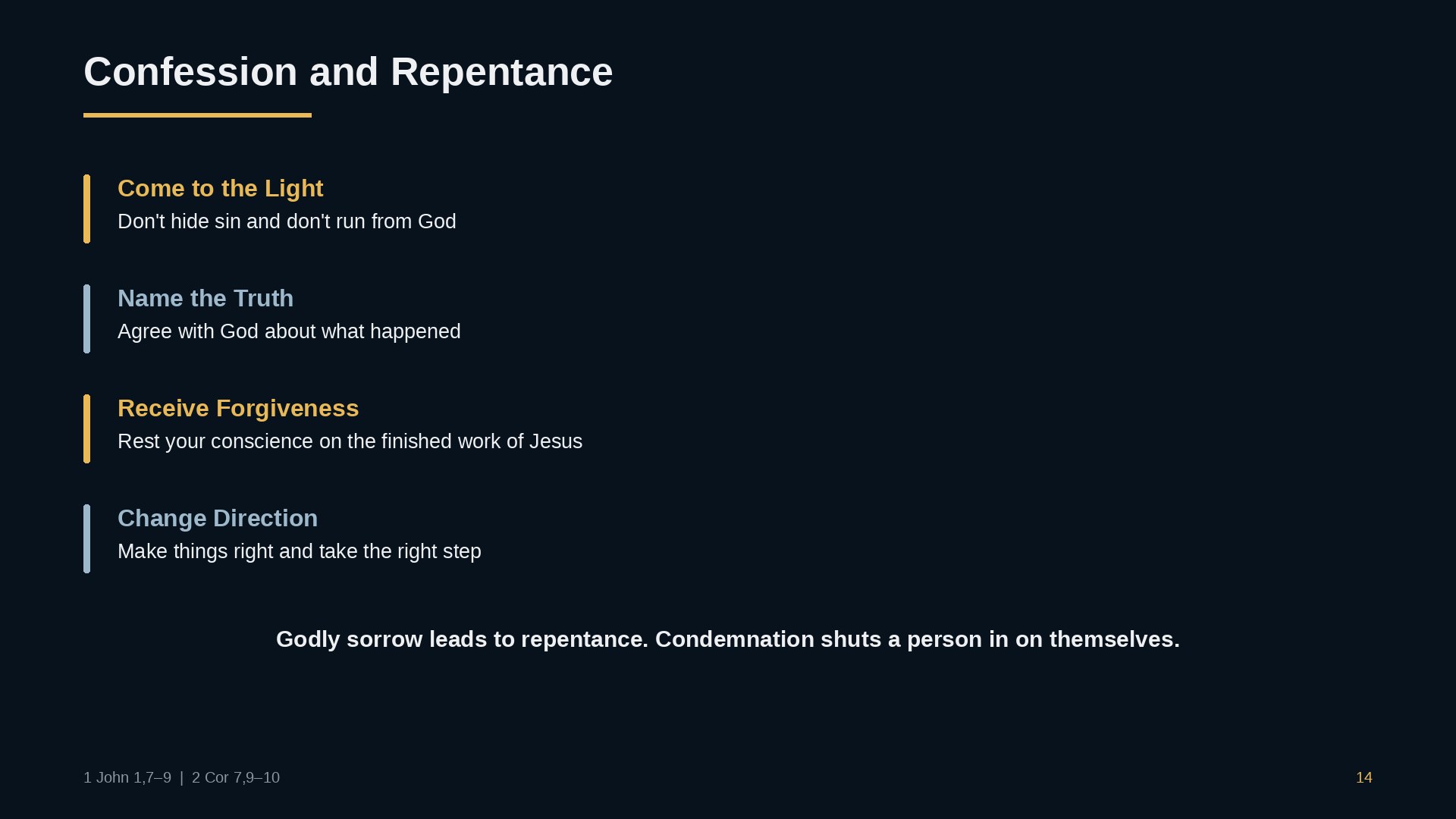
When a believer sins, they should not run from God until they feel worthy again. Scripture instead shows a consistent pattern for returning, made up of four steps.
| Step | What to do |
|---|---|
| 1. Come to the light | Do not hide your sin and do not run from God — come to Him in truth and honesty. |
| 2. Name the truth | Agree with God about what happened: “What I did was wrong. I don’t want to excuse it.” |
| 3. Receive forgiveness | Rest your conscience on the finished work of Jesus. Thank Him that He already bore this sin on the cross and will never die for it again. |
| 4. Change direction | Return to the truth and close the door to the enemy. If you have hurt someone, apologize and make things right. |
True repentance does not consist of long self-punishment. The Greek word metanoia points to a change of mind that leads to a change of direction. Sorrow may accompany it, but sorrow alone is not yet transformation. Grace allows us to look at sin without denial and without losing our identity as a child of God.
When you fall, don’t run from God. Run to the Father, who has already opened the way to you through the blood of Jesus.
Fatherly Discipline in Love
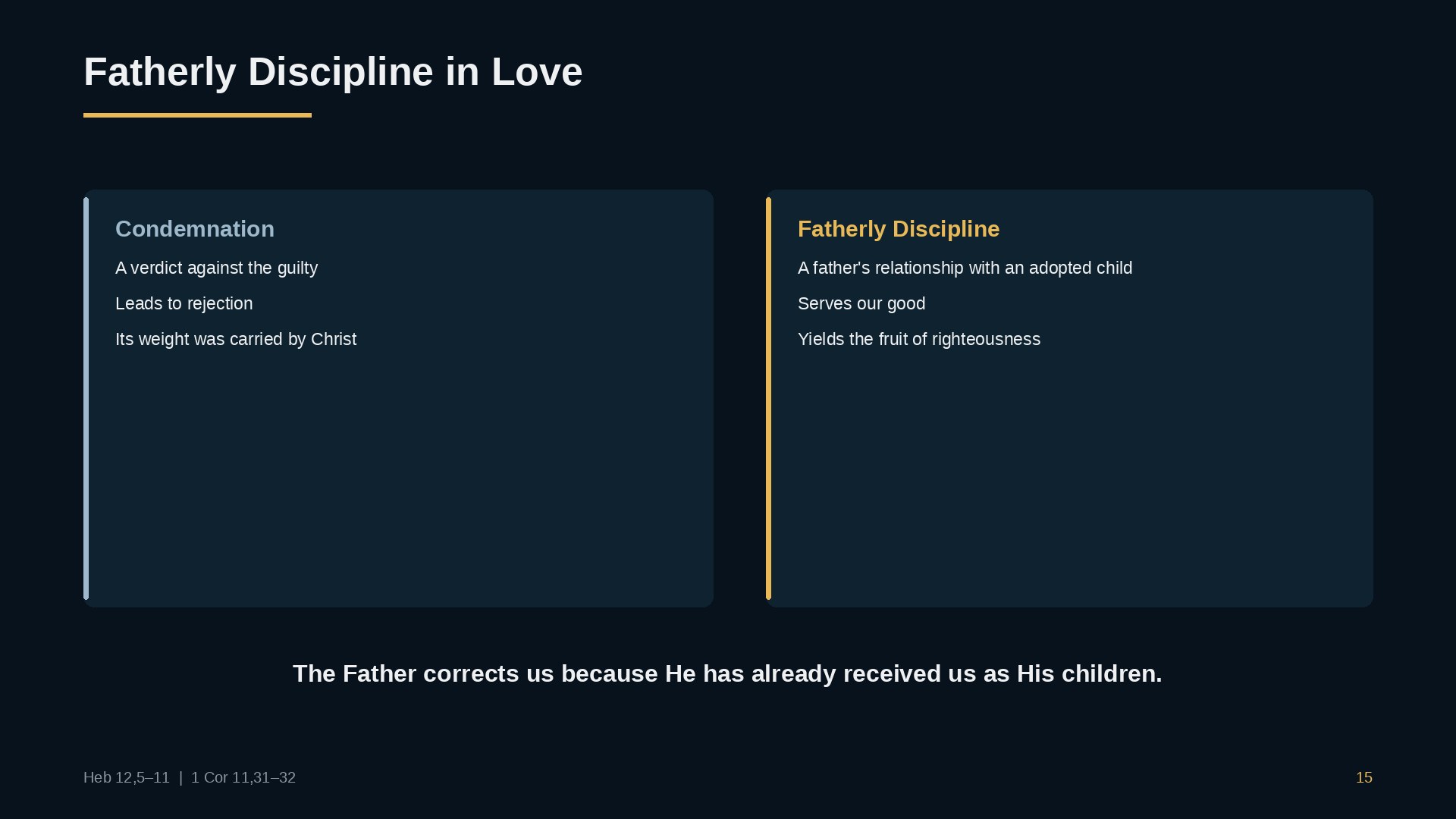
The fatherly discipline spoken of in Hebrews differs from condemnation. Condemnation is a verdict against the guilty; it leads to rejection, and its weight has already been carried for us by Christ. Fatherly discipline is a Father’s relationship with a child He has already adopted — it serves our good and yields the fruit of righteousness. The Father corrects us precisely because He has already received us as His children.
Can Salvation Be Lost
The question of losing salvation can easily dominate the subject of sanctification, so it deserves a clear, brief answer. Andrew Wommack accepts neither the view that a person loses salvation with every serious sin, nor the simple version of “once saved, always saved,” according to which a later, conscious rejection of Christ would carry no significance at all.
Salvation cannot be accidentally misplaced or “sinned away.” It is not lost by someone who has fallen, who struggles, who goes through a season of doubt, or who feels far from God. Salvation rests on faith in Christ, not on flawless behavior.
Wommack does hold, however, that a mature believer can consciously, willingly, and decisively renounce faith in Jesus. He bases this view chiefly on Hebrews 6:4–6. The text describes people with a deep experience of God who then fall away. In this reading, it is not about an unconscious mistake, an emotional crisis, or a single sin, but about the deliberate rejection of Christ by a person who truly knew Him.
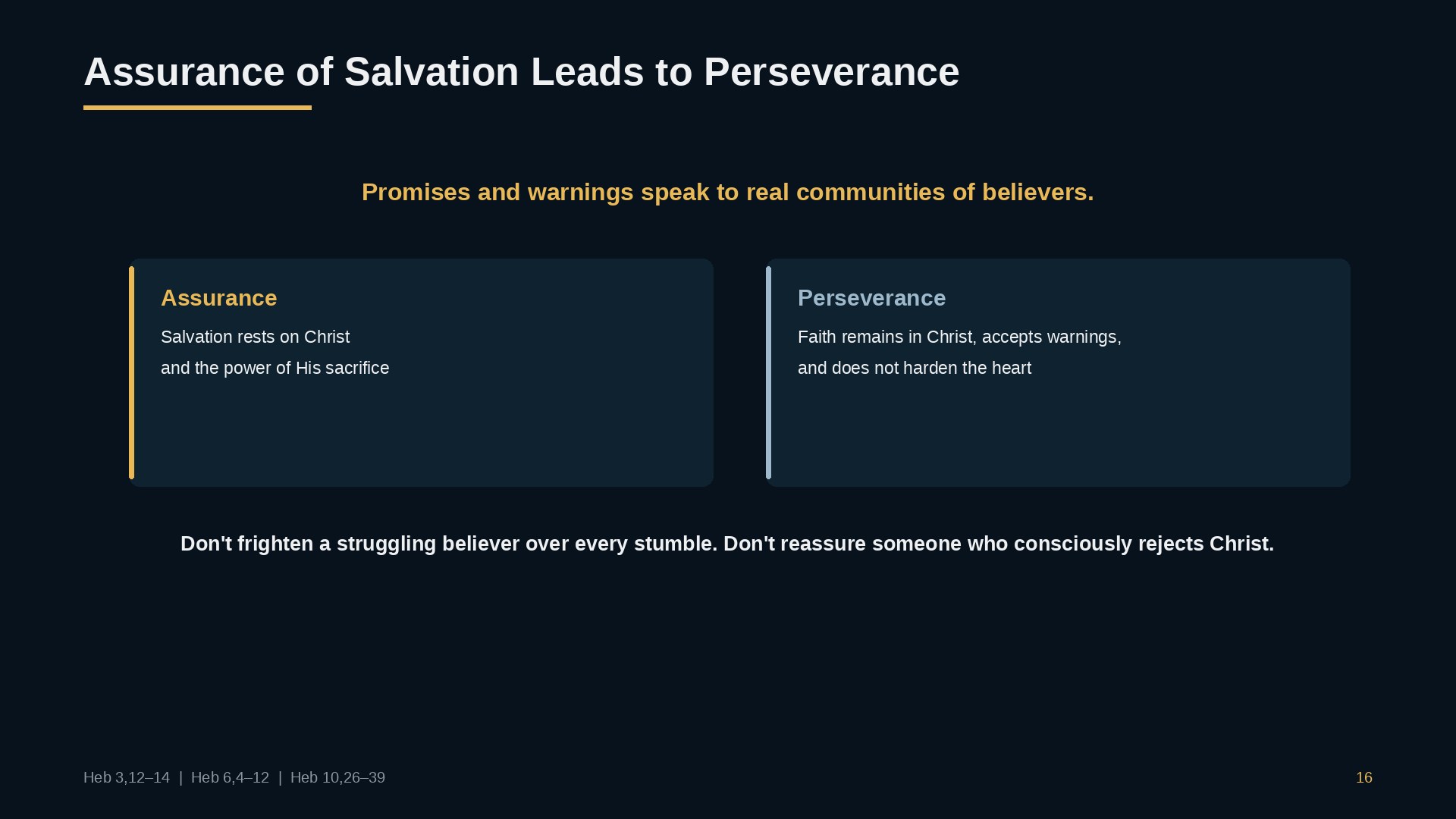
Sinful conduct by itself does not remove salvation, but it can harden the heart. Hebrews 3:13 speaks of sin’s deceitfulness. A person can reject the truth for a long time until they reach a point of conscious renunciation of faith. That is why grace provides security, but does not teach us to disregard Scripture’s warnings. The promises and warnings in Hebrews speak to real communities of believers: don’t frighten a person who is struggling with every stumble, but also don’t reassure a person who consciously rejects Christ.
Not every evangelical tradition interprets these passages the same way. In pastoral teaching, though, we should not frighten saved people into thinking that every fall means the loss of eternal life. If a person longs for God, is troubled about the state of their heart, and wants to return, they are not behaving like someone who has consciously and finally renounced Christ.
You do not lose your salvation through a moment of weakness. It can only be rejected consciously, willingly, and with full awareness of what a person is giving up.
Salvation and Reward
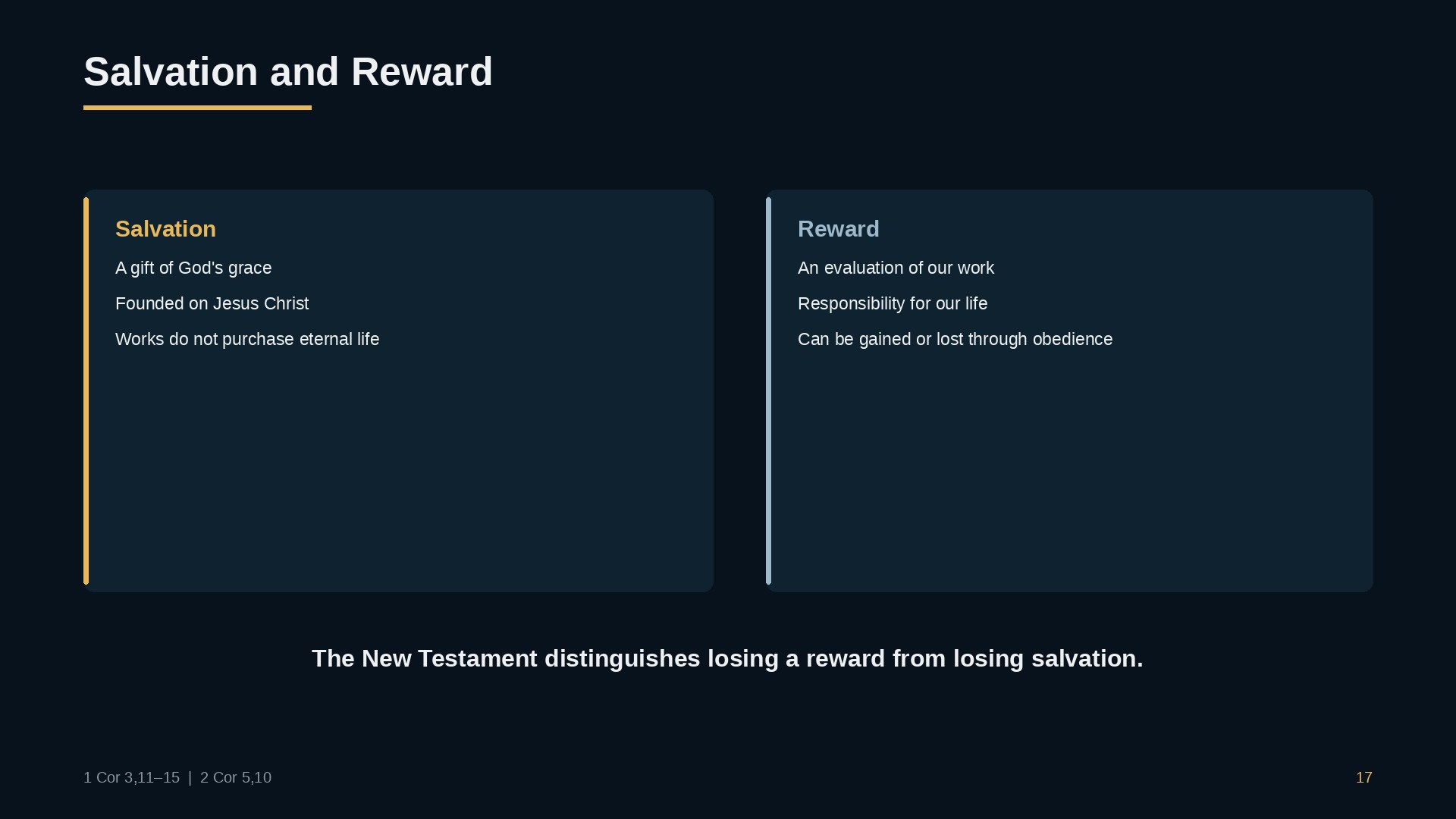
The New Testament also distinguishes losing a reward from losing salvation. Salvation is a gift of God’s grace, founded on Jesus Christ — works do not purchase eternal life. Reward, on the other hand, concerns the evaluation of our work and our responsibility for how we lived; it can be gained or lost, depending on what our obedience produced. This distinction protects us both from the fear that one bad day cancels our salvation, and from treating how we live as unimportant.
Living in Sanctification Today
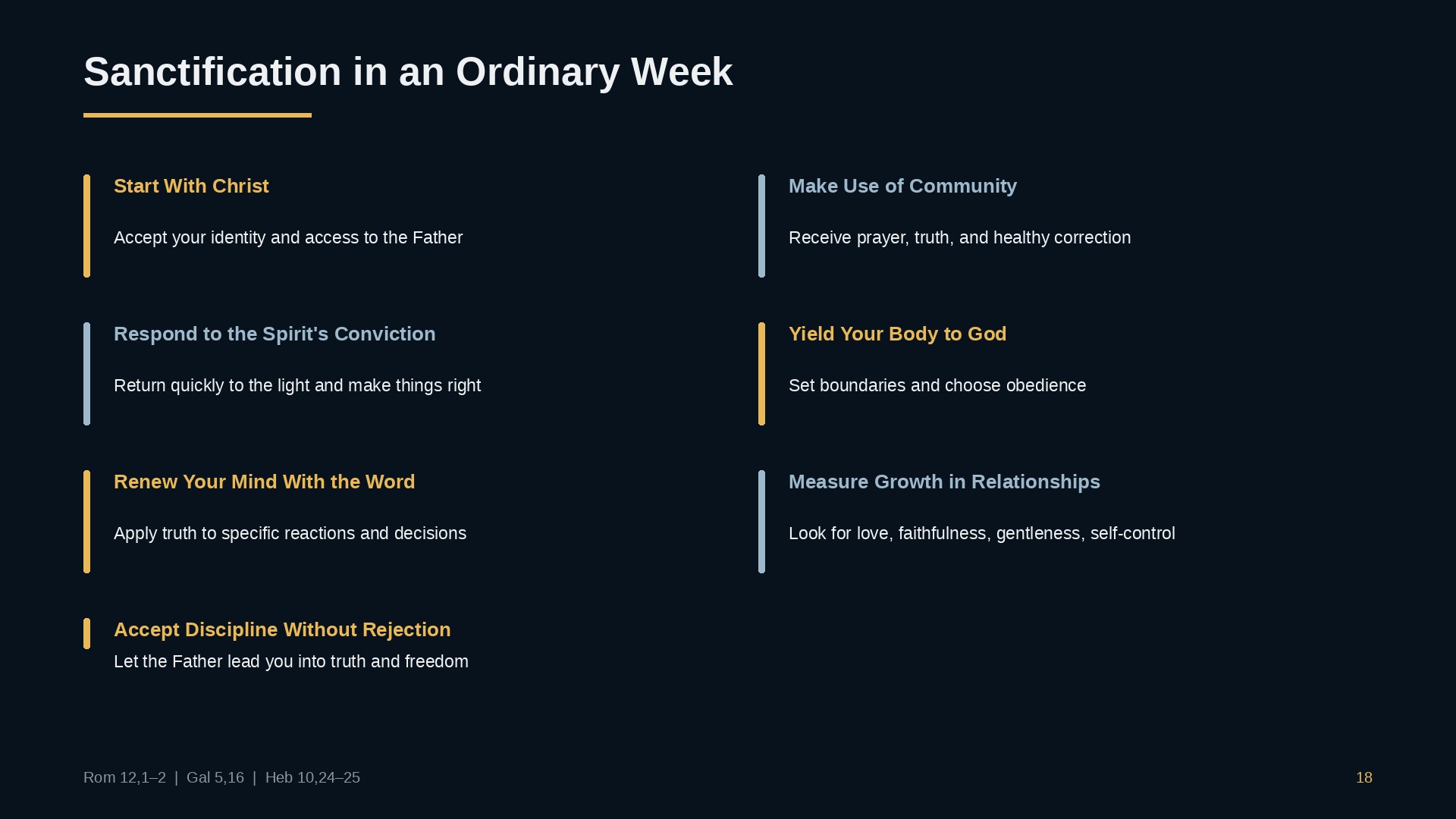
A believer today, born again and filled with the Holy Spirit, does not need to go back to a system of religious control. They need to learn to live out of their new identity. The following practices are not meant to earn God’s love — they help the soul and body submit to the life we have already received.
Start from identity. Don’t begin the day by asking, “Will I be good enough today?” Start with the truth: “I am in Christ. My spirit has been made new. I belong to God. The Holy Spirit lives in me. Therefore I can choose today to live in line with Him.” This is not positive thinking — it is agreement with the Word.
Renew your mind with the Word. It’s not just about the number of chapters you read. Pause at the truth, meditate on it, speak it, and apply it to specific situations. If you have reacted with fear for years, you need more than a resolution — you need a deep change in how you see God, yourself, and your circumstances. The Word gradually tears down old ways of thinking.
Yield your body to God. The body has habits. It needs boundaries around sexuality, food, alcohol, rest, the phone, money, and the words we speak. Discipline does not save, but it lets the body serve what the spirit recognizes as good. Don’t ask only, “Is it allowed?” Also ask, “Does this control me, and does it help me express the life of Christ?”
Respond quickly to the Spirit’s conviction. The Holy Spirit does not lead through condemnation. Condemnation says, “You’re hopeless, hide from God.” Conviction shows you something specific: “This behavior does not match who you are. Come to the Father and choose the truth.” Don’t excuse sin, but don’t build your identity out of it either.
Let the fruit mature in your relationships. Holiness is tested at home, at work, and in community. It’s easy to talk about spiritual identity, and harder to answer gently, keep your word, forgive, stay faithful, and control your anger. It is precisely in relationships that the invisible life of the spirit becomes visible.
Make use of community. Renewing the mind doesn’t have to happen alone. We need sound teaching, prayer, honest conversations, and people who remind us of the truth. Community is not meant to control the conscience, but to help us walk in the light and get back up after a fall.
Questions for Personal Reflection
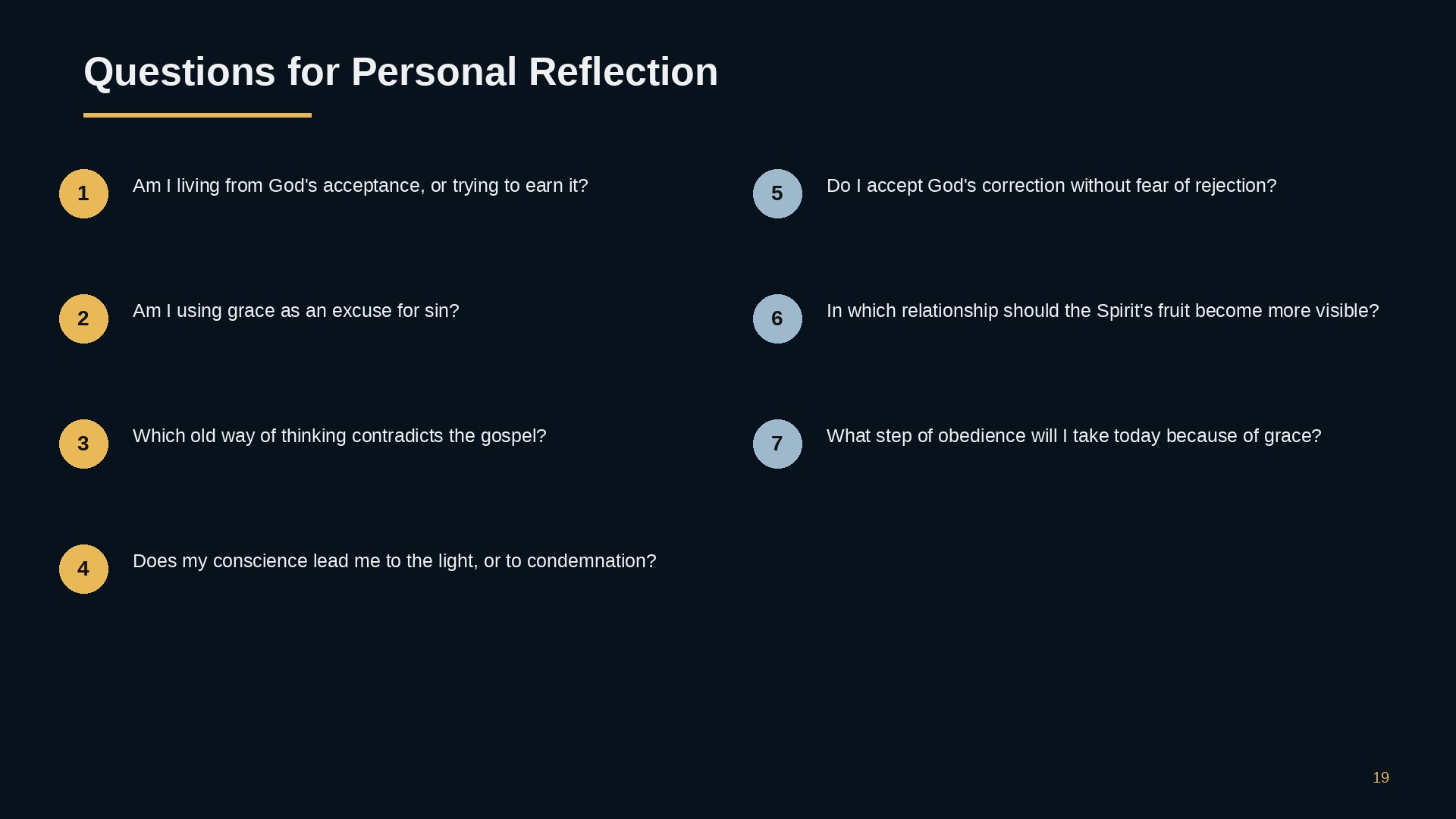
- Am I trying to earn God’s acceptance through my behavior, or am I living from the acceptance I have received in Christ?
- In what area do I still define myself by a past sin, a wound, or a failure?
- Which belief in my mind most opposes what the Word says about my new spirit?
- Is there a sin I excuse because I know about God’s grace?
- What one concrete choice will let me reveal the Spirit’s love, peace, or self-control in my relationships this week?
Conclusion — Holiness as Fruit, Not a Price
God does not call us to holiness while leaving us with the same old nature and a mere list of requirements. In Christ He made us new. He sanctified us through one sacrifice, justified us, and gave us His Spirit. Now He invites us, by faith, to learn what we have received, to renew our mind, and to yield our body to Him.
You don’t have to build your relationship with God on the constant question of whether you’ve done enough. Jesus did what you could never have done. But don’t use this truth as an excuse for sin. Sin still steals, destroys, and hardens. Grace frees us from condemnation so that we can truly change.
We do not sanctify ourselves so that God will love us. He loved us and sanctified us in Christ.
As we renew our mind and yield our body to Him, we allow the holiness of our born-again spirit to become visible in our whole life. God works in us, and we respond with faith, obedience, and perseverance.
Closing Prayer
Father, we thank You for the perfect sacrifice of Jesus. We thank You that we do not have to earn Your love or cleanse ourselves by our own strength. We thank You that in Christ we have been washed, justified, and sanctified.
Open the eyes of our hearts so that we may see who we are in our born-again spirit. Help us renew our mind with Your Word, offer You our bodies, and walk according to the Spirit. Show us the places where we excuse sin or still live under condemnation. Teach us to return to the truth quickly.
Let love, joy, peace, patience, goodness, faithfulness, gentleness, and self-control become visible in our homes, our relationships, and our community. We want to live not in order to earn Your acceptance, but because You have already received us in Jesus. Amen.
Key Bible Passages
- Genesis 2:3 — God sanctifies the day, setting it apart for Himself
- Exodus 19:10–14 — sanctifying the people before meeting God
- Leviticus 20:7–8 — the call to consecration, and God who sanctifies
- John 17:17 — sanctified in the truth; God’s Word is truth
- Romans 6:1–14 — dying to sin, considering the truth, and offering our members to God
- Romans 8:1–4 — no condemnation, and the law of the Spirit of life in Christ
- Romans 8:23 — the future redemption of the body
- Romans 12:1–2 — offering the body and transformation through renewing the mind
- 1 Corinthians 1:2 — sanctified in Christ and called to be saints
- 1 Corinthians 6:11, 17 — washed, sanctified, justified, and one spirit with the Lord
- 2 Corinthians 5:17–21 — new creation and the righteousness of God in Christ
- Galatians 5:16–25 — walking by the Spirit, the works of the flesh, and the fruit of the Spirit
- Ephesians 1:13; 4:24 — sealed with the Spirit and the new man created in holiness
- 1 Thessalonians 4:3–7 — sanctification visible in sexuality and daily conduct
- 1 Thessalonians 5:23 — spirit, soul, and body kept for God
- Titus 2:11–14 — grace that trains us to renounce ungodliness
- Hebrews 3:12–14 — the warning against hardening through sin’s deceitfulness
- Hebrews 6:4–6 — the warning against deliberate falling away
- Hebrews 8:6–13 — a better covenant and the law written on the heart
- Hebrews 9:11–15 — eternal redemption and the cleansing of the conscience
- Hebrews 10:1–22 — one sacrifice, sanctification, and confident access to God
- Hebrews 12:14 — the call to pursue sanctification
Andrew Wommack Resources Used in This Study
- Spirit, Soul, and Body — awmi.net/blog/spirit-soul-and-body
- Redemption — awmi.net/browse-teaching/redemption
- Hebrews: Living in the New Covenant Reality — awmi.net/browse-teaching/hebrews-living-in-the-new-covenant-reality
- Spirit vs. Flesh — Spirit, Soul & Body Study Guide, lesson 18 — cdn.awmi.net
- Once Saved, Always Saved or Born Again, Again? — lesson 11 — cdn.awmi.net
Definitions of Hebrew and Greek terms were prepared based on standard biblical lexicons. Quotations marked as a descriptive rendering are an English rendering of the sense of the text prepared for this teaching.