

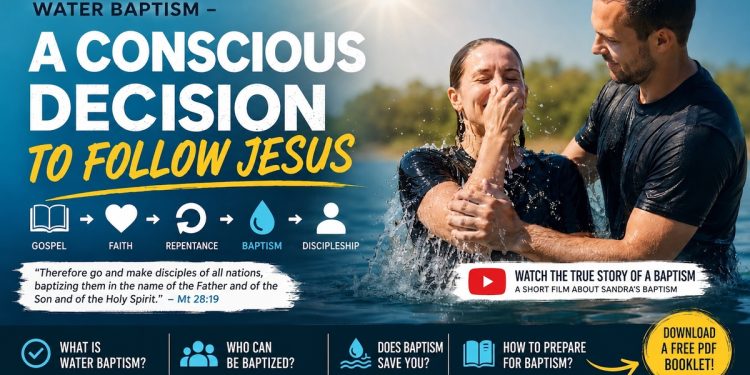
Water baptism is one of the first and most important steps of obedience for someone who has believed in Jesus Christ. It is not an empty ritual, a religious tradition, or a formality. It is the conscious decision of a disciple of Jesus who wants to publicly confess their faith, confirm their repentance, and begin a new life with God.
🎥 Watch a short example of water baptism
Sandra received water baptism as a conscious decision to follow Jesus. This short video shows a simple and beautiful moment of public confession of faith.
In the Bible we see a simple order:
Gospel → faith → repentance → baptism → discipleship
First a person hears the Gospel about Jesus Christ. Then they respond with faith, turn away from sin and their old life, and afterward receive baptism as a public confession that they belong to Christ. Jesus said:
“Go therefore and make disciples of all nations, baptizing them in the name of the Father and of the Son and of the Holy Spirit.”
Matthew 28:19
Baptism is therefore connected to discipleship. It is not the end of the road with God, but the beginning of the life of a disciple who wants to grow in Christ.
What is water baptism?
The word “baptize” comes from the Greek word baptizo, which means to immerse, to cover completely with water, and then to bring up out of it. That is why we understand biblical water baptism as the full immersion of a believer in water. Water baptism is:
- an act of obedience to Jesus’ command,
- a public confession of faith that I belong to Christ,
- an outward sign of the inward transformation that has taken place through faith,
- a picture of death, burial, and resurrection with Christ.
The apostle Paul wrote:
“Do you not know that all of us who have been baptized into Christ Jesus were baptized into his death? We were buried therefore with him by baptism into death, in order that, just as Christ was raised from the dead by the glory of the Father, we too might walk in newness of life.”
Romans 6:3–4
In baptism we show that our old life has been buried with Christ, and that we want to live a new life for God.
Baptism as a public confession of faith
Faith in Jesus is not merely a private opinion. A person who has truly believed is called to acknowledge Christ before others. Jesus said:
“So everyone who acknowledges me before men, I also will acknowledge before my Father who is in heaven.”
Matthew 10:32
Baptism is exactly this kind of public confession. Through it, a person says: I belong to Jesus Christ. It is my conscious “yes” to God and my “no” to the old life. It is not just about entering the water. It is about a heart that has believed, repented, and wants to follow Jesus as Lord.
Baptism and repentance
In the New Testament, baptism is closely connected to repentance. Repentance means turning away from sin and turning to God. On the day of Pentecost, people moved by the preaching of the Gospel asked the apostles:
“Brothers, what shall we do?”
Acts 2:37
Peter answered:
“Repent and be baptized every one of you in the name of Jesus Christ for the forgiveness of your sins, and you will receive the gift of the Holy Spirit.”
Acts 2:38
Repentance comes first. A person understands that they have lived without God, turns away from sin, and comes to Jesus. Baptism is then the outward confirmation of that inward decision.
Who can receive baptism?
According to the New Testament, baptism is received by people who:
- have heard the Gospel,
- have believed in Jesus Christ,
- are repenting, that is, turning away from sin,
- want to consciously follow Jesus as His disciples.
In the Bible we see that people often received baptism immediately after conversion. They did not put off obedience for years once they understood the Gospel and believed in Jesus. Examples from the Acts of the Apostles show this simple order:
- the people on the day of Pentecost heard the Gospel, repented, and were baptized,
- the Samaritans believed and received baptism,
- the Ethiopian official asked for baptism after hearing the Gospel,
- the jailer in Philippi believed together with his household and was baptized.
When a person understands the Gospel, believes in Jesus, and wants to belong to Christ, baptism becomes a natural step of obedience.
Does baptism save us?
Jesus Christ saves—through grace and faith. The rite of baptism itself has no power to save a person if there is no real faith, repentance, and personal turning to God. The Bible says:
“For by grace you have been saved through faith. And this is not your own doing; it is the gift of God.”
Ephesians 2:8
This does not mean, however, that baptism is unimportant. A person saved by grace desires to be obedient to Jesus. That is why a disciple of Christ does not treat baptism as an optional extra, but as faith’s response to the Word of God. We could put it this way:
Baptism does not replace faith, but true faith leads to obedience, and one of the first steps of obedience is baptism.
Baptism without faith is not biblical baptism. But faith that hears Jesus’ command and knowingly disregards it needs an honest examination of the heart.
What baptism is not
It is worth stating clearly what water baptism is not.
Baptism is not joining a denomination. It is not about enrolling a person in a religious organization, but about a public confession of faith in Jesus Christ.
Baptism is not a magic ritual that removes sin without real conversion. Water in itself does not cleanse the heart. God cleanses the heart through faith in Jesus Christ.
Baptism does not replace a personal relationship with Jesus. It publicly confirms it.
Baptism is also not an automatic solution to every problem. After baptism we still keep learning to walk with God, growing in the Word, in prayer, in the fellowship of the Church, and in obedience to the Holy Spirit.
Baptism is important, but it must never be treated as a religious custom. It is the conscious step of a person who has believed and wants to follow Jesus.
What about infant baptism?
We love children and believe that they are precious to God. Jesus blessed children and showed how important they are in the Kingdom of God. However, in the New Testament, baptism is tied to personal faith, repentance, and a conscious decision to follow Christ.
An infant cannot yet understand the Gospel, consciously believe, repent, or publicly confess Jesus as Lord. That is why we practice believer’s baptism by immersion. This is not a rejection of the child. It is keeping the biblical order:
hearing the Gospel → faith → repentance → baptism → discipleship
Instead of infant baptism, we can pray for children, bless them, and raise them in the knowledge of God, so that when they grow up and consciously believe in Jesus themselves, they can receive baptism as their own personal decision of faith.
What if I was baptized as a child?
Many people ask: “What if I was baptized as an infant or a child, but I had no personal faith at the time?”
This is an important question, and it is worth approaching it with respect, without dismissing anyone’s family history. However, we need to ask: was that earlier rite the same thing as the biblical baptism of a disciple of Jesus?
In Acts 19 we read about people who had earlier received John’s baptism. Yet when they heard the fuller Gospel about Jesus, they were baptized in the name of the Lord Jesus.
This shows that not every earlier religious rite is the same as a conscious baptism following personal faith and repentance.
That is why someone who was baptized as an infant, or without personal faith, should consider consciously receiving biblical baptism. This is not about “repeating a ceremony,” but about faith’s response to the Gospel.
Why is baptism important?
Baptism is important for several reasons.
First, Jesus himself was baptized. When he came to John at the Jordan, he said:
“Let it be so now, for it is fitting for us to fulfill all righteousness.”
Matthew 3:15
Second, Jesus commanded his disciples to preach the Gospel, make disciples, and baptize them in the name of the Father, the Son, and the Holy Spirit.
Third, the first Christians took baptism seriously. When people believed in Jesus, they were baptized. It was not an addition at the end of their spiritual life, but one of the first steps of a new life with God.
Fourth, baptism is a testimony to others. It shows family, the Church, and the world that a person has made a decision: I belong to Jesus Christ.
A good conscience before God
The apostle Peter writes that baptism is not merely a washing of the body, but an appeal to God for a good conscience through the resurrection of Jesus Christ.
“Baptism, which corresponds to this, now saves you, not as a removal of dirt from the body but as an appeal to God for a good conscience, through the resurrection of Jesus Christ.”
1 Peter 3:21
So it is not just about water. It is about a heart reconciled with God. A person coming to baptism should do so sincerely, with faith, with a desire for a clean conscience, and with a decision to live in obedience to Jesus.
What does biblical baptism look like in practice?
In practice, water baptism usually includes a few simple elements.
First, the person being baptized gives a short confession of faith in Jesus. In their own words, they can share who Jesus is to them, why they want to be baptized, and what God has done in their life.
Then the person is immersed in water in the name of the Father, the Son, and the Holy Spirit.
After the baptism, the Church prays for the newly baptized person—for their continued growth, being filled with the Holy Spirit, perseverance, and life as a witness of Jesus.
The event itself can be very simple. What matters most is not the outward details, but faith, obedience, and a clear confession of Jesus as Lord.
How to prepare for baptism
Before baptism, it is worth pausing before God and honestly answering a few questions:
- What led me to decide to be baptized?
- Have I turned away from sin and my old life?
- Do I believe that Jesus Christ is the Son of God and my Savior?
- Do I want to follow Jesus as Lord, whatever the cost?
- Do I want to publicly confess that I belong to Christ?
It is also worth reading Bible passages about baptism, preparing a short testimony of faith, and asking questions about anything you do not yet understand.
There is no need to be afraid of questions. It is better to go into the water consciously, with faith and a good conscience, than to treat baptism as a religious custom. Practically speaking, it is worth preparing:
- dark, non-transparent clothing for the water,
- a towel,
- a short testimony: “Who is Jesus to me?”,
- an open heart for prayer and further guidance from God.
A short heart check before baptism
Before you make your decision, you can pray and answer before God:
- Do I believe in Jesus Christ as my Savior and Lord?
- Do I want to turn away from sin and live in obedience to God?
- Am I ready to publicly confess Christ?
- Do I want to be a disciple of Jesus, and not merely a participant in a religious rite?
- Do I understand that baptism is the beginning of further growth?
You can also pray a simple prayer:
Lord Jesus, I believe in You. I turn away from sin and I want to belong to You. Lead me in a new life. Amen.
What comes after baptism?
Baptism is not the end of the road. It is the beginning of the life of a disciple of Jesus. After baptism, it is worth continuing steadfastly in:
- the Word of God,
- prayer,
- the fellowship of the Church,
- the Lord’s Supper,
- serving others,
- bearing witness about Jesus.
A disciple of Jesus needs to grow. They need the Church, relationships, teaching, encouragement, and the guidance of the Holy Spirit. Baptism is a strong beginning, but after it comes the daily walk with God.
Jesus did not call us merely to a one-time decision. He called us to a life of discipleship.
Do you want to be baptized?
If you have believed in Jesus, baptism is the next step of obedience.
Do not put it off just because you are afraid of what people will think, do not feel ready enough, or do not have answers to every question. Talk to a leader, ask questions, read the Word of God, and make a conscious decision before God. Contact us and we will certainly help you with this.
If you understand the Gospel, believe in Jesus, are turning away from sin, and want to belong to Christ—baptism is the right step of faith.
Download the free leaflet on water baptism
We have prepared a short leaflet from the “Foundations of the Christian Faith” series, which explains in a simple way the most important truths about water baptism. In the leaflet you will find answers to questions like:
- what water baptism is and why it matters,
- who can receive baptism,
- what about infant baptism,
- does baptism save us,
- what baptism looks like in practice,
- how to prepare for baptism.
Download the PDF leaflet and read it before making your decision:
If you want to be baptized or have questions, contact us or come talk to the person leading the meeting afterward.
Christian Church in Czestochowa
ul. Wały Dwernickiego 117/121, Częstochowa
Industrial and Technology Park, Room No. 1
Sunday, 11:00 AM–1:00 PM
Contact:
phone 501 437 112
kontakt@kosciol.czest.pl
www.kosciol.czest.pl