

Right from the start it needs to be said clearly that the Bible does not command believers to fast. Fasting is not something God requires of us, although we do find a great deal of encouragement in Scripture that it is something good, something from which we can gain real benefit. The Lord Jesus even assumed that we would fast (Matt 6:16).
Although fasting in Scripture almost always means going without food, there are other kinds of fasting as well. Giving up anything that gets in the way of focusing more fully on God is a kind of fast in itself (1 Cor 7:1-5). Too often we focus simply on not eating during a fast. Instead, we should be turning our attention away from the things of this world that grab our attention, and turning it toward God. Fasting is an attempt to show God, and ourselves, that we take our relationship with Him seriously. Fasting helps us gain a fresh perspective and renew our bond with God.
Fasting should be limited in time, especially when it involves abstaining from food. Going too long without food is harmful to our health. The purpose of fasting is not to “punish” our bodies, but to help us focus on God. Nor should it become a kind of “diet.” Do not fast in order to lose weight – instead, seek a deeper relationship with God. In truth, anyone can fast. Some people may not be able to go without food (diabetics, for example), but everyone can give something up for a time in order to focus on God.
Fasting is not a way to get from God the things we want. Fasting is meant to change us, not God. It is not a way to appear more spiritual to others than we actually are.
By turning our eyes away from what is happening in this world, we can focus more fully on Christ. Fasting is meant to be a time filled with humility and a joyful attitude.
“Moreover when ye fast, be not, as the hypocrites, of a sad countenance: for they disfigure their faces, that they may appear unto men to fast. Verily I say unto you, They have their reward. But thou, when thou fastest, anoint thine head, and wash thy face; that thou appear not unto men to fast, but unto thy Father which is in secret: and thy Father, which seeth in secret, shall reward thee openly.” – Matt 6:16-18
Satisfying hunger is a powerful drive, so gaining victory over it opens the way to victory over every other temptation. It is no accident that the Lord Jesus began His ministry with a forty-day fast:
“Then was Jesus led up of the Spirit into the wilderness to be tempted of the devil. And when he had fasted forty days and forty nights, he was afterward an hungred. And when the tempter came to him, he said, If thou be the Son of God, command that these stones be made bread. But he answered and said, It is written, Man shall not live by bread alone, but by every word that proceedeth out of the mouth of God.” – Matt 4:1-4
Jesus began His work of redemption with a victory in the very place where the first humans had fallen – in the matter of appetite, through which they took and ate from the forbidden tree. His forty-day fast, together with His obedience to the Word of God, was the first blow He struck against the kingdom of darkness in the battle for humanity.
Before Jesus began His fast, we read that He was full of the Spirit:
“And Jesus being full of the Holy Ghost returned from Jordan, and was led by the Spirit into the wilderness…” – Luke 4:1
But when He returned from the wilderness, where He had fasted and overcome the temptations of the devil, He was now in the power of the Holy Spirit:
“And Jesus returned in the power of the Spirit into Galilee: and there went out a fame of him through all the region round about.” – Luke 4:14
To be full of the Spirit is one thing; to be in the power of the Spirit is another. The Spirit had been present in Jesus from His baptism onward. But it was the fast that equipped Jesus to overcome the weaknesses of His flesh and defeat the devil’s temptations. He came out of that contest with God’s power and a victory that would go on to accompany Him throughout His entire ministry, over every work of the devil.
The Lord Jesus assumed that all believers would not only pray and study the Word of God, but would also fast (Matt 6:16-17). As a result, fasting brings benefit to both our spirit and our body. Christians should from time to time join together in fasting and prayer of agreement, just as God’s people did in the Old Testament (2 Chron 20:3-4), asking God to bind the works of the kingdom of darkness, to break open the hearts of God’s people, to open the eyes of unbelievers to the Gospel…
How to Carry Out a Fast
It’s best to start preparing your body a few days beforehand, cutting out harmful fast food so that the body doesn’t experience a sudden shock. Our bodies should be a temple of the Holy Spirit, not a poisoned organism. The apostle Paul wrote:
“I beseech you therefore, brethren, by the mercies of God, that ye present your bodies a living sacrifice, holy, acceptable unto God, which is your reasonable service.” – Rom 12:1
Improper eating dulls the body’s sensitivity – in taste, in mind, and in spirit. A mind saturated with toxins from bad food, alcohol, caffeine, and other substances does not perceive spiritual matters clearly. Satan knows this, which is why he tries to push as much of the population as possible into bondage to these habits, starting from our youth.
During a fast, it’s best to drink only water with fresh-squeezed lemon juice. This helps reduce the negative symptoms that accompany the body’s cleansing process and speeds it up. Discomforts that can appear at the start of a fast include headache, weakness, and a feeling of coldness. How intense these symptoms are depends on how many substances (or medications) you’ve been using in the recent past. The cleansing process is often accompanied by slightly more frequent urination and a coated tongue, and therefore less-than-pleasant breath. The more coated the tongue, the greater the level of toxicity in the body.
Those who have trouble getting through the first day of fasting can drink unsweetened juices, or begin the fast only after breakfast or an early lunch, so that the hardest hours (when hunger is greatest) fall during sleep. The stomach needs 3-5 hours to digest a meal, so in order not to disturb this process we should avoid eating between meals and for 3-5 hours before bed, so the stomach can rest just like the other organs. When the stomach has to work on something we’ve dropped into it right before bed, we wake up feeling unrested.
The hardest part is the first 2-3 days of fasting, when the body is removing the most toxins, which is why there’s headache, a feeling of weakness, and discomfort. During mealtimes, occupy yourself with something that requires activity from your whole body – a brisk walk, a run, exercise, a hobby, or absorbing work. Studies show that regular 30-minute exercise sessions three times a week not only strengthen muscles and improve appearance, but also, as a result, improve overall well-being. Running, walking, swimming, cycling are all wonderful activities. Make use of them every day, not just while fasting.
During a fast, resistance to illness increases, since the energy normally used for digesting food can instead be used to strengthen the immune system. Stamina, physical condition, and mental sharpness increase as well.
After three days of fasting, a feeling of lightness sets in, and overall well-being improves. The feeling of hunger disappears. Unnecessary fat begins to vanish, along with various forms of swelling and blemishes. The body begins to feed on diseased tissue. This has a rejuvenating effect, since the diseased tissue is replaced by new tissue. This is the reason behind many healings that result from longer fasts.
A fast longer than three days requires drinking large amounts of water! Our bodies can only survive about 3 days without water! Coming out of a longer fast should also be done gently, following a plant-based diet and not eating too much all at once. The physical benefits of fasting are enormous, but the spiritual blessings are even more important. Below, following Elmer Towns, I present nine biblical types of fasting.
Types of Fasts
The Bible shows fasting as a help in the face of, among others, the following spiritual struggles:
- in seeking God (Jonah 3:5),
- in seeking answers (Ps 35:13),
- in drawing near to God (Luke 2:37),
- in gaining freedom from enemies (Esther 4:16),
- before beginning a mission or making important decisions (Acts 13:2; 13:4; 14:23),
- in delivering the demonized (Matt 17:21).
Men of God also fasted. In Scripture we find at least nine different types of fasts. Looking at them together illustrates certain functions and purposes they serve.
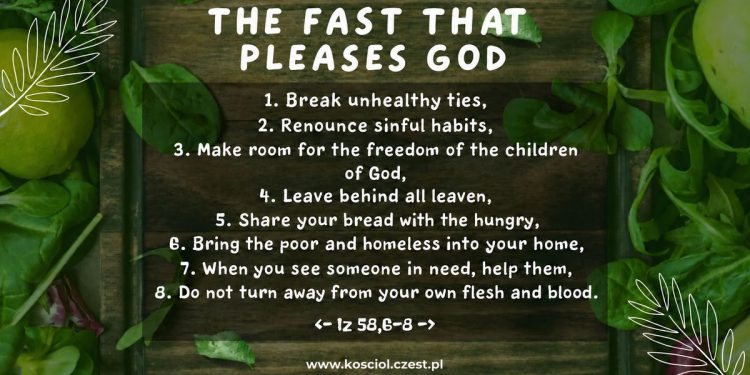
“Is not this the fast that I have chosen? to loose the bands of wickedness, to undo the heavy burdens, and to let the oppressed go free, and that ye break every yoke? Is it not to deal thy bread to the hungry, and that thou bring the poor that are cast out to thy house? when thou seest the naked, that thou cover him; and that thou hide not thyself from thine own flesh? Then shall thy light break forth as the morning, and thine health shall spring forth speedily: and thy righteousness shall go before thee; the glory of the LORD shall be thy rearward.” – Isa 58:6-8
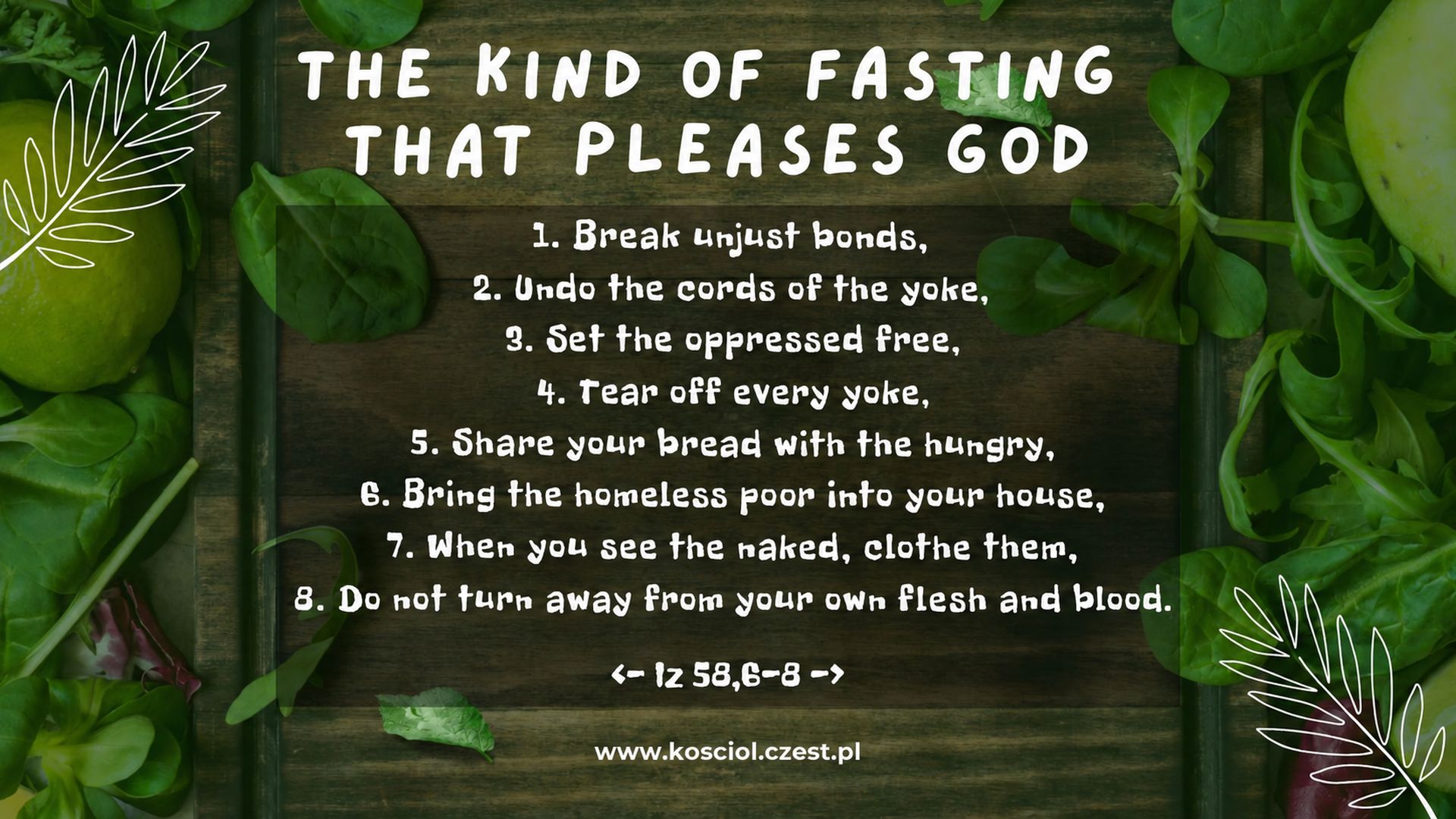
Is not this the fast that I have chosen:
- loose the bands of wickedness,
- undo the heavy burdens,
- let the oppressed go free,
- break every yoke,
- share your bread with the hungry,
- bring the poor and homeless into your house,
- when you see the naked, clothe him,
- do not turn away from your own flesh and blood
1. The Fast of Jesus’ Disciples
“to loose the bands of wickedness” – Isa 58:6
A worried father brought his son to Jesus’ disciples – a boy who suffered from seizures so severe that he would often fall into fire or water. The apostles were unable to heal him. When Jesus arrived, He rebuked the demon, which came out, and the boy was healed.
“And I brought him to thy disciples, and they could not cure him. Then Jesus answered and said, O faithless and perverse generation, how long shall I be with you? how long shall I suffer you? bring him hither to me. And Jesus rebuked the devil; and he departed out of him: and the child was cured from that very hour. Then came the disciples to Jesus apart, and said, Why could not we cast him out? And Jesus said unto them, Because of your unbelief. For verily I say unto you, If ye have faith as a grain of mustard seed, ye shall say unto this mountain, Remove hence to yonder place; and it shall remove; and nothing shall be impossible unto you. Howbeit this kind goeth not out but by prayer and fasting.” – Matt 17:16-21
Jesus’ words show that the disciples would have been able to heal the young man had they used fasting. We too could have greater effectiveness and sensitivity to the Holy Spirit in our ministry if we more often combined prayer with fasting when praying for deliverance. The bonds Isaiah writes of could be a leaning toward alcohol, drugs, nicotine, caffeine, or immoral sexual practices. These are deeply rooted within us and are not easily broken by willpower alone. Fasting and prayer can help us with this, as disciples of Jesus.
We shouldn’t tolerate our weaknesses or make excuses for them or hide them. God forgives confessed sins, but remaining in them weakens our sense of self-worth and our willpower, making us more prone to further falls.
2. The Fast of Ezra
“to undo the heavy burdens” – Isa 58:6
Ezra was a priest at the time when the Babylonian captivity came to an end. The Persian king Artaxerxes issued a decree permitting the rebuilding of Jerusalem’s walls and temple, providing the necessary funds for the purpose. Ezra was to bring back to Jerusalem the vessels the Babylonians had carried off from the temple. The journey ahead of him and his companions was long and dangerous. Rather than ask the king for an armed escort, Ezra called a fast in order to seek from God a safe journey. God heard them, and they arrived safely in Jerusalem. (Ezra 8:21-23).
In this case, fasting helped in the face of serious life problems and obstacles standing in the way of a God-given mission. During this fast, God lifted the yoke, the pressure, and the fear from Ezra, so that he could move forward with joy and confidence, without fear. A fast like this strengthens a person’s will and gives the conviction that in God’s power we can survive hardship, overcome weaknesses, and remove obstacles.
3. The Fast of Samuel
“to let the oppressed go free” – Isa 58:6
Sunk deep in idolatry, the Israelites lost God’s blessing and suffered defeat after defeat at the hands of the Philistines. In desperation they brought out the Ark of the Covenant, thinking its mere presence would guarantee them victory, yet they suffered another defeat. The Ark fell into the hands of the Philistines, who soon had to give it back, since it brought them painful plagues. When it was placed in the temple of the idol Dagon, in the morning his statue was found broken before the Ark.
In time the Israelites turned back to God. The prophet Samuel called them together at Mizpah, where they repented of their sins and prayed. When the Philistines heard of this gathering, they set out to defeat them. Filled with fear, the Israelites turned to Samuel. He proclaimed a fast and interceded for the people. That very day the Philistines advanced to do battle, but God thundered loudly against them, throwing their camp into such panic that they were easily defeated. From then on they did not attack Israel again until Samuel’s death (1 Sam 4-8).
This example shows that true fasting is not merely going without food, but involves the examination of hearts, the confession of sins, intercession in prayer, and spiritual warfare. The fast called for by the prophet Samuel served for spiritual renewal. This fast loosed Israel’s bonds, so that they could finally be freed from the destructive influence of the Philistines.
4. The Fast of Elijah
“that ye break every yoke” – Isa 58:6
On Mount Carmel the prophet Elijah won a great victory over the prophets of Baal. Their idol could not answer their pleas, since he was bound by Elijah’s prayer. All the false prophets lost their lives. God vindicated Elijah, showing where the truth was. Elijah hoped that this great spiritual victory would draw Israel back to God. He counted on it weakening the influence the apostate and wicked queen Jezebel held over King Ahab of Israel. Instead, Jezebel, obedient to Satan’s schemes, issued a death sentence against Elijah.
The prophet, so recently lifted up on high, now found himself in a dark valley. His effort seemed to have been in vain. He felt forgotten by God and abandoned by people. He fell into depression. He longed for his own death. Exhausted, he lay down and fell asleep. An angel of God woke him, bringing him a freshly baked cake and a jar of water. Touching the prophet, the angel told him to wake up and eat, for a long journey lay ahead of him.
Elijah walked forty days without food until he reached Mount Horeb. There he found shelter from his enemies, and above all, comfort and support from God. God lifted the burden Elijah had placed upon himself. The prophet returned with fresh vision and enthusiasm. God provided him a helper in the person of Elisha, who carried on the work of reform Elijah had begun. Jezebel, meanwhile, died at the hands of her own servants after Jehu’s uprising (1 Kings 18-19).
In the story above, we see that fasting helped bring victory over the spiritual and emotional weaknesses with which Satan seeks to plunge us into unbelief and depression. It helped him feel afresh the power, love, care, and closeness of the Creator, and it helped tear down the evil thoughts directed against Elijah personally and against his ministry.
5. The Fast of the Widow
“deal thy bread to the hungry” – Isa 58:7
During a long drought that fell upon Israel as a result of the apostasy led by King Ahab and Jezebel, God sent Elijah to the Phoenician town of Zarephath, promising that the prophet would find a hospitable home there. Elijah came upon a widow in the town who was gathering wood. He asked her for water, and as she went, he called after her:
“And as she was going to fetch it, he called to her, and said, Bring me, I pray thee, a morsel of bread in thine hand. And she said, As the LORD thy God liveth, I have not a cake, but an handful of meal in a barrel, and a little oil in a cruse: and, behold, I am gathering two sticks, that I may go in and dress it for me and my son, that we may eat it, and die. And Elijah said unto her, Fear not; go and do as thou hast said: but make me thereof a little cake first, and bring it unto me, and after make for thee and for thy son. For thus saith the LORD God of Israel, The barrel of meal shall not waste, neither shall the cruse of oil fail, until the day that the LORD sendeth rain upon the earth. And she went and did according to the saying of Elijah: and she, and he, and her house, did eat many days. And the barrel of meal wasted not, neither did the cruse of oil fail, according to the word of the LORD, which he spake by Elijah.” – 1 Kings 17:10-16
This hospitable Phoenician woman, in her tragic circumstance, agreed to give up her last bit of food to help Elijah. The Moravian Brethren were known for investing money saved through frequent fasting into missionary work. Thanks to their sacrifice, many peoples on different continents came to know the Gospel.
In a similar way, the widow who put her last few coins into the temple treasury acted, as did the boy who gave his two fish and five loaves to Jesus, who then multiplied them. So too did those Israelites who, every third year, gave an additional tithe for the poor, orphans, widows, and Levites. All these examples teach us to pay attention to the needs of others before our own.
6. The Fast of the Apostle Paul
“then shall thy light break forth as the morning” – Isa 58:8
The apostle Paul, known before his conversion as Saul of Tarsus, served the Sanhedrin as a tool for persecuting the first Christians. His superiors believed that decisive action would defeat what they considered heresy. They sent Saul to Damascus with a mission to imprison all who followed Jesus Christ. On the way he had an extraordinary encounter. A great light dazzled him, so that he fell to the ground and heard the voice of God.
“And he fell to the earth, and heard a voice saying unto him, Saul, Saul, why persecutest thou me? And he said, Who art thou, Lord? And the Lord said, I am Jesus whom thou persecutest: but arise, and go into the city, and it shall be told thee what thou must do.” – Acts 9:4-6
Saul now believed that the testimony of Jesus’ disciples was true. He understood the significance of the words of Stephen, at whose stoning he had been present. He realized that in persecuting the followers of Christ, he had been a tool of darkness. He received Jesus as his Lord and Savior. For three days he remained without food or drink. Alone, he examined and humbled his heart before God. He felt deep sorrow over having persecuted others. God’s mercy was his only hope. The more he pondered the biblical texts concerning the Messiah, the more clearly he saw them fulfilled in Jesus of Nazareth. Saul’s heart longed for reconciliation with God the Father and the Son. His prayers were not in vain. God’s grace washed his heart clean. After three days God sent the prophet Ananias to him, who prayed for his healing, and Saul regained his sight. God called him to be His apostle (Acts 9).
The apostle Paul’s fast helped him as he sought wisdom and understanding in order to make an important decision. Decisions like these are well served by being preceded by fasting and prayer for wisdom.
7. The Fast of Daniel
“thine health shall spring forth speedily” – Isa 58:8
Among those carried off into Babylonian captivity was Daniel, along with his three friends, who were assigned together with other capable young men to the king’s school. As a special privilege, the king assigned them food from his own table, along with the wine he himself drank.
Daniel resolved not to defile himself with what, according to the Word of God, was unclean for them. Together with his three friends he asked the official in charge for water and a vegetable diet. They also asked for a ten-day trial. At the end of that time, it turned out that Daniel and his three friends looked considerably better and were stronger, and during the examinations achieved results ten times better than the others who ate from the king’s table (Dan 1:5-17).
Daniel and his friends followed the diet God originally gave to Adam and Eve. The word “vegetables” used in the original refers to edible fruits and plants. This kind of fast helped them overcome the lust and excess of Babylon and focus instead on God, His help, and His provision. When they trusted the Creator, He supernaturally healed and strengthened their bodies. As we’ll see next, John the Baptist practiced a similar kind of fast.
8. The Fast of John the Baptist
“thy righteousness shall go before thee” – Isa 58:8
John the Baptist was to go before the Messiah. In preparing for this work he spent many years in secluded places, where nothing would disturb his fellowship with God. John took the vows of a Nazirite. In keeping with them he lived a life of great restraint. This did not mean, however, that he spent his time in ascetic idleness. He visited inhabited settlements in order to stay in close contact with people. By his example he stirred people toward righteous living, and by his word he prepared them for the coming of the Messiah.
The Bible tells us that John drank no wine and lived on honey and locusts. The term “locusts” (Greek: acridas) in ancient Greek sources can also refer to wild-growing roots and fruits. This suggests that John the Baptist may have eaten food of this kind. Today, as the Church, we too have received a similar task: to prepare humanity for the coming of Christ.
9. The Fast of Esther
“the glory of the LORD shall be thy rearward” – Isa 58:8
In the days of King Artaxerxes, the devil planned the total annihilation of God’s people. For this purpose he used Haman – a proud and arrogant prince. Having gained a high position, Haman demanded honor from everyone. Only Mordecai resisted him, because he served the true God. Knowing that Mordecai was an Israelite, Haman tricked the king into issuing a death decree against his entire nation.
Not long before, Esther, who had been raised by Mordecai, her uncle, had been chosen as queen. Neither Haman nor the king knew of this connection. On hearing of Haman’s cruel plan, Esther resolved to intercede before the king on behalf of her people. Yet according to Persian tradition, a queen faced death for appearing before the king uninvited. And it sometimes happened that she would go months without being summoned, while the deadline for the decree to take effect drew near. Before Esther risked her life, she turned to her friends and to her uncle Mordecai, saying:
“Fast and pray for me. Do not eat or drink for three days, night and day. I and my maidens will also fast and pray about this matter.”
As a result, God was able to intervene, revealing to the king Haman’s true nature. Haman died on the gallows he had built for Mordecai. The plans Satan had schemed against God’s people were brought to nothing as a result of the fast of Esther and her companions. (Esther 3-8).
This kind of fast helped protect Israel and her loved ones from attack, death, and destruction. It caused Satan’s plans to be destroyed and the enemies to be exposed. If you too feel you are in a spiritual battle or under diabolical pressure, fasting can prove helpful for you as well. Don’t avoid confrontation, but like Esther, in humility, repentance, and fasting, go out to meet the attacks. Ask God to expose the deception and the true nature of those who proclaim lies under the guise of truth.
See also other articles on the subject of fasting: