




How will they recognize you? Not by the fish sticker on your car, and not by how many verses you know. Jesus said it plainly: “By this everyone will know that you are my disciples, if you have love for one another” (John 13:35). In a world full of divisions, arguments and exhaustion, many people are watching Christians and asking whether we are any different. This teaching shows what Christian love looks like when it cannot go unnoticed: in the church, in marriage, in conversations, in conflict and in forgiveness.
Watch on YouTube
Listen to the Podcast
The central message
The answer to the question “how will they recognize you?” is: by love. I truly grow in faith when the love I have received from God begins to reach others through me. Knowledge, service and gifts matter, but love is the sign by which the world recognizes the disciples of Jesus. It does not begin with everyone at once, but with one name and one step.
This teaching walks through five steps: from love that has grown cold, through the towel and the dirty feet, knowledge without love, love under pressure and forgiveness, to a concrete step you can take this very week.
The love of many will grow cold
All it takes is switching on the news to see how divided we are: yet another poll, political disputes, scandals, and a war on the eastern border that once again strikes Ukraine’s energy system before winter. All of this stirs up strong emotions. The question is: do Christians look any different in all this noise?
The study “State of Polarization 2026” (the New Community Foundation and SWPS University) shows the scale of the problem:
- 69% of Poles believe that we are deeply divided.
- Only about 1 in 4 is ready to be friends with someone who has different political views (a year earlier it was almost half).
- 33% of people blame politicians from the other side for the divisions, and only 5% blame their own.
The researchers’ conclusion: we differ in our views less than we think, but we like each other less.
“Because iniquity will be multiplied, the love of many will grow cold.”
— Matthew 24:12
Jesus speaks about love that does not explode but slowly cools down. Like tea: nobody pours it out, nobody simply reheats it. Is your love cooling down, or is it warming up? Because it will not warm itself.
Do you remember the older son in the parable of the prodigal son? He lived in his father’s house, but his heart had gone cold. He could not rejoice at his brother’s return. Of the younger one he said to his father, “this your son,” and the father answered, “this your brother.” We also wrote about the parable of the two sons in the teaching “Think Like a Child of the King, Not Like a Slave”.
Where can we get the warmth? Not from ourselves. “We love him, because he first loved us” (1 John 4:19). And right after that John adds strong words: if someone says, “I love God,” and hates his brother, he is a liar (1 John 4:20). The only thing that warms us is closeness to God, our Father, and the fire of the Holy Spirit.
Remember: I mature in faith when the love I receive from God begins to reach others through me.
A towel instead of a throne
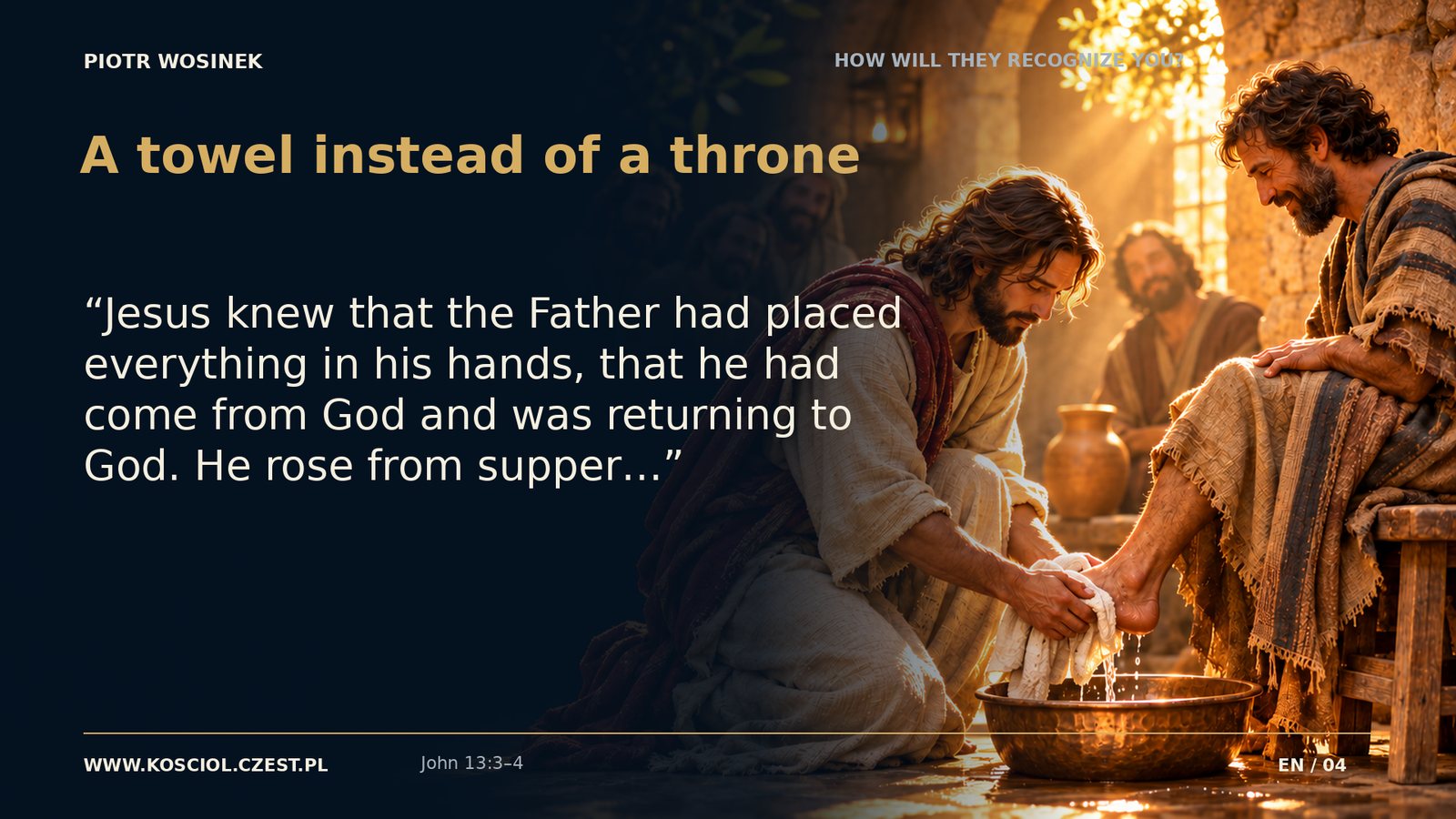
Jesus said plainly how the world would recognize us. But before he said it, he took a towel in his hands. It happened at the Last Supper. The disciples had dirty feet after the journey, and washing feet was the work of the lowest servant. Meanwhile the disciples were arguing about which of them was the greatest (Luke 22:24).
And then Jesus gets up. He takes off his robe, picks up a towel and a basin. He kneels before Peter, who within hours will deny him, and before Judas, who has already decided to betray him.
“Jesus, knowing that the Father had given all things into his hands, and that he came from God, and was going to God, arose from supper…”
— John 13:3–4
Insecure people need to win, to rule and to have the last word. Someone who knows he is loved by the Father can stoop down. The greatest confidence looks like a towel in the hand.
“A new commandment I give to you, that you love one another. Just as I have loved you, you also love one another. By this everyone will know that you are my disciples, if you have love for one another.”
— John 13:34–35
What is new here? The measure: “just as I have loved you,” that is, with a towel in hand, including those who will fail. Jesus did not say, “they will know you by your music, your building, your knowledge or your number of likes.”
Love that could not go unnoticed
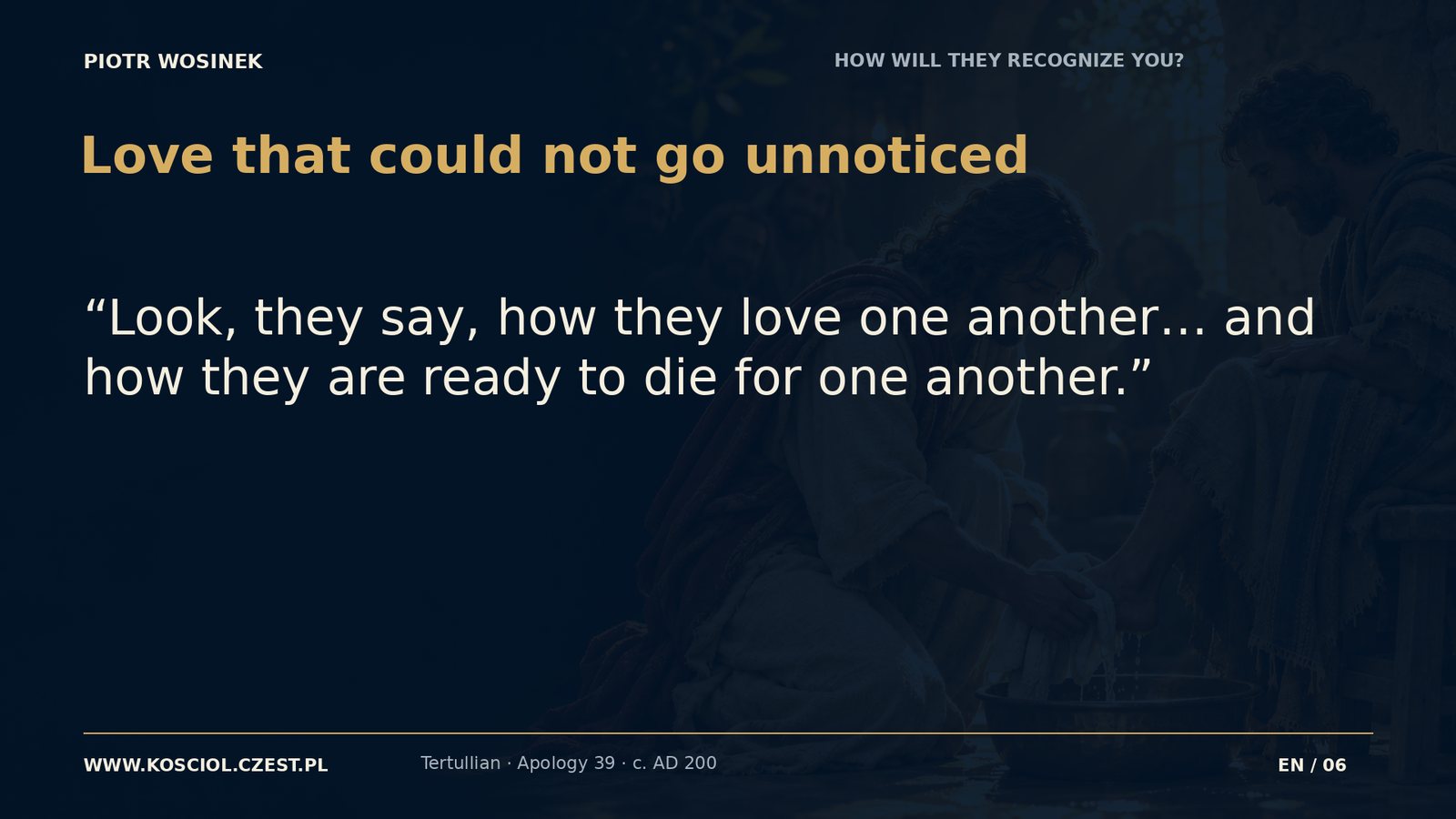
The year is 362. Emperor Julian the Apostate wants to restore paganism. In a letter to the pagan priest Arsacius he complains that the Christians (“Galileans”) “feed not only their own poor but ours as well,” while the pagans do not help even their own.
Earlier, during the plague of the third century, Bishop Dionysius of Alexandria wrote that Christians cared for the sick even though they themselves caught the disease and died (Eusebius, Church History VII,22). They had no influence and no buildings. How were they recognized? They had love that could not go unnoticed.
“See,” they say, “how they love one another… and how ready they are to die for each other.”
— Tertullian, Apology 39 (c. AD 200)
“Love is the sign Christ gave Christians to wear before the world.”
— Francis Schaeffer, “The Mark of the Christian” (1970)
What do people see when they look at our marriages, our conversations about others, our comments online and our church?

People need someone who will hear them out to the end, without a sermon. According to a study by the Humanites Institute (October 2026), 30% of Poles find it easier to talk about their problems with artificial intelligence than with someone close, and among the young it is more than a third. AI does not interrupt, does not judge and does not bring up the past. Perhaps this is not a charge against technology, but against us?
James urges us to be “swift to hear, slow to speak” (James 1:19). Whom will you hear out to the end today, before you say anything?
Are you right, or in a relationship?
Someone will say, “But I know a lot about God. I serve. I help.” Paul writes to just such a church, one that had everything except one thing. In Corinth there was a church full of gifts and knowledge (1 Corinthians 1:5–7). But there were also divisions (“I am of Paul,” “I am of Apollos”) and lawsuits between brothers. Does that sound familiar? Many gifts, little love.
“If I speak with the languages of men and of angels, but don’t have love, I have become sounding brass, or a clanging cymbal.”
— 1 Corinthians 13:1
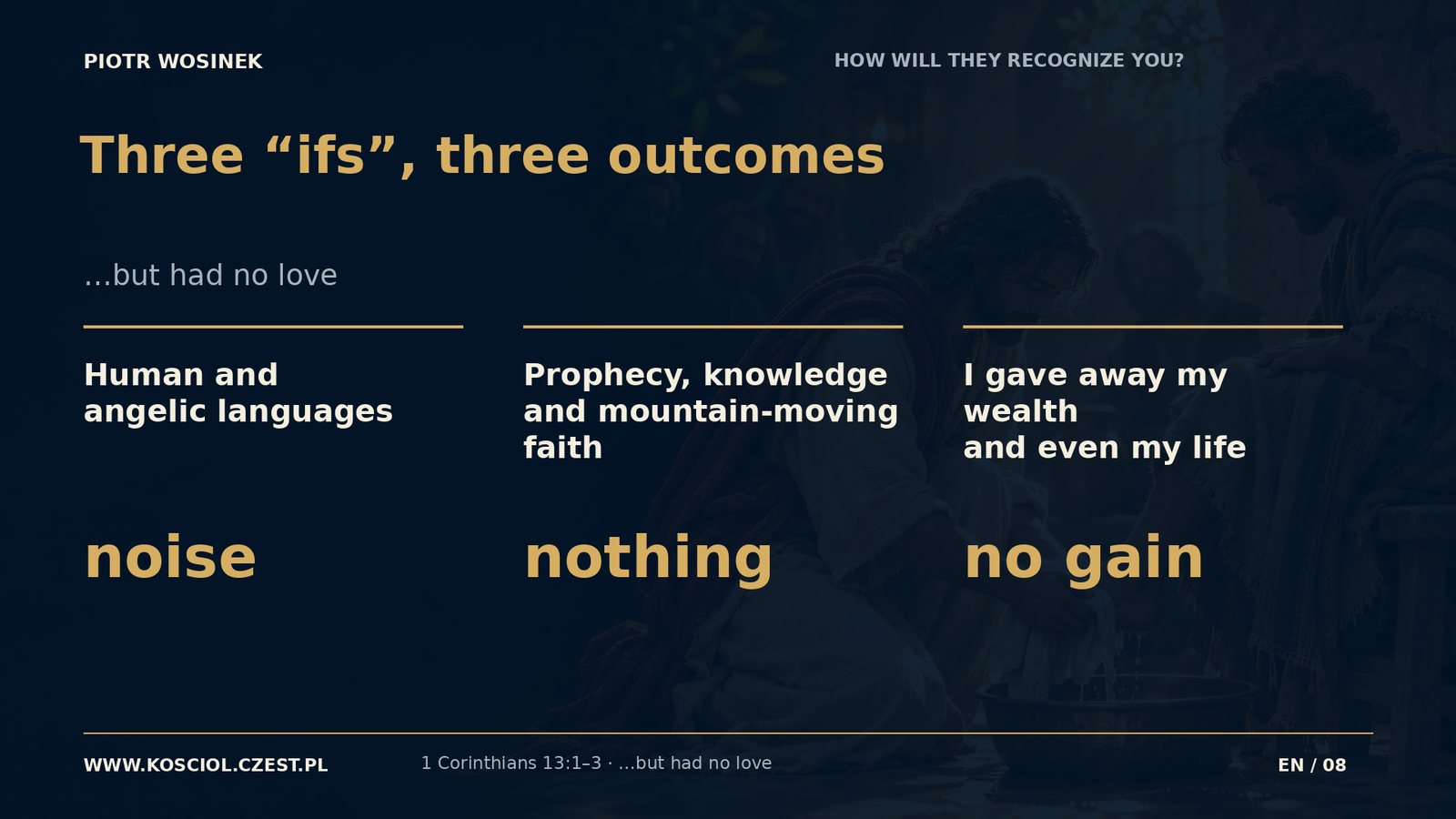
| If I had… | …but had no love |
|---|---|
| Human and angelic languages | noise |
| Prophecy, knowledge and mountain-moving faith | nothing |
| I gave away my wealth and even my life | no gain |
Corinth was famous for its bronze, and in ancient theaters bronze vessels were placed to amplify sound (Vitruvius writes about this). It was loud, but empty inside. This is what Christianity without love sounds like.
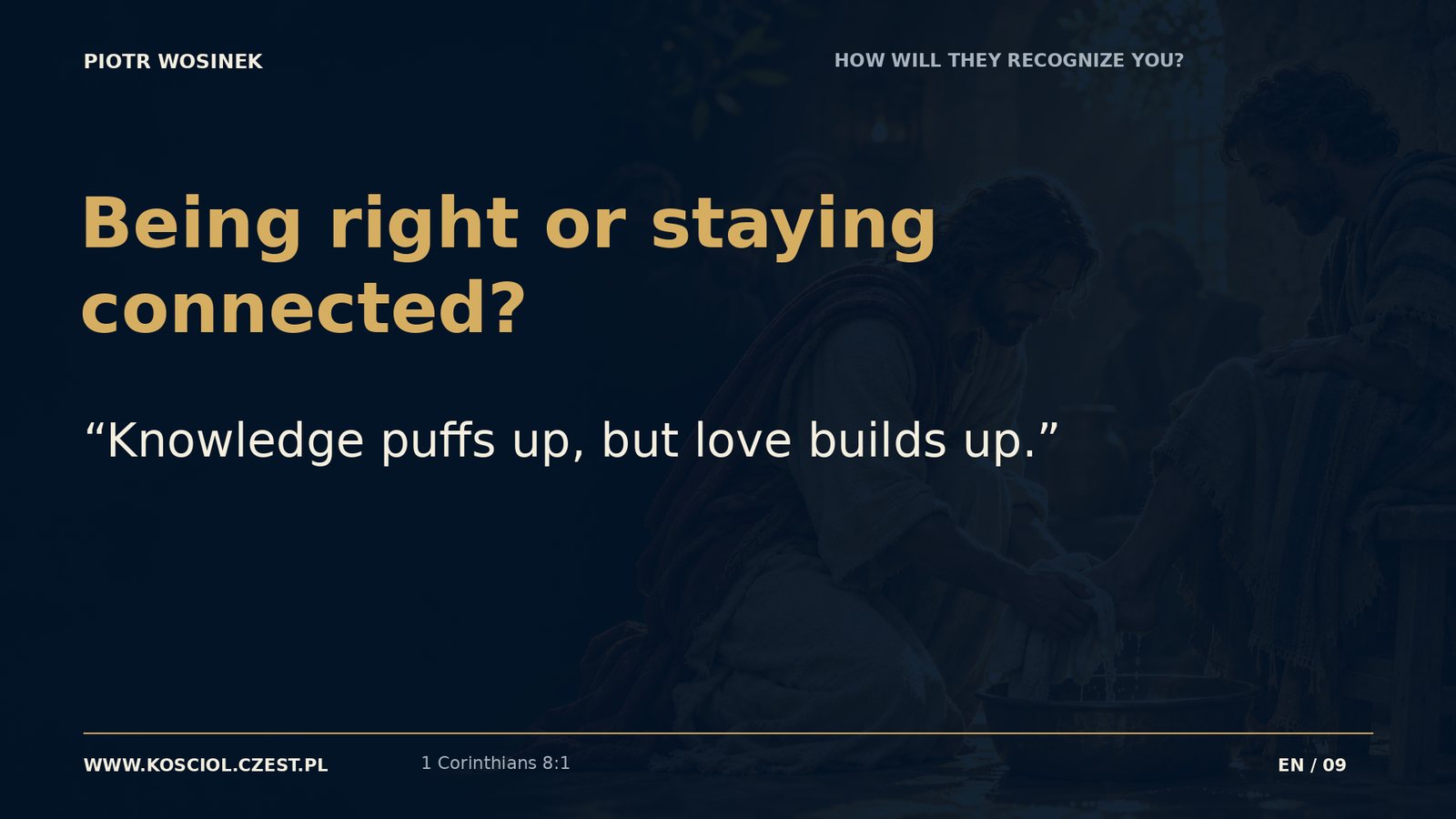
You can win a discussion about God, be right about a verse, and end the relationship. Paul writes, “If I have all knowledge, but don’t have love, I am nothing” (1 Corinthians 13:2). Not “a slightly weaker Christian,” but nothing. You may be right about the verse, but your tone says, “I am better than you.” “Knowledge puffs up, but love builds up” (1 Corinthians 8:1). Being right without love is only empty noise.
This applies to the church too. Lifeway Research (USA, 2025) surveyed 730 former pastors: 87% had experienced conflict in the church, 49% had endured a serious personal attack, and 18% had left ministry mainly because of conflict in the church. According to Barna (USA, 2010), 37% of people who do not attend church avoid it because of bad experiences with the church or with people from the church. Almost 4 out of 10. Not because of Jesus, but because of us.
In Poland, according to ISKK, 29.6% of Catholics attend Mass on Sunday (2024); before the pandemic it was 36.9%. Not everyone leaves because of doctrine. Many leave because of how people in the church treated them. This applies to every community, ours included.
Love keeps no ledger
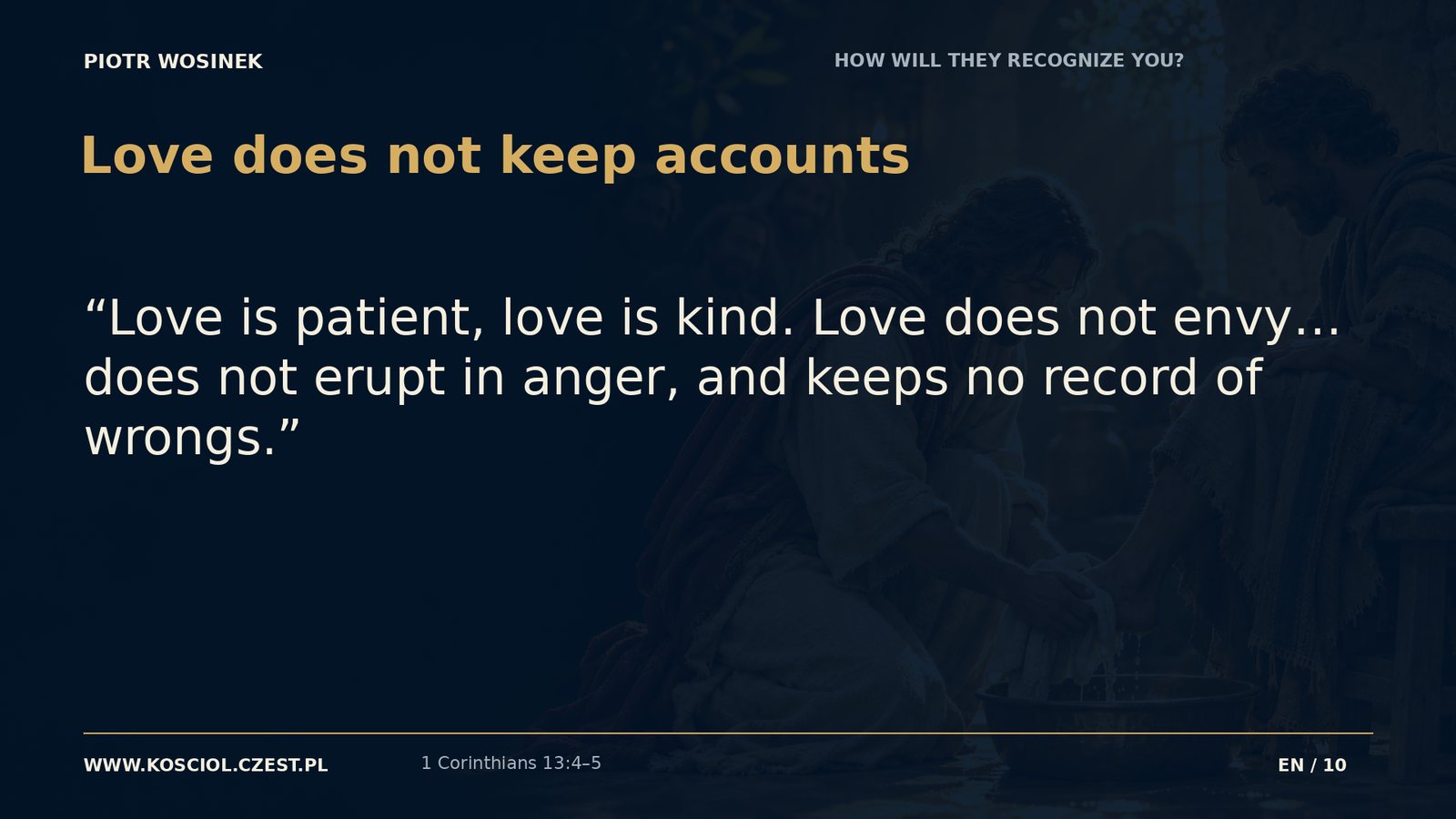
It is easy to love when everyone is nice. Paul shows what love looks like under pressure:
“Love is patient and is kind; love doesn’t envy… is not provoked, takes no account of evil.”
— 1 Corinthians 13:4–5
These are not feelings but verbs: what I do or what I refrain from doing. Almost every trait assumes that someone has tired me, let me down or hurt me. Patience is needed only when someone is difficult.
Do you keep a notebook of wrongs? “You said…”, “Three years ago you did…”, “You always…”. Paul writes that love “takes no account of evil,” and he uses a word from the language of accountants. The older son in the parable had his list ready: “these many years I have served you, and you never gave me a goat.” He had everything, and he counted what he lacked. Love does not pretend that no wrong was done. But at some point it closes the notebook. Which account will you close today?
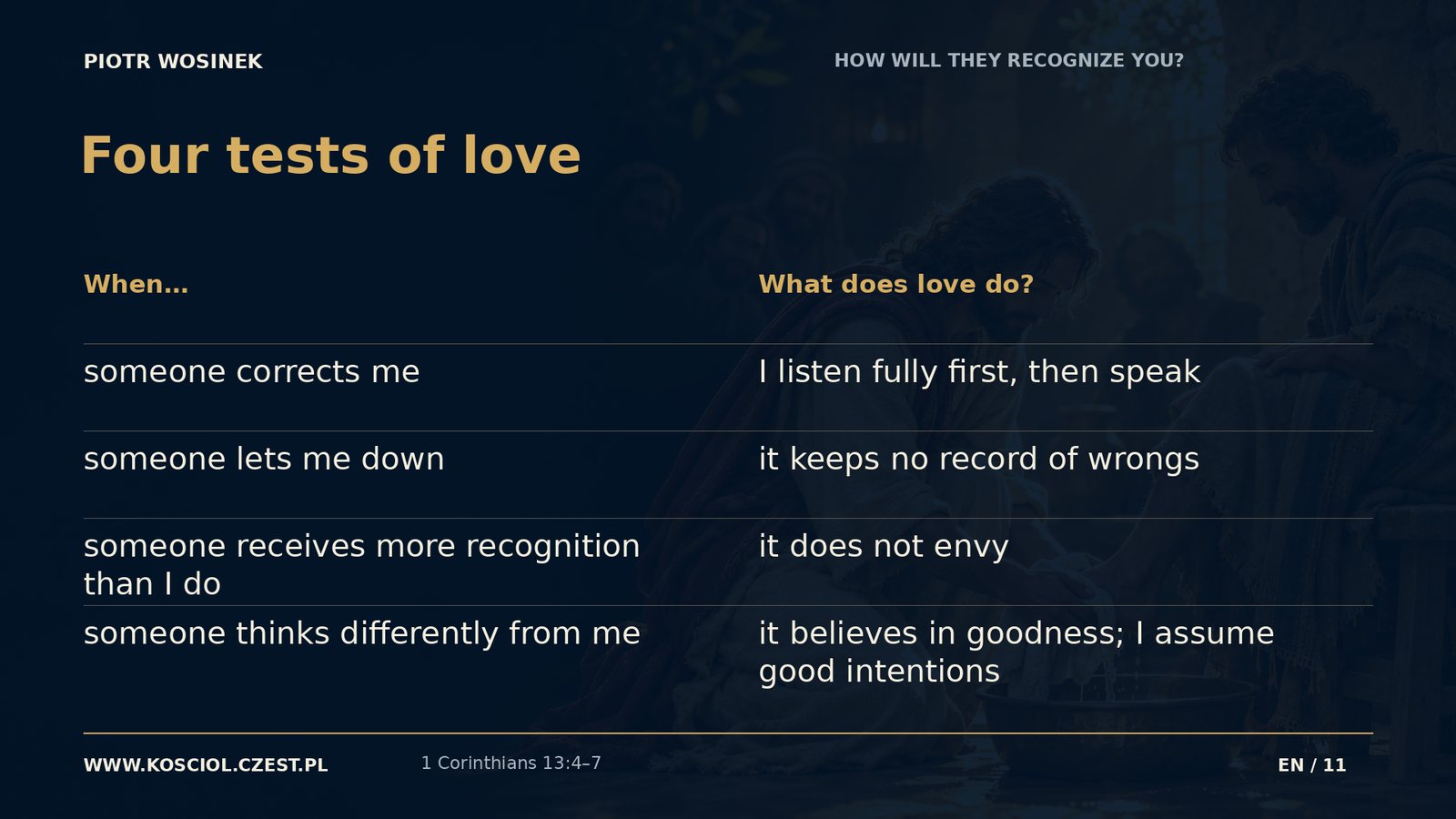
| When… | What do I do by reflex? | What does love do? |
|---|---|---|
| someone corrects me | I defend myself, interrupt, and list how much I have done | It is patient: first I listen to the end, then I speak |
| someone lets me down | I remember it for years and bring it up in every argument | It keeps no account of wrongs: I speak about it once and do not return to it |
| someone is appreciated more than I am | I envy and look for what is wrong with them | It does not envy: I rejoice with them, like a father at his son’s return |
| someone thinks differently from me | I ridicule them and assume bad intentions | It believes all things: it believes in the good and assumes they mean well |
The Harvard Study of Adult Development is one of the longest studies in history: since 1938 it has followed the lives of the same people, and today also their children. The conclusion of the study’s director, Robert Waldinger: “Good relationships keep us happier and healthier. Period.”
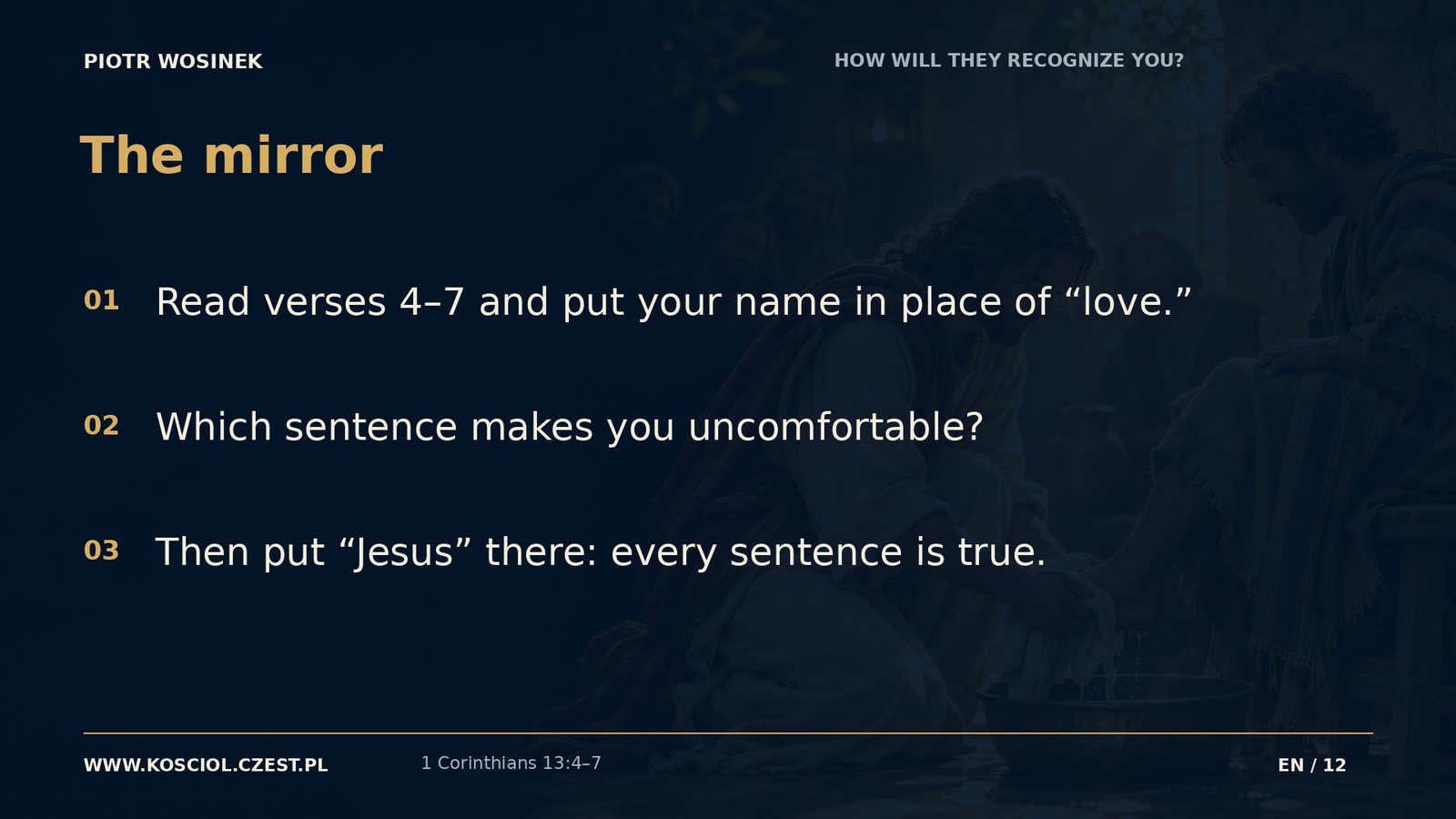
Exercise – the mirror. Read verses 4–7 and put your own name in place of “love”: “John is patient… John does not envy… John keeps no account of wrongs…” At which sentence do you start to feel uncomfortable? Then put in “Jesus”: every sentence is true. He is that love, and he wants to grow it in us.
Note: “bears all things” does not mean “tolerates everything.” Love “rejoices with the truth” (verse 6), so it does not tell the victim to stay silent.
Forgiveness is a decision, not a temperature
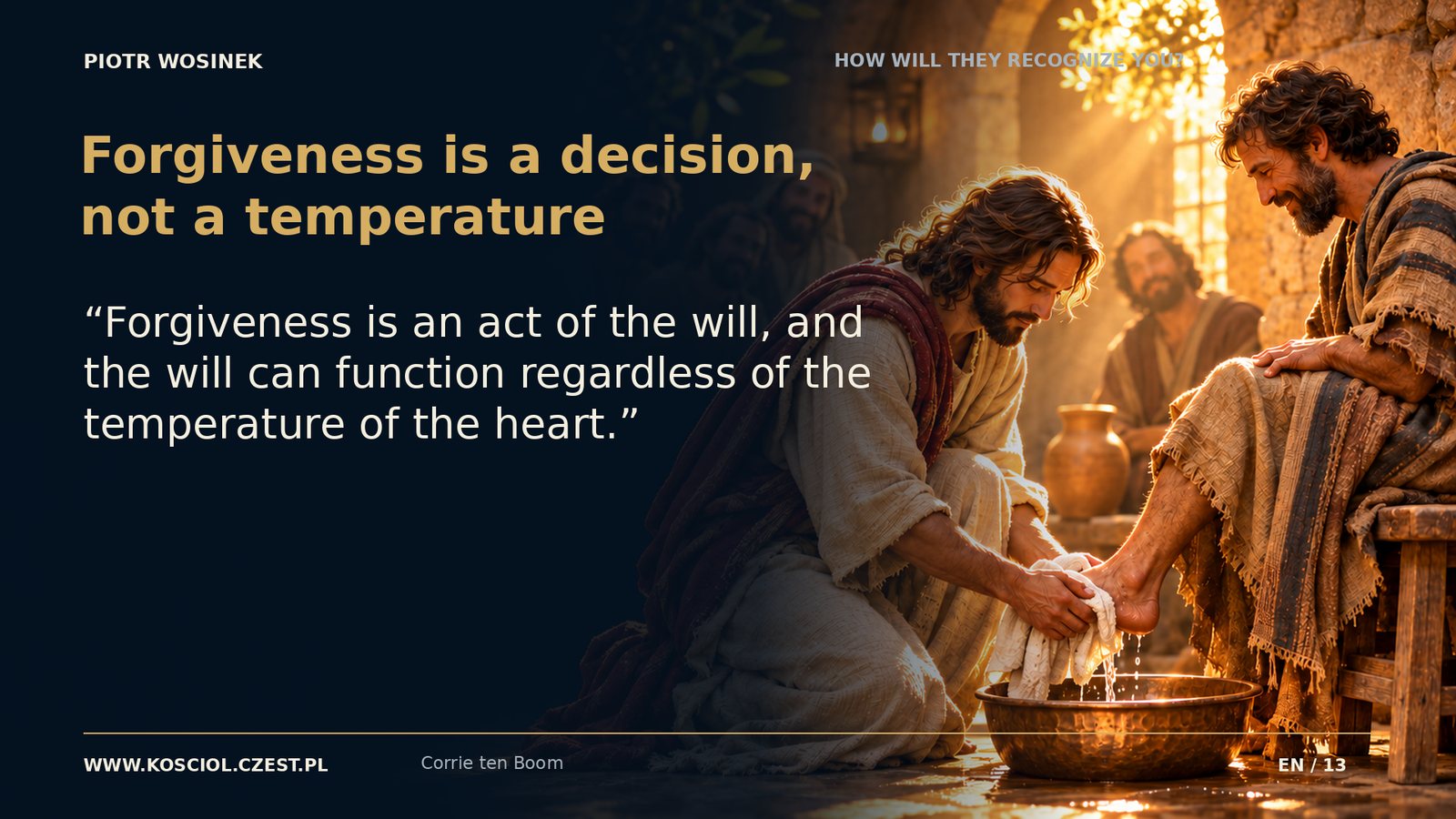
How to forgive when it is cold inside? We often think, “I will forgive when I feel that it has passed.” We wait for the heart to warm up, for the anger to fade and for the pain to stop hurting. But sometimes that never comes. Then we carry resentment all our lives and wait for a feeling that does not arrive.
Temperature is my feelings: anger, grief, coldness, pain. I do not have full control over them. They come and go on their own. A decision is my will: what I resolve to do. I do have control over that, even when it is cold inside.
This is the story of Corrie ten Boom. She survived the Ravensbrück camp, where her sister died. In 1947, after a church service, a former guard came up to her and asked for forgiveness. She felt nothing but coldness. She prayed, “Jesus, I cannot.” And she gave him her hand. Only afterwards did the warmth come. She later wrote:
“Forgiveness is an act of the will, and the will can function regardless of the temperature of the heart.”
— Corrie ten Boom
Do not wait until you feel it. Take a step, and God will add the warmth. In practice, forgiveness means that:
- I give up revenge, that is, I do not repay evil with evil;
- I stop “collecting the debt”: I do not keep bringing it up or wait for that person to do penance;
- I hand the matter over to God: “You are the judge, not I” (Romans 12:19);
- I pray for that person, even if for now without enthusiasm.
| Forgiveness IS | Forgiveness IS NOT |
|---|---|
| giving up revenge | pretending that nothing happened |
| handing the matter over to God (Romans 12:19) | saying that the wrong was fine |
| a process; sometimes it has to be repeated | a one-time feeling |
| possible without an apology from the other side | the same as reconciliation (reconciliation requires repentance) |
| a road to freedom from bitterness | consent to being hurt again |
Five rules for speaking the truth in love (Ephesians 4:25–32)
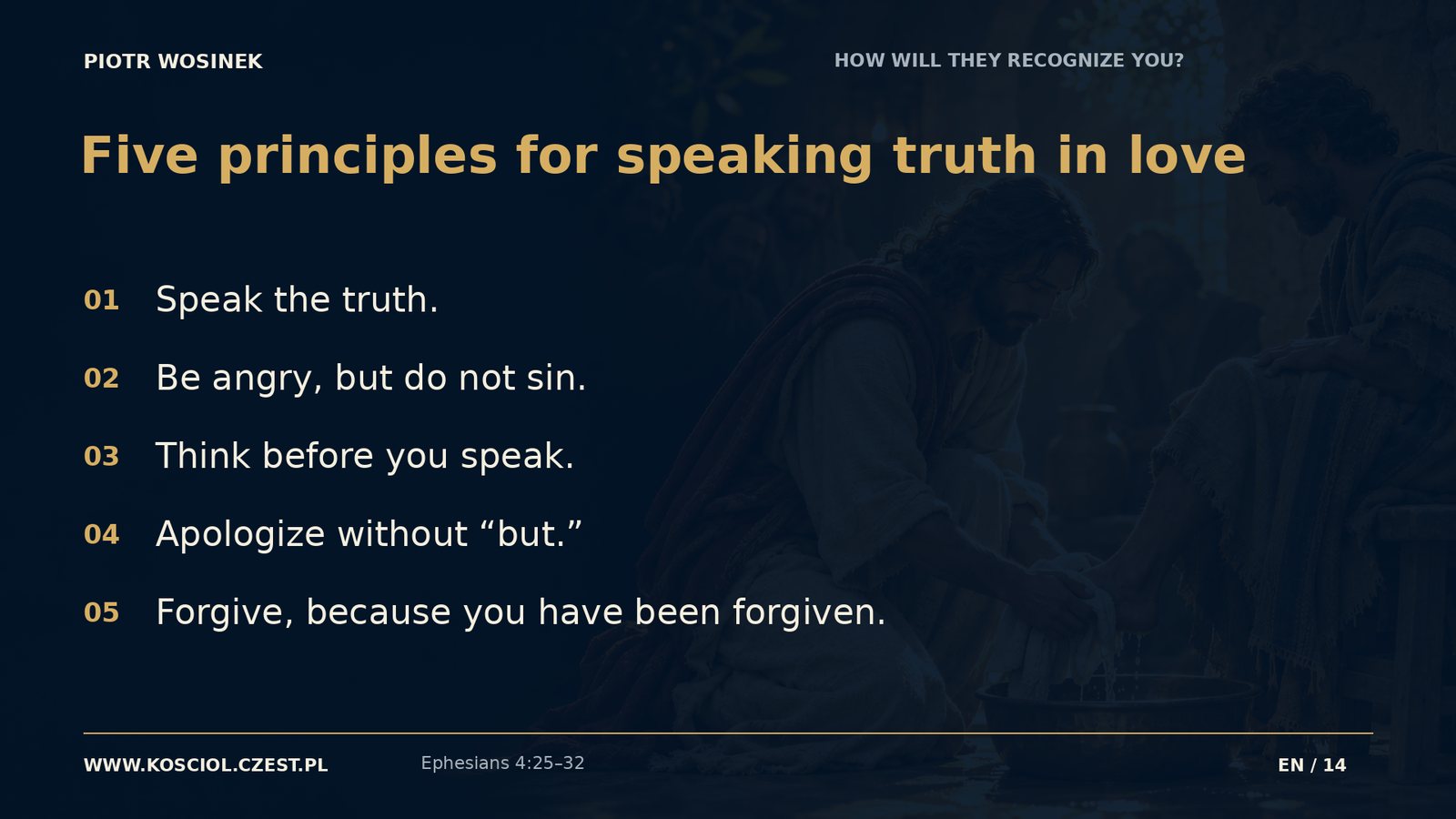
Paul writes about how people who belong to Jesus should treat one another when lies, anger, harsh words and hurt appear. These are five simple rules for conversation and for resolving conflicts in a Christian way.
- Speak the truth. “Putting away falsehood, speak truth each one with his neighbor” (verse 25). Do not pretend that everything is fine. Do not talk about someone behind their back. Tell them, not others.
- Be angry, but do not sin. “Be angry, and don’t sin. Don’t let the sun go down on your wrath” (verse 26). Anger is not wrong in itself. What you do with it can be. Do not put the conversation off. The longer you wait, the more anger turns into bitterness.
- Think before you speak. “Let no corrupt speech proceed out of your mouth, but only what is good for building others up” (verse 29). Before you say something, send a text or write a comment, ask yourself: will this help anyone?
- Apologize without a “but.” “Let all bitterness, wrath, anger, outcry, and slander, be put away from you” (verse 31). “I’m sorry, but you also…” is not an apology, it is another accusation. Simply say, “I was wrong. I’m sorry.”
- Forgive, because you were forgiven. “Forgiving each other, just as God also in Christ forgave you” (verse 32). God has forgiven you far more than you have to forgive others. That is why you can forgive.
“Darkness cannot drive out darkness; only light can do that. Hate cannot drive out hate; only love can do that.”
— Martin Luther King Jr., a collection of sermons, 1963
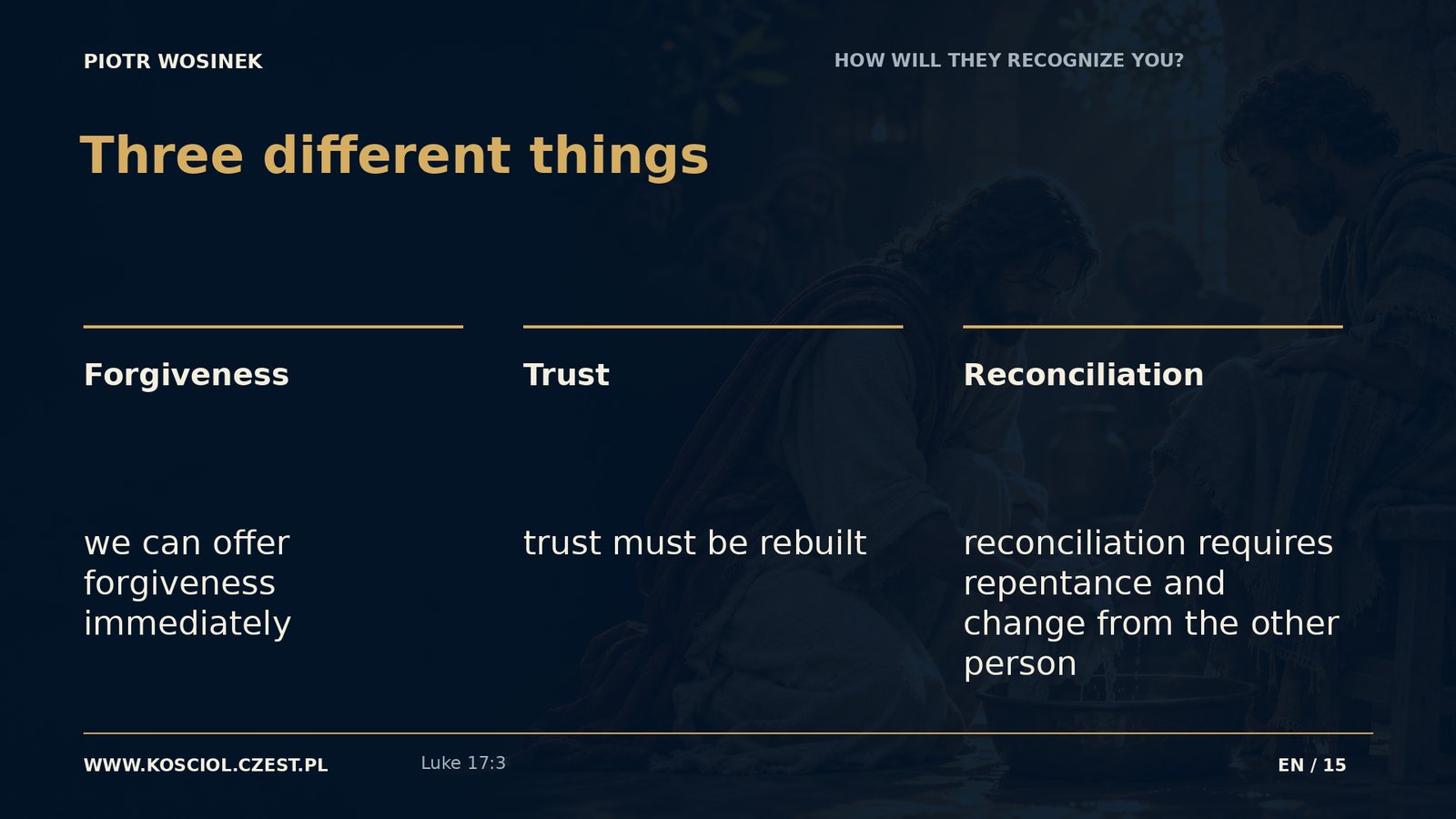
Forgiveness, trust and reconciliation are three different things. We can give forgiveness at once. Trust has to be rebuilt. Reconciliation requires repentance and change on the other side (Luke 17:3).
Love is not naivety: when to set a boundary
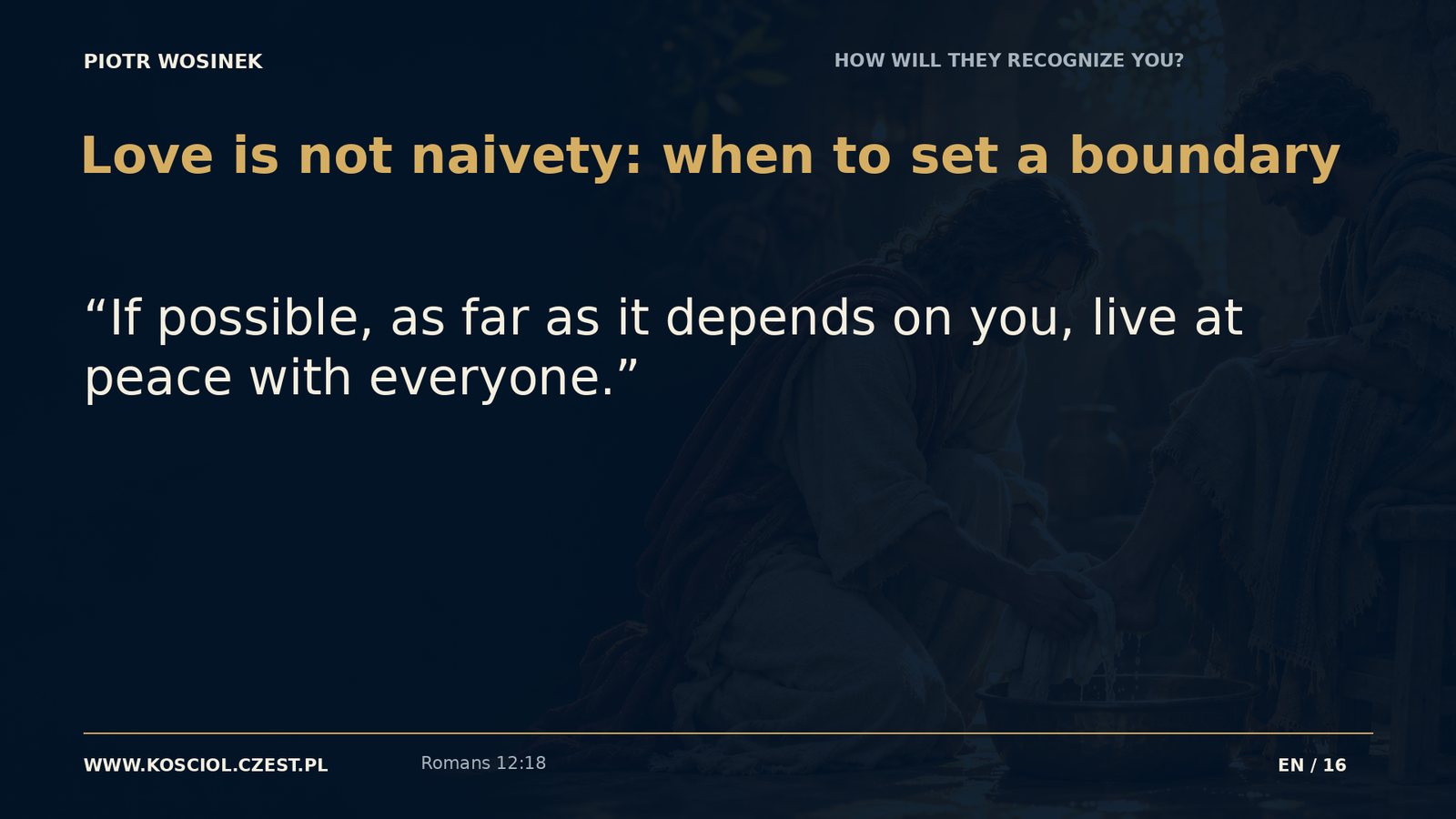
Is a Christian supposed to endure everything? To let himself be beaten and used, and pretend that this is love? No. Love wants the good of the other person and does not help him keep doing harm. “If it is possible, as much as it is up to you, be at peace with all men” (Romans 12:18). There are two important conditions here: “if it is possible,” because it is not always, and “as much as it is up to you,” because not everything depends on you.
Jesus loved everyone, but he did not trust everyone: “Jesus didn’t entrust himself to them, because he knew everyone” (John 2:24). When the crowd wanted to throw him off a cliff, he “passing through the middle of them, went his way” (Luke 4:30). When a guard struck him in the face, he did not stay silent: “If I have spoken evil, testify of the evil; but if well, why do you beat me?” (John 18:23).
David spared Saul twice, did not take revenge and spoke of him with respect. But he did not go back to the court where Saul had thrown a spear at him (1 Samuel 18:11; 26). He forgave, but he did not return under the spear. Paul escaped from Damascus in a basket (2 Corinthians 11:33), in Philippi he insisted on his rights (Acts 16:37), and he reported the plot against his life to the authorities (Acts 23:16–22).
Note: “Turn the other cheek” (Matthew 5:39) means not repaying an insult with revenge. It is not a command to remain in violence. Jesus himself, when struck, asked, “Why do you beat me?” Reporting violence is not a lack of love, because authority is from God in order to protect (Romans 13:4).
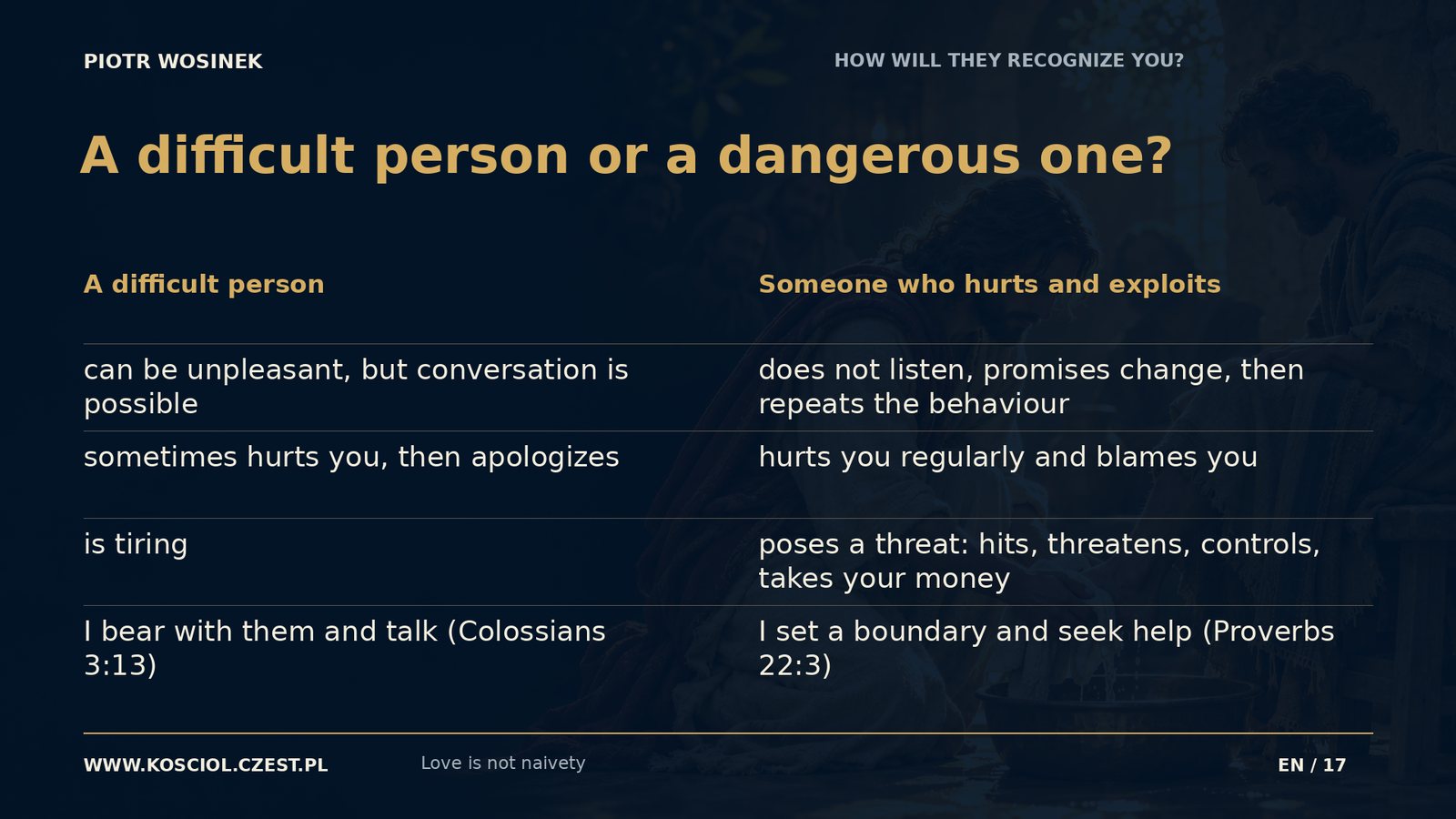
| A difficult person | A person who harms and exploits |
|---|---|
| can be unpleasant, but you can talk to them | does not listen, promises to improve and goes back to the same thing |
| sometimes hurts, then apologizes | hurts regularly and shifts the blame onto you |
| wears you out | threatens: hits, makes threats, controls, takes your money |
| I bear with them and talk (Colossians 3:13) | I set a boundary and look for help (Proverbs 22:3) |
Love everyone. Do not give everyone the keys to your house. I forgive at once. I trust gradually. I reconcile when there is repentance and change (Luke 17:3). Forgiveness is my decision, trust has to be rebuilt, and reconciliation takes two sides. If you are experiencing violence, do not stay alone with it: look for help and talk to a trusted person.
One name, one step
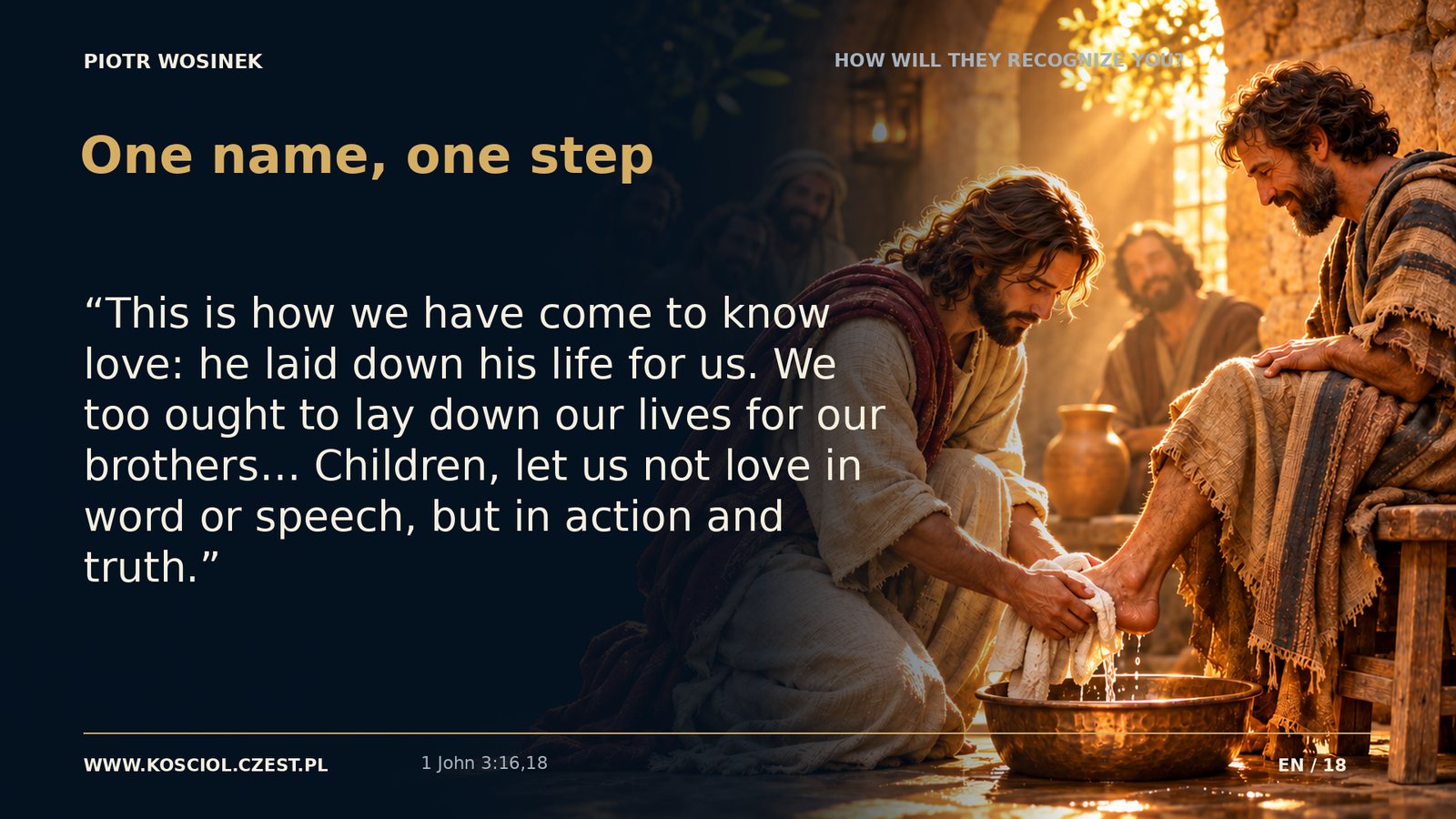
Love is not only theory. John closes the subject with a single sentence:
“By this we know love, because he laid down his life for us. And we ought to lay down our lives for the brothers… My little children, let’s not love in word only, or with the tongue only, but in deed and truth.”
— 1 John 3:16, 18
In John 3:16 God gives his Son. In 1 John 3:16 we give ourselves. It is the same verse number, but two sides of the same love. “Laying down your life” means giving your time, attention, money and comfort. Love that stays in words is not yet love.
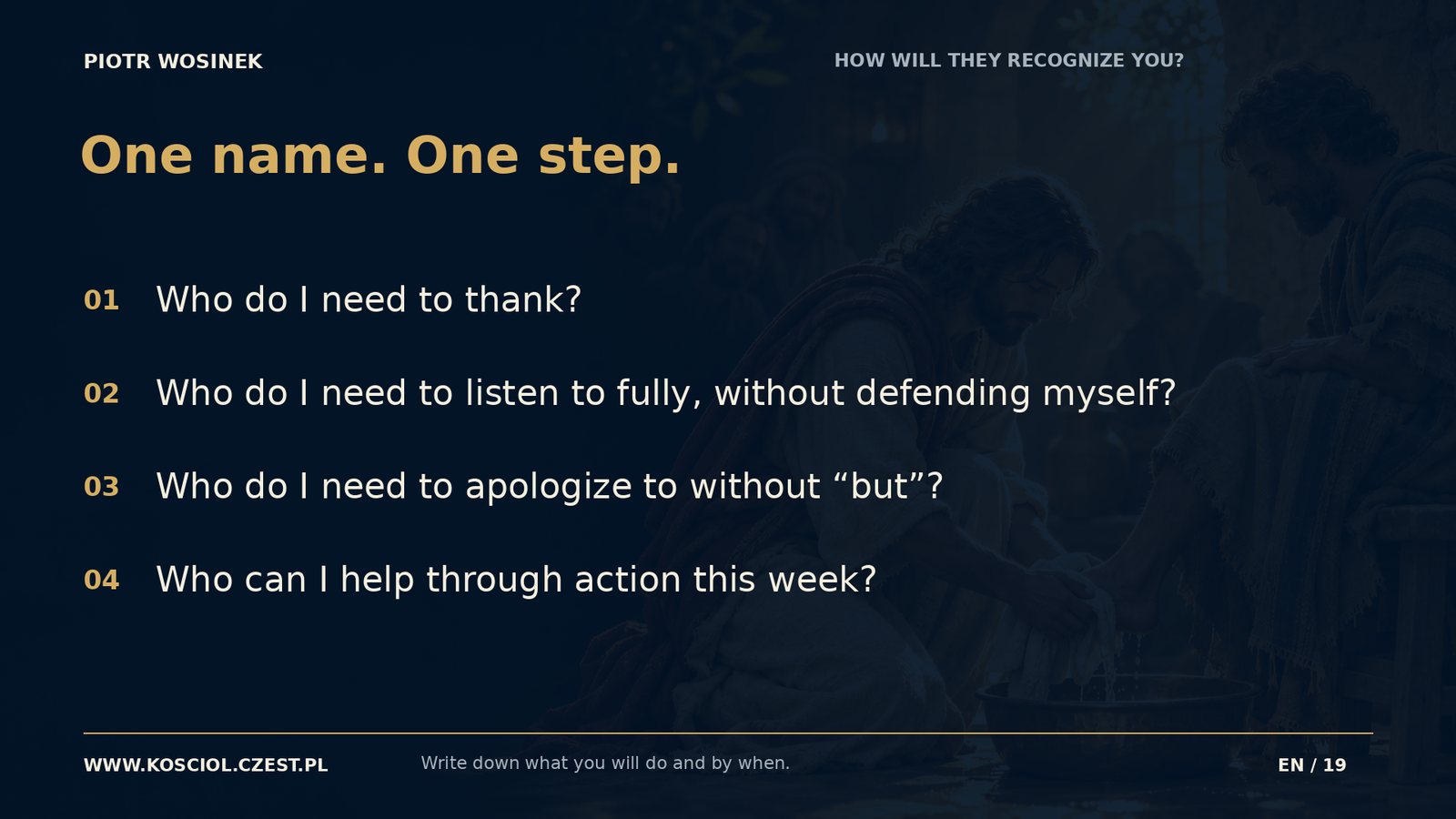
Exercise – a sheet of paper. You do not have to love the whole world. Today one name is enough. Take a sheet of paper, choose one question and write down a specific name:
- Whom do I need to thank?
- Whom do I need to hear out to the end, without defending myself?
- Whom do I need to apologize to without a “but”?
- Whom can I help with a deed this week?
Add what you will do and by when, and take the sheet home. Father Jan Twardowski wrote: “Let us hurry to love people, they leave so quickly.” One name. One step. This very week. Love does not begin with everyone. It begins with one name and one step. If you would like to talk to someone or ask for prayer, see our Prayer page or come to a church meeting.
We leave with the Father’s heart
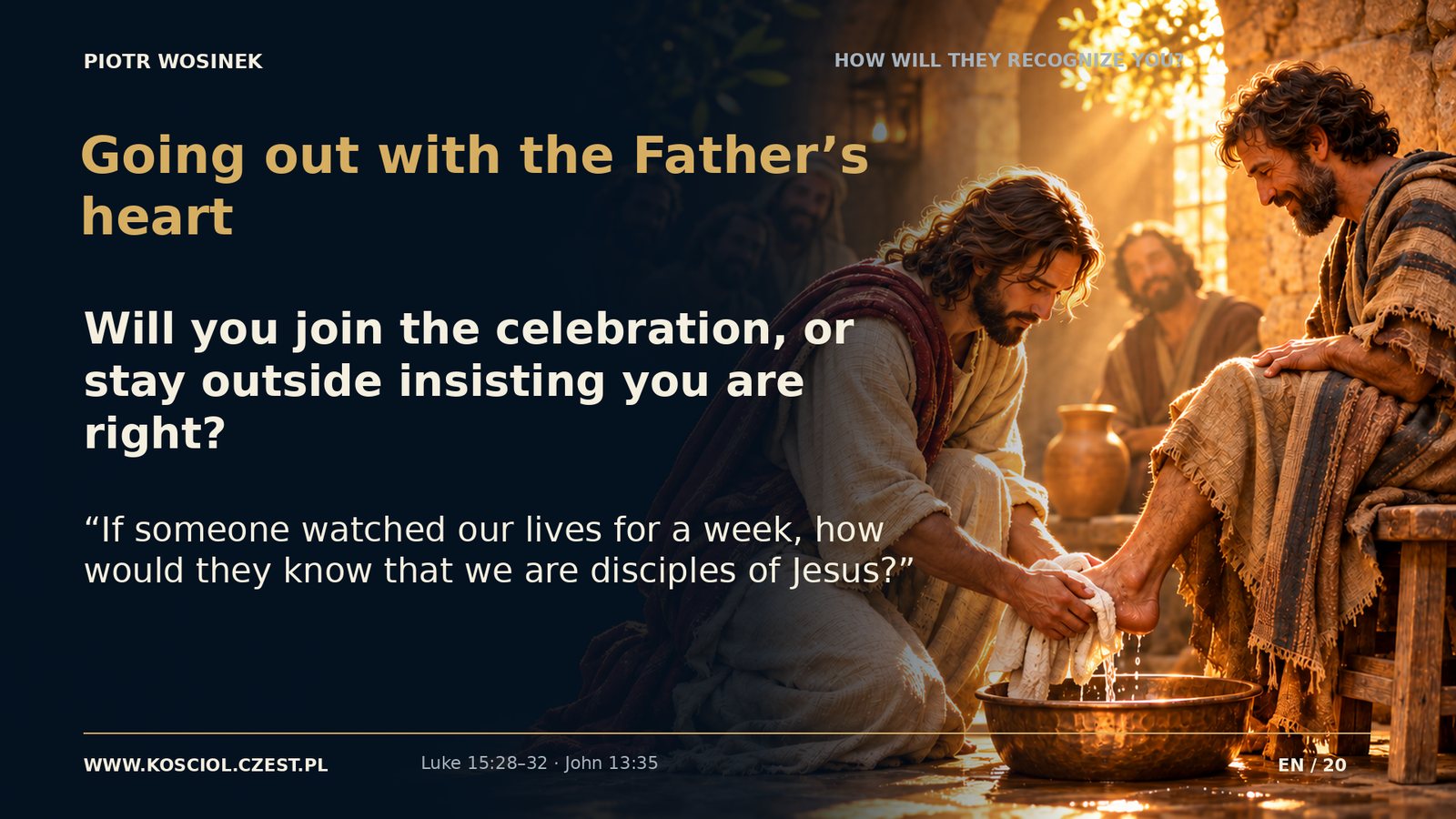
Let us return, finally, to the father’s house, in front of which the older son is still standing. The saddest figure in the parable was not sitting among the pigs. He was sitting in the father’s house. The older son was obedient, he worked and he never left. But when his brother came back, he did not want to go in to the feast. He said “this your son,” not “my brother.” You can be in church every Sunday and have a heart as cold as ice toward the people next to you. The father went out to him and begged: “Come in.” Did he go in? That question is for you.
Saint Augustine, commenting on the First Letter of John, wrote: “Love, and do what you will.” Whoever truly loves does not look for excuses. Will you go in to the feast, or stay at the door with your being right?
How will they recognize you on Monday morning, at work, at home and in the comments under someone else’s post?
If someone watched our lives for a week, how would they know that we are disciples of Jesus? The answer is: “By love, and by how they love one another.”
Sources: State of Polarization 2026 (New Community Foundation / SWPS University); Humanites Institute (October 2026); Lifeway Research (2025); Barna (2010); ISKK (2024). Scripture quotations are from the World English Bible (public domain); quotations from church history and literature are translated or paraphrased.