

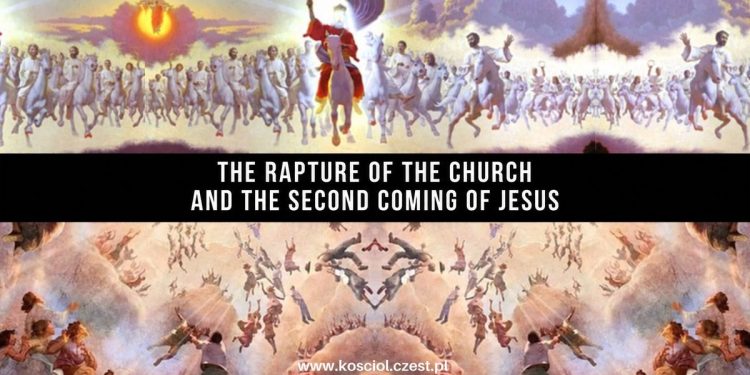
The rapture of the Church and the second coming of Jesus to the earth are two events that believing Christians all over the world are still waiting for. “The Rapture” and “the Second Coming” are often confused with one another. Sometimes it is hard to tell whether a given passage of Scripture is referring to the rapture or to the Second Coming of Jesus. Yet a careful study of the biblical prophecies of the end times requires us to distinguish between these two events.
THE RAPTURE OF THE CHURCH
We won’t actually find the word “rapture” anywhere in the Bible, but in its place we find very similar terms such as “caught up” and “taken away.” The Greek word used in 1 Thess 4:16-17 is harpazo (“to seize,” “to snatch away”). The rapture of the Church is the event in which God will remove all believers from the earth in order to begin a righteous judgment on the earth and its people, otherwise known as the tribulation. The rapture of the Church, also called the parousia, is first described in 1 Thessalonians 4:13-18, in 1 Corinthians 15:50-54, and in Luke 17:20-36.
1 Thess 4:13-18 describes the rapture as an event in which God raises from the dead all believers who have died, giving them glorified, renewed bodies, after which they leave the earth together with the believers who are still alive. Those still living will likewise receive new bodies.
“For this we say unto you by the word of the Lord, that we which are alive and remain unto the coming of the Lord shall not prevent them which are asleep. For the Lord himself shall descend from heaven with a shout, with the voice of the archangel, and with the trump of God: and the dead in Christ shall rise first: Then we which are alive and remain shall be caught up together with them in the clouds, to meet the Lord in the air: and so shall we ever be with the Lord.” – 1 Thess 4:16-17
1 Cor 15:50-54 focuses on the fact that the rapture will take only a few moments, as well as on the renewed bodies we will receive. The rapture is an event that all of us as believers should be eagerly looking forward to. It will be the moment when we are finally set free from these bodies of ours. From that moment on we will be with our God forever. Scripture urges us to “comfort one another with these words.”
“Behold, I shew you a mystery; We shall not all sleep, but we shall all [believers] be changed, In a moment, in the twinkling of an eye, at the last trump: for the trumpet shall sound, and the dead shall be raised incorruptible, and we shall be changed. For this corruptible must put on incorruption, and this mortal must put on immortality.” – 1 Cor 15:51-53
One final passage on the end times describes both of these events together. First, it tells us not to listen to those who say that Jesus has “already come” and is on the earth. It explains that His coming will be visible to all people, as plain as a great flash of lightning across the sky. At this point it is speaking of His second coming in glory and power.
Later, however, it goes back to what will come before His second coming, saying “But first”. It then mentions two people – Noah and Lot – whose stories show us how God, ahead of time, rescued His faithful ones from a coming judgment. Both Lot and Noah were righteous believers; both listened to God’s voice, and in this way were saved from destruction and judgment. If God did not want to rescue us from the great tribulation, He would not have given us these stories.
Finally, Jesus says that these faithful people will suddenly be caught up from the earth and, in a single moment, will vanish (caught up into the clouds). Others will remain behind on the earth for the time of judgment. Since God is going to judge unrighteous and unbelieving people, why would He treat believers the very same way? That would make no sense – which is why other theories concerning the rapture are less likely to be correct.
“And he said unto the disciples, The days will come, when ye shall desire to see one of the days of the Son of man, and ye shall not see it. And they shall say to you, See here; or, see there: go not after them, nor follow them. For as the lightning, that lighteneth out of the one part under heaven, shineth unto the other part under heaven; so shall also the Son of man be in his day [2]. But first [1] must he suffer many things, and be rejected of this generation. And as it was in the days of Noe, so shall it be also in the days of the Son of man. They did eat, they drank, they married wives, they were given in marriage, until the day that Noe entered into the ark, and the flood came, and destroyed them all. (God will first RESCUE the chosen -> THE RAPTURE) Likewise also as it was in the days of Lot; they did eat, they drank, they bought, they sold, they planted, they builded; But the same day that Lot went out of Sodom it rained fire and brimstone from heaven, and destroyed them all. Even thus shall it be in the day when the Son of man is revealed. In that day, he which shall be upon the housetop, and his stuff in the house, let him not come down to take it away: and he that is in the field, let him likewise not return back. Remember Lot’s wife. Whosoever shall seek to save his life shall lose it; and whosoever shall lose his life shall preserve it. I tell you, in that night there shall be two men in one bed; the one shall be taken, and the other shall be left. Two women shall be grinding together; the one shall be taken, and the other left. Two men shall be in the field; the one shall be taken, and the other left.” – Luke 17:20-36
| Jesus comes for His own |
| Jesus appears in the clouds |
| Jesus comes as a loving bridegroom for His bride |
| Only the chosen will see Him |
| A time of great joy for all the chosen, the saved |
| A secret disappearance, a rapture, a catching away |
| The focus is on Jesus and His Church, the chosen |
THE SECOND COMING OF JESUS
The second coming of Jesus Christ is the hope that believers place in God – trusting that He is in control of everything and is faithful to the promises and prophecies He has given in His Word. Certain prophecies concerning the Messiah have not yet been fulfilled. The second coming of Christ will bring about the fulfillment of those remaining prophecies. During His first time on earth, Jesus was a suffering servant. At His second coming, Jesus will be a victorious King. The first time, Jesus was born in very humble circumstances. The second time, He will arrive with the armies of heaven at His side.
After Jesus ascended into heaven, the angels said to the apostles: “Ye men of Galilee, why stand ye gazing up into heaven? this same Jesus, which is taken up from you into heaven, shall so come in like manner as ye have seen him go into heaven” (Acts 1:11). Zechariah, in his book, chapter 14:4, says that the second coming of Jesus will take place on the Mount of Olives. The Gospel of Matthew 24:30 says: “And then shall appear the sign of the Son of man in heaven: and then shall all the tribes of the earth mourn, and they shall see the Son of man coming in the clouds of heaven with power and great glory.” Titus 2:13 describes the second coming as “the glorious appearing.”
So the second time, Jesus will come to a specific place – Israel, and “the Mount of Olives.” There are also other prophecies saying that He will pass through the Golden Gate into the Temple and the old city (which today is sealed shut).
The second coming is described in great detail in Revelation 19:11-16:
“And I saw heaven opened, and behold a white horse; and he that sat upon him was called Faithful and True, and in righteousness he doth judge and make war. His eyes were as a flame of fire, and on his head were many crowns; and he had a name written, that no man knew, but he himself. And he was clothed with a vesture dipped in blood: and his name is called The Word of God. And the armies which were in heaven followed him upon white horses, clothed in fine linen, white and clean. And out of his mouth goeth a sharp sword, that with it he should smite the nations: and he shall rule them with a rod of iron: and he treadeth the winepress of the fierceness and wrath of Almighty God. And he hath on his vesture and on his thigh a name written, KING OF KINGS, AND LORD OF LORDS.” – Rev 19:11-16
The book of Revelation also describes the day of judgment in great detail:
“And they had a king over them, which is the angel of the bottomless pit, whose name in the Hebrew tongue is Abaddon, but in the Greek tongue hath his name Apollyon (Destroyer). One woe is past; and, behold, there come two woes more hereafter. And the sixth angel sounded, and I heard a voice from the four horns of the golden altar which is before God, Saying to the sixth angel which had the trumpet, Loose the four angels which are bound in the great river Euphrates. And the four angels were loosed, which were prepared for an hour, and a day, and a month, and a year, for to slay the third part of men. And the number of the army of the horsemen were two hundred thousand thousand: and I heard the number of them. And thus I saw the horses in the vision, and them that sat on them, having breastplates of fire, and of jacinth, and brimstone: and the heads of the horses were as the heads of lions; and out of their mouths issued fire and smoke and brimstone. By these three was the third part of men killed, by the fire, and by the smoke, and by the brimstone, which issued out of their mouths. For their power is in their mouth, and in their tails: for their tails were like unto serpents, and had heads, and with them they do hurt. And the rest of the men which were not killed by these plagues yet repented not of the works of their hands, that they should not worship devils, and idols of gold, and silver, and brass, and stone, and of wood: which neither can see, nor hear, nor walk: Neither repented they of their murders, nor of their sorceries, nor of their fornication, nor of their thefts.” – Rev 9:11-21
Zechariah also prophesied about that day, and he too centers his attention on Israel. He also mentions that the Lord will come together with His holy ones:
“Behold, the day of the LORD cometh, and thy spoil shall be divided in the midst of thee. For I will gather all nations against Jerusalem to battle; and the city shall be taken, and the houses rifled, and the women ravished; and half of the city shall go forth into captivity, and the residue of the people shall not be cut off from the city. Then shall the LORD go forth, and fight against those nations, as when he fought in the day of battle. And his feet shall stand in that day upon the mount of Olives, which is before Jerusalem on the east, and the mount of Olives shall cleave in the midst thereof toward the east and toward the west, and there shall be a very great valley; and half of the mountain shall remove toward the north, and half of it toward the south. And ye shall flee to the valley of the mountains; for the valley of the mountains shall reach unto Azal: yea, ye shall flee, like as ye fled from before the earthquake in the days of Uzziah king of Judah. And the LORD my God shall come, and all the saints with thee.” – Zech 14:1-5
There are many descriptions of the second coming of Jesus throughout the Bible. The prophet Daniel, while interpreting Nebuchadnezzar’s dream, reveals to us what will happen to the kingdoms of the earth. He tells us that all these kingdoms are like a great and proud statue that tries to reach up to heaven and take God’s place. Each of these kingdoms is different and has its own distinct characteristics – from Nebuchadnezzar’s kingdom, undivided and most glorious (the head of gold), down to progressively weaker kingdoms, more divided and independent (the feet of iron and clay). But God has planned that (during the fourth kingdom) a stone will be cut out from heaven without hands (Jesus is called the Rock, and He is the one who comes again here to the earth) – a stone that will strike this statue and shatter the whole concept of these “kingdoms,” establishing His own one, eternal kingdom on the earth that belongs to Him. This is another picture of what the second coming of Jesus will look like and what its purpose will be.
“And the fourth kingdom shall be strong as iron: forasmuch as iron breaketh in pieces and subdueth all things: and as iron that breaketh all these, shall it break in pieces and bruise. And whereas thou sawest the feet and toes, part of potters’ clay, and part of iron, the kingdom shall be divided; but there shall be in it of the strength of the iron, forasmuch as thou sawest the iron mixed with miry clay. And as the toes of the feet were part of iron, and part of clay, so the kingdom shall be partly strong, and partly broken. And whereas thou sawest iron mixed with miry clay, they shall mingle themselves with the seed of men: but they shall not cleave one to another, even as iron is not mixed with clay. And in the days of these kings shall the God of heaven set up a kingdom, which shall never be destroyed: and the kingdom shall not be left to other people, but it shall break in pieces and consume all these kingdoms, and it shall stand for ever. Forasmuch as thou sawest that the stone was cut out of the mountain without hands, and that it brake in pieces the iron, the brass, the clay, the silver, and the gold; the great God hath made known to the king what shall come to pass hereafter: and the dream is certain, and the interpretation thereof sure.” – Dan 2:40-45
| Jesus comes with His holy ones |
| Jesus returns to the earth |
| Jesus returns as a warrior – King of kings |
| Everyone will see Him, the whole earth |
| A time of great fear and repentance for unbelievers |
| A public, visible appearing |
| The focus is on Israel and His Kingdom |
DOING THE WORK OF THE KINGDOM UNTIL JESUS RETURNS IS MORE IMPORTANT THAN KNOWING WHEN HE WILL RETURN!
The Difference Between the Rapture and the Second Coming of Jesus?
The rapture of the Church and the second coming of Jesus differ from one another as follows:
| THE RAPTURE | THE SECOND COMING OF JESUS |
| Jesus comes for His own | Jesus comes with His holy ones |
| Jesus appears in the clouds | Jesus returns to the earth |
| Jesus comes as a loving bridegroom for His bride | Jesus returns as a warrior – King of kings |
| Only the chosen will see Him | Everyone will see Him, the whole earth |
| A time of great joy for all the chosen, the saved | A time of great fear and repentance for unbelievers |
| A secret disappearance, a rapture, a catching away | A public, visible appearing |
| The focus is on Jesus and His Church, the chosen | The focus is on Israel and His Kingdom |
The second coming of Jesus will not take place until a number of end-time events have been fulfilled (2 Thessalonians 2:4; Matthew 24:15-30; Revelation chapters 6-18). The rapture is imminent – it could happen at any moment (Titus 2:13; 1 Thessalonians 4:13-18; 1 Corinthians 15:50-54).
If the rapture and the second coming of Jesus were the same event, believers would have to go through the great tribulation (1 Thessalonians 5:9; Revelation 3:10).
If the rapture and the second coming of Jesus were the same event, then the return of Christ would not be imminent, because many things would still have to happen before He returns (Matthew 24:4-30).
In the description of the great tribulation, the book of Revelation, chapters 6-19, does not mention the church anywhere. During the great tribulation, also called “the time of Jacob’s trouble” (Jeremiah 30:7), God will once again turn His gaze toward Israel (Romans 11:17-31).
The rapture and the second coming of Jesus are similar, yet they refer to different events. Both are connected with the coming of Jesus. Both will take place at the end of the age. Even so, it is enormously important to recognize the differences between them.
The rapture is Christ’s return in the clouds to take all believers off the earth before the pouring out of God’s wrath. The second coming of Jesus is Christ’s return to the earth to bring the great tribulation to an end, to defeat the antichrist and his worldwide kingdom.
Summary
- Jesus will physically return.
- We do not know when the prophetic promises of His coming will be fulfilled.
- We know that many will ignore and/or mock the promise of Christ’s coming because of the delay of that promise.
- At every moment we are to be continually prepared for Christ’s return.
- We are to “occupy” until He comes, extending the Kingdom of God on earth as it is in heaven (Luke 12:35-48).
Other Theories
Trying to work out when the rapture will occur in relation to the tribulation is one of the most controversial questions in the Church today. A few of the most popular views on this subject are:
- The rapture will take place before the tribulation (the pre-tribulation view),
- The rapture will take place during the tribulation,
- The rapture will take place after the tribulation (post-tribulation).
1. Historicism (associated with postmillennialism)
In philosophy, historicism is an approach to history that assigns a particular meaning to an event according to that event’s place within the arc of history. In some cases this results in historical change being viewed as a force in its own right. Historicism can go as far as claiming that certain changes are “historically inevitable,” as though history were a force equal to gravity or magnetism. In most cases, however, the term historicism simply refers to a careful interpretation of events that takes their cultural, historical, and political context into account.
In theology, historicism is an approach to eschatology and to prophecy generally. In historicism, biblical prophecies are interpreted as representing literal historical events. Historicism views the whole of biblical prophecy as a broad survey of church history, from Pentecost to the end times. This approach includes interpreting symbols or figures in the Bible as metaphors for real events, nations, or historical figures. Historicism was especially popular during the Reformation, when it was used to argue that the Catholic Church was part of the end-times deception (the great harlot), with the Pope as the antichrist.
Historicism is distinguished from other eschatological views:
- idealism (the events of the Apocalypse are fully symbolic of the cosmic struggle between good and evil);
- preterism (the events of Revelation were fulfilled in 70 AD);
- futurism (the events of Revelation await a future fulfillment in the end times, during the tribulation and beyond).
- Historicism, in its approach, falls between preterism and futurism: according to historicism, most of Revelation symbolizes people and events across the history of the world. According to historicists, the book of Revelation was prophecy at the time John wrote it, but most of the book has already been fulfilled in the time since.
Here are a few examples of how historicism typically interprets the events of Revelation: the seven churches of Revelation 2-3 symbolize seven ages of church history, beginning with the apostolic church (the church in Ephesus) and ending with the modern, lukewarm church (the church of Laodicea). The seals in chapters 4-7 depict the decline and fall of the Roman Empire. The “little scroll” given to John in chapter 10 is a picture of the Protestant Reformation. The beasts of chapters 12 and 13 represent Catholicism and the papacy. Other passages in Revelation are connected with the invasion of the Huns, the spread of Islam, and the rise of the modern missionary movement.
However, because of the vagueness of this method of interpretation (no two historicists agree on which symbols correspond to which historical events) and because John’s original readers could not have understood the book of Revelation in a historicist way, the historicist view is not widely held today.
A Simplified Graphic Version
You can download this graphic in good resolution by clicking the “download” button.

A More Detailed Graphic
You can download this graphic in good resolution by clicking the “download” button.