

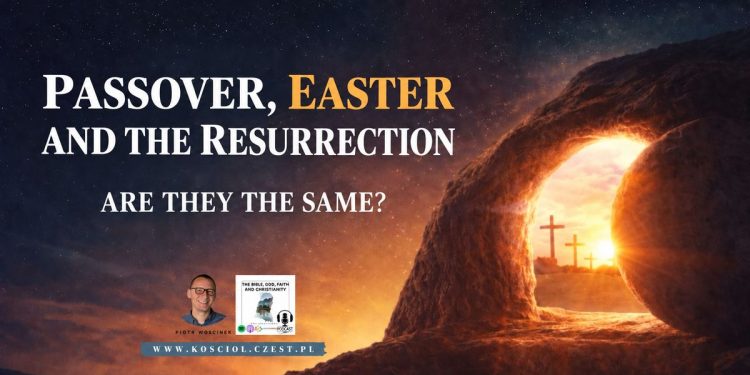
Easter is one of the most widely recognized holidays in the world. But do we really understand what it means? Are Easter, Passover, and the resurrection of Jesus the same thing — or are there important differences between them?
Watch on YouTube
Listen to the Podcast
Many people associate this season mainly with tradition: eggs, the Easter bunny, the blessing of food baskets, or a few days off work. Others see it as connected to the death and resurrection of Jesus, but don’t always understand its biblical meaning. So it’s worth sorting out the facts.
Easter and the Bunny – Is There Any Connection to the Bible?
From a biblical standpoint, there is no connection at all between the resurrection of Jesus Christ and modern customs such as:
- the Easter bunny
- colored eggs
- the blessing of food
- or egg-hunt games
Practices of this kind have no source in Scripture.
It’s worth being precise here, though: the Bible does not connect the resurrection of Jesus with these symbols, but neither does it automatically assign them any spiritual meaning. They are, above all, cultural traditions that appeared later in European history.
There is also no clear evidence that they were introduced by the Council of Nicaea (325 AD). That council was concerned mainly with settling the date of the celebration, not with introducing symbols such as eggs or a rabbit. The date that was settled on, however, happened to coincide with the date of a pagan fertility festival, with which all these symbols we associate with Easter are connected.
The problem isn’t the mere existence of tradition, but what becomes the center of our celebration. Is it Jesus Christ and His resurrection, or customs and cultural symbols? The Bible clearly warns us about a situation where human traditions begin to replace God’s truth:
Then Pharisees and scribes came to Jesus from Jerusalem and said, “Why do your disciples break the tradition of the elders?” For they do not wash their hands when they eat. He answered them, “And why do you break the commandment of God for the sake of your tradition?” For God commanded, “Honor your father and your mother,” and, “Whoever reviles father or mother must surely die.” But you say, “If anyone tells his father or his mother, ‘What you would have gained from me is given to God,’ he need not honor his father.” So for the sake of your tradition you have made void the word of God. You hypocrites! Well did Isaiah prophesy of you, when he said: “This people honors me with their lips, but their heart is far from me; in vain do they worship me, teaching as doctrines the commandments of men.” And he called the people to him and said to them, “Hear and understand: it is not what goes into the mouth that defiles a person, but what comes out of the mouth; this defiles a person.” Then the disciples came and said to him, “Do you know that the Pharisees were offended when they heard this saying?” He answered, “Every plant that my heavenly Father has not planted will be rooted up. Let them alone; they are blind guides. And if the blind lead the blind, both will fall into a pit.” But Peter said to him, “Explain the parable to us.” And he said, “Are you also still without understanding? Do you not see that whatever goes into the mouth passes into the stomach and is expelled? But what comes out of the mouth proceeds from the heart, and this defiles a person. For out of the heart come evil thoughts, murder, adultery, sexual immorality, theft, false witness, slander. These are what defile a person. But to eat with unwashed hands does not defile anyone.” – Matt 15:1-20
Our human or religious traditions and teachings must never overshadow the teaching of God’s Word!
If you’ve properly understood the statements above, you have to conclude that:
- Blessing food baskets, Easter bunnies, colorfully decorated Easter eggs, and Easter egg hunts are not required by God at all. They are human or religious customs that people invented, and they have no foundation in the Bible or in God.
- Every human or religious tradition is likewise not required by God, and is at most an addition to our faith. Such traditions are valuable only insofar as they do not overshadow or replace the content of God’s message, as we saw in the passage above.
- What matters most is our heart before God, and its condition. God does not look at our outward rituals, but at our heart and the level of our faith in Him and His Word.
From a biblical perspective, God does not require of us:
- blessing food
- decorating eggs
- observing customs connected with a rabbit
These are elements of human tradition, not of God’s revelation. That said, the point isn’t to focus solely on criticizing tradition. The key question is whether these things draw me closer to God, or pull me away. The Bible shows a clear principle: traditions may exist, but they must not replace the truth.
Jesus also said:
“It is not what goes into the mouth that defiles a person, but what comes out of the mouth, this defiles a person (…)
For out of the heart come evil thoughts (…) These are what defile a person.”
(Matthew 15:11,19–20)
That is why God looks above all at:
- our heart
- our faith
- our relationship with Him
and not at:
- outward rituals
God looks at our heart far more than at our outward religious rituals and traditions
The True Origin of the Word “Easter”
The origin of the Polish word “Wielkanoc” is relatively clear — it simply means “the Great Night,” that is, the night of the resurrection of Jesus Christ. In a broader, European context, however, a theory often comes up that the English word Easter and the German Ostern are connected to a supposed pagan goddess, Eostre (or Eastre), worshipped by Germanic peoples.
Did Eostre Really Exist?
The main problem with this theory is the lack of reliable historical evidence. The only mention of Eostre comes from the 8th century, from a work by the Anglo-Saxon monk the Venerable Bede (De Temporum Ratione), who wrote:
“Eosturmonath has a name which is now translated ‘Paschal month,’ and which was once called after a goddess of theirs named Eostre, in whose honor feasts were celebrated in that month. Now they designate that Paschal season by her name, calling the joys of the new rite by the time-honored name of the old observance.”
Beyond this one mention:
- no other ancient sources exist
- no temples or altars have been found
- there is no evidence of any actual cult devoted to this goddess
That is why many scholars believe it isn’t certain whether Eostre was a real figure, or merely an interpretation of the name of the month.
Jacob Grimm’s Theory
In the 19th century, the German scholar Jacob Grimm tried to link the German word Ostern to an ancient goddess he called Ostara. However, he himself admitted he had no hard evidence. His theory rested mainly on linguistic analysis and conjecture. Notably, before his work (Deutsche Mythologie, 1835), there are no sources at all speaking of such a goddess.
So What Do We Actually Know?
It is most likely that:
- the words Easter / Ostern are connected to the concept of “the east,” “dawn,” “light”
- rather than to any specific goddess
The Polish name Wielkanoc, on the other hand, has no connection whatsoever to Eostre — it comes directly from the Christian meaning of the event. There is no solid evidence that Easter, as a holiday, derives from a pagan goddess. Theories about Eostre / Ostara rest largely on single, uncertain sources, and the names of the holiday differ in origin from language to language.
Although the name “Wielkanoc” itself has no pagan origin in Polish, the way it is celebrated today has often become heavily secularized and commercialized, which is why many people today associate Easter more with tradition than with the fact of Jesus’ resurrection.
So the key question is not where the name comes from, but what its content and center are today!
The Origin of the Word “Wielkanoc”
The Polish word “Wielkanoc” is a compound of two words:
- “wielka” → great, momentous, decisive
- “noc” → night, the night in which something crucial took place
The words “the Great Night” = a unique, most important night. It referred to the night of Jesus’ resurrection. In the tradition of the early Church, night was seen as the moment of the turning point (darkness overcome by light), and the resurrection was seen as the greatest event in history. That is why it was called “the Great Night.” In Jewish culture, a day begins at night, because God brought light in place of darkness. That is why, in Israel to this day, the Sabbath begins on Friday after sunset. Here’s how the name for “Easter” compares across languages:
Polish:
- Wielkanoc → focused on the event (the night of the resurrection)
English:
- Easter → possibly linked to the name of the month (Eostre) or to “the east”
German:
- Ostern → “east,” “dawn”
Greek / Latin:
- Pascha (Πάσχα / Pascha) → straight from the Bible
So Easter (Wielkanoc) is a cultural term (as in Polish) while Passover (Pascha) is a biblical term (Exodus 12, the Gospels). “Easter” ≠ “Passover,” but in a certain sense it points back to the events tied to the Passover and to Jesus’ resurrection. The word “Easter” in itself is not wrong, but it does not fully capture the biblical meaning of the Passover and of Jesus’ resurrection.
Christians and Easter
Christians celebrate the resurrection of Jesus Christ, which took place on the third day after His crucifixion. This event is the foundation of the Christian faith.
“And if Christ has not been raised, then our preaching is in vain and your faith is in vain.”
(1 Corinthians 15:14)
The resurrection is not merely an element of tradition — it is the center of the Gospel and the hope of believers. Various forms of observing this season developed over the history of the Church. In many traditions:
- the preceding period involves a time of preparation (such as fasting)
- the culmination is the week connected with Jesus’ crucifixion and resurrection
- afterward comes a period recalling life in the power of the resurrection
These, however, are liturgical and traditional forms, not direct biblical commands. Because of various cultural associations and today’s commercialization, some communities prefer to use the term “Resurrection Sunday,” to underscore the essence of the event. Still, it isn’t really about the name, but about the content. What matters most is that Jesus Christ:
- died for our sins
- rose from the dead
- lives
The apostle Paul says:
“And if Christ has not been raised, your faith is futile and you are still in your sins.”
(1 Corinthians 15:17)
Therefore, whichever name we use:
- “Easter”
- “Passover”
- “Resurrection Sunday”
The reason for the celebration remains the most important thing:
“We were buried therefore with him by baptism into death, in order that, just as Christ was raised from the dead by the glory of the Father, we too might walk in newness of life.”
(Romans 6:4)
Christians do not, first and foremost, celebrate a day or a tradition. They celebrate the living Christ. And not just once a year, but every single day.
From Easter to Pentecost
Easter, and the event of Christ’s death and resurrection, lead us inseparably to the event of Pentecost. The experience of Pentecost carries just as much significance for us as the death and resurrection of Jesus. It is precisely what Jesus did for us on the cross that opens the door for us to be born again of the Holy Spirit and to enter a place of freedom.
If you have experienced the risen Christ, you should also taste the “wine” that comes with His new covenant.
The Bible connects the outpouring of the Holy Spirit to two feasts, both associated with the number fifty. The Feast of Weeks — Pentecost (Shavuot) and the Sabbatical Year (Shmita).
Shavuot (Pentecost) – fulfillment in the Holy Spirit:
- celebrated 50 days after the feast of Passover
- was a harvest feast (of the firstfruits)
- offerings from the first crops were presented (for example, loaves of new flour – Lev 23:15–21)
- it was a festive day (a day of rest from work)
- celebrated every year
In the Old Covenant:
- 50 days after leaving Egypt, Israel arrives at Mount Sinai
- Sinai is fire and the voice of God
- there God gives the Law (the Torah) — this was the birth of the nation of God
- the Law on stone
In the New Covenant:
- 50 days after Jesus’ resurrection → Acts 2
- Acts 2 is fire, tongues, the voice of God speaking through people
- the Holy Spirit is poured out — this is the birth of the Church
- the Spirit writing the law on the heart
“I will put my law within them…” – Jeremiah 31:33
The Sabbatical Year (Shmita) – a picture of release
- celebrated every 50 years (the Jubilee)
- occurred every 7 years (Lev 25)
- at that time:
- it was not permitted to sow or reap in the normal way
- the land was to “rest” (as in the sabbatical year)
- debts were forgiven
- slaves were set free
- land returned to its original owners
- this was a long-term ordinance, not a one-day feast
This was a reset for life. Jesus announces a “spiritual jubilee”:
“God sent me… to proclaim the year of the Lord’s favor” – Luke 4:18–19
This was a direct reference to the Jubilee, and it meant release from the slavery of sin, the forgiveness of debt (sins), and the restoration of inheritance.
Pentecost gives us power and a new heart (the Holy Spirit) while the Jubilee gives us a lifelong return to freedom.
- a new heart (the Spirit)
- freedom (the Jubilee)
- restored inheritance (sonship)
- Egypt is slavery (sin), but Passover is salvation (the blood of Jesus)
- The 50 days are transformation (the Holy Spirit), but the Jubilee is full freedom and restoration
Should We Celebrate Easter?
Many Christians ask themselves this question, especially in light of today’s customs. Should we allow children to:
- paint eggs
- hunt for Easter eggs
- play games involving a rabbit
The Bible gives no direct command or prohibition on this matter. That is why it can be treated as a matter of conscience:
“One person esteems one day as better than another, while another esteems all days alike. Each one should be fully convinced in his own mind.”
(Romans 14:5)
On one hand, activities like these have no spiritual meaning or biblical basis in themselves. On the other, they are not automatically sinful, as long as they don’t replace what matters most. So the key thing is not whether we do them, but what is at the center of our heart and attention.
If children take part in such activities, it’s important that they:
- know the true meaning of this day
- understand that the eggs are not the essence of the celebration
- know that the center is Jesus and His resurrection
It is up to parents and the Church to make this clear. So we could put it this way:
- eggs, decorations, and games → can be part of the culture
- but they must never become the meaning of the celebration
If they remain merely an addition and don’t draw attention away from Christ, they don’t have to be a problem.
What matters most is this:
- we are not celebrating eggs
- we are not celebrating tradition
- we are not celebrating customs
We are celebrating the risen Jesus Christ. The decision to take part in these traditions belongs to each person’s conscience. What matters most is right teaching and understanding. The center must remain unchanged. Jesus Christ — crucified and risen — is the heart of everything.
What Is Passover, and How Does It Point to Jesus?
Passover is the true, original word, which was later replaced with the term “Easter.” The word Passover (Hebrew: pesach) means “to pass over,” “to skip over.” It refers to the event in the book of Exodus (chapter 12), when God brought the Israelites out of Egypt. The blood of a lamb on the doorframes caused death to “pass over” the houses of Israel. This event was a foreshadowing of Jesus:
“For Christ, our Passover lamb, has been sacrificed.” – 1 Cor 5:7
Jesus died at the exact time of Passover — as the true Lamb, who takes away the sin of the world.
The word “Passover” is often confused with the word “Passion.” Short answer: linguistically, no — the two words have nothing in common, but theologically, yes, and very deeply so. Passover comes from the Hebrew pesach (פסח), meaning “to pass over,” “to skip,” while Passion comes from the Latin word passio, meaning “suffering.” These words come from entirely different sources and have entirely different meanings. Yet in the Bible they are connected through the person of Jesus, because Passover is the event of deliverance through the blood of the lamb, while the Passion is the suffering of Jesus through which that deliverance was accomplished. As I wrote above: “For Christ, our Passover lamb, has been sacrificed.” – 1 Corinthians 5:7. How does this connect theologically?
Passover (OT):
- a lamb without blemish
- blood on the doorframes
- death “passes over”
- deliverance from slavery
The Passion of Jesus (NT):
- Jesus suffers and dies
- His blood saves mankind
- judgment does not touch believers
- deliverance from the slavery of sin
The Passion (the suffering of Jesus) is the fulfillment of the Passover (the picture of salvation). In the Gospels, Jesus dies at exactly the time of Passover — that is no coincidence. This means Passover was a prophecy, and the Passion of Jesus is its fulfillment. Passover is the promise, the Passion is the accomplishment, and the resurrection is the confirmation.
🐑 The Passover Lamb
During the first Passover, God commanded the Israelites:
“Then they shall take some of the blood and put it on the two doorposts and the lintel of the houses in which they eat it.”
(Exodus 12:7)
“The blood shall be a sign for you, on the houses where you are. And when I see the blood, I will pass over you, and no plague will befall you to destroy you.”
(Exodus 12:13)
The lamb had to be without blemish, killed at an appointed time, and eaten by the household. All of this pointed forward to Jesus.
✝️ Jesus as the Passover Lamb
The New Testament clearly shows that Passover pointed forward to Christ:
“For Christ, our Passover lamb, has been sacrificed.”
(1 Corinthians 5:7)
Jesus is without sin, and He gives up His life. His blood saves us from judgment — just as the blood of the lamb in Egypt protected people from death.
The blood on the doorframes was a sign of salvation, and it separated life from death. It’s worth noting that it was placed on the lintel and the doorposts, which for many represents a picture of the cross as the place of salvation (marking the doorframe this way effectively traced the shape of a cross). This is not a direct symbolic instruction found in the text itself, but a clear theological parallel.
Jesus’ Last Supper was a Passover meal. In the Gospels we read:
“And on the first day of Unleavened Bread, when they sacrificed the Passover lamb, his disciples said to him, ‘Where will you have us go and prepare for you to eat the Passover?'”
(Mark 14:12)
“Then came the day of Unleavened Bread, on which the Passover lamb had to be sacrificed. So Jesus sent Peter and John, saying, ‘Go and prepare the Passover for us, that we may eat it.'”
(Luke 22:7–8)
In some Bible translations the word “Easter” appears here, but in the original Greek text the word used is “pascha” (πάσχα). The same is true in the apostolic letters:
“Cleanse out the old leaven that you may be a new lump, as you really are unleavened. For Christ, our Passover lamb, has been sacrificed. Let us therefore celebrate the festival, not with the old leaven, the leaven of malice and evil, but with the unleavened bread of sincerity and truth.”
(1 Corinthians 5:7–8)
Passover was Israel’s feast of deliverance, and the Passover lamb foreshadowed Jesus. Jesus fulfills Passover as the Lamb of God, and His blood grants deliverance from judgment. Passover is not merely history — it is a prophecy that was fulfilled in Jesus Christ.
The Date of Passover and Easter
Different Christian traditions celebrate Easter on different dates, even though the principle for calculating it is similar. In the Western Church (Catholic and most Protestant traditions), Easter falls on the first Sunday after the first full moon of spring. That is why the feast is movable and falls somewhere between March 22 and April 25. It’s worth noting that the so-called “Paschal full moon” isn’t determined by astronomical observation, but according to tables established in advance.
The Eastern (Orthodox) churches follow a similar principle, but use the Julian calendar, which is why their Easter often falls on a different date than in the West.
In the early centuries of Christianity there was no agreement on the date for celebrating Passover. There were two main practices:
Quartodecimans (the 14th of Nisan)
- celebrated Passover on exactly the 14th day of the month of Nisan
- regardless of the day of the week
- tied directly to the Jewish Passover
Sunday After Passover
- other Christians celebrated on a Sunday, as the day of Jesus’ resurrection
The Council of Nicaea (325 AD) did not introduce Easter, but it put the way it was observed into order. It was established that:
- Easter would be celebrated on a Sunday
- it would be determined independently of the Jewish calendar
- its date would be tied to the spring cycle
Over time, the rule adopted was: the first Sunday after the first full moon of spring.
An important distinction! The date of Easter was established historically by the Church, and it is not a direct biblical command. The Bible, on the other hand, clearly indicates when the Passover and the resurrection of Jesus actually took place, but it does not command an annual celebration on a specific date.
So the biblical Passover was tied to a specific day (the 14th of Nisan). Easter, as a Christian holiday, has a date fixed historically. The differences between East and West come from differing calendars. What matters most, though, is not when, but what we are celebrating! Namely, the resurrection of Jesus Christ.
On What Day Did Jesus Rise From the Dead?
The Bible clearly states that Jesus rose on the first day of the week, that is, on Sunday (according to our calendar). In the biblical order:
- the Sabbath (Saturday) was the seventh day of the week — a day of rest
- Sunday was the first day of the week
“Now after the Sabbath, toward the dawn of the first day of the week [Sunday], Mary Magdalene and the other Mary went to see the tomb. And behold, there was a great earthquake, for an angel of the Lord descended from heaven and came and rolled back the stone and sat on it. His appearance was like lightning, and his clothing white as snow. And for fear of him the guards trembled and became like dead men. But the angel said to the women, “Do not be afraid, for I know that you seek Jesus who was crucified. He is not here, for he has risen, as he said. Come, see the place where he lay. Then go quickly and tell his disciples that he has risen from the dead, and behold, he is going before you to Galilee; there you will see him. See, I have told you.” – Matt 28:1-7
The other Gospels confirm the same thing (Mark 16:2,9; Luke 24:1; John 20:1,19).
The resurrection happening on the first day of the week is not accidental. It signals the beginning of something new. After six days of creation, God rested on the seventh day (the Sabbath). Jesus’ resurrection, by contrast, points to a new creation:
“By abolishing the law of commandments expressed in ordinances, that he might create in himself one new man in place of the two, so making peace.”
(Ephesians 2:15)
This is a picture of new life, a new humanity, and a new reality in Christ.
Jesus’ resurrection is an event that ought to be celebrated and remembered:
“And if Christ has not been raised, your faith is futile.”
(1 Corinthians 15:17)
Even so, the name of the day itself is not what matters most. Some Christians prefer to use the term “Resurrection Sunday” in order to clearly emphasize the meaning of the event. Yet it’s worth keeping a balance. The problem isn’t the name “Easter” itself — the problem arises when its meaning gets distorted or obscured.
The resurrection of Christ is something we should celebrate every day, not only once a year
What matters most is this: Jesus Christ died, was buried, and rose again. He is alive! That is why the resurrection is not something we celebrate only once a year, but a reality we live in every single day.
Jesus rose on Sunday — the first day of the week. This event marks the beginning of a new creation and is the foundation of the Christian faith. It should remain at the center — above tradition, above the name, above any custom.