

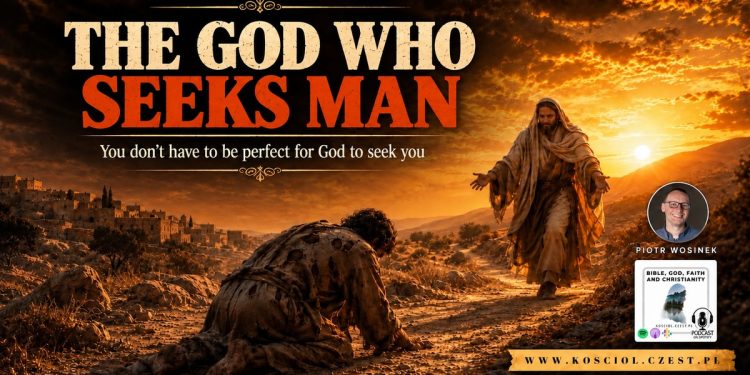
God seeks man, but when Adam and Eve sinned, they did not come to God. They did not say, “Help us, we’re lost.” When a person feels shame, guilt, or fear, they start to hide.
Usually, when we do something wrong, something improper, we don’t want to admit our mistake. Is it the same for you? Most often we hide!
Watch on YouTube
Listen to the Podcast
- Sometimes we hide behind religious activity.
- Sometimes behind work.
- Sometimes behind a joke.
- Sometimes behind indifference.
- Sometimes behind the phrase, “I’m not interested in that.”
- Sometimes behind success, money, a relationship, a phone, noise, busyness, or apparent self-confidence.
- Sometimes behind an addiction…
But God did not respond to man after the fall with: “How could you?”, “You’re done for,” “I don’t want to know you.” God’s first question was:
“Where are you?”
God knew where Adam was. That was—and is—a question for us! Today I want to talk about the God who seeks man.
“For the Son of Man came to seek and to save the lost.” – Luke 19:10
Quotes and thoughts
“You have made us for yourself, and our heart is restless until it rests in you.” – AUGUSTINE OF HIPPO
“Christianity, if false, is of no importance, and if true, of infinite importance.” – C. S. LEWIS
“God does not love us as a reward for passing life’s exam well. He goes out to meet man with a love that seeks first.” – BRENNAN MANNING (paraphrase)
“The gospel is not an invitation to people who managed to save themselves, but to those who need a Savior.” – CHARLES SPURGEON
Every person carries within them some kind of longing, some emptiness. It can be drowned out, given another name, laughed at. But the human heart was created for relationship with God.
Man hid, but God began to search
1. Sin introduced hiding
“And they heard the sound of the Lord God walking in the garden in the cool of the day, and the man and his wife hid themselves from the presence of the Lord God among the trees of the garden. But the Lord God called to the man and said to him, ‘Where are you?’ And he said, ‘I heard the sound of you in the garden, and I was afraid, because I was naked, and I hid myself.'” – Genesis 3:8-10
Man, who was created for closeness with God, suddenly begins to fear Him! God—the source of life—is now perceived as a threat. Sin distorts the image of God and distorts the image of ourselves. It separates us from God, so instead of coming to Him, we hide from Him.
Modern hiding places:
- “I’m not religious”—sometimes this is honest, and sometimes it’s a curtain over the questions of the heart.
- “I don’t have time”—busyness can become a way of running from God.
- “I have to get my life together first”—as if a doctor only saw healthy patients.
- “I’ve done too many bad things”—as if God’s grace were smaller than human sin.
- “God is probably angry with me”—a false image of the Father builds a wall instead of a bridge.
Sin made man start hiding from God, but God never stopped seeking man.
2. The question “Where are you?” is a question of love
God doesn’t ask Adam because He doesn’t know his location. God asks because:
- He wants Adam to see the truth about his condition.
- Where are you in relation to Me?
- Why are you hiding?”
Not to humiliate, but so that the person will stop pretending and turn back to Him!
Example: the child who hid
Imagine a small child who broke something valuable at home. They hear a parent’s footsteps and hide behind a curtain. The curtain moves, feet stick out—of course the parent knows where the child is. But they ask, “Where are you?” Not because they don’t know. They ask because they want the child to come out of hiding and return to the relationship.
Many people live spiritually behind such a curtain. God knows where we are. The question is: do we want to come out?
“Where shall I go from your Spirit? Or where shall I flee from your presence? If I ascend to heaven, you are there! If I make my bed in Sheol, you are there! If I take the wings of the morning and dwell in the uttermost parts of the sea, even there your hand shall lead me, and your right hand shall hold me.” – Psalm 139:7-10
Jesus sees Zacchaeus — God seeks specifically
1. Zacchaeus wanted to see Jesus, but Jesus saw him first
“Jesus entered Jericho and was passing through. And there was a man named Zacchaeus, who was a chief tax collector and was rich. And he was seeking to see who Jesus was, but on account of the crowd he could not, because he was small in stature. So he ran on ahead and climbed up into a sycamore tree to see him, for he was about to pass that way. And when Jesus came to the place, he looked up and said to him, ‘Zacchaeus, hurry and come down, for I must stay at your house today.’ So he hurried and came down and received him joyfully. And when they saw it, they all grumbled, ‘He has gone in to be the guest of a man who is a sinner.’ And Zacchaeus stood and said to the Lord, ‘Behold, Lord, half of my goods I give to the poor. And if I have defrauded anyone of anything, I restore it fourfold.’ And Jesus said to him, ‘Today salvation has come to this house, since he also is a son of Abraham. For the Son of Man came to seek and to save the lost.'” – Luke 19:1-10 (Working translation for teaching purposes)
- Zacchaeus was a man many had written off.
- He was a tax collector—someone associated with betrayal, greed, and harm.
- He was rich, but not necessarily free.
- He had a position, but not respect.
- He had money, but probably not peace.
He wanted to see Jesus:
- Maybe out of curiosity.
- Maybe out of longing.
- Maybe out of some emptiness that money could not fill.
He climbs a tree because he is short and can’t see over the crowd. Jesus stops right under that tree. Zacchaeus wanted to see Jesus, but discovered that Jesus had seen him first!
2. Jesus calls him by name
Jesus does not say, “You there, in the tree.” He says, “Zacchaeus.” That is very personal. God does not seek a faceless crowd. God seeks a specific person, with a specific history, pain, specific sin, and specific name. God is not only interested in “religious people.” God sees the person that others avoid, criticize, or judge.
3. Jesus’ grace leads to transformation
Zacchaeus did not change so that Jesus would come to his house. Jesus came to his house, and that encounter brought about transformation. This is the difference between religion and the gospel.
Religion says: “Change, and then maybe God will come.” The gospel says: “Jesus comes to you with grace, and an encounter with Him transforms the heart.” Jesus did not accept Zacchaeus’s sin. Jesus accepted the man his sin was destroying, and that is exactly why sin lost its power over him.
Zacchaeus sits in the tree a bit like someone who wants to see God from a safe distance. He doesn’t want to come to the center yet. He doesn’t want to be noticed by the crowd. He just wants to look. Many people are spiritually up in the tree: they observe from a distance, sometimes come to a meeting once, sometimes listen to a sermon online, sometimes say, “I’m just looking”—but Jesus stops and says, “Come down.” In other words: “I don’t want you to just watch from far away. I want to come into your house, into your life, into your everyday reality.”
Three pictures of being lost and being sought — Luke 15
Luke 15 shows three of Jesus’ parables: the lost sheep, the lost coin, and the lost son. These are not three random stories. They are three pictures of one heart—the heart of God.
1. The lost sheep — the person who cannot find their own way back
“So he told them this parable: ‘What man of you, having a hundred sheep, if he has lost one of them, does not leave the ninety-nine in the open country, and go after the one that is lost, until he finds it? And when he has found it, he lays it on his shoulders, rejoicing. And when he comes home, he calls together his friends and his neighbors, saying to them, ‘Rejoice with me, for I have found my sheep that was lost.’ Just so, I tell you, there will be more joy in heaven over one sinner who repents than over ninety-nine righteous persons who need no repentance.'” – Luke 15:3-7 (Working translation for teaching purposes)
- The sheep has no map.
- The sheep doesn’t sit down and plan its route back.
- The sheep gets lost.
- If the shepherd does not find it, it will be in danger.
- This is a picture of a person who sometimes cannot find their own way back.
- They are tired, wounded, disoriented, not knowing where to begin.
The shepherd does not wait for the sheep to find its own way. The shepherd goes after the sheep until he finds it.
2. The lost coin — the person who lies in the dust but has not lost their value
“Or what woman, having ten silver coins, if she loses one coin, does not light a lamp and sweep the house and seek diligently until she finds it? And when she has found it, she calls together her friends and neighbors, saying, ‘Rejoice with me, for I have found the coin that I had lost.’ Just so, I tell you, there is joy before the angels of God over one sinner who repents.” – Luke 15:8-10 (Working translation for teaching purposes)
- The coin may lie in the dust, but it does not lose its value.
- Its value does not depend on where it is lying.
God does not seek man because man is beautifully polished. God seeks man because man has value given by the Creator. Dust on the coin does not change its value. Sin has damaged man, but it has not made him stop being precious to God.
3. The lost son — the person afraid to return to the Father
“But when he came to himself, he said, ‘How many of my father’s hired servants have more than enough bread, but I perish here with hunger! I will arise and go to my father, and I will say to him, “Father, I have sinned against heaven and before you. I am no longer worthy to be called your son. Treat me as one of your hired servants.”‘ And he arose and came to his father. But while he was still a long way off, his father saw him and felt compassion, and ran and embraced him and kissed him. And the son said to him, ‘Father, I have sinned against heaven and before you. I am no longer worthy to be called your son.’ But the father said to his servants, ‘Bring quickly the best robe, and put it on him, and put a ring on his hand, and shoes on his feet. And bring the fattened calf and kill it, and let us eat and celebrate. For this my son was dead, and is alive again; he was lost, and is found.’ And they began to celebrate.” – Luke 15:17-24 (Working translation for teaching purposes)
The prodigal son rehearses a speech: “I am no longer worthy.”
- He wants to return as a hired hand.
- But the father does not let him finish that theology of shame.
- The father runs, embraces, kisses, restores the robe, the ring, and the sandals.
Jesus shows God as a Father who does not stand at the gate with folded arms, waiting for the son to humble himself long enough. The father watches for him. The father runs. The father restores. The lost son’s greatest lie: “At best I can come back as a hired hand.” The Father’s greatest truth: “You are still my son.”
Table: three pictures of being lost
| Picture | What was lost? | What does the seeker do? | What does this say about God? |
| The sheep | Someone helpless, far away, exposed to danger | The shepherd goes until he finds it | God does not leave the lost to fend for themselves |
| The coin | Someone covered in dust, but still valuable | The woman lights a lamp and searches diligently | God sees a person’s worth despite the dirt and shame |
| The son | Someone who left knowingly and returns with shame | The father watches, runs, and restores | God receives us through grace, not through merit |
Which character do you identify with most: Adam, Zacchaeus, the lost sheep, the lost coin, or the prodigal son?
Religion says “earn it,” the gospel says “come”
Many people do not reject the Jesus the Bible shows us. They reject a false image of God: a God who is a strict controller, an accountant God, a God who must be bought off with good behavior.
1. Jesus did not come for the healthy, but for the sick
“And as he reclined at table in his house, many tax collectors and sinners were reclining with Jesus and his disciples, for there were many who followed him. And the scribes of the Pharisees, when they saw that he was eating with sinners and tax collectors, said to his disciples, ‘Why does he eat with tax collectors and sinners?’ And when Jesus heard it, he said to them, ‘Those who are well have no need of a physician, but those who are sick. I came not to call the righteous, but sinners.'” – Mark 2:15-17 (Working translation for teaching purposes)
A doctor doesn’t open an office for people who have already healed themselves. A doctor is for the sick. Jesus uses this image to show that His mission is directed at those who need rescuing. The Church is not a museum of saints posing for a photo. The Church should be a place where the sick meet the Physician, and the lost meet the Shepherd.
2. God showed love while we were still sinners
“For while we were still weak, at the right time Christ died for the ungodly. For one will scarcely die for a righteous person—though perhaps for a good person one would dare even to die—but God shows his love for us in that while we were still sinners, Christ died for us.” – Romans 5:6-8 (Working translation for teaching purposes)
This is the heart of the gospel. God did not wait for people to become worthy. Christ died for us while we were still sinners. God’s love is not a reward for our self-improvement. God’s love is the source of our rescue.
3. God did not send the Son to condemn the world
“For God so loved the world, that he gave his only Son, that whoever believes in him should not perish but have eternal life. For God did not send his Son into the world to condemn the world, but in order that the world might be saved through him. Whoever believes in him is not condemned, but whoever does not believe is condemned already, because he has not believed in the name of the only Son of God. And this is the judgment: the light has come into the world, and people loved the darkness rather than the light because their works were evil. For everyone who does wicked things hates the light and does not come to the light, lest his works should be exposed. But whoever does what is true comes to the light, so that it may be clearly seen that his works have been carried out in God.” – John 3:16-17 (Working translation for teaching purposes)
Many people think Jesus came mainly to point a finger and say, “You don’t measure up.” But Jesus says something different. The Father sent the Son so that the world might be saved. Of course Jesus speaks the truth about sin. But He speaks it as a Savior, not as someone who delights in human condemnation.
Comparison: religion versus the gospel
| Religious thinking | The gospel of Jesus |
| Improve yourself first, then come to God. | Come to Jesus, and He will begin to transform you. |
| God loves you if you earn it. | God showed love while we were still sinners. |
| You must hide the dirt in order to be accepted. | Come out of hiding, because Jesus came to save. |
| You are your worst act. | In Christ you can receive new life and a new identity. |
| God waits with punishment. | The Father goes out to meet the lost son. |
What to do when God calls you?
1. Stop pretending you aren’t lost
The first step is not perfection. The first step is truth.
- Adam had to come out of hiding.
- Zacchaeus had to come down from the tree.
- The prodigal son had to say, “I will arise and go to my father.”
“If we say we have no sin, we deceive ourselves, and the truth is not in us. If we confess our sins, he is faithful and just to forgive us our sins and to cleanse us from all unrighteousness.” – 1 John 1:8-9
2. Come closer
Zacchaeus could have stayed in the tree and said, “It’s enough that I saw Jesus from a distance.” But Jesus invited him down. There are people who are close to Christianity, close to the Church, close to content about God, but still at a distance. Jesus did not come just so you could watch Him from afar. He wants to enter your life.
3. Receive Jesus as Savior, not just as inspiration
For many, Jesus is an inspiring figure, a moral teacher, or a symbol of love. But the gospel says more: Jesus came to seek and to save. If He came to save, that means we need a Savior.
“He came to his own, and his own people did not receive him. But to all who did receive him, who believed in his name, he gave the right to become children of God.” – John 1:11-12
4. Let God’s grace transform your life
Grace is not permission to keep destroying yourself. Grace is the power that restores a person to life with God. After meeting Jesus, Zacchaeus began to make things right. Not because he had to buy his salvation, but because salvation had come to his house.
“For the grace of God has appeared, bringing salvation for all people, training us to renounce ungodliness and worldly passions, and to live self-controlled, upright, and godly lives in the present age.” – Titus 2:11-12
Conclusion
You may think that today you came to see who God is. But maybe today you are discovering that He has already been looking for you for a long time.
- Maybe you’re like Adam—you’re hiding because you’re ashamed, but God calls out: “Where are you?”
- Maybe you’re like Zacchaeus—you’re curious about Jesus, but you’re keeping your distance. Jesus says: “Come down, today I want to stay at your house.”
- Maybe you’re like the lost sheep—tired, wounded, without the strength to find your own way back. The Shepherd is going after you.
- Maybe you’re like the coin—covered in dust, but still valuable in God’s eyes.
- Maybe you’re like the prodigal son—afraid to return because you think the Father will accept you at best as a servant. But Jesus shows a Father who runs, embraces, and restores.
Today you don’t have to pretend. You don’t have to hide behind a curtain. You don’t have to fix your whole life before you come to God. You can answer His call.
Closing prayer
Lord Jesus, if You really came to seek and save the lost, then I come to You just as I am. I don’t want to hide anymore. I recognize that I need a Savior. I believe that You died for my sins and rose again to give me new life. Forgive me, cleanse me, and lead me as Your child. I want to belong to You. Amen.
“If you want to answer Jesus today, you can say in your heart: Lord, I don’t want to hide anymore.”
Questions
- Which character do you identify with most: Adam, Zacchaeus, the lost sheep, the lost coin, or the prodigal son?
- What are the most common “hiding places” people use to hide from God?
- Is it easier for you to see God as a Father, a Judge, a Physician, a Shepherd, or someone distant?
- What does the statement “You don’t have to be perfect for God to seek you” mean to you?
- What first step can you take to close the distance and answer Jesus?