

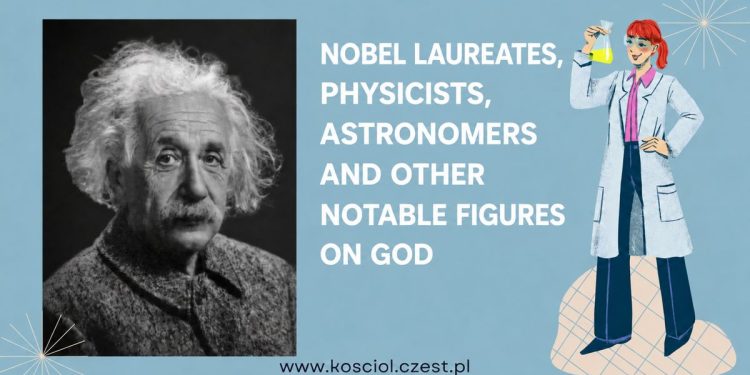
Nobel laureates, physicists, astronomers and many other well-known and gifted people, over the years, have had a connection to faith. Below I include a list of such people found online.
Following up on our previous letter and your uncertainties, I can point you to the names of people whose authority even a so-called materialist would not deny — at least someone who finished some kind of school and still remembers the basics of physics, chemistry and mathematics, and hasn’t been struck by a peculiar civilizational amnesia. Here are the names of at least some of the great, brilliant minds who spoke of God the Creator. Collected by the industrious Dr. Eng. Włodzimierz Wawszczak, inspired by a good idea, in a booklet published under exactly that title in Calgary in 1982. It lists only the names of people from the so-called “exact” sciences.
Of course, I’m aware that this won’t be enough for the various poor souls under the influence of one substance or another, but even they — I know — always get at least one chance to test their so-called “atheism.” So here is a list of 43 distinguished individuals:
- André M. Ampère (1775-1836) – French physicist and mathematician. Founder of the basics of modern electrodynamics.
“One of the most convincing proofs of the existence of God is the harmony and remarkable order that prevails throughout the universe /…/.“
- Francis Bacon (1561-1626) – Founder of the experimental method. English statesman and philosopher. Chief representative of 16th-century methodological empiricism and materialism. Forerunner of the theory of eliminative induction.
“A little philosophy inclineth man’s mind to atheism, but depth in philosophy bringeth men’s minds about to religion; for while the mind of man looketh upon second causes scattered, it may sometimes rest in them and go no further, but when it beholdeth the chain of them confederate and linked together, it must needs fly to Providence and Deity.“
- Antoine H. Becquerel (1852-1908) – French physicist, discoverer of natural radioactivity.
In his work “On Physico-Chemical Forces,” he wrote:
“It is impossible to understand life on Earth without a Creator.”
- Henri Bergson (1859-1941) – Nobel laureate. French philosopher, founder of the school of thought known as intuitionism. A critic of rational knowledge. His work and thought rank among the greatest achievements of our age.
Henri Bergson traveled every road and byway of materialism, and finally, after years lived far from God, confessed with humility:
“For me, Christ is God. Honestly, I did not want to arrive where I have arrived, but is that my fault?… I have come to see that all the roads of goodness and truth lead to the Gospel.”
- Jöns J. Berzelius (1770-1848) – The great Swedish chemist and mineralogist, who determined the atomic weight of many elements and developed the theory of the polar structure of chemical compounds.
In his famous “Treatise on Chemistry,” he said:
“More than once a shallow philosophy has wished to pass for profound by claiming that everything that exists is the work of chance. And yet we will always have to admire the supreme wisdom of the world’s Creator in His purposeful action — a wisdom and purpose that often lie beyond the grasp of our understanding.”
- Niels Bohr (1885-1962) – Nobel laureate. Danish. One of the most outstanding scholars of the 20th century, founder of the theory of atomic structure, co-founder of quantum theory. As a member of the Pontifical Academy of Sciences, he confessed:
“I owe all my discoveries in atomic physics to God.”
- Robert Boyle (1627-1691) – English physicist, chemist and philosopher, one of the founders of modern chemistry.
“Even the best books ever written by scholars, compared to Holy Scripture, are like the planets, which owe all their light to the sun.”
- Louis de Broglie (1892-1987) – French theoretical physicist, founder of the basics of wave mechanics.
“In a certain sense, knowledge and technology correspond to opposing tendencies of human nature. And this tension recalls the Gospel account portraying the characters and activity of two sisters: Mary and Martha. Just as Mary, pure knowledge sits at the feet of God, absorbed in contemplation, while applied knowledge (technology), like Martha, bustles about to serve life’s simple needs.”
- Alexis Carrel (1873-1944) – Nobel laureate. French biologist and physician.
“I believe everything the Church holds to be believed. I have not encountered any contradiction between the truths of religion and the discoveries of knowledge.”
- Augustin Cauchy (1789-1857) – One of the greatest mathematical geniuses humanity has ever produced. Creator of the rigorous exposition of mathematical analysis based on the concepts of limit and continuity of functions (PWN Encyclopedia, 1992)
“I am a Christian, and I believe as the great astronomers believed, as all the great physicists and mathematicians of past centuries believed. I too am a believer, as most of the great scholars were. If I were asked the reason for this, I would gladly reveal it. It would then become clear that my faith flows from research that goes deep…”
- Charles Coulomb (1736-1806) – French physicist. One of the founders of the science of electricity, researcher of the fundamental laws of electrostatics (Coulomb’s law). The scholar was a deeply devout man.
- Charles R. Darwin (1809-1882) – English naturalist, founder of the first modern theory of evolution, who advanced the concept of species variation, natural selection, and the struggle for survival.
- Arthur S. Eddington (1882-1944) – English physicist and astronomer, creator of cosmological models and the theory of stellar structure.
“Although science will in the future uncover yet more secrets of nature, it will never fully fathom the inner structure of the universe. The new physics does not take us further from God — on the contrary, it leads us to Him.”
- Thomas Edison (1847-1931) – American self-taught inventor, whose inventions revolutionized our entire civilization; he patented 1,200 inventions. In 1899, at the Eiffel Tower, Thomas Edison wrote the following words in the guest book:
“I express my admiration for the bold builder of this original tower, for I have great respect for all builders — and the greatest for the most brilliant of them all: God!”
- Albert Einstein (1879-1955) – One of the greatest physicists of all time, Nobel laureate. Creator of the special and general theories of relativity, he also demonstrated the equivalence of mass and energy, and developed fundamental quantum ideas about the theory of light.
“I believe in God, and I can say with complete honesty that I have never in my whole life held to an atheistic philosophy”
“My religion is a humble admiration of the illimitable superior spirit”
It’s also good to know this:
“Only the Church stood squarely across the path of Hitler’s campaign for suppressing the truth. I never had any special interest in the Church before, but now I feel a great admiration for it because the Church alone has had the courage and persistence to stand for intellectual and moral freedom. I am forced thus to confess that what I once despised I now praise unreservedly. (Time Magazine, 23 December 1940; quoted in the weekly “Niedziela,” 29 March 1988, p.16, “The Jews Speak”)”
- Michael Faraday (1791-1867) – English physicist and chemist, discoverer of electromagnetic induction, formulated the laws of electrolysis.
“You surprised, gentlemen, to hear the word God from my lips, but I assure you that my concept of God, and the reverence I hold for Him, rests on foundations as certain as the truths of physics.”
- Galileo (1564-1642) – Italian physicist and astronomer, founder of the experimental-mathematical methodology in the study of nature. The first to use a telescope for astronomical observation.
“Only megalomania could lead our incredibly feeble minds to sit in judgment over the works of God, and to regard as vain and superfluous everything in the universe that does not serve our own benefit.”
- Carl F. Gauss (1777-1855) – Outstanding German mathematician, astronomer and geodesist. In a letter to a friend, he wrote:
“And now, God be with you, my good, dear friend; may this sleep called life be sweet for you — a foretaste of the true life awaiting us once we cross the threshold of death.”
- Werner K. Heisenberg (1901-1976) – Nobel laureate. German theoretical physicist, co-founder of quantum mechanics, quantum dynamics, the theory of nuclear forces, discoverer of the uncertainty principle so fundamental to microphysics.
“The development of atomic physics turned him away from the basic premises of materialist philosophy of experience; it proved that elementary particles are not eternal and unchanging. Rather, they are simple expressions of underlying mathematical constructs. So for modern science — in the beginning was the mathematical formula, not matter. And since a mathematical formula is an intellectual concept, one might say: In the beginning was Meaning.”
- Frederick W. Herschel (1738-1822) – English astronomer of German descent, builder of the largest telescope of his day. Discoverer of over 2,500 nebulae and of the planet Uranus.
“True science so thoroughly explains the attributes of God that atheism becomes absurd. Only the presence of the SPIRIT can resolve these difficulties.”
- Heinrich R. Hertz (1857-1894) – German physicist, who detected and experimentally proved the existence of electromagnetic waves,
“If we wish to have a practically complete picture of the laws of the universe, then beyond our visible material world we must acknowledge another, invisible one — beyond the limits of our senses and our instruments — and acknowledge powers that govern and direct the whole.”
- C.J. Heymans (1892-1968) – Nobel laureate. Belgian physician-physiologist, awarded the Nobel Prize for his work on the physiology of respiration and blood circulation.
“In my physiological research, far from finding any contradiction between faith and knowledge, I found, on the contrary, that they always drew me toward God…”
- James H. Jeans (1877-1946) – English astronomer and physicist, founder of the tidal theory of the origin of the planetary system, author of numerous works on the theory of gases and astrophysics.
“Modern science compels us to acknowledge a Creator working outside of time and space, being apart from His creation — just as a painter is apart from his canvas… One cannot conceive of the existence of the world without God” …
- Johannes Kepler (1571-1630) – German astronomer and mathematician, a follower of Copernicus’s theory. He discovered the laws of planetary motion, known as Kepler’s laws.
“Before I rise from the table where I have been conducting my research, there is nothing left for me to do but to lift my eyes and hands to Heaven, sending up a humble prayer to the Creator of these wonders.” Great is our God, and great is His power, and His wisdom without limit. Praise Him, every one of you, with your own voice — you heavens, and earth, and sun and moon; praise Him, my own soul too, as its Lord and the Creator of all things.
- Nicolaus Copernicus (1473-1543) – Great Polish astronomer, mathematician and economist of the Renaissance era. Originator of the heliocentric model of the universe.
“Reflecting on the wondrous order of the universe established by God’s wisdom, who would not admire the supreme Builder” /…/ How could anyone admire the marvelous order by which our God governs the universe without feeling compelled to bring order to their own life, to acquire virtues, and above all to come to know the Creator, the Source of all good, in all things”
- Jean B. Lamarck (1744-1829) – French biologist, member of the Academy of Sciences in Paris, who reformed the systematic classification of animals and introduced the term “biology.”
“The existence and omnipotence of God constitute the whole of man’s positive knowledge… God created matter and endowed it with various properties. It will exist for as long as it pleases God.”
- Pierre S. Laplace (1749-1827) – Famous French physicist, mathematician and astronomer. The scientific world owes to him the nebular hypothesis of the origin of the planets.
“Our God reigns over time and eternity. And in Him there is no change at all. The more we grow rooted in this truth, coming to know Him through His works, the more deeply we believe.”
- Max von Laue (1879-1960) – Nobel laureate. Outstanding German physicist, theorist of the diffraction and interference of X-rays in crystals.
“The best of physicists have always been able to subscribe to the statement that the experience of scientific truth is, in a certain sense, a glimpse of GOD”
- Urbain J. Le Verrier (1811-1877) – Famous French astronomer. Through his theoretical calculations, he predicted the existence of the planet Neptune.
Urbain J. Le Verrier was a zealous believer. In his workshop he had a cross placed, to which he often turned his eyes, weary from research.
- Justus von Liebig (1803-1873) – The great German chemist, who won fame for his work in the field of organic synthesis and metabolism. He proved the theory of mineral plant nutrition and contributed to the use of artificial fertilizers.
“Only he can truly know the greatness and wisdom of the Creator who strives to read His thoughts in the great book called nature…”
- Guglielmo Marconi (1874-1937) – Nobel laureate. Italian physicist and inventor, builder of the radiotelegraph.
“As a researcher of the laws of nature, everywhere I encounter traces of the wonders of God’s Almighty power. It is only with the help of God, who places the many and mysterious forces of nature at the service of man, that I built this apparatus.”
- James C. Maxwell (1831-1879) – English physicist, who formulated the theory of the electromagnetic field and the electromagnetic nature of light.
“I have looked closely into most philosophical systems, and I have seen with my own eyes that not one of them can be developed without a fundamental concept of God”… /…/ “God, who created the world and mankind, teach us to study Your works so that we may gain dominion over the earth, so that our reason may be strengthened in Your service”
- Johann G. Mendel (1822-1884) – Czech naturalist, founder of the theoretical foundations of modern genetics, who established the laws of heredity. The great scholar prayed daily, before beginning his research work, with these words from the psalms.
“Make me to know thy ways, O Lord, and show me thy path. Lead me in thy truth, and teach me, for thou art the God of my salvation; on thee do I wait all the day.”
- Robert A. Millikan (1868-1953) – Nobel laureate, American physicist, who perfected the measurement of the charge of the electron.
“I can state with complete certainty that the denial of faith is devoid of all scientific foundation. In my opinion, it will never be possible to obtain any evidence that would separate knowledge and faith from one another. Whoever cannot reconcile these two things bears the fault himself.”
- Robert Thornton Morrison (1918-2010) – Biologist and chemist.
“Despite the efforts of the world’s most outstanding biologists and chemists, no one has succeeded in bringing dead matter to life. The sole giver of life, in its countless forms, is God.”
- Władysław Natanson (1864-1937) – Polish physicist, professor at the Jagiellonian University, noted for his work on the kinetic theory of gases, thermodynamics, the electron theory of matter, and optics; author of physics textbooks.
“Our modest labor, if only it is sincere, is obedient to a power beyond our comprehension. An honest, open striving toward truth — that is our prayer of praise to the Creator and Giver of all life.”
- Charles J. Nicolle (1866-1936) – Nobel laureate. French bacteriologist, researcher of tropical diseases, typhus and measles. After a fairly long period of unbelief, he returned to religion and to God.
“Having become convinced that the human mind is not capable of explaining the phenomena of life, and feeling responsible before my readers, I decided to return to the religious convictions of my ancestors. They carry with them the highest authorities.”
- Hans C. Ørsted (1777-1851) – Danish physicist, discoverer of the effect of electric current on a magnetic needle. The unit of magnetic field strength, the oersted, is named after him.
“Thorough research into nature must lead to its primary cause — GOD”
- Georg Ohm (1787-1854) – Outstanding German physicist, researcher of electrical and acoustic phenomena, discoverer of the law concerning the resistance encountered by electric current flowing through conductors (Ohm’s Law). Ohm was a deeply religious man, showing his feelings and his relationship to faith at every step.
- Blaise Pascal (1623-1662) – Outstanding French mathematician, physicist, writer and philosopher. Researcher of hydrostatics, co-founder of probability theory, forerunner of infinitesimal calculus, who proclaimed the autonomy of rational thought and the principles of the interdependence of psychophysical factors on human personality.
“I would like to move you to seek God… God — Jesus Christ — Certainty, Joy, Peace. He is found only along the path shown by the Gospel.”
- Louis Pasteur (1822-1895) – Brilliant French chemist, biologist and microbiologist, a benefactor of humanity.
“A little science takes you away from God, but a lot of science brings you back.”
- Ivan Pavlov (1849-1936) – Nobel laureate. Russian physiologist, founder of the physiology of higher nervous activity, who established the laws governing the formation and extinction of nervous reflexes.
He was a deeply devout man. He began nearly every day’s activities with prayer and often attended the Orthodox church, even though this drew criticism from unbelievers. When someone once tried to mock his piety, he replied with humor:
“I am a believer, as my parents were, and you, it seems, are so highly educated a man that I could never match you in intellect.”
As it turned out, the mocker was a simple laborer, and Pavlov had just, a few days earlier, received the Nobel Prize.
- Max Planck (1858-1947) – Nobel laureate.
Found online…
Also read: Transformed by God (kosciol.czest.pl)
Watch testimonies of people who were healed: HEALINGS, MIRACLES, SUPERNATURAL encounters with God – YouTube