


THE CHURCH THAT FORGOT WHY IT EXISTS is a church that has forgotten its primary calling.
Watch on YouTube
Listen to the Podcast
1. WHAT IS THE BIBLE REALLY ABOUT?
Most people think the Bible is about:
- morality
- living a good life
- church
- going to heaven
But the Bible has one main subject:
REDEMPTION – (def.) is God’s work of bringing Christ to a world that needs Him.
“The Lamb who was slain from the foundation of the world” (Rev 13:8 – God had already planned this!)
Before man ever sinned – God already had a plan – a rescue mission! In the book of Genesis there is a prophecy to the offspring of Adam that Jesus would come and bring redemption to humanity; this thought is then carried through the entire Old Testament.
2. THE GREAT COMMISSION IS NOT OPTIONAL
Mission is God’s work of bringing Christ to a world that needs Him — through His Church and through obedient believers (you!) — until every people group has heard the Gospel of the Kingdom and become disciples of Jesus. (Just like the definition of redemption).
Mission (evangelism) is not one of the Church’s activities. Evangelism and mission are the reasons the Church exists (John 3:16)
“For God so loved the world, that he gave his only Son, that whoever believes in him should not perish but have eternal life. For God did not send his Son into the world to condemn the world, but in order that the world might be saved through him. Whoever believes in him is not condemned, but whoever does not believe is condemned already, because he has not believed in the name of the only Son of God. And this is the judgment: the light has come into the world, and people loved the darkness rather than the light because their works were evil. For everyone who does wicked things hates the light and does not come to the light, lest his works should be exposed. But whoever does what is true comes to the light, so that it may be clearly seen that his works have been carried out in God.” – John 3:16-21
That is why Jesus said:
“Go therefore and make disciples of all nations” (Matt 28:19) (preach the gospel)
Jesus did not propose this to us, He did not suggest it — He gave a command. The Great Commission is an order! The problem with Christianity today is that we have:
- meetings
- worship
- teaching
- but we often forget OUR PURPOSE
“A church without a strong emphasis on missions drifts off course” –> it stops winning souls
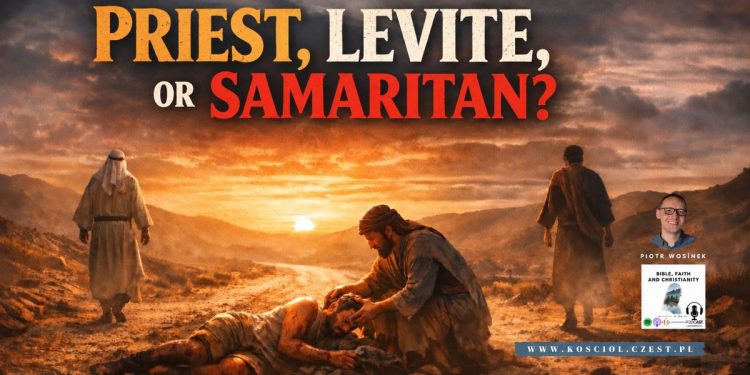
3. THE GOOD SAMARITAN – MISSION IN PRACTICE
Jesus shows what mission truly is in Luke 10:25-37:
“And behold, a lawyer stood up to put him to the test, saying, ‘Teacher, what shall I do to inherit eternal life?’ He said to him, ‘What is written in the Law? How do you read it?’ And he answered, ‘You shall love the Lord your God with all your heart and with all your soul and with all your strength and with all your mind, and your neighbor as yourself.‘ And he said to him, ‘You have answered correctly; do this, and you will live.’ But he, desiring to justify himself, said to Jesus, ‘And who is my neighbor?’ Jesus replied, ‘A man was going down from Jerusalem to Jericho, and he fell among robbers, who stripped him and beat him and departed, leaving him half dead. Now by chance a priest was going down that road, and when he saw him he passed by on the other side. So likewise a Levite, when he came to the place and saw him, passed by on the other side. But a Samaritan, as he journeyed, came to where he was, and when he saw him, he had compassion. He went to him and bound up his wounds, pouring on oil and wine. Then he set him on his own animal and brought him to an inn and took care of him. And the next day he took out two denarii and gave them to the innkeeper, saying, “Take care of him, and whatever more you spend, I will repay you when I come back.” Which of these three, do you think, proved to be a neighbor to the man who fell among the robbers?’ He said, ‘The one who showed him mercy.‘ And Jesus said to him, ‘You go, and do likewise.'”
Everyone at that time knew the trade route from Jerusalem to Jericho. It was a well-known trade route, and at the same time a dangerous one. In this story we have three people who represent:
- The wounded man = humanity without Christ (about to die!)
- The priest and the Levite = religious people, indifferent to what they see
Who was the priest? The priest was a descendant of Aaron, appointed to:
- offer sacrifices in the temple
- represent the people before God
- teach the Law
The priest was a religious authority, a symbol of “closeness to God.” Why did the priest pass by? The Law of Moses said that:
- touching blood or a dead body makes one unclean (Lev 21)
- and uncleanness disqualified him from serving in the temple
The priest chose ritual over mercy. He chose religious correctness over love. The priest represents religiosity without the heart of God. This is someone who:
- knows God “by office”
- serves “within a structure”
- but does not respond to suffering
You can be very close to the temple, to church, and very far from God (from love)
Who was the Levite? Levites:
- came from the tribe of Levi
- assisted the priests
- were responsible for:
- music
- order
- teaching
The Levite represents service without mission. This is someone who:
- is “in the church”
- is involved
- but does not feel the weight of the lost
You can serve God without serving people
Who was the Samaritan? Samaritans:
- were rejected ethnically and religiously by the Jews
- were considered heretics
- had no access to the main temple in Jerusalem
- were “foreign,” “unclean,” “theologically wrong”
To a Jew, a Samaritan was an enemy. What did the Samaritan do? Jesus shows three key actions:
- He stopped
- He got involved
- He paid the price (time, money, risk)
The Samaritan had no title, office, or religious function, but he had a heart of mercy. The Samaritan represents the heart of God in action.
Mercy is the proof of truly knowing God.
The Samaritan is the one who:
- dared to look
- dared to get involved
- dared to pay the price
Our neighbor is NOT the one who KNOWS the Law. Our neighbor is the one who ACTS in love!
A church can be priestly – focused on rituals
A church can be Levitical – focused on services
BUT the Church is called to be Samaritan – missional and full of love
That is why Jesus, at the end, says to you: “Go, and do likewise.” (Luke 10:37)
The facts are these: about 150,000 people die every single day, and tens of thousands of them have never heard the Gospel. Jesus’ question is NOT: “Are you religious?” The question is: “Are you passing by?”
4. THE KINGDOM OF GOD AND THE CHURCH
The Church is not the Kingdom of God! (Church ≠ Kingdom)
- The Kingdom – is wherever the King reigns
- The Church – is a tool for expanding the Kingdom (a group of people meant to extend God’s Kingdom)
The Bible says: “Seek first the kingdom and his righteousness” (Matt 6:33)
Today’s threat:
- we build ministries instead of the Kingdom
- we protect structures instead of the mission
- we focus on church growth, not on reaching the lost
Our goal is NOT to build churches. The goal is to complete the mission!
5. THE PROBLEM IS NOT A LACK OF RESOURCES
This is SHOCKING, but for every unreached people group there are thousands of churches and tens of thousands of believers. 55% of the world’s wealth is in the hands of Christians. The Church has many times more power, money, and people than it needs! The problem is not a lack of opportunity. The problem is a lack of obedience.
The Church is 20 times stronger than it needs to be — but most of it is asleep.
6. THE GREATEST THREAT TO THE CHURCH
The greatest threat to the Church is not persecution, not a lack of freedom, not politics. The greatest threat is getting entangled in the affairs of everyday life (2 Tim 2:4).
Christians have traded:
- calling → career
- mission → security
- the Kingdom → comfort
It was not the devil who stopped the Church. The Church stopped itself.
7. WHO IS TO GO?
In Isaiah 6:8 it is written: “Whom shall I send? Who will go?” God does NOT ask:
- who has a diploma?
- who is ready?
- who feels confident?
He asks: Who is available? Mission is made up of two roles:
- the sent ones (you evangelize, you go on mission trips…)
- the sending ones (people who support the church, missionaries, evangelism…)
But no one is exempt from mission. Everyone can be involved.
8. CONCLUSION – RETURNING TO THE PURPOSE
“And this gospel of the kingdom will be proclaimed throughout the whole world… and then the end will come.” (Matt 24:14)
- We are not waiting for revival.
- We are not waiting for a sign.
- We are not waiting for the perfect moment.
God is waiting for an obedient Church.
CLOSING QUESTIONS:
- Does my life serve the growth of the Kingdom?
- Am I living out the Great Commission?
- Am I a Samaritan — or am I passing by?
“Here am I, send me.” Isa
“How then will they call on him in whom they have not believed?
And how are they to believe in him of whom they have never heard?
And how are they to hear without someone preaching?
And how are they to preach unless they are sent?” (Rom 10:14–15)